As I reflected upon the relationship between faith and scholarship, I have come to realize something I feel is crucial in regards to historicity of scripture: we should evaluate historicity as a matter of faith; not as a matter of scholarship. When examining whether or not the Book of Mormon, Book of Abraham, or Book of Moses contain any historical truth, we often overlook necessity of the fundamental principle of it: “it rests first upon faith in the Lord Jesus Christ.”[1] Satan moves scriptures wholly to a secular sphere because it invites skepticism. While many evidences exist in favor of the historicity of the Book of Mormon[2] and Book of Abraham[3], there exists much to explore and uncover. Indeed, we do not have a complete picture of any ancient civilization, especially not in the Americas. By transitioning the conversation about historicity into an entirely secular sphere, we do not encounter scriptures on the terms that they must be encountered upon. [Read more…] about Historicity: Not By Scholarship Alone
Book of Mormon
A Detailed Look at Internally Consistent References in the Book of Mormon Text, Part 11
Part 11: 3 Nephi 19 – 4 Nephi
The introduction to this series on internal consistency in the Book of Mormon is found in part 1 here.
This part covers the rest of 3 Nephi plus 4 Nephi. It also includes references to Mormon. In the description of the Savior’s visit to the Americas, there are several particularly interesting and unique examples of internal consistency in the text, as we will discuss below.
87. 3 Nephi 19:4 and 3 Nephi 7:19 — Nephi raising his brother from the dead
We learn a detail about Nephi in 3 Nephi 19:4 [Read more…] about A Detailed Look at Internally Consistent References in the Book of Mormon Text, Part 11
Chiasmus in the News
by John W. Welch
Strong interest in the study of chiasmus, especially in biblical texts and in the Book of Mormon, continues to abound. Indeed, so much is being regularly published on this subject that it takes a very watchful eye and lots of effort just to keep tabs on all that is coming out.
Of special interest is a book written by Dr. Joshua a Berman of Bar Ilan University in Israel and published by Oxford University Press in 2017. Entitled Inconsistency in the Torah: Ancient Literary Convention and the Limits of Source Criticism, this study reports results that emerged from a year of study by a group “composed of eight of the most distinguished names in Pentateuch criticism.” The book challenges theories about the composition of biblical texts, and Berman’s lucid and detailed investigations cannot be ignored. [Read more…] about Chiasmus in the News
Q&A with editors of Producing Ancient Scripture: Joseph Smith’s Translation Projects in the Development of Mormon Christianity
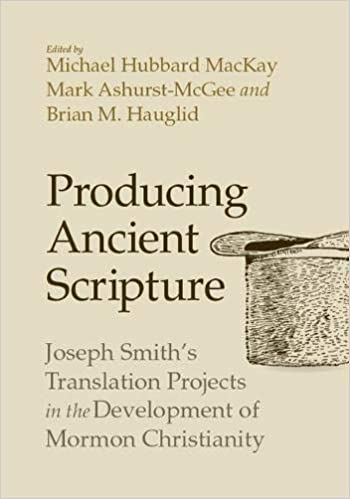
This book includes a mixture of scholarship about all of Joseph Smith’s translation projects, including the highly anticipated paper by Thomas A. Wayment and Haley Wilson-Lemmon on the use of the Clarke Commentary in the Joseph Smith Translation of the Bible. We had the opportunity to discuss the book with Michael Hubbard MacKay and Mark Ashurst-McGee. A review of the book will be forthcoming.
Q1: What is the purpose of the book?
Mike and Mark: The book was conceived as an attempt to cover all of the various Joseph Smith translation projects—not only the Book of Mormon and the “New Translation” of the Bible and the Book of Abraham but also the excerpt from the new account of John (D&C 7), the excerpt from the “record of John” (in D&C 93), the Kinderhook plates, and anything else. This had actually never been done before—at least not at this depth. [Read more…] about Q&A with editors of Producing Ancient Scripture: Joseph Smith’s Translation Projects in the Development of Mormon Christianity
A Detailed Look at Internally Consistent References in the Book of Mormon Text, Part 10
Part 10: 3 Nephi 1 – 3 Nephi 18
The introduction to this series on internal consistency in the Book of Mormon is found in part 1 here.
This part includes examples of internal consistency from the first half of 3 Nephi which haven’t already been covered in previous parts of this series due to their relation to earlier chapters in the dictation.
77. 3 Nephi 1:1 and Mosiah 29:46 — More on the tight control of the timeline.
In 3 Nephi 1:1, we get details about two systems of time reckoning [Read more…] about A Detailed Look at Internally Consistent References in the Book of Mormon Text, Part 10
A Detailed Look at Internally Consistent References in the Book of Mormon Text, Part 9
Part 9: Helaman 8 – Helaman 16
The introduction to this series on internal consistency in the Book of Mormon is found in part 1 here.
This part covers the rest of the Book of Helaman. With respect to internal consistency, the prophecies of Samuel the Lamanite are particularly impressive. The fulfillment of several of his prophecies are recorded in great detail later, just as they were foretold.
69. Helaman 8:22 and 1 Nephi 1:19-20, 2 Nephi 25:12 — “they have testified of the coming of Christ”
In Helaman 8, Nephi gives a bold speech about how prophets down through the ages have “spoken concerning the coming of the Messiah.” In the process, he says: [Read more…] about A Detailed Look at Internally Consistent References in the Book of Mormon Text, Part 9
FAIR Voice Podcast #2 – Sunday Special: Overview of Historicity, and Come Follow Me with Alicia Settle
Podcast: Download (40.6MB)
Subscribe: RSS
On this first Sunday segment, we begin with a discussion of what historicity is as a preview for future interviews that will address Book of Abraham historicity. We talk about the methods of determining historical authenticity and how to respond to different claims. Then, we transition to our first Come Follow Me segment. This segment is done with Alicia Settle.
 Alicia Settle is a BYU graduate in Psychology. She plans on being a social worker and is passionate about helping people, particularly with respect to mental health.
 Hanna Seariac is a MA student in Greek and Latin at Brigham Young University. She is writing a book on the history of the priesthood and another one that responds systematically to anti-LDS literature. She works as a research assistant on a biblical commentary and as a producer on a news show. She values Jesus Christ, family, friends, hiking, baking, and really good ice cream.
A Detailed Look at Internally Consistent References in the Book of Mormon Text, Part 8
Part 8: Alma 61 – Helaman 6
The introduction to this series on internal consistency in the Book of Mormon is found in part 1 here.
This part covers the end of Alma and the first part of Helaman.
60. Alma 61:3-4,8 and Alma 51:2-5 — Internally consistent politics
In Alma 61, Pahoran (the chief judge) responds to Moroni’s chastisement and threats with a remarkably calm request for help. He explains the problem: [Read more…] about A Detailed Look at Internally Consistent References in the Book of Mormon Text, Part 8
A Detailed Look at Internally Consistent References in the Book of Mormon Text, Part 7
Part 7: Alma 43 – Alma 56
The introduction to this series on internal consistency in the Book of Mormon is found in part 1 here.
This part covers the “war chapters” in Alma. They go into a lot of detail, especially concerning the geography. The examples shown in this part don’t do justice to the complexity of the Book of Mormon geography since there is more here than we can cover.
49. Alma 43:5 and Alma 31:3 — “the land of the Zoramites”
In Alma 43:5, Mormon informs us that an army of Lamanites arrived at…
…the land of Antionum, which is the land of the Zoramites
A Detailed Look at Internally Consistent References in the Book of Mormon Text, Part 6
Part 6: Alma 26-Alma 38
The introduction to this series on internal consistency in the Book of Mormon is found in part 1 here.
This part covers the Zoramite mission and Alma’s words to his sons.
39. Alma 26:27 and Alma 17:10-11 — “the Lord comforted us”
Ammon reflects on the early phase of their mission, saying
Now when our hearts were depressed, and we were about to turn back, behold, the Lord comforted us, and said: Go amongst thy brethren, the Lamanites, and bear with patience thine afflictions, and I will give unto you success. (Alma 26:27)
