• Skip to primary navigation
  • Skip to main content
  • Skip to primary sidebar
  • Skip to footer

FAIR

  • Find Answers
  • Blog
  • Media & Apps
  • Conference
  • Bookstore
  • Archive
  • About
  • Get Involved
  • Search

Evidences

FairMormon Conference Podcast #9 – Matthew Bowen, “Semitic Semiotics: The Symbolic, Prophetic, and Narratological Power of Names in Ancient Scripture”

June 28, 2018 by Trevor Holyoak

https://media.blubrry.com/mormonfaircast/www.fairlatterdaysaints.org/wp-content/uploads/2018/06/Matthew-Bowen.mp3

Podcast: Download (88.0MB)

Subscribe: RSS

This podcast series features a past FairMormon Conference presentation each month. Please join us for the 2018 FairMormon Conference coming up August 1-3. You can attend in person or purchase the video streaming.

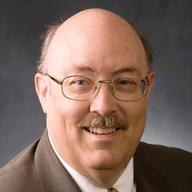
Matthew Bowen, Semitic Semiotics: The Symbolic, Prophetic, and Narratological Power of Names in Ancient Scripture

Transcript available here.

Matthew L. Bowen is an assistant professor of Religious Education at Brigham Young University–Hawaii where he has taught since 2012. He holds a Ph.D. in Biblical Studies from the Catholic University of America in Washington, DC, where he also earned an M.A (Biblical Studies). He previously earned a B.A. in English with a minor in Classical Studies (Greek emphasis) from Brigham Young University (Provo) and subsequently pursued post-Baccalaureate studies in Semitic languages, Egyptian, and Latin there. In addition to having taught at Brigham Young University–Hawaii, he has previously taught at the Catholic University of America and at Brigham Young University. Bowen is the author of numerous peer-reviewed articles on scripture- and temple-related topics and two forthcoming books on scriptural onomastics. Bowen grew up in Orem, Utah, and served a two-year mission in the California Roseville Mission. He and his wife, the former Suzanne Blattberg, are the parents of three children, Zachariah, Nathan, and Adele.

Audio and Video Copyright © 2017 The Foundation for Apologetic Information and Research, Inc. Any reproduction or transcription of this material without prior express written permission is prohibited.
Filed Under: Bible, Book of Mormon, Book of Moses, Evidences, FAIR Conference, FairMormon Conference, Joseph Smith, Podcast

What Similarities Are There Between Egyptian and Israelite Temples? (Old Testament Gospel Doctrine Lesson 14A)

April 18, 2018 by Jeffrey M. Bradshaw

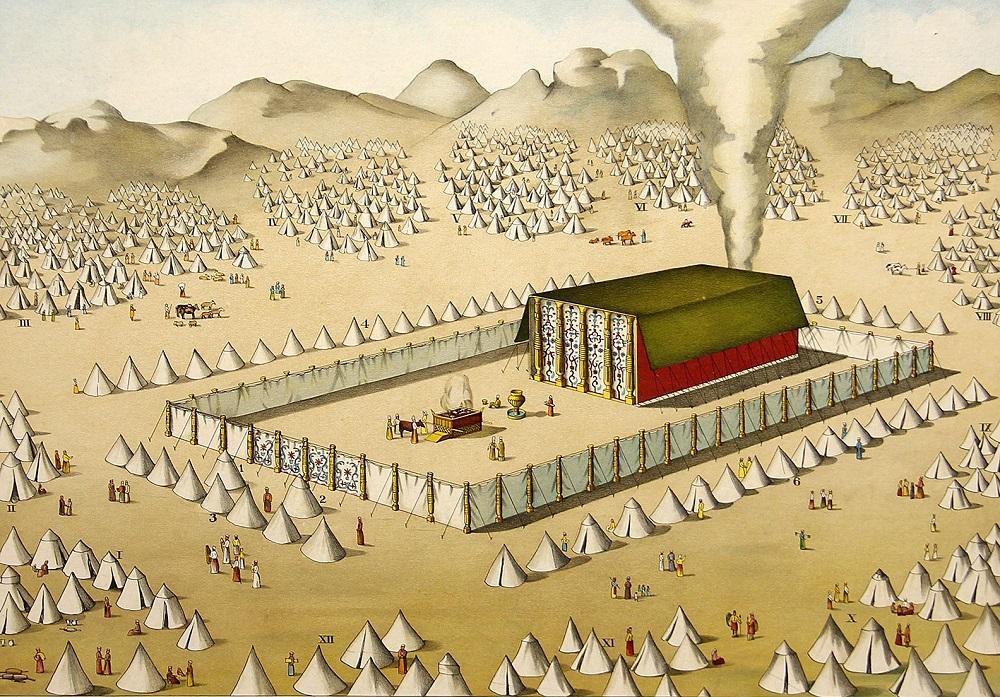
Israel Camped Around the Wilderness Tabernacle

An Old Testament KnoWhy relating to the reading assignment for Gospel Doctrinesson 14: “Ye Shall Be a Peculiar Treasure Unto Me” (Exodus 15-20; 32-34) (JBOTL14A)

Question:Hugh W. Nibley and other LDS scholars have written at length about Egyptian temple rites. What similiarities are there between Egyptian and Israelite temples?

Summary: Temple rituals in the ancient Near East may seem in some respects far removed from current LDS teachings and ritual practices. However, what resemblances exist may be of significance to a people who claim that divine revelation about the ordinances go back to the beginning of mankind. Predating, as they do, the Israelite Tabernacle by more than a millennium, such resemblances may be “an embarrassment to exclusivistic readings of religion.” However, to Mormons they represent “a kind of confirmation and vindication.” Thus, Egyptian and other ancient temples should be better understood by Latter-day Saints. For although, as Hugh Nibley observed, “the Egyptian endowment was but an imitation, it was still a good one, and we may be able to learn much from it.”


The full article may be found at the Interpreter Foundation website: KnoWhy OTL14A — What Similarities Are There Between Egyptian and Israelite Temples?

An excellent short video discussing the Tabernacle and the Messiah is available from Daniel Smith at https://www.youtube.com/watch?v=TygiChDYd4Y. See also his presentation on “The Ancient Israelite Tabernacle, Its Accoutrements, and the Priestly Vestments,” given at the Interpreter Foundation 2016 Temple on Mount Zion Conference, 5 November 2016, Provo, Utah (https://www.youtube.com/watch?v=rEb4u4OB-aU).

On 7 October 2015, Joshua Berman gave a talk for the Academy for Temple Studies on “Differences between the Tabernacle and the Temple,” https://www.youtube.com/watch?v=LB6xlYpcO-w. He gave a similar talk on 8 October 2015 at the BYU Kennedy Center, https://www.youtube.com/watch?v=15ew7on3UL4 and https://www.youtube.com/watch?v=K3nw2C1J5Lg.

Filed Under: Bible, Evidences, Lesson Aids, Questions, Resources, Temples Tagged With: Egypt, Exodus, Gospel Doctrine: Old Testament, Moses, Tabernacle

What Can We Learn About the Historical Exodus from Outside the Scriptures? (Old Testament Gospel Doctrine Lesson 13B)

April 4, 2018 by Jeffrey M. Bradshaw

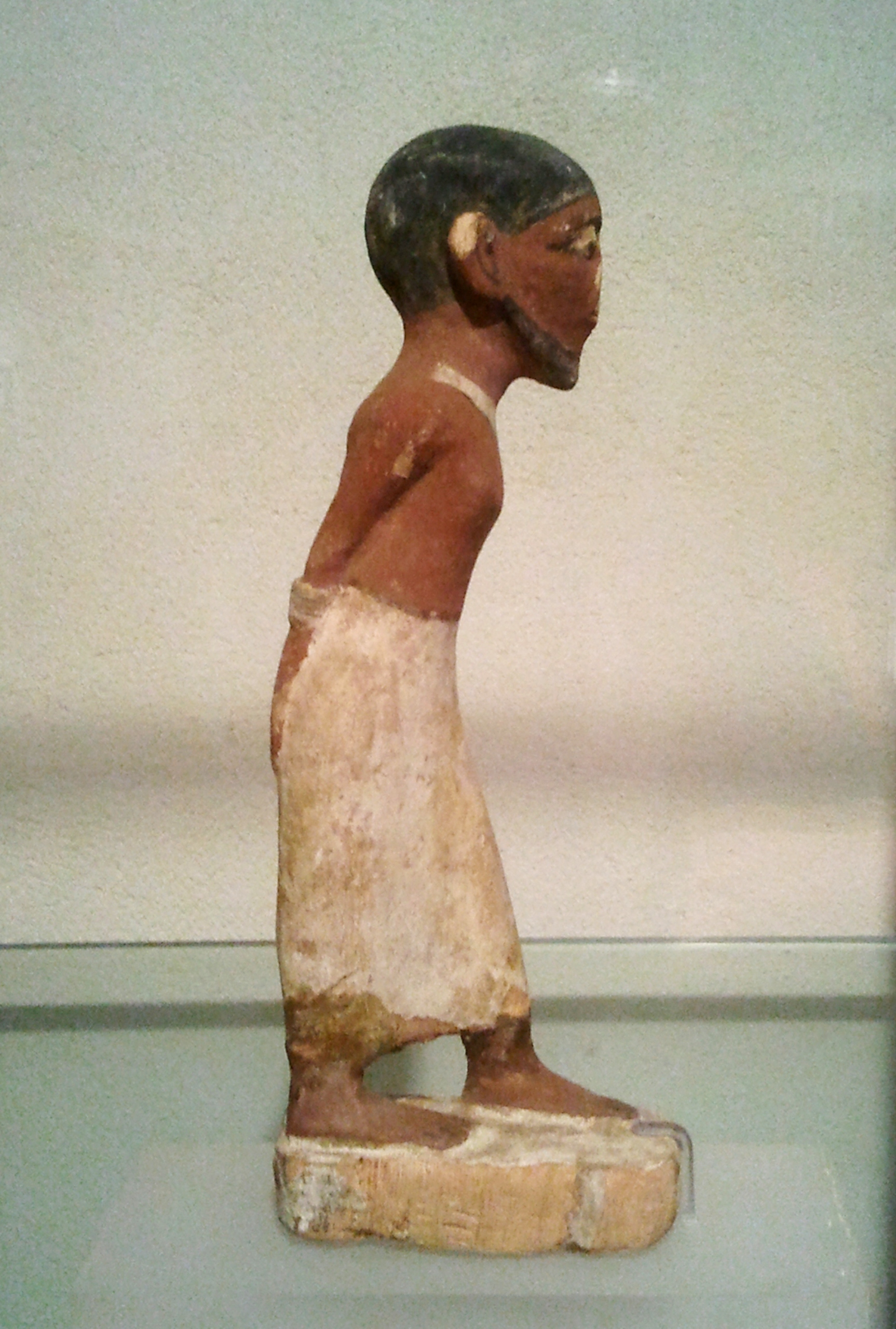
Egyptian Figurine of a Semitic Slave

An Old Testament KnoWhy relating to the reading assignment for Gospel Doctrine Lesson 13: Bondage, Passover, and Exodus (Exodus 1-3; 5-6; 11-14) (JBOTL013B)

Question:Many people nowadays believe that the Exodus never happened. Are there traces of the historical Exodus from sources outside the scriptures? And do they help us to identify the Pharaoh of the Exodus?

Summary: Traces of the historical Exodus from sources outside the scriptures are available — but only if you are looking for the right things in the right direction. For example, if you are expecting to find archaeological evidence for a group of millions of Israelites crossing the Sinai desert after leaving Egypt in shambles, you are likely to be disappointed. True it is that large numbers of Semitic people came and went from Egypt in the centuries before a much smaller group eventually left in the Exodus. But teasing out the subtleties of the historical context of scripture requires tedious and diligent efforts of dedicated scholars. In this article, we present a few tentative conclusions to help familiarize readers with the current landscape.


The full article may be found at the Interpreter Foundation website: KnoWhy OTL13B — What Can We Learn About the Historical Exodus from Outside the Scriptures?

A video version of a presentation by Richard Elliott Friedman on the subject entitled “The Exodus Based on the Sources Themselves” can be found at https://www.youtube.com/watch?v=H-YlzpUhnxQ 

Filed Under: Bible, Book of Mormon, Evidences, Lesson Aids, Questions, Resources Tagged With: Allegory of the Olive Tree, Egypt, Exodus, Gospel Doctrine: Old Testament, Historicity, Merneptah Stele, Moses, Pharaoh, Ramesses

FairMormon Conference Podcast #4 – Daniel Peterson, “What Difference Does It Make?”

March 19, 2018 by Trevor Holyoak

https://media.blubrry.com/mormonfaircast/www.fairlatterdaysaints.org/wp-content/uploads/2018/03/Dan-Peterson.mp3

Podcast: Download (97.2MB)

Subscribe: RSS

This podcast series features a FairMormon Conference presentation each month. If you would prefer to watch the videos, they can still be purchased here for the 2017 conference. Older conference presentation videos are available on our YouTube channel and FairMormon TV for Roku, Amazon Fire TV, and Android TV.

Daniel Peterson, What Difference Does It Make?

Video and transcript available here.

Daniel C. Peterson

A native of southern California, Daniel C. Peterson received a bachelor’s degree in Greek and philosophy from Brigham Young University (BYU) and, after several years of study in Jerusalem and Cairo, earned his Ph.D. in Near Eastern Languages and Cultures from the University of California at Los Angeles (UCLA). Dr. Peterson is a professor of Islamic Studies and Arabic at BYU, where he has taught Arabic language and literature at all levels, Islamic philosophy, Islamic culture and civilization, Islamic religion, the Qur’an, the introductory and senior “capstone” courses for Middle Eastern Studies majors, and various other occasional specialized classes. He is the author of several books and numerous articles on Islamic and Latter-day Saint topics–including a biography entitled Muhammad: Prophet of God (Eerdmans, 2007)—and has lectured across the United States, in Europe, Australia, and New Zealand, and at various Islamic universities in the Near East and Asia. He served in the Switzerland Zürich Mission (1972-1974), and, for approximately eight years, on the Gospel Doctrine writing committee for The Church of Jesus Christ of Latter-day Saints. He also presided for a time as the bishop of a singles ward adjacent to Utah Valley University. Dr. Peterson is married to the former Deborah Stephens, of Lakewood, Colorado, and they are the parents of three sons.

Filed Under: Anti-Mormon critics, Apologetics, Atheism, Doctrine, Evidences, FAIR Conference, FairMormon Conference, Faith Crisis, LDS Culture, Perspective, Podcast, Suicide, Testimonies

Could Joseph Smith Have Drawn On Ancient Manuscripts When He Translated the Story of Enoch? (Old Testament Gospel Doctrine 5C)

January 27, 2018 by Jeffrey M. Bradshaw

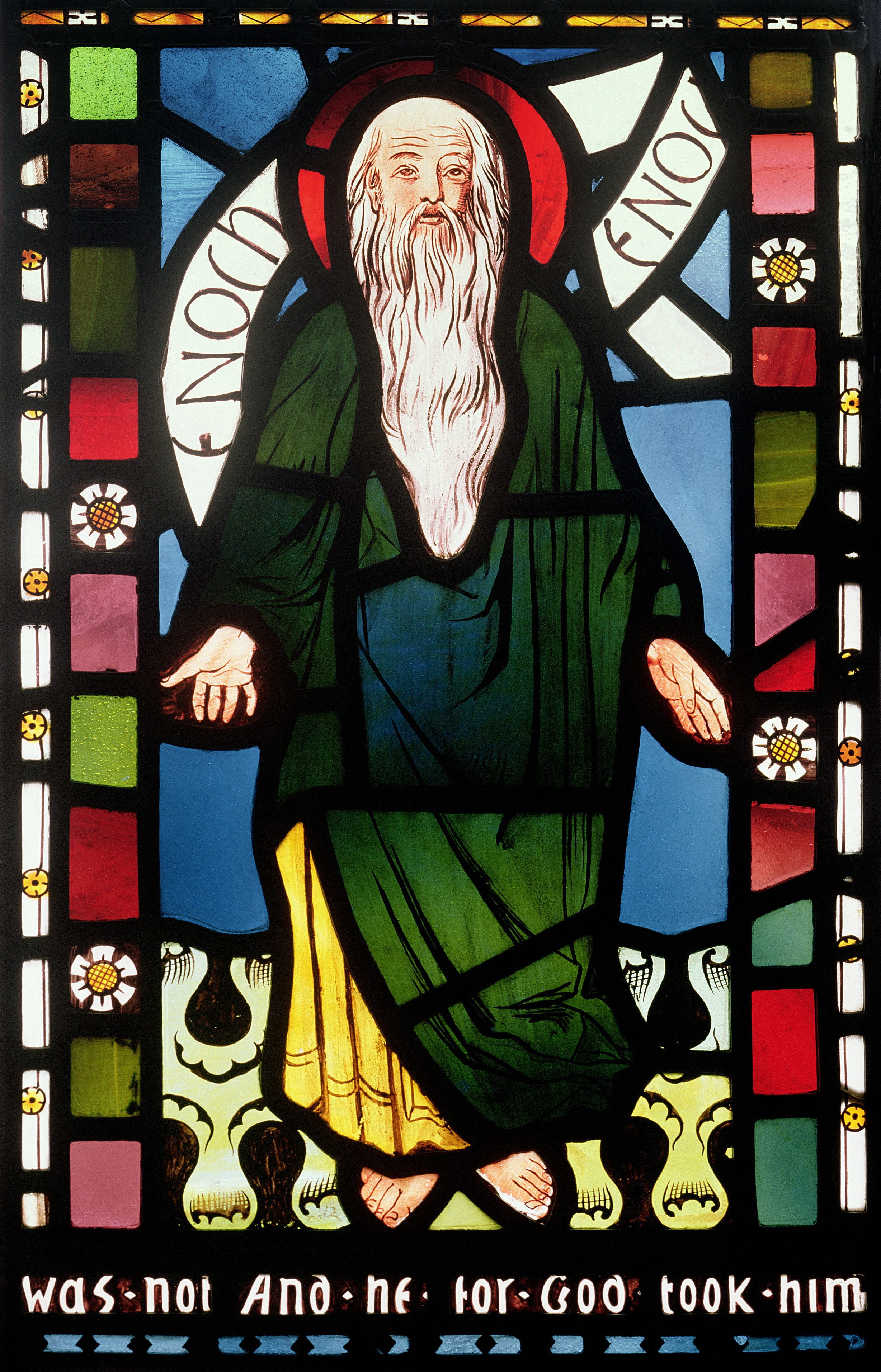
George Campfield, fl. 1861: Enoch, Creation Window, All Saints Church, Selsley, England, 1861

An Old Testament KnoWhy for Gospel Doctrine Lesson 5:“If Thou Doest Well, Thou Shalt Be Accepted” (Moses 5-7) (JBOTL05C). See the link to video supplements to this lesson at the end of this article under “Further Reading.”

Question: Some say that Joseph Smith drew on ancient stories about Enoch not found in the Bible as he translated the chapters on Enoch in Moses 6-7. How similar are the stories of Enoch in ancient accounts to modern scripture? And could Joseph Smith have been aware of them?

Summary: Although an English translation of the Ethiopian book of 1 Enoch appeared in 1821, the ancient manuscripts that are most relevant to the LDS story of Enoch were not available during Joseph Smith’s lifetime. The Qumran Book of Giants, discovered in 1948, contains striking resemblances to Moses 6-7, ranging from general themes in the story line to specific occurrences of rare expressions in corresponding contexts. It would be thought remarkable if any nineteenth-century document were to exhibit a similar density of close resemblances with this small collection of ancient fragments, but to find such similarities in appropriate contexts relating in each case to the story of Enoch is astonishing.


The full article may be found at the Interpreter Foundation website: KnoWhy OTL05C — Could Joseph Smith Have Drawn On Ancient Manuscripts When He Translated the Story of Enoch?

As a first video supplement to this lesson with additional details and artwork not included in this article, see Jeffrey M. Bradshaw, “Could Joseph Smith Have Drawn on Ancient Manuscripts When He Translated the Story of Enoch?” available at The Interpreter Foundation (http://cdn.interpreterfoundation.org/ifvideo/180122-Could Joseph Smith Have Drawn on Ancient.m4v) and FairMormon (https://youtu.be/7zJwuZ_yPyY).

As a second video supplement to this lesson, see Jeffrey M. Bradshaw, “The LDS story of Enoch As a Temple Text (http://www.templestudies.org/2013-enoch-and-the-temple-conference/conference-videos/). Several other excellent video presentations on Enoch and the temple, including one by David J. Larsen discussing ancient parallels with the taking up of Enoch’s city to heaven, are available at this same link.

Filed Under: Best of Fair, Bible, Book of Moses, Evidences, Joseph Smith, LDS Scriptures, Lesson Aids, Questions Tagged With: 1 Enoch, 2 Enoch, 3 Enoch, Book of Giants, Enoch, Gospel Doctrine: Old Testament, Historicity, Joseph Smith Translation

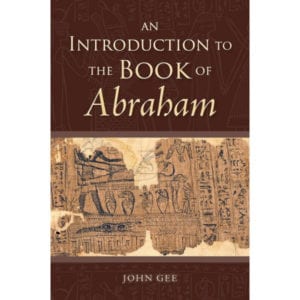
Book Review: An Introduction to the Book of Abraham

October 4, 2017 by Trevor Holyoak

10% off at the FairMormon Bookstore

Publisher: Religious Studies Center, Brigham Young University and Deseret Book
Author: John Gee
Number of Pages: 197
Binding: Hardcover
ISBN-13: 978-1-9443-9406-6
Price: $19.99
Click to purchase the book.

The Book of Abraham is my favorite book of scripture. Mostly it is because of chapter 3, which contains information that is not found anywhere else in LDS scripture. I also remember discovering the facsimiles as a child and thinking that they were really neat. Unfortunately, the Book of Abraham has also become a favorite for critics to attack, as it is the only book of scripture that Joseph Smith translated for which there appears to be any extant source material, and that material does not seem to match what is in the Book of Abraham. But it’s really much more complicated than that.

This book explains what is currently known about the Book of Abraham and its associated artifacts and documents, and why the critics are wrong. It is written by John Gee, who is a professor of Egyptology at BYU. He got his PhD in Egyptology at Yale and has written many research publications for professional journals as well as writing for LDS audiences. The book is written to be understandable by any reader (although an LDS background is very helpful) in a straightforward manner that actually makes for a fairly quick read.

The book contains 17 chapters, most of them fairly short, that build on each other. At the end is a series of questions and answers that basically provides a summary of the book. It also has photos of the extant papyri, maps, charts, diagrams, and other helpful or interesting illustrations scattered throughout. At the end of most chapters is a list of “Further Reading” with notes about each item. Unfortunately, there are not many footnotes in the book; they only exist to provide sources for quotes. So you have to refer to the notes in the “Further Reading” section to deduce where some of the information came from. This did lead me to find one inconsistency – on page 97, it says “The Book of Abraham begins much like other autobiographies from Abraham’s time and place.” However, on page 103 in “Further Reading,” there is an entry that says, “This essay is a comparison of the Book of Abraham with the only other autobiographical inscription to survive from the approximate time and place of Abraham.”

After the introduction, the book begins with a historical overview which explains how Joseph Smith got the papyri and then what happened to them after his death, with the church finally receiving surviving fragments in 1967 (most of what Joseph had in his possession ended up burning in the Chicago Fire of 1871). “To the disappointment of many, although these remaining fragments contained the illustration that served as the basis for Facsimile 1, they were not the portion of the papyri that contained the text of the Book of Abraham” (page 9).
The next chapter is about the translation. Some have thought that Joseph may have used a seer stone (see my review of Joseph Smith’s Seer Stones), but Gee says that “Some thirdhand accounts claim he did, but those accounts do not come from anyone who actually observed the translation” and that “By the time that Joseph finished translating the Book of Mormon in 1829, he no longer needed to use the Urim and Thummim to receive revelation” (page 20.) What is known is that much more was translated than what ended up being published (the rest has been lost), and that it was done without using a dictionary or grammar as a conventional translation normally would. It does appear that W. W. Phelps attempted to compile an Egyptian grammar after the translation, but the extent of Joseph’s involvement in that is unknown. [Read more…] about Book Review: An Introduction to the Book of Abraham

Filed Under: Apologetics, Book of Abraham, Book reviews, Doctrine, Evidences, Joseph Smith, LDS History, Racial Issues, Temples

Some Thoughts on Finding “Truth”: The Right Tool for the Job

February 24, 2017 by Mike Ash

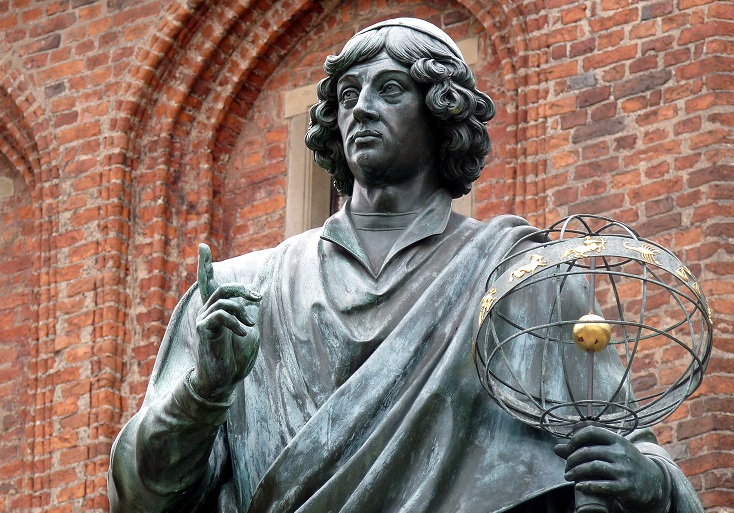
Nicolaus Copernicus Monument by Bertel Thorvaldsen

According to the on-line Oxford Dictionary, science is defined as “the intellectual and practical activity encompassing the systematic study of the structure and behaviour of the physical and natural world through observation and experiment.”[i] In short, science works by interpreting data, and data is typically collected through observations (using eyes, computers, microscopes, etc.).

Thousands of years ago, in the early days of human history, our ancestors could see that the sun, moon, planets, and stars moved across the sky. Direct observation demonstrated that the sun rose in the east and set in the west. In winter months, the days became shorter, and in the summer, longer. The Milky Way also rises from the horizon. North Americans watch the ribbon of stars arch into the sky, nearly paralleling the horizon in the winter months, and arching straight overhead during the summer months.

Very early humans recorded the movement of these celestial objects. NASA, for example, points to the discovery of an ancient lunar calendar that dates to about 32,000 B.C.[ii] The ancient Egyptians likewise had an annual calendar that was based on the “rhythms of the farming year.”[iii] The “morning rising of Sirius or the morning setting of Pleiades, were taken as announcing the Nile flood or as a reminder to plough.”[iv]

All evidence, and the direct eye-witness observations of millions of people all over the world, testified that celestial objects moved above the Earth. Any argument for an alternative interpretation of the observable data would have been preposterous. In fact, when the Greek mathematician and astronomer Aristarchus (about 300 B.C.) suggested that the Earth revolved around the sun (rather than the sun around the Earth), his arguments were rejected because they didn’t fit the prevailing understanding of the cosmos.

It was nearly 2000 years later before Copernicus revived the theory in the mid-1500s (and his writings, like Aristarchus before him, were initially rejected by many people). The Copernicus model was imperfect, however, and it wasn’t until Kepler suggested elliptical orbits (instead of circular orbits) that some of the problems began to fade. In 1632 Galileo could support the Copernicus/Kepler model with observations made through the newly invented telescope.

For thousands of years before Copernicus, Kepler, and Galileo, humans were technically “wrong” regarding what they saw with their very eyes. They weren’t wrong that the sky seemed to move, and they weren’t wrong knowing when to plant and harvest, but they didn’t have a complete understanding as to how the sky appeared to move. Sixteenth-century astronomers added information to the undeniable fact that the sky appears to move, by showing that the universe was not geocentric (Earth-centered), but rather that the universe was heliocentric (sun-centered). While the demarcation between accurate and inaccurate might be debated, I see the Copernicus/Kepler resolution as building on previously accurate beliefs, and correcting erroneous beliefs. There really is an Earth, a sun, a moon, planets, and stars, and they somehow move in predictable patterns with very real relationships to each other.

In our modern world, more modifications were made thanks to better astronomical tools. We now know that a heliocentric universe is also incorrect. Our planets orbit around the sun, but the universe doesn’t. Our solar system orbits around the center of our Milky Way Galaxy, and our galaxy is just one of perhaps a hundred billion galaxies in the observable universe.[v] Each new refinement comes, in part, by building on the discoveries and calculations of previous scientists, as well as continually improved technology (or tools) which offer greater access to understanding the space in which we live.

Even though scientific understanding has evolved tremendously in the course of human history, each generation is typically pretty confident that they have the answers (or are, at least, headed in the right direction). While the humble and inquisitive can acknowledge that we still have a lot to learn, it’s human nature to believe that we are probably right. It’s hard to imagine that some of our cherished truths might be overturned or drastically altered with additional discoveries—but some of them will.

While we know more today (scientifically) and have achieved more in modern times (technologically) than we might have even imaged tens of thousands of years ago, I find it fascinating that the more we learn and achieve, the more we discover, ironically, that there is an even greater collective of things which are unknown.

It’s as if we achieve knowledge and technology by discovering a new doorway, but each door we open leads to the discovery of enormous storerooms filled with new data and information that needs exploration and answers. We might reach inside some of the rooms to examine and learn about those things contained therein, but we are never quite able to learn the full details of everything inside every room.

Sometimes, there are doorways within those rooms that lead to new related, yet undiscovered, information. And as we examine the few bits of things we can analyze and measure, new doors are opened just down the hall and we again peek into storerooms full of new mysteries. The opening of doors to the unknown seems to outpace those things which we can fully comprehend. The pursuit of such mysteries is exciting—especially as puzzles are solved and pieces come together—but is also never-ending.

One of the theoretical pursuits of science is to find the “theory for everything”—a unifying principal or paradigm that explains everything. We want to understand the overall structure of the building which houses all the doors, the rooms to which they lead, and the furnishings within. We hope—or at least suspect—that there may be a unifying set of laws that govern everything. But in the meantime, we find that some of the different rooms seem to have laws which don’t cooperate with the laws in other rooms.

A few years ago, I read a book entitled, Knocking on Heaven’s Door: How Physics and Scientific Thinking Illuminate the Universe and the Modern World, by Dr. Lisa Randall. Randall is one of America’s leading scientists on theoretical particle physics and cosmology, and her religious beliefs seem to be on the continuum somewhere between agnostic and atheist. Nevertheless, she recognizes that a turf war between science and religion can be avoided if we realize that the two perspectives don’t necessarily pitch their tents in the same campground. “Science is not religion. We’re not going to be able to answer the ‘why’ questions. … Religion asks questions about morals, whereas science just asks questions about the natural world.”[vi]

I’ve often heard those who lean toward the agnostic/atheist point of view as saying something to the effect: “I don’t believe that feelings are accurate barometers of truth”—and by “feelings” they are, of course, referring to spiritual promptings, manifestations, revelations, inspirations, or any other communication which comes via supernatural discourse or impressions.

The problems with such a claim, however, are numerous. First, I personally don’t believe that “feelings” accurately describes how I’ve received spiritual enlightenment (although this is a topic for another time). Secondly, all humans incorporate “feelings” in their decision-making process (yes, even scientists—which is part of the reason that science occasionally reverses the conclusions of previous positions). Thirdly, “truth” doesn’t universally describe all conclusions (which are often temporary points of consensus) in all fields of knowledge (including spiritual knowledge).

As noted above, there is yet to be discovered a “theory for everything,” and we often run into seemingly conflicting laws in the world of physics. Randall explains, for example, that “Newton’s laws are instrumental and correct, but they cease to apply at or near the speed of light where Einstein’s theory applies. Newton’s laws are at the same time both correct and incomplete. They apply over a limited domain.”[vii] This, in some ways, is not unlike what we find with the moving sky, moving Earth, and moving solar system models. All three positions have validity depending on one’s perspective and ability to measure and observe.

“As scales decrease,” notes Randall, “matter seems to be governed by properties so different that they appear to be part of entirely different universes.”[viii] Newton’s laws work well for the types of things he was able to observe (and the same kinds of things we can observe today) but at very small distances the rules change and we have to apply quantum mechanics. Likewise, at extremely high speeds the rules of relativity take over. With the enormous densities of black holes, we must turn to general relativity.[ix]

The rules and principles of quantum mechanics, string theories, and general relativity are theoretical tools to help us better understand our world and the cosmos. Just as the telescope helped humans understand the solar system, the microscope helped us understand the miniature world around us, and as DNA helps us understand our physical relationship to life on this planet, so likewise tools such as the Large Hadron Collider (nearly 600 feet underground, beneath the France-Switzerland border) help us understand the early formation of the universe.

The right tool is needed for each different job. We can’t measure heat with a hammer, or weight with a yardstick. When it comes to understanding spiritual truths, we must use spiritual tools such as humility, scriptures study, and prayer. There are currently no scientific tools available to examine the existence of God or the reality of the Resurrection.

Conversely, it’s important to recognize that the Holy Ghost reveals all of those that are “expedient,” or necessary, to return to God (D&C 75:10), not necessarily those things which explain quarks, black holes, gravity, Earth’s diversity of life, or even Book of Mormon geography. Revelation on scientific principles are typically not “expedient” for our divine family reunion.

The late scientist, Dr. Stephen Jay Gould, advocated what he termed “non-overlapping magisteria” (NOMA) for the supposed conflict between science and religion. Gould defined “magisteria”—a term he borrowed from Pope John Paul II—as “a domain where one form of teaching holds the appropriate tools for meaningful dialogue and resolution.”[x] While not all of his atheist friends agreed with Gould, the scholar argued that the domains of religion and science don’t overlap.

NOMA also cuts both ways. If religion can no longer dictate the nature of factual conclusions residing properly within the magisterium of science, then scientists cannot claim higher insight into moral truth from any superior knowledge of the world’s empirical constitution.[xi]

Truth is truth, and while the Holy Ghost may certainly prompt or inspire scientists and scholars, we should be open to accepting the scientific discoveries about the natural world because science offers the best tools for discovering those truths. As Joseph Smith said, “One of the grand fundamental principles of Mormonism is to receive truth, let it come from whence it may.”[xii]

While Randall sees no reason to believe in a God, and although she agrees that scientific tools cannot measure the existence of a divine being, she nevertheless believes that God, if He exists, should leave some sort of fingerprint on those things which can be measured by science. “…it is inconceivable from a scientific perspective,” she writes, “that God could continue to intervene without introducing some material trace of his actions.”[xiii] If Randall knew me and my religious beliefs, she might be surprised to find that I agree with her.

I personally believe that there is a grand unifying theory for everything; that there are top-tier laws and principles which govern all areas of physics. I also believe, however, that the grand unifying theory for everything governs all facets in our universe, including not only the physical world, but also the unseen world of the spiritual realm, and the moral codes of the divine realm. This grand law, is the law of God. Like the pinnacle of a pyramid, it sits above all other subordinate laws, including those physical laws discovered in science. If we fully understood the grand divine law, we would see that the spiritual world, moral principles, and physics are intertwined and are not—in the big scheme of existence—contrary to the other laws.

The problem is that we simply don’t know enough about physics, the cosmos, and our own material universe to confidently state with certainty that God’s imprint is absent. Before we understood those light waves which are invisible to human eyes, those waves were, for all intents and purposes, non-existent. While we can’t see—with the unaided eye—x-rays or infrared light, we know they exist because we’ve discovered tools which can measure or “see” them.

Thanks to physics, we do understand more about our world and cosmos than at any other time in the past (even if that understanding is incomplete). Scientists are aware, however, that there are many more things we really don’t understand. The stuff in the universe that interacts with light, notes Randall, “constitutes only about four percent of the energy density of the universe. About 23 percent of its energy is carried by something known as dark matter that has yet to be positively ID’d.”[xiv] Dark matter somehow interacts—albeit weakly—with matter we know. Detecting it, however, has thus far remained elusive.

“Even more mysterious than dark matter,” Randall continues, “is the substance that constitutes the remaining 73 percent and that has become known as dark energy.”[xv] Einsteinian equations for the universe are based, in part, on the matter and energy found in the universe. These equations show that some other energy—“not carried by matter… particles or other stuff”—is required to exist. The conclusion is based on the observations and “measurements of the characteristics of the universe.” This dark energy “doesn’t clump like conventional matter. It doesn’t dilute as the universe expands but maintains a constant density. The expansion of the universe is slowly accelerating as a consequence of this mysterious energy, which resides throughout the universe, even if it were empty of matter.”[xvi]

Dark energy and dark matter are possibly the mere tips of enormous icebergs of undiscovered properties and laws in our universe (or perhaps just in our dimension). Most scientists who have spent any time studying what we know about the universe, seem open to the possibility that there may be multiple universes, or even multiple dimensions in our own universe. “…space,” Randall explains, “might contain more than the three dimensions we know about: up-down, forward-backward, and left-right. In particular, it could contain entirely unseen dimensions that hold the key to understanding particle properties and masses.”[xvii]

I’m a big fan of science and I believe that science, as a self-correcting discipline, is moving closer to truths about how the diversity of life developed on Earth, and how our planet and perhaps the universe was formed. As a human institution, scientific explorations have, at times, stumbled, changed positions, or hit dead ends—but then so have more than a few of our religious beliefs for the simple fact that we can’t help but see through a glass, darkly (1 Corinthians 13:12; once again, a topic for another time).

Overall, I believe that scientific truths are part of God’s universal grand truth. Not only don’t we need to fear the discoveries which science brings to light, but we need to embrace those discoveries—even if it means reexamining religious traditions that are based on human assumptions.

With so much left to learn and discover, I think it’s a bit naïve to claim that God’s fingerprint is missing from the physical world. We have not yet discovered all the tools we need to measure the physical world. When, or if, we ever do, I suspect that God’s fingerprint will be as visible as a human fingerprint under ultraviolet light. Until that day comes, however, God has already given us the right tools to know that He is there. It’s found in all religions and in all cultures.

All people of the Earth—at every stage of known history—are given the ability to seek and find God through the spiritual practices of their culture, and according to the spiritual light available. The answer to God’s existence may also come packaged in the cultural raiment of those seeking spiritual enlightenment (another topic for another discussion). God grants all His children a door which can be opened to feel his presence—a door that can be reached by every normal human, regardless of their status or stature. Neither technological abundance, nor scientific deficiency, impacts access to spiritual tools. While I believe that the revelatory tool is as much a part of God’s universal law as is our embryonic understanding of physics, this “expedient” tool is all that is necessary to mark the path which ultimately leads back to the Father.


[i] https://en.oxforddictionaries.com/definition/science (accessed 9 February 2017).


[ii] “The Oldest Lunar Calendars,” https://sservi.nasa.gov/articles/oldest-lunar-calendars/ (accessed 9 February 2017).


[iii] John Romer, Egypt: From the Great Pyramid to the Fall of the Middle Kingdom, V2 (New York: St. Martin’s Press, 2017), 97.


[iv] Bartel L. van der Waerden, Science Awakening II: The Birth of Astronomy (Noordhoff International Publishing, 1974), 13.


[v] http://www.physics.org/facts/sand-galaxies.asp (accessed 9 February 2017).


[vi] Quoted by Corey S. Powell, “The Discover Interview: Lisa Randall,” Discover (July 2006), at http://discovermagazine.com/2006/jul/interview-randall/ (accessed 9 February 2017).


[vii] Lisa Randall, Knocking on Heaven’s Door: How Physics and Scientific Thinking Illuminate the Universe and the Modern World (Harper Collins Publishing, 2012; Kindle Edition), 8.


[viii] Ibid., 69.


[ix] Ibid., 71.


[x] Stephen Jay Gould, Rock of Ages: Science and Religion in the Fullness of Life (New York: Ballantine Publishing Group, 199), 3.


[xi] Ibid., 9-10.


[xii] Joseph Smith, History of the Church of Jesus Christ of Latter-day Saints, 5:499.


[xiii] Randall, 50-51.


[xiv] Ibid., 119-120.


[xv] Ibid., 122.


[xvi] Ibid., 123.


[xvii] Ibid., 119.


Michael R. Ash is the author of: Of Faith and Reason: 80 Evidences Supporting The Prophet Joseph Smith. He is the owner and operator of MormonFortress.com and is on the management team for FairMormon. He has been published in Sunstone, Dialogue: A Journal of Mormon Thought, the Maxwell Institute’s FARMS Review, and is the author of Shaken Faith Syndrome: Strengthening One’s Testimony in the Face of Criticism and Doubt. He and his wife live in Ogden, Utah, and have three daughters.


Filed Under: Apologetics, Evidences, Faith Crisis, Michael R. Ash, Uncategorized Tagged With: apologetics, Copernicus, cosmos, faith, Michael R. Ash, science, Truth

Courtroom Analogy

November 3, 2016 by Keller

Guest post by Paul Brooks from The Reasonable Mormon

Not guilty vs innocent


Since the organization of the Church in 1830, some form of the question “Is the Church true?” has been prevalent among proponents and detractors alike. While much can be said to directly answer the question, much can also be said about nature of the question itself. This post demonstrates why believing the Church is “not true,” or not believing the Church is “true,” does not necessarily mean believing the Church is “false” or worthy of abandoning faith.

Imagine the following fictional conversation between two critics of the Church we shall call Simon and Peter:

Simon: I’ve just been speaking with a friend who asked me to provide a good argument that the LDS Church is false.

Peter: Oh right, how did you get on?

Simon: I couldn’t do it. Everything I raised was contended with good counter evidence, many that I hadn’t heard before.

Peter: OK, so what now?

Simon: Well there isn’t one reason to think it’s false so I guess it’s true. I’m going to start attending each week.

Now this doesn’t usually happen and it’s obvious that something is wrong. Just because Simon couldn’t demonstrate the LDS Church was false, it doesn’t necessarily mean he should believe that the Church is true. We would rightfully expect Simon to be troubled by his experience but not to start attending Sunday services.

But look what happens when we flip this on its head, now imagine two believing members of the Church in a similar conversation:

 Simon: I’ve just been speaking with a friend who asked me to provide a good argument that the LDS Church is true.

 Peter: Oh right, how did you get on?

 Simon: I couldn’t do it. Everything I raised, was contended with good counter evidence, many that I hadn’t heard before.

 Peter: OK, so what now?

 Simon: Well there isn’t one reason to think it’s true so I guess it’s false. I’m going to stop attending each week.

Again, something is wrong but we do see this in our own experience. Sadly this is an argument from ignorance, which is a logical fallacy and occurs when something is believed to be false simply because it has not been shown to be true (or vice versa).

So let’s explore a little more why this is a problem.

In everyday language we use the words “not true” and “false” interchangeably, but they are actually distinct. Usually the distinction doesn’t get us into trouble, but in this situation it may prove highly problematic. Imagine risking eternal salvation based on an error in logic!

The key point to remember is that something that is “not true,” is not necessarily “false.” This would constitute a false dichotomy, meaning that only two options are presented but in reality there are more than two options available. The condition “not true” is a negation of “true,” but also encompasses other conditions in addition to “false.”  

To put it another way:

  • Something “true” is clearly “not false”, but something that is “not true” is not necessarily “false” – for example it may be unknown or nonsensical
  • Something “false” is clearly “not true”, but something that is “not false” is not necessarily “true” – for example again, it may be unknown or nonsensical

This principle is demonstrated in a courtroom, where a case is presented to the judge and the jury for them to evaluate whether the person accused is “guilty” or “not guilty.” This is done by setting a threshold for guilt, such as “beyond reasonable doubt.” In the context of a courtroom, it is important to note:

  • The judge and jury are not deciding between “guilty” and “innocent.” They are looking to see if there is enough evidence to consider them “guilty,” or else consider them “not guilty.”
  • If the person is found to be “not guilty” they are not found to be “innocent,” they were already presumed innocent as a matter of principle before the hearing. It would require another case to evaluate the evidence as to whether the person is actually “innocent” or “not innocent.”
  • A person could theoretically be found “not guilty” and then found “not innocent!”  

Usually faithful members of the Church when called upon to give reasons or an argument that the Church is true, in addition to a spiritual witness, might include things such as:

  • The visions of Joseph Smith
  • The hundreds of statements by the Book of Mormon witnesses
  • The complexity and beauty of the Book of Mormon

However after reading material that challenges these reasons, members may feel they are left without any compelling reason or argument and potentially doubt their own experience of the Spirit. Even if they previously had many reasons for belief, if each one fails then a problem arises. As atheist-turned-deist Anthony Flew once said:

“If one leaky bucket will not hold water there is no reason to think that ten can” (1)

So what should be remembered if you no longer feel you have a compelling or sufficient reason to believe that the Church is true?

The first thing to remember is that your threshold for truth is naturally subjective. Regarding levels of confidence, John Welch has observed:

How much evidence do we need in order to draw a certain conclusion? Answering this question is another choice that combines and bridges faith and evidence.

…a survey conducted in the Eastern District of New York among ten federal judges determined that the phrase “beyond a reasonable doubt” ranged from 76 percent to 95 percent certainty (although most were on the high end of this range). “Clear and convincing evidence” covered from 60 percent to 75 percent. Obviously, a degree of subjectivity is again involved in deciding what level of certitude should be required or has been achieved in a given case.

…In a religious setting, no arbiter prescribes or defines the level of evidence that will sustain a healthy faith. All individuals must set for themselves the levels of proof that they will require… Few people realize how much rides on their personal choice in these matters and that their answer necessarily originates in the domain of faith. (2)

The second thing to remember is that two people can fully agree on the evidence but come to different conclusions based on their assumptions and expectations of what a true Church would look like. From a Church historian’s perspective, Davis Bitton has said:

What’s potentially damaging or challenging to faith depends entirely, I think, on one’s expectations, and not necessarily history. Any kind of experience can be shattering to faith if the expectation is such that one is not prepared for the experience.

…One moves into the land of history, so to speak, and finds shattering incongruities which can be devastating to faith. But the problem is with the expectation, not with the history (3).

The third and most important thing to remember is that irrespective of your level of confidence and your expectations, no longer believing the Church is true is not the same as believing the Church is false (remember the courtroom analogy of “not guilty” and “innocent”). Flip the question around and see if you believe that the Church is false. To say that the Church is false, is a positive statement that carries a rather heavy burden of proof.

If you believe the Church is false, then this would most likely include the Book of Mormon too. You would need to believe there is a good explanation for:

  • How Joseph obtained physical gold plates that weighed around 60 pounds, with the appearance of gold and engravings on both sides
  • How Joseph was able to dictate the complex narrative of the Book of Mormon while looking into a hat without any divine intervention
  • How the Book of Mormon contains different specialist areas (horticulture, seasons of warfare, Bedouin poetry etc) without being an actual ancient record
  • Why the book is full of hebraisms that were not even realized or noticed when it was written
  • How there are multiple writing styles implying multiple authors, which were only noticed by computer power
  • Why none of the witnesses ever recanted their testimonies

With the above in mind, it would be difficult to honestly conclude the Book of Mormon is false. Dan Peterson at the FairMormon conference in 2016 said that:

…the alternative explanations just don’t work and they get more and more complex and it’s just too much for me, and so I’ve said sometimes that I simply don’t have the faith to disbelieve Joseph Smith’s story. I just can’t get there. I can’t do it. And I’ve tried. I’ve really tried… (4).

Again, from Church historian Davis Bitton:

Let’s get one thing clear. There is nothing in church history that leads inevitably to the conclusion that the church is false. There is nothing that requires the conclusion that Joseph Smith was a fraud. How can I say this with such confidence? For the simple reason that the Latter-day Saint historians who know the most about our church history have been and are faithful, committed members of the church. More precisely, there are faithful Latter-day Saint historians who know as much about this subject as any anti-Mormon or anyone who writes on the subject from an outside perspective. In fact, with few exceptions, they know much, much more. They have not been blown away. They have not gnashed their teeth and abandoned their faith. To repeat, they have found nothing that forces the extreme conclusion our enemies like to promote (5).

This consideration could very likely put the person in a limbo period, and in terms of the courtroom analogy, somewhere between “not guilty” and “not innocent.”

As shown above, no longer believing the Church is true, is not concluding the Church is false or necessarily worthy of abandoning faith. In the same way a critic would still need a positive reason to believe the Church is true, a member should still need a positive reason to believe the Church is false.

In many cases, potential reasons for believing the Church is false are based on our own expectations of God or the Church, such as “A true Church would not allow (or be permitted to allow) XYZ to happen, but XYZ did happen.” When we examine our assumptions and expectations, we may see that some are quite questionable. Even our opinion of sufficient conditions for the Church being false may be questionable.

In summary, if there are things you have come across which challenge your testimony, it is likely that there are still things to come across which would strengthen your testimony, such as over 200 KnoWhys from Book of Mormon Central or 80 evidences supporting the Prophet Joseph Smith from Michael R. Ash.

Ultimately faith is a choice and we can choose to be faithful, or choose not to be faithful, to the light that we have been given, remembering the promise that:

…he that receiveth light, and continueth in God, receiveth more light; and that light groweth brighter and brighter until the perfect day. (D&C 50:24)

Further reading

I Don’t Have a Testimony of the History of the Church

Recommended reading – Positive evidence for Mormonism

References

1. Antony G. N. Flew, God and Philosophy (London, 1966), 63.

2. John Welch. 2016. The Power of Evidence in the Nurturing of Faith. [ONLINE] Available at:http://publications.mi.byu.edu/fullscreen/?pub=1082&index=4. [Accessed 21 October 2016].

3. Davis Bitton. 2004. I Don’t Have a Testimony of the History of the Church. [ONLINE] Available at:http://publications.mi.byu.edu/publications/review/16/2/S00017-5176ad2f5804e17Bitton.pdf. [Accessed 24 October 2016].

4. Daniel Peterson. 2016. The Logic Tree of Life, or, Why I Can’t Manage to Disbelieve. [ONLINE] Available at: http://www.fairmormon.org/perspectives/fair-conferences/2016-fairmormon-conference/logic-tree-life. [Accessed 19 October 2016].

5. Davis Bitton. 2004. I Don’t Have a Testimony of the History of the Church. [ONLINE] Available at:http://publications.mi.byu.edu/publications/review/16/2/S00017-5176ad2f5804e17Bitton.pdf. [Accessed 24 October 2016].

Filed Under: Evidences, LDS History, Philosophy, Power of Testimony

A Case for Ancient Temple Ordinances

May 25, 2016 by Oliver Mullins

salt-lake-temple-exterior-789727-printThe most sacred structure to Latter-day Saints is the Temple. Of course, what makes the Temple sacred has nothing to do with the building; it is because of the holy ordinances that are performed inside. The Church teaches that only through those ordinances are the greatest blessings available through the Atonement to be had1.  The Church also teaches that Temple ordinances have been around since the time of Adam2. By contrast, most anti-Mormons believe that they are a modern invention, a mixture of Joseph Smiths imagination and plagiarized Freemason ritual.  This is simply not true. Although not a comprehensive analysis, I hope to give throughout this post a glimpse of the plentiful evidences that these ordinances were practiced anciently, and that divine revelation to Joseph Smith is a much better explanation for their genesis than pretending he made it up.


Before getting into the heart of the subject, I want clarify a couple of things. First, I am not suggesting that early Temple ritual was a carbon copy of what is practiced today. We just don’t know exactly what the ordinances were like in ancient times. How they are performed has been changed from time to time by the presiding authorities to better meet the needs of the Church membership (one of the beauties of continuing revelation), and so there is no need to assume that the ordinances have remained unchanged throughout history.  Also, it is entirely possible that there have been periods of time where the full spectrum of Temple ordinances has not been available on the earth (for example after the Children of Israel lost the Melchizedek Priesthood). But since those ordinances are critical to our salvation, the essential core aspects would have remained the same throughout time, and would have been known to the faithful.  As I hope to demonstrate, there are many evidences of this found within ancient texts and traditions.

Second, I’m purposefully not discussing in detail any connections to Freemasonry. This has been explored extensively, and FairMormon has plenty on the subject. The primary purpose of this post is to discuss documents and traditions relating to the Temple that pre-date Freemasonry. From my point of view, any connection between Temple ritual and Freemasonry need not be distressing. I believe that it is entirely possible (if not probable) that Joseph Smith was inspired to become a Mason so that he could better learn how to use dramatic ritual and symbols to teach complex ideas; and while some similarities undoubtedly exist, you cannot explain the ordinances of the Temple by looking at Freemasonry alone. [Read more…] about A Case for Ancient Temple Ordinances

Filed Under: Apologetics, Evidences, Joseph Smith, Temples

Fair Issues 101: Types of evidence and the Book of Mormon

May 25, 2016 by Ned Scarisbrick

https://media.blubrry.com/mormonfaircast/www.fairlatterdaysaints.org/wp-content/uploads/2016/05/Fair-Issues-101-Pod.mp3

Podcast: Download (12.1MB)

Subscribe: RSS

Ash (newer) PictureIn this installment brother Ash discusses the basic techniques used to establish different types of evidence and the Book of Mormon.

The full text of this article can be found at Deseret News online.

Brother Ash is author of the book Shaken Faith Syndrome: Strengthening One’s Testimony in the Face of Criticism and Doubt, as well as the book, of Faith and Reason: 80 Evidences Supporting the Prophet Joseph Smith. Both books are available for purchase online through the FairMormon Bookstore. Tell your friends about the Mormon Fair-Cast. Share a link on your Facebook page and help increase the popularity of the Mormon Fair-Cast by subscribing to this podcast in iTunes, and by rating it and writing a review.

The views and opinions expressed in the podcast may not reflect those of the Church of Jesus Christ of Latter-day Saints or that of FairMormon

Filed Under: Anti-Mormon critics, Apologetics, Book of Mormon, Evidences, Fair Issues, General, Hosts, Joseph Smith, Michael R. Ash, Ned Scarisbrick, Podcast Tagged With: Book of Mormon evidences

  • « Go to Previous Page
  • Go to page 1
  • Interim pages omitted …
  • Go to page 5
  • Go to page 6
  • Go to page 7
  • Go to page 8
  • Go to page 9
  • Interim pages omitted …
  • Go to page 16
  • Go to Next Page »

Primary Sidebar

Faithful Study Resources for Come, Follow Me

Subscribe to Blog

Enter your email address:

Subscribe to Podcast

Podcast icon
Subscribe to podcast in iTunes
Subscribe to podcast elsewhere
Listen with FAIR app
Android app on Google Play Download on the App Store

Pages

  • Blog Guidelines

FAIR Latest

  • Come, Follow Me with FAIR – Doctrine and Covenants 137–138 – Part 2 – Autumn Dickson
  • Come, Follow Me with FAIR – Doctrine and Covenants 137–138 – Mike Parker
  • FAIR December Newsletter
  • Come, Follow Me with FAIR – Doctrine and Covenants 137–138 – Part 1 – Autumn Dickson
  • Prophets of God 

Blog Categories

Recent Comments

  • LHL on Come, Follow Me with FAIR – Doctrine and Covenants 132 – Mike Parker
  • Stephen Johnsen on Come, Follow Me with FAIR – Doctrine and Covenants 132 – Mike Parker
  • Bruce B Hill on Come, Follow Me with FAIR – Doctrine and Covenants 124 – Part 1 – Autumn Dickson
  • Gabriel Hess on Join us Oct 9–11 for our FREE virtual conference on the Old Testament
  • JC on When the Gospel “Doesn’t Work”

Archives

Follow Us

  • Facebook
  • Twitter
  • iTunes
  • YouTube
Android app on Google Play Download on the App Store

Footer

FairMormon Logo

FAIR is a non-profit organization dedicated to providing well-documented answers to criticisms of the doctrine, practice, and history of The Church of Jesus Christ of Latter-day Saints.

Donate to FAIR

We are a volunteer organization. We invite you to give back.

Donate Now

Site Footer