Becoming Spiritually and Emotionally Resilient in Christ
Background and Education
Thank you, everybody.
A little bit about my background—it’s kind of all over the place. I have a journalism degree from BYU, with a deep interest in the family, so I minored in family life just for fun.
Then I did a stint as a paralegal, a photographer, and in just discovering any talents and gifts that Heavenly Father might have given me. I fell deep into the world of studying mental health and resiliency.
Current Path and Goals
Right now, I have a little unconventional education, you could say. I’m certified as a brain health trainer, and then I did a certification in family life coaching.
But you heard it here first—one day I do want to become a licensed mental health counselor. Maybe marriage and family therapy, maybe positive psychology.
I’m going to keep learning because it’s something I feel Heavenly Father has prompted me to keep going, to keep studying.
So the study of resilience is very near and dear to me.
 Personal Experience with Teen Depression
Why must we endure hard things?
I also have the experience of teen depression.
When I was around 15 or 16 years old, I was involved in a lot of social things at school and extracurriculars, and yet I was the cheerleader going to therapy because I was so sad and I couldn’t get out of this deep hole.
But thankfully, I think through the prompting of the Holy Ghost, God told me to seek help.
I found the strength and courage to tell my parents,
“I think I need help. I think I want to see our bishop. I want to go to LDS Family Services.”
I don’t know what 16-year-olds think with that brain, but Heavenly Father told me, “Seek help, and it will be a blessing to you.”
Grief and the Reality of Suicide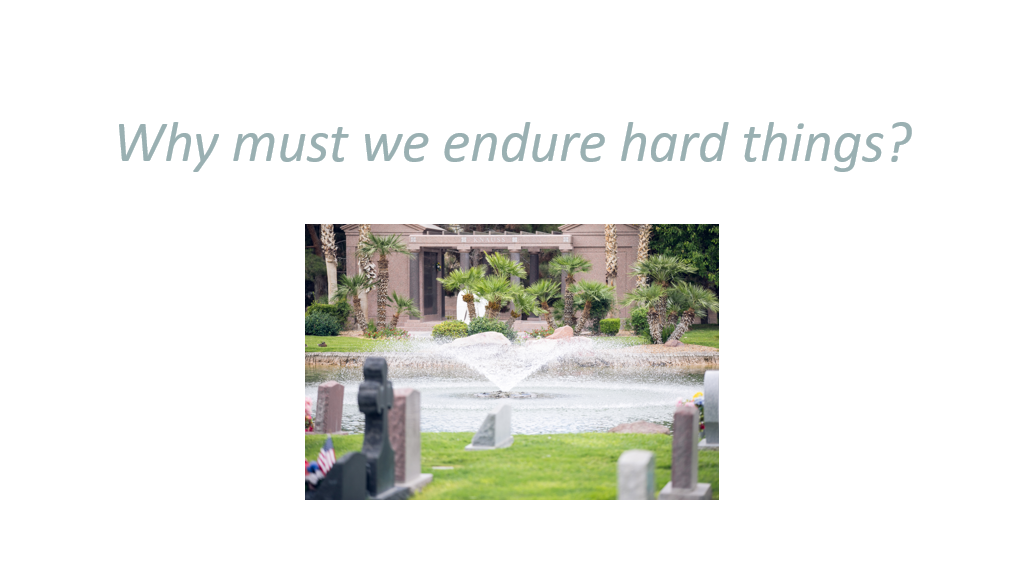
This picture right here is of a cemetery in Las Vegas where I’m from. Sadly enough, just a month ago, one of our dear friends lost their son to suicide. In our stake, we’ve been kind of like this core family for 15 years.
It rocked our world. It rocked my friends. And we’re just there, loving, trying to understand.
Again, you have these feelings of, “Man, this could have happened to me.” And I know so many family members and friends who are also struggling with health issues.
Sometimes it’s intertwined with faith—sometimes you don’t feel the Spirit as much, or you start to feel numb.
But why must we endure?
It’s so hard, right?
Hard Times Are for Our Good
As I’ve come to learn these things for myself—trying to coach others and understand my loved ones—I’ve learned this interesting, hard truth: the hard times are for our good.
I think of this beautiful scripture from the Prophet Joseph Smith: “Know thou, my son, that all these things shall give thee experience and shall be for thy good.”
Sometimes it’s so hard to see the good, but I know it’s there.
At the funeral of their son, my dear friends had the resiliency to share publicly: “We still believe in God’s fabulous plan, and we know that because of Him, we can think celestial.”
So I know of their resiliency, and I know that it’s possible.
Types of Resilience
Resilience, I see in two different ways:
- Spiritual resilience, so that we can have unshaken faith.
- Emotional resilience, because we also have this mortal body.
I love how our Church’s self-reliance course on emotional resilience describes it: “the ability to adapt to emotional challenges with courage and faith centered in Jesus Christ.”
We need both—not just secular mental health tools, but also something more.
Why Build Resilience?
“The adversary never stops attacking, so we can never stop preparing. The more self-reliant we are temporally, emotionally, and spiritually, the more prepared we are to thwart Satan’s relentless assaults.”
There’s a scripture when we’re talking about the people of Enoch, and Satan laughs at the wickedness that’s going on in the world.
So I think the adversary finds enjoyment in all of our mental health struggles. That’s why we need the spiritual resiliency to thwart his assaults.
The State of Mental Health Today
I was reading a Time magazine article titled “America Has Reached Peak Therapy. Why Is Our Mental Health Getting Worse?”
Typically the media talks very positively about things like:
- We need more mental health therapists.
- We need more tools.
- We need more help
And that’s a great thing.
But this article really piqued my interest. It said:
- One in eight are taking antidepressants.
- One in five are receiving some sort of mental health care.
- One in three are reporting symptoms of depression or anxiety.
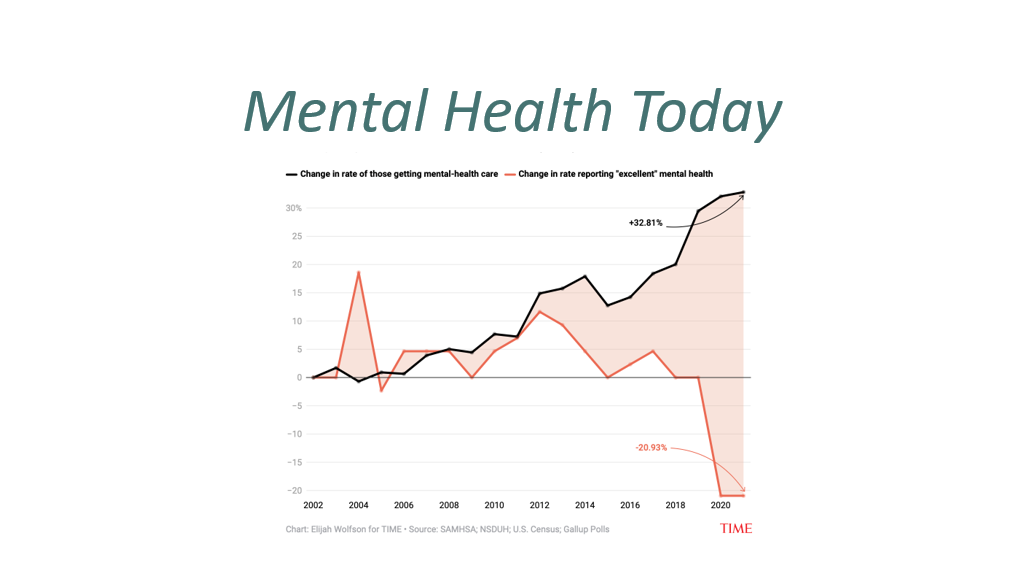
This was an interesting quote: “Trends are going in the wrong direction even as more people seek care.”
So with all the scientific advancements, you know, we’re helping with cancer, we’re helping with different ailments, and you’re like, why is this getting worse?
This chart shows the black line—people receiving help—going up. But the red line—people reporting excellent mental health—going down. Why?
- It could be a multi-faceted thing.
- It could be just a condition of mortality, our brain health, nutrition, our habits.
- It could be so many things. 1
Suffering and Sin
Just because we’re suffering—and I know a lot of us are—does that mean that we’re sinning?
No.
Sometimes we’re suffering because it’s a part of that mortal life, and we use it for our good to grow.
But what about the state of the world that is covered in wickedness right now? President Hinckley said 20 years ago that we’re worse than Sodom and Gomorrah. So think about what the world is like today.
But sin does cause suffering. President Ballard said:
Sin will always, always, result in suffering. It may come sooner, or it may come later, but it will come. The scriptures state that you will “stand with shame and awful guilt before the bar of God” (Jacob 6:9) and that you will experience “a lively sense of … guilt, and pain, and anguish” (Mosiah 2:38).
So, I’m not here to judge or condemn anyone, but the world as a whole—the scriptures, especially the Book of Mormon—talk about the wickedness in the latter days.
And this chart right here is just kind of eye-opening to me about that.
Who is Suffering the Most?
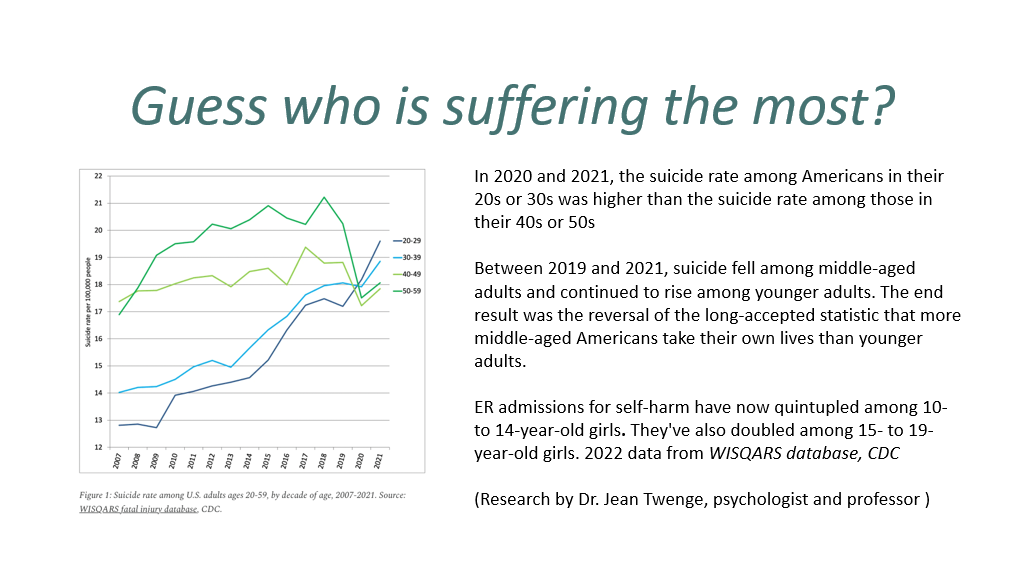
And guess who is suffering the most? I won’t go into a lot of the details here, but it’s the rising generation—young adults and children.
My children are 12, 9, and 5. So I’m thinking about them. How can I build their resiliency? And some of these statistics are just hard. A decade ago it wasn’t as bad, but it was bad. Now it’s this astronomical number.
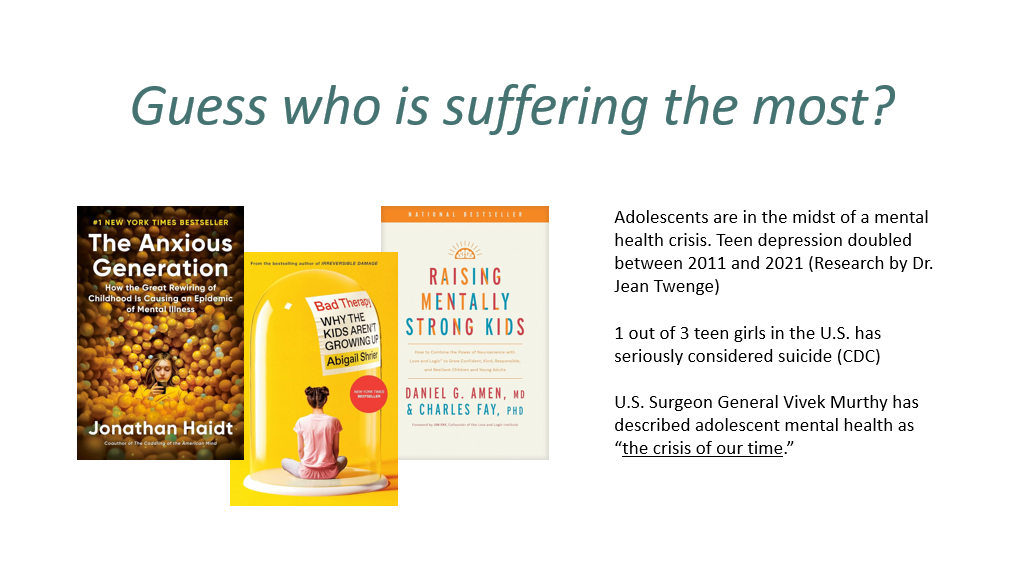
I want to share a little bit about these three books. You may or may not be familiar with them, but I’m the weirdo in book club that was like, “Oh, we should read this.” I want to learn all that I can about what is going on for the youth of today.
And it’s not that we have to agree 100% with everything that’s in these books. I know the Bad Therapy book was very controversial. When I read it, I’m like, “Yeah, okay, I can see that some things maybe I don’t agree with.”
Opposition in all Things
But if there’s opposition in all things, wouldn’t you think that there’s also some bad therapy out there? Even within our own membership, if someone is being publicly called “Korihor” online, maybe they’re not the greatest therapists.
But I think again of my kids. I think about girls on social media. I think about boys and the examples that we’re setting for them. What are we going to do here?
The answer is always Jesus Christ.
And sometimes when I talk about mental health and spirituality in the same sentence, I get the worst comments on Instagram.
And that’s because some people are like, “No, no, no, no—spirituality has nothing to do with mental health.”
I think Christ wants to give us these other tools.
- He’s the creator of everything, and
- He gave us wisdom to learn and grow, with more light and knowledge.
- He is trying to help us.
Christ is Able to Heal Us
But ultimately, Christ is the Master Healer. We have to believe that just as He healed
- the lame,
- the deaf,
- the blind, and
- those with demons,
He can do the same today.
But it’s also really neat when you find information from Harvard that says there’s a five-time protection against suicide if you attend church weekly.
Nearly 40% of the recent increase in the U.S. suicide rate could be attributed to the decline of religious attendance. So again, we can see the cultural trends of what’s happening.
I thought this was a beautiful quote to summarize what’s happening here.
“The study authors noted that religious participation may serve as an important antidote to despair and an asset for sustaining a sense of hope and meaning. They also wrote that religion may be associated with strengthened psychological resilience by fostering a sense of peace and positive outlook, and promoting social connectedness.”
And I just think about how in General Conference President Oaks talked about the need for a church, and I’m like—this is it.
This is a part of it.
Faith and Mental Health in Latter-day Saints
Justin Dyer, a professor at BYU, studies a lot about members and mental health. And I love that he said this:
“…Latter-day Saints are typically found to have just as good, if not better, mental health than other groups. The more religious Latter-day Saints are, the better their mental health. Still, many Latter-day Saints struggle with their mental health, and we need to be as understanding and helpful as possible.”
I see that every day.
It’s something we need to give compassion to—our ward members, our family, and our friends—because it’s happening.
Along with that compassion, we should never assume Latter-day Saints struggling with mental health issues are simply not living their religion. Nor should we assume that giving increased attention to religious faith and activity will solve all mental health problems.
However, research does suggest that continuing with these practices in healthy ways will benefit those who are faithful.
And we’ve been asked before, “What about the LGBT community? Don’t they suffer more in a religious setting?”
Justin Dyer specifically studied that, and he said that in general, it’s still the best place to uplift your mental health.
Hope, Agency, and Growth
And that’s why I think Christ gives us hope.
But also, we want to find the Goldilocks zone. Because in high school, I think part of my mental health problems was toxic perfectionism.
Oldest child here—I was trying to do it all. And as I’ve grown, I’ve learned about the difference between optimism and hope.
Arthur Brooks wrote in The Atlantic that optimists tend to imagine a better future but can then be disappointed when it doesn’t pan out, while hope involves personal agency and allows for one to envision progress without distorting reality.
Hope makes people act.
When I read that about action, I thought, “Oh, Elder Bednar talks about that.” He said once, holding up the scriptures:
“These scriptures are an object. They have no ability to move on their own unless I move them. You and I, however, are agents. We have power in us to act, not simply to be acted upon.”
And that’s why we have moral agency. I think we do have more agency than we think. We can do something that can increase our hope. 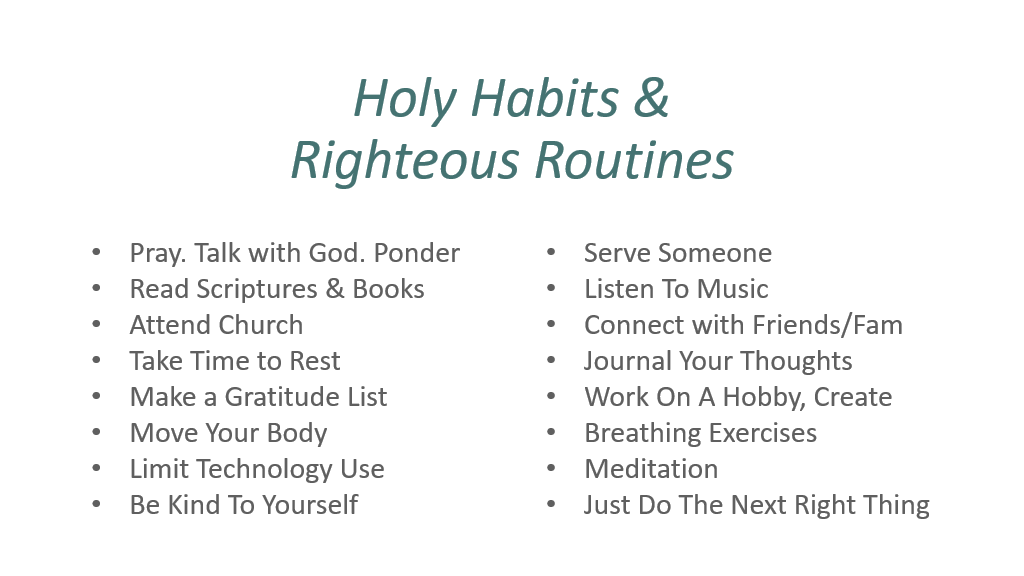
Holy Habits
One of the things that I love to talk about is these holy habits and righteous routines that are mentioned in General Conference all the time. I’ve noticed a pattern of our leaders talking about this.
I won’t read through all of them. But if you’ve ever been to therapy like me, sometimes this is part of the package.
And so I’m thinking religious practices are such a huge part of our mental health and building up our resiliency. I feel we can use our agency to take action and not always be acted upon—little by little, just 1% better.
Why the Gospel of Jesus Christ?
So, why the gospel of Jesus Christ? I think it provides so much hope. Because of opposition in all things, it is going to be hard, but hard can be for our good.
If you’ve ever watched the video about the refiner’s fire—when they’re melting this metal, in the end they have a beautiful flower.
I just think if we’re going into the refiner’s fire, it’s going to burn a little, and we have to realize that’s normal, that that’s okay. We’re going to come out stronger and more beautiful from that. 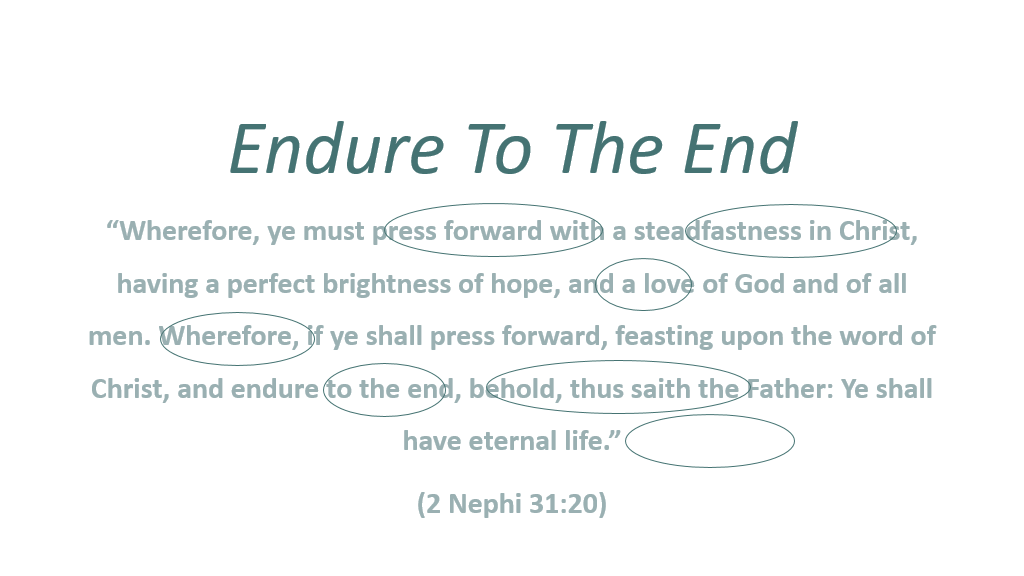
Endure to the End
Another story about my journey with mental health is that I received my patriarchal blessing around the same time that I was either going through therapy or talking about it. It was in that period of youth where I was like, “Heavenly Father, I need help.”
The patriarch didn’t know my background. We didn’t talk about that. The patriarch didn’t know my favorite scripture. But at the end of my patriarchal blessing, it ended with “endure to the end.”
And that’s when I knew that God knew me personally. He knew that that was something I was struggling with.
My favorite scripture embodies this spiritual and emotional resilience that I want to build in my life, in my children’s lives, and that I want to teach others to find as well. Because when we press forward, we’re not just gliding through super easily—we have to press against something. But we want to do it steadfastly in Christ. We want to have a love of God.
(My little circles moved around, but I circled things like we want to have that perfect brightness of hope that we talked about.)
I know we can’t have perfect optimism all the time, but we can have
- a perfect brightness of hope,
- a love of God,
- and love of all men.
That’s how we have compassion—by loving all men. We want to feast on Christ’s words and then endure to the end.
Conclusion
I think this life is what President Oaks said: “the challenge to become.”
As I’ve learned these last two days, that’s why we’re here—because we’re learning to become who God wants us to become.
This is a gospel of redemption, like we talked about earlier. I don’t think we can be redeemed from anything if we’re not suffering sometimes.
It’s awful, and it stinks, and I tell my kids, but we can do hard things. And as adults, we can do hard things.
I testify that Christ is our Master Healer. One day all the suffering will end. But in the meantime, we can rely upon Him.
And I say these things in the name of Jesus Christ, amen.
 Debra Theobald McClendon, PhD is a licensed psychologist in the state of Utah and has interjurisdictional authorization to work with clients in most U.S. states. She specializes in treating those with scrupulosity, a religious and moral subtype of OCD. She is the owner of The OCD & Scrupulosity Clinic (ocdscrupulosityclinic.com) and is a member of the International OCD Foundation. She has been interviewed on podcasts, published articles, and published the book: “Freedom from Scrupulosity: Reclaiming Your Religious Experience from Anxiety and OCD.”
 Ryan Sorensen is a native of Cache Valley, Utah. He earned his Bachelor’s degree at BYU-Idaho and is currently pursuing a Master of Divinity at Abilene Christian University, with plans to become a chaplain after graduation. Ryan previously hosted a podcast called The Whom Shall We Go? Podcast. In his spare time, he enjoys being involved in interfaith work, reading about Latter-day Saint theology and history, training for triathlons, and spending time with friends and family.

 Edwin E. Gantt is currently Professor of Psychology at Brigham Young University and a Research Fellow of the Wheatley Institution. He received his doctoral degree in Clinical Psychology from Duquesne University. He is the author of over 80 scholarly articles and book chapters. His primary research interests revolve around the questions of moral agency and the relationship between religion, science, and psychology. He is co-author (with Richard N. Williams) of Hijacking Science: Exploring the Nature and Consequences of Overreach in Psychology, editor of the textbook series Taking Sides: Clashing Views on Psychological Issues, and Co-Editor of the journal Issues in Religion and Psychotherapy (the official journal of the Association of Latter-day Saint Counselors and Psychologists). He teaches courses in the History and Philosophy of Psychology, Personality Theory, Qualitative Research Methods, Psychology of Religion, and (his favorite) LDS Perspectives on Psychology. He and his wife Anita live in Springville and have four wonderful sons, two amazing daughters-in-law, and two beautiful grandsons.