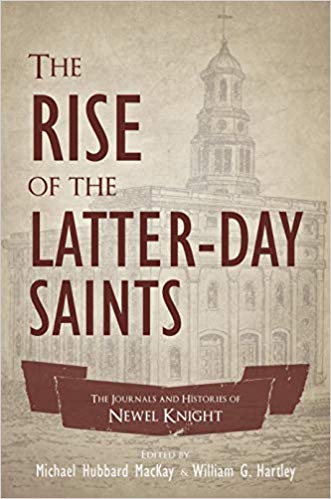
Newel Knight lived from September 13, 1800 to January 11, 1847. He met Joseph Smith in 1826 and remained close friends with him until Joseph’s death. He was directly involved in some of the early events in church history, so his autobiography and journals are valuable to historians. However, these have only been available in manuscript form, in several different versions, which have made them difficult to use. This book amalgamates them in a coherent form and provides a transcription that can be better understood and cited.
The book splits Knight’s writing into five parts, covering different chronological periods of his life. Each section has an introduction with a biographical summary. Editorial remarks are given in footnotes, and spelling and punctuation are generally retained, except in cases where the editors felt clarification was necessary (which to me seemed inconsistent, and in at least one case, possibly incorrect[1]).
There are many things included that are important, such as a letter from Joseph Smith that has not been published in the Joseph Smith Papers Project, Christ’s appearance in the Kirtland Temple[2], many accounts of healings, the aftermath of the martyrdom of Joseph and Hyrum Smith, and the exodus from Nauvoo. Despite his human imperfections, Knight comes to life as a role model worth emulating with his tremendous faith, even during discouragement, and always remembering to be grateful for the blessings that followed.
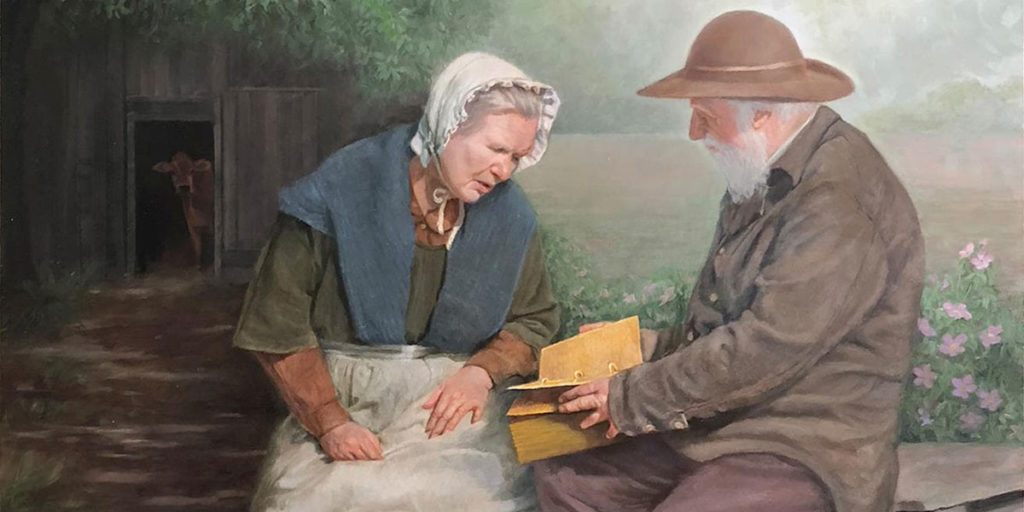
I found this particular episode of 1839 in Nauvoo to be very interesting, involving his wife Lydia: [Read more…] about Book Review: The Rise of the Latter-day Saints: The Journals and Histories of Newel Knight


 A native of southern California, Daniel C. Peterson received a bachelor’s degree in Greek and philosophy from Brigham Young University (BYU) and, after several years of study in Jerusalem and Cairo, earned his Ph.D. in Near Eastern Languages and Cultures from the University of California at Los Angeles (UCLA). Dr. Peterson is a professor of Islamic Studies and Arabic at BYU, where he has taught Arabic language and literature at all levels, Islamic philosophy, Islamic culture and civilization, Islamic religion, the Qur’an, the introductory and senior “capstone” courses for Middle Eastern Studies majors, and various other occasional specialized classes. He is the author of several books and numerous articles on Islamic and Latter-day Saint topics–including a biography entitled Muhammad: Prophet of God (Eerdmans, 2007)—and has lectured across the United States, in Europe, Australia, and New Zealand, and at various Islamic universities in the Near East and Asia. He served in the Switzerland Zürich Mission (1972-1974), and, for approximately eight years, on the Gospel Doctrine writing committee for The Church of Jesus Christ of Latter-day Saints. He also presided for a time as the bishop of a singles ward adjacent to Utah Valley University. Dr. Peterson is married to the former Deborah Stephens, of Lakewood, Colorado, and they are the parents of three sons.
 René Alexander Krywult, a native of Vienna, Austria, Europe, has been a member of FairMormon for over eighteen years and has been instrumental in founding the German-speaking FairMormon group. He is a software developer and project manager for a European financial institution. He is married to Gabriele Krywult, and they have four children and three grandchildren. His first publication was “Mormon Deification Compared to Orthodox Christian Theosis” in the magazine Spirituality in East and West of Dialog Center International, a Protestant network of organizations engaged in researching new religious movements. More articles on the FairMormon website followed. He organized four FairMormon conferences in Germany from 2009 to 2015 and spoke at all of them.

 Huh? How could that be? I knew I’d just unplugged the phone.