• Skip to primary navigation
  • Skip to main content
  • Skip to primary sidebar
  • Skip to footer

FAIR

  • Find Answers
  • Blog
  • Media & Apps
  • Conference
  • Bookstore
  • Archive
  • About
  • Get Involved
  • Search

Joseph Smith

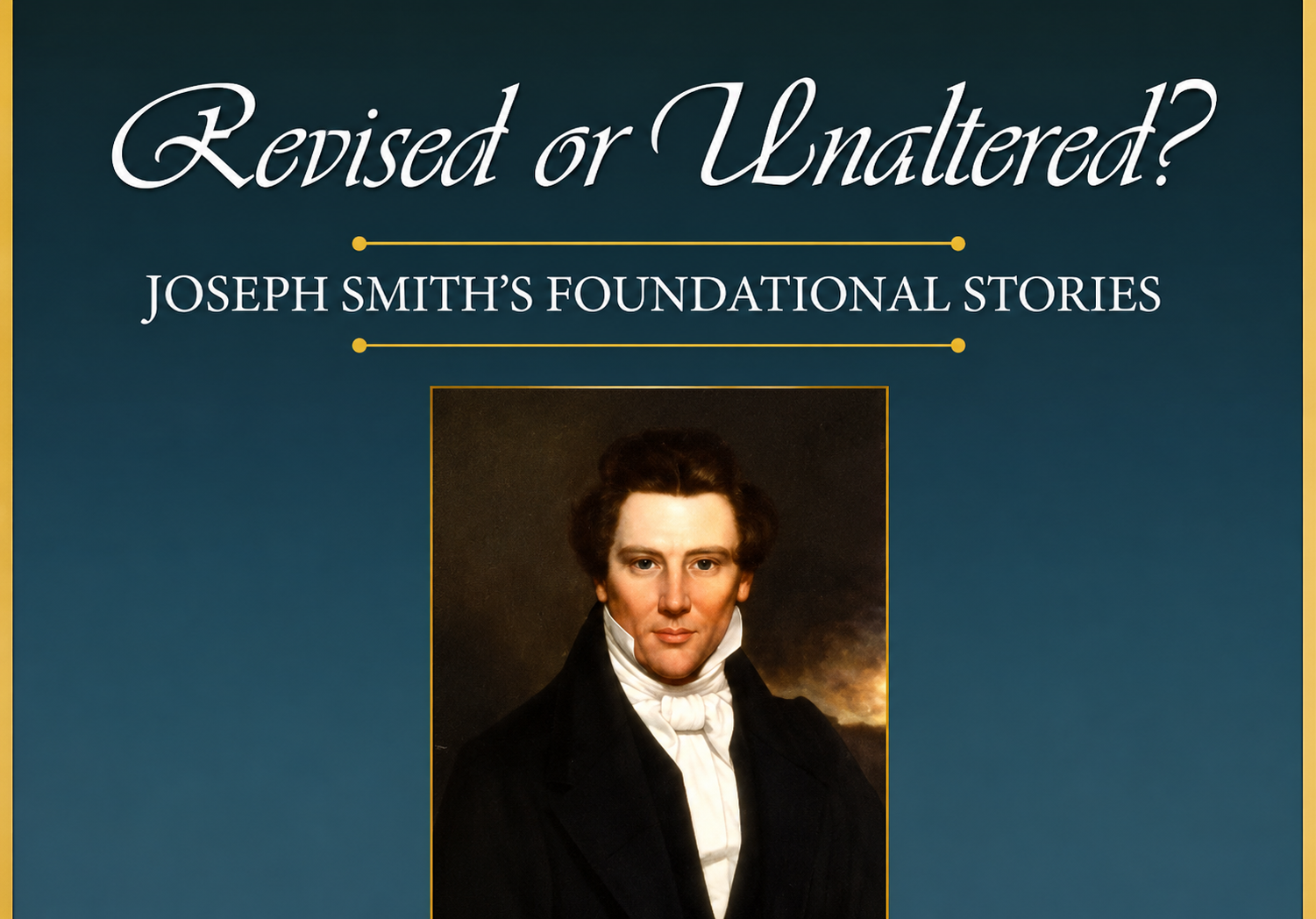
Revised or Unaltered? Joseph Smith’s Foundational Stories

Jump to Transcript

Start Here

Question
Did Joseph Smith revise the First Vision story over time?

Short Answer
Critics sometimes claim that Joseph Smith changed his account of the First Vision and the coming forth of the Book of Mormon over time. This presentation argues that the historical evidence instead shows a consistent core narrative from the earliest accounts onward, while later retellings often expanded details or emphasized different aspects for different audiences.
Key Takeaways
  • Early eyewitness reports from Joseph Smith’s family and associates consistently describe an angelic visitation connected to golden plates and divine revelation.
  • Hostile newspaper accounts and critical sources often preserved authentic elements of Joseph Smith’s story even while attempting to reinterpret or ridicule it.
  • The presentation compares the 1832 and 1838 histories and argues that differences between them reflect incomplete narratives and differing purposes rather than fabrication.
  • Accusations involving money digging, folk magic, and Luman Walter are examined in historical context using eyewitness documents.
  • The speaker argues that many claims of “revisionism” are based on selective readings, incomplete documents, hostile reinterpretations, or natural variations in retelling.
  • The talk explores the multiple First Vision accounts and argues that they preserve a stable underlying narrative.
  • Revival activity near Palmyra and throughout western New York is examined as historical context for Joseph Smith’s religious questions.
  • Oliver Cowdery’s early church history writings are presented as evidence that early Church leaders were already familiar with the First Vision narrative.
  • The presentation also analyzes the literary and biblical structure of Joseph Smith’s 1832 First Vision account, including parallels to Acts 26 and Psalm 31.

Summary

Summary

This presentation analyzes accusations that Joseph Smith altered the stories of the Restoration over time, particularly the coming forth of the Book of Mormon and the First Vision. Using early eyewitness accounts, critical sources, newspaper reports, and manuscript comparisons, the speaker argues that Joseph Smith’s central storyline remained remarkably consistent from its earliest tellings. He contends that many alleged “revisions” actually stem from misunderstandings of incomplete documents, selective readings, or hostile reinterpretations created by critics.

A major focus of the talk is Joseph Smith’s 1832 history, including its relationship to later First Vision accounts and Book of Mormon narratives. The speaker proposes that the 1832 account was deliberately constructed using biblical frameworks and literary parallels, particularly from Acts 26 and Psalm 31. He also examines revival activity in the Palmyra region, Oliver Cowdery’s early historical writings, accusations involving money digging and Luman Walter, and the broader question of how historical memory becomes reshaped over time.

TL;DR

TL;DR (Too Long; Didn’t Read)

This talk argues that Joseph Smith’s accounts of the Book of Mormon and the First Vision did not evolve into entirely new stories over time. Instead, the speaker shows that early eyewitnesses, critics, and historical documents consistently preserve the same core narrative elements. The presentation also explores how later critics contributed to confusion through rumor, speculation, and selective interpretation of historical records.

Introduction

Critics of Joseph Smith have long claimed that the stories of the Restoration offered by him were revised over a period of time until they became what is known today as the accepted history of the Church. In my lecture this morning, I would like to examine some aspects of this claim of revisionism from a documentary perspective. 1

I will start by talking about the story of the coming forth of the Book of Mormon and then move into a discussion of the First Vision.

I have a very definite reason for addressing these topics in reverse historical order. This will become apparent as my lecture progresses. Please be aware that in my remarks today I will be utilizing several abbreviations such as:

  • JS1832, which refers to Joseph Smith’s 1832 history, and
  • JS1838, which refers to the manuscript that was published in 1842 and became the official history of the Church.

I will be presenting and summarizing a considerable amount of new research on both the story of the coming forth of the Book of Mormon and that of the First Vision. But it’s not nearly all that I have available at this time. It is my hope that you will find something in this material that will be useful in defending the prophet’s foundational stories from the critics of the Church.

The Earliest Book of Mormon Accounts

If a person wants to determine whether or not a story has changed over time, it is logical to first examine that story in its earliest known form. In the case of the Book of Mormon account, we are fortunate to have records from several eyewitnesses who heard Joseph Smith relate this story for the first time.

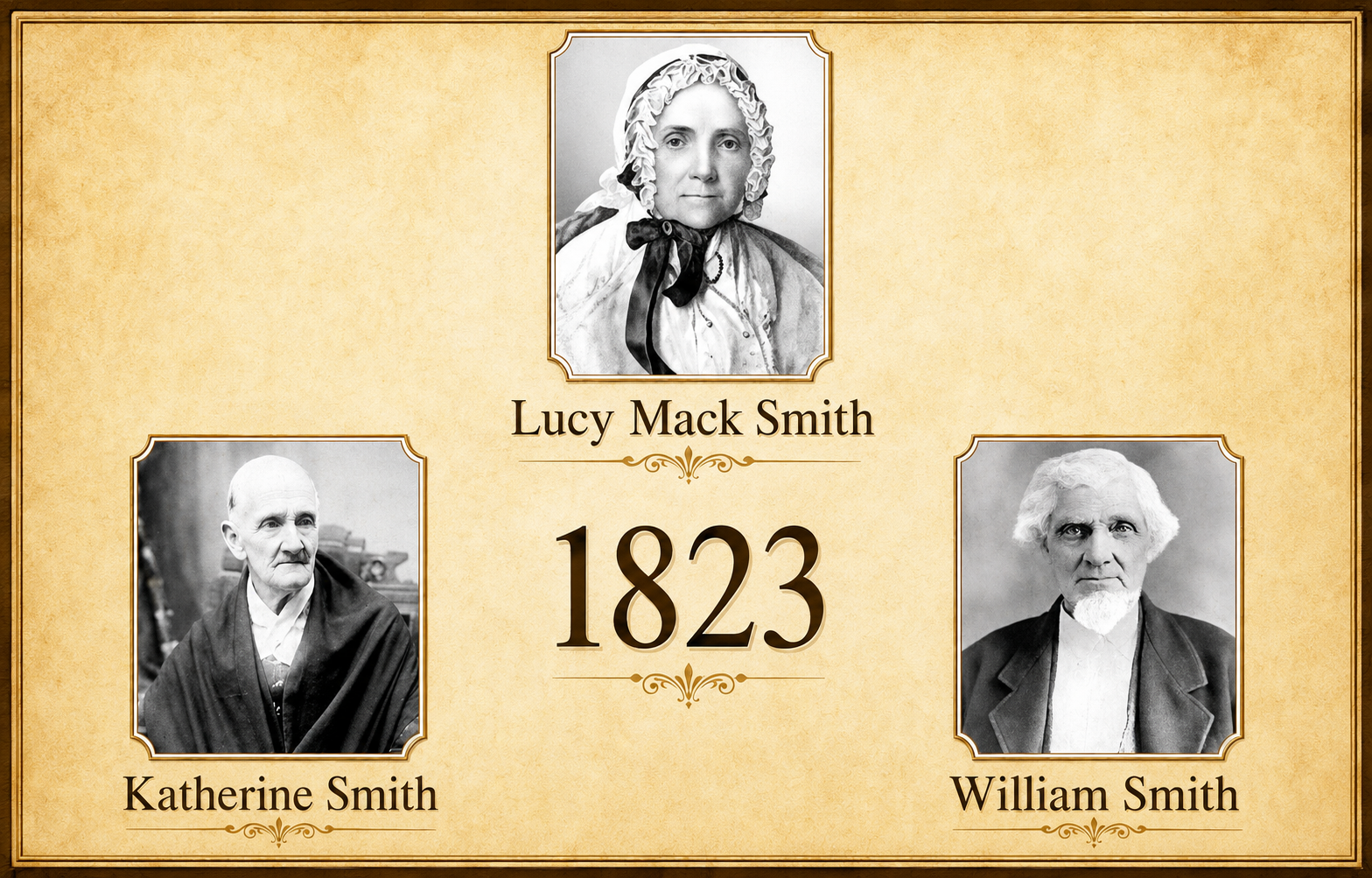
These witnesses are his mother, Lucy Mack Smith, his sister Katherine Smith, and his brother William Smith.

These three eyewitnesses agree that Joseph’s story was first told to them during the fall harvest season shortly before Alvin Smith died, thereby giving us a date of 1823. They are also in agreement that the story told to them was that an angel had appeared to Joseph and told him about a golden engraved record hidden in a nearby hill.

Joseph talked to his whole family about this revelation for a considerable length of time. He stated that he was required to wait for a period of four years before he was allowed to retrieve the record.

He also warned his family members that they must not tell others in the community about this ancient artifact.

None of these three eyewitnesses ever mentions that they heard any different story of origin related by Joseph Smith, and none of them ever mentions hearing, even in the community, any earlier version of this story.

Independent Witnesses to the Story

Lorenzo Saunders

It is interesting to note that one of the Smiths’ neighbors named Lorenzo Saunders stated that before Alvin Smith died in November of 1823, Joseph Smith Jr. told the Saunders family that he had seen an angel and was notified about the plates.

Joseph Smith evidently broke his own rule of non-disclosure in this instance, but in the process provided an independent set of witnesses to the elements of his story in 1823.

Harrison Chamberlain

A possible secondhand verification of this circumstance comes from Harrison Chamberlain. He claimed to have heard from people living in the vicinity of Palmyra that in the late fall of 1823, Joseph Smith told his most intimate associates about his vision of an angel and the engraved golden plates buried in a hill which contained revelation from God.

The Knight Family

We know that Joseph’s story about the Book of Mormon remained the same through the year 1826 because during that period he worked in southern New York State for the Knight family.

While he was in their employ, he said that a person had appeared to him in a vision and told him where there was an ancient gold book buried.

Martin Harris and the Golden Plates

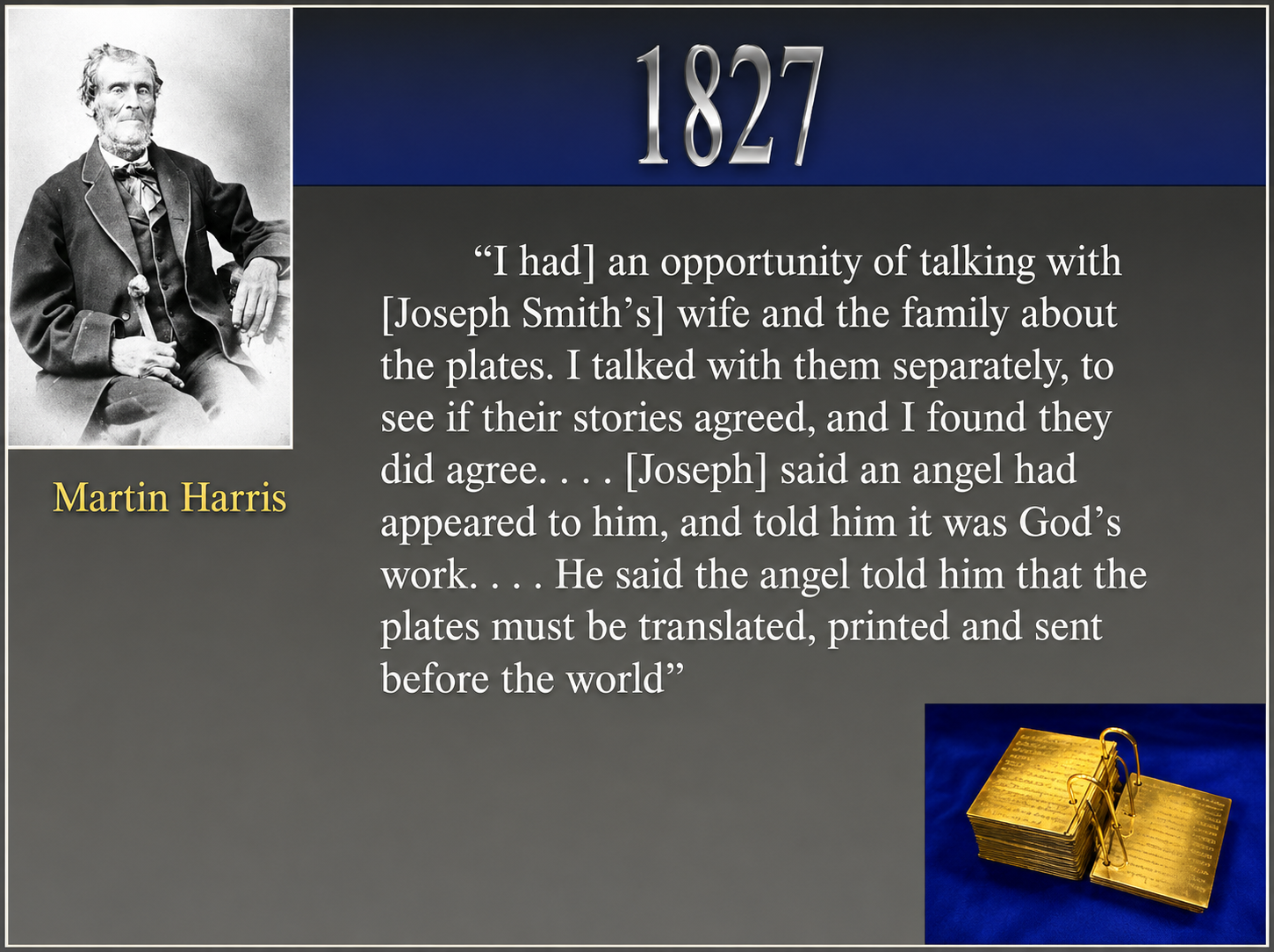
Martin Harris is our next eyewitness for the content of Joseph Smith’s story. He said that the first time he heard about the gold Bible was around the 1st of October in the year 1827.

Harris recalled that the day following this, he went into Palmyra and spoke to some of the residents of the village about this matter. They repeated the account of it as given to them by Joseph Smith Sr., and it matched with what Joseph Jr. had said earlier.

Lucy Mack Smith arrived a little bit later at the house of Martin Harris and told him about Joseph bringing the plates to the Smith residence and many other things.

She further informed Martin that Joseph wished to see him. Martin sent his wife and daughter home with Lucy Mack Smith at this time. When they returned, they told Martin that they had both been allowed to lift a very heavy object that was said to be the golden plates.

When Martin Harris went himself to the Smith home in Manchester, New York, Joseph Jr. was away. Martin reports,

“This gave me an opportunity of talking with his wife and family about the plates.”

Harris Interviews the Smith Family

Martin indicates that he desired to get at the truth of the matter.

“I talked with them separately,” he said, “to see if their stories agreed, and I found they did agree.”

“When Joseph came home, I did not wish him to know that I had been speaking with them. So, I took him by the arm and led him away from the rest, and requested him to tell me the story, which he did as follows. He said an angel had appeared to him and told him it was God’s work.”

Joseph talked about the spectacles and said that they had the ability to display a lifelike visual image. 2 He also said the angel told him that the plates must be translated, printed, and sent before the world.

Martin relates,

“While at Mr. Smith’s, I hefted the plates and knew from the heft that they were lead or gold, and I knew that Joseph had not credit enough to buy so much lead.”

We may conclude from all of this documentary evidence that between the initial disclosure of the origin of the Book of Mormon in the fall of 1823 and Joseph bringing the plates into the Smith residence in the fall of 1827, his story did not change.

He consistently told individuals that an angel of God had informed him about a set of golden plates.

Public Speculation and Competing Narratives

Then the historical scene changes dramatically.

It is known from documentary sources that in the year 1827, Joseph Smith started making his story known among the general populace. I have collected several statements by critics — actually, there’s eleven — who say that they heard the story during this year from either Joseph Smith or one of his close associates.

There were, of course, some people who were skeptical about the young man’s claims of new revelation from the Almighty. This is the time period where the public started to speculate heavily about what they thought was really behind Joseph Smith’s story and how they imagined the book idea really originated.

Rumors and Alternative Explanations

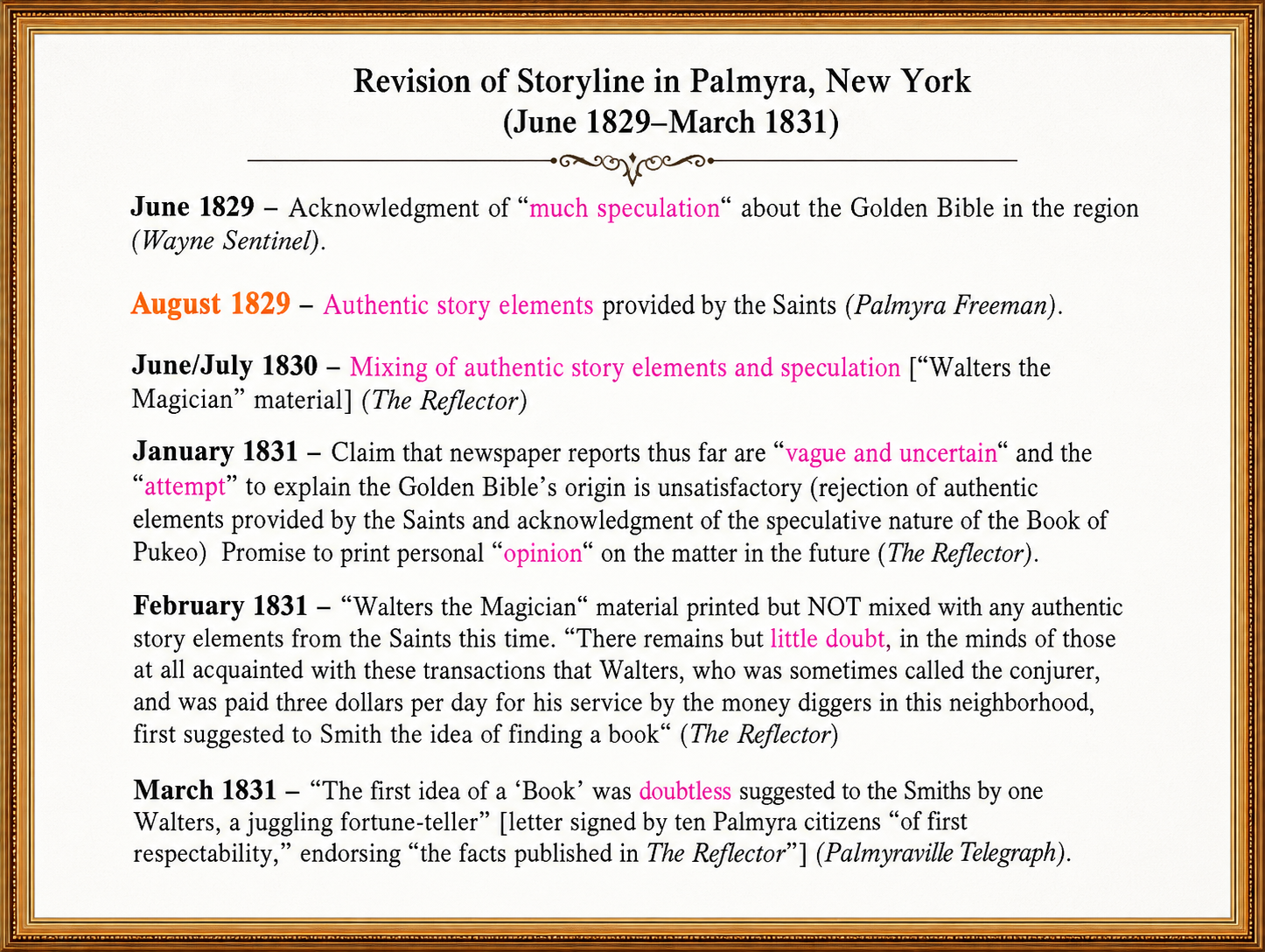
By the summer of 1829, when the Book of Mormon was being prepared for the press, the line between history and mythology had been blurring for some time. An issue of the June 1829 Wayne Sentinel newspaper in Palmyra made note of the fact that there had already been much speculation about the Golden Bible floating around the region. 3

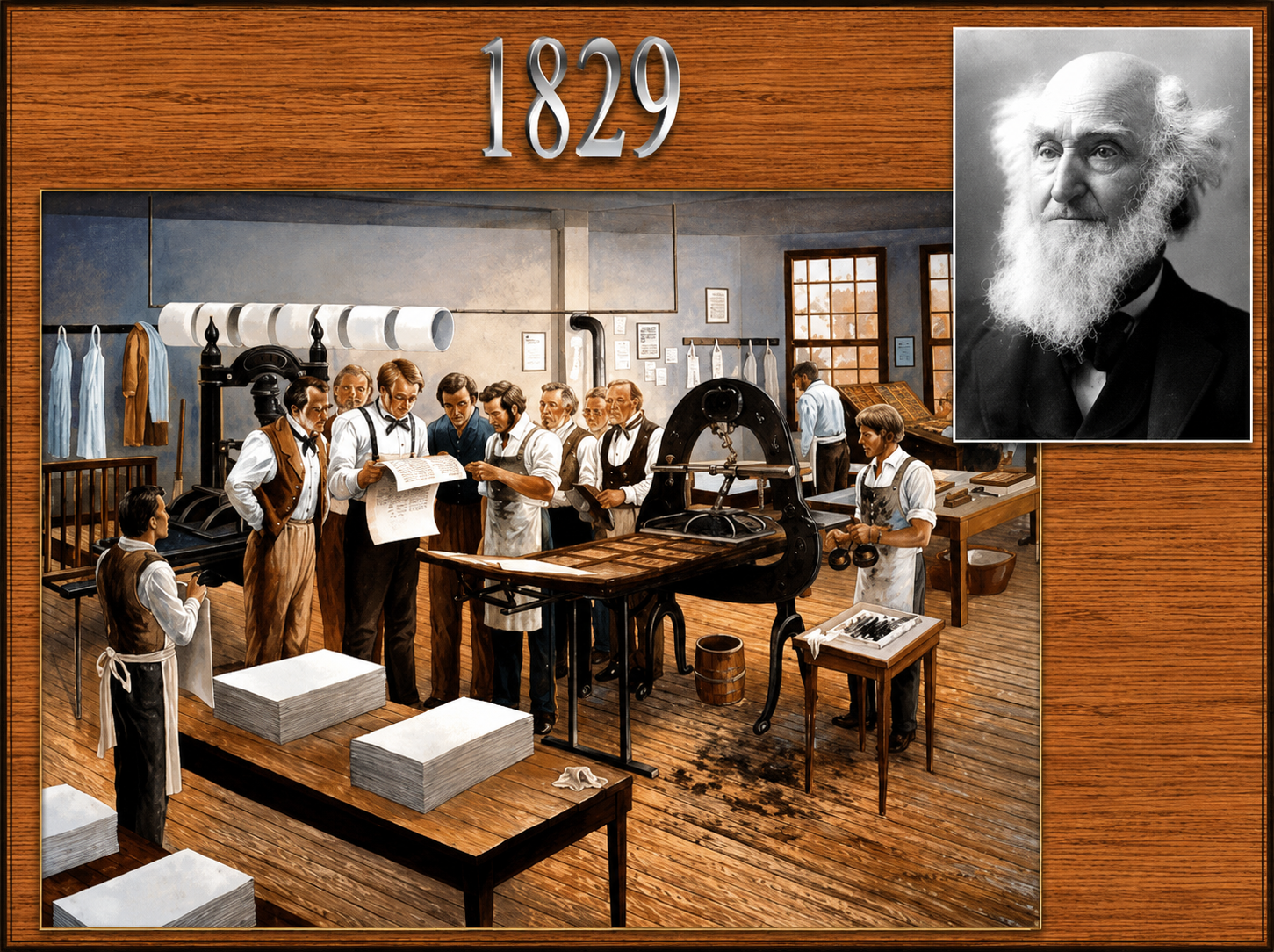
Steven S. Harding provides us with a unique and insightful snapshot of what was going on during this precise time period. He visited the Grandin print shop where the book was being published, and there he met Father Smith, the prophet, Oliver Cowdery, and Martin Harris in the morning.

Then in the afternoon, he had a lengthy conversation with his cousin Pomeroy Tucker and Mr. Grandin where he heard some new things about the book that was being produced.

Martin Harris About the Book of Mormon

The things that he heard from these two different groups of men is very instructive. Martin Harris informed Harding that:

  • the plates of the book were found in a hill,
  • an angel of the Lord was involved, and
  • the devil was working to thwart the project.

Tucker About the Book of Mormon

Pomeroy Tucker, on the other hand, told him something quite different. He wanted Harding to believe that Joseph Smith had a connection:

  • with the black art,
  • animal sacrifice, and
  • money digging. 4

Though in later years, Tucker admitted that these stories only qualified as rumors.

When Mr. Grandin was interviewed about the Book of Mormon just two years later than his meeting with Harding, he also seemed to be of the opinion that the golden plates were connected with money-digging lore.

John H. Gilbert, whose picture you see here on the screen, was also a workman in the Grandin print shop during the production of the Book of Mormon. He likewise held to the belief that Joseph Smith was a money digger who was involved in magic practices.

From this documentary evidence, it can be concluded that two different stories of origin were being promulgated in the Grandin building at the same time that the Book of Mormon was being issued from it.

Authentic Accounts Versus Public Speculation

The workmen of the Grandin print shop typeset and proofread the preface page of the Book of Mormon. And so they knew without any ambiguity what the authentic story of its origin was.

They were also aware from this document that there were “many false reports” circulating about the book.

Yet they chose to champion the rumors that were swirling around the region. Their repetition of idle reports, therefore, represents a deliberate revision of Joseph Smith’s own story.

On this next slide, I have highlighted the date, August 1829, so that you can see how the information that I just presented correlates with what I will talk about next.

It is at the very same time that Steven Harding was hearing an alternative storyline in Palmyra that some Latter-day Saints tried to set the record straight.

The report of story elements printed in the 11th of August 1829 issue of the Palmyra Freeman is not perfect, but it is very close to being correct in its elements. After filtering out a little of the biased opinion and incorrect notations, it says this:

“Joseph Smith of Manchester, New York, said he was visited three times by a messenger of the Almighty. Joseph was informed that a golden Bible 5 was deposited in a hill in Manchester. It was an ancient record of divine nature and origin. Joseph went to the place of deposit, dug into the earth a little ways, and found the golden Bible along with a huge pair of spectacles.

“Joseph was instructed not to let any person see the objects on penalty of death. The plates of gold measured 8 inches long and 6 inches wide and were 1/8 of an inch thick. The plates were engraved with hieroglyphics and the spectacles enabled Joseph to interpret the characters on the plates.”

The rest of the information that is on this slide shows a very interesting pattern. The first item tells us that rumors were flying through the countryside. Next, the Saints offer the authentic elements of the story to the public.

Then we find a blatant act of historical revisionism.

Abner Cole and the “Book of Pukei”

Abner Cole wanted to mock the Book of Mormon in his newspaper, The Reflector. He was most probably motivated to do this because he had violated copyright law (by the way, he was an ex-justice of the peace) by printing portions of the Book of Mormon in his paper, and the prophet forced him to stop his illegal activity.

Cole’s mockery text was called the Book of Pukei.

In this production, the editor took authentic elements of the story of the Book of Mormon’s origin and mixed them together with elements of speculation that had been floating around the community.

This is important to understand. He is using authentic elements in that Book of Pukei and he’s mixing them together with the rumors, and something’s going to happen.

Cole utilized the dialogue of one of the characters in his mockery text to call Joseph Smith an ignoramus, a criminal, and a servant of Satan.

It is in this text that Joseph Smith is connected with a man from the Great Sodus Bay called Walters the Magician, which is probably Luman Walter.

Cole claims in the Book of Pukei that the Book of Mormon really came into existence in the following manner.

Walters the Magician Narrative

  • Walters the magician was involved in witchcraft and money digging. Walters was summoned to Manchester, New York, by a group of wicked, idle, and slothful individuals, one of which was Joseph Smith.
  • Walters took the slothful individuals of Manchester out into the woods on nighttime money-digging excursions. They drew a magic circle, sacrificed a rooster, and dug into the ground on many occasions, but never actually found anything.
  • The slothful group of Manchesterites then decided that Walters was a fraud. Walters himself admitted that he was an impostor. And decided to skip town before the strong arm of the law caught up with him.

Remember that Cole is an ex-justice of the peace, and so he is talking through this document. “The strong arm of the law is going to catch up with you impostors.”

  • At this point, the mantle of Walters the Magician falls upon Joseph Smith and the rest of the Manchester rabble rallied around him.
  • And then we have the spirit of the money diggers — who is identified implicitly with Satan in the text — who appears to Joseph and reveals the golden Bible 5 idea to him.

This is what we’re hearing from Abner Cole in the Book of Pukei. If we look again at the chronological data on this slide, we can see a very informative pattern.

From Speculation to “Certainty”

A few months after Abner Cole published his book, he lamented that the published attempts to explain the origin of the Book of Mormon were thus far unsatisfactory and uncertain.

This means two very important things.

  1. Number one, Abner Cole was announcing that he rejected the authentic elements of the Book of Mormon story that had been made known in the Palmyra Freeman during the same time when the book was being published.
  2. Number two, Abner Cole was not claiming that the information put forward in his Book of Pukei was the final word in historical authenticity.

But that acknowledgement did not last long.

In the next item on the slide, we see that shortly thereafter, Cole reprinted the speculatory information on Walters the Magician, but this time he left out all of the authentic elements of the story that had been included in his previous work.

He proclaimed this time around that there was little doubt in the minds of some Palmyra residents that this version of events was the real deal.

Shortly thereafter, there was yet another transformation of the magic theory. In March of 1831, it was being proclaimed in the press that there was no doubt about Cole’s purported connection between Joseph Smith and Walters the Magician.

So, we can see that between June 1829 and March 1831, the progression among outsiders was from uncertain speculation to absolute certainty.

Eyewitnesses Contradict the Walters Narrative

There was only one thing wrong with the Walters the Magician scenario being advocated by Abner Cole. It was the exact opposite of historical reality as reported by eyewitnesses.

Eyewitness – Emer Harris

Emer Harris, the brother of Martin Harris, said that he had personal knowledge of the fact that some people in Palmyra had hired an astrologer to find the plates of the Book of Mormon.

Eyewitnesses from the Smith Family

Lucy Mack Smith recalled that a group of 10 or 12 men sent for a conjurer 6 to come and divine by magic art the place where the record was deposited.

This conjurer did in fact arrive in Palmyra and assembled with the group which had sent for him.

We know this because Father Smith, the prophet’s father, saw them himself meeting together to the east of his farm, and he overheard their plans to try and obtain the golden Bible for themselves.

The prophet’s sister Katherine remembered that when her father heard about the conjurer, an effort was made to go and warn Joseph Smith about this man and the plan that was being used against him.

Eyewitness – Joseph Knight Sr.

Joseph Knight Sr. verifies that “a great rodsman went to the Smith home in Manchester and attempted to locate the hiding place of the golden plates through the use of divining rods.” 7

Eyewitness – Brigham Young

And Brigham Young reported that this fortune teller was named Walters.

President Young related that this man angrily pointed out Joseph Smith among a crowd of people. And with considerable profanity identified Joseph as the one person who could obtain the treasure that was hidden in the hill.

But he acknowledged that he himself was not able to obtain it.

Walters the Magician was not the friend of Joseph Smith. He was his adversary.

The eyewitnesses never connect these two individuals in any type of complicity.

Critical Sources That Preserve the Original Story

Now that I have shown you that some of Joseph Smith’s critics were perfectly willing to intentionally alter his storyline, I would like to demonstrate that some of these critics have, in fact, preserved clear evidence that the prophet did not alter his storyline over time.

I have taken a careful look at the accounts of Mormonism’s detractors who claim that they heard Joseph Smith and his close associates tell the Book of Mormon story between 1827 and 1830.

Once a person understands the full Book of Mormon account that was being repeated by the early Saints, then it is not difficult to pick up the pieces of that pattern as they are scattered throughout the narratives of the critics.

Let me read to you just the pattern that is present in one single source for the year 1827. The source is Willard Chase.

The Willard Chase Account

These are the elements he says he heard from Joseph Smith Sr. and Joseph Smith Jr. in 1827.

Learning About the Plates

  • Joseph Smith Sr. said that some years prior to 1827, a spirit was sent and appeared to his son in a vision and informed him about the existence of a record on golden plates which were deposited inside of a stone box.
  • Joseph Jr. was identified as the person who must obtain the plates, and he was to do so on September 22nd.

Seeing the Plates

  • Joseph went to the place and raised up the stone box lid. There was a large pair of spectacles in with the plates.
  • Joseph removed the golden book. He was worried that someone might discover where he had gotten it. So, he laid down the plates in order to replace the top stone of the box.
  • The book vanished and reappeared inside the box.
  • Joseph attempted to get the book again, but he was struck several times.
  • A man, who was “the spirit of the prophet who wrote the book”, appeared and told Joseph that he had not been obedient.
  • Joseph was told to come to the same spot one year later and bring his older brother. By the end of the year, however, Joseph’s older brother died. Joseph went one year later and was directed by the spirit to return after another year. Joseph went to Harmony, Pennsylvania, and he eloped with Emma Hale.

September 1827

  • In the forepart of September 1827, Joseph Jr. told Willard Chase himself that he expected that he would soon take possession of the gold book, and he asked Chase to make him a chest with a lock on it, stating that he had been commanded to keep the book concealed from the eyes of all others but himself.
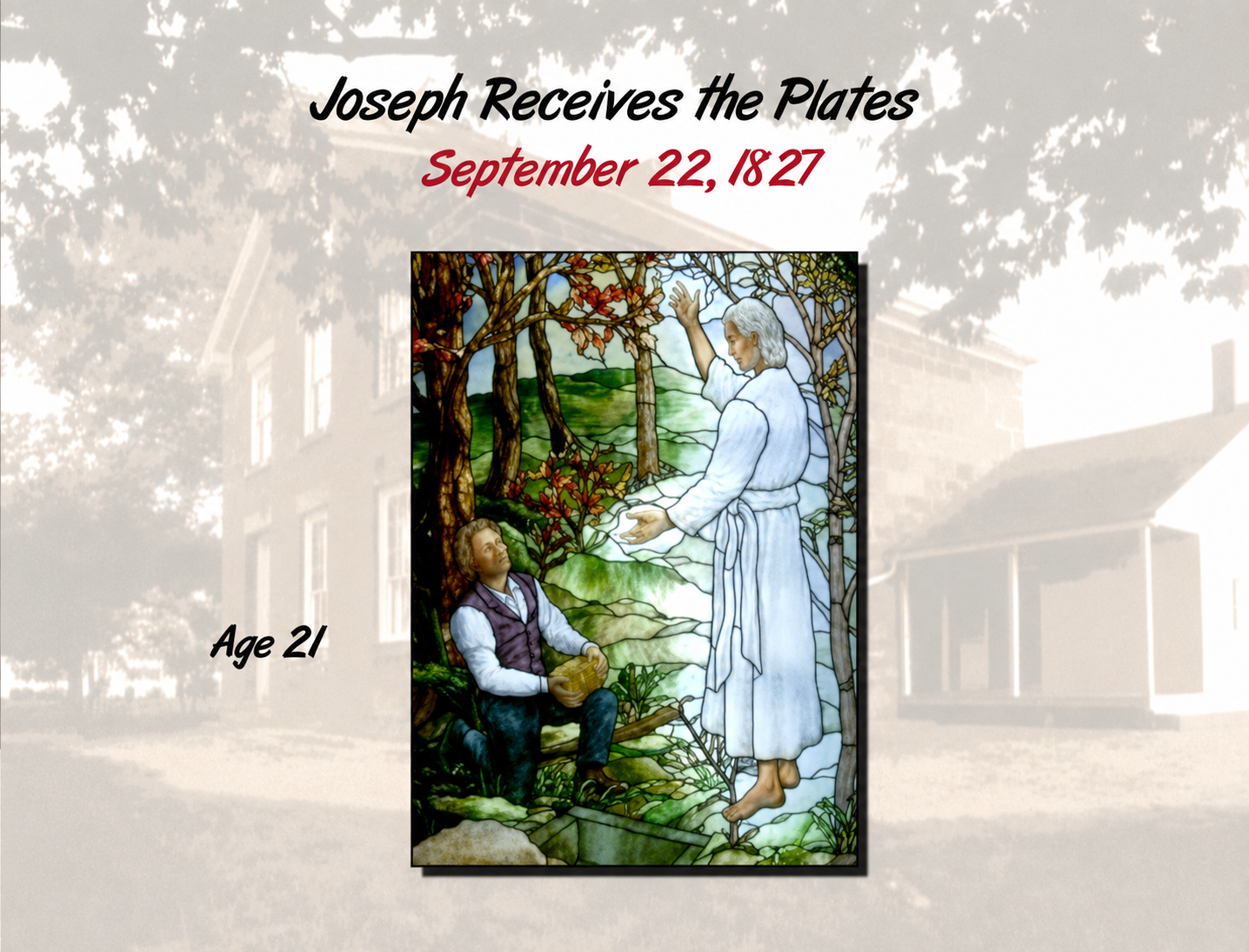
  • A few weeks later, Joseph told Chase that early in the morning of the 22nd of September 1827, he took the one-horse wagon of a house guest and together with his wife went to the hill that contained the book.
  • Joseph left his wife in the wagon, retrieved the book, hid it inside of a tree, and went home. He then traveled to Macedon, New York, to work.
  • After 10 days, a rumor arose that someone had gotten the book, and so Joseph’s wife went after him.
  • Joseph went to the place where he had hidden the plates, wrapped them in his frock, and headed toward his family’s home.
  • Joseph was attacked in the woods by two men. He knocked them down, arrived safely at his home, and secured his treasure.
  • Martin Harris gave Joseph Smith $50 to help him in the work of translating the book.

That’s Just One Source

This is just the information from one single 1827 critical source. I have 11 of them just for the year 1827.

And if you read the autobiography of Lucy Mack Smith, you will see that there are many matches with the information that she provides.

I wish I had adequate time to show you those, but we have got a lot more to deal with.

So, let’s move on.

Did the Book of Mormon Story Evolve?

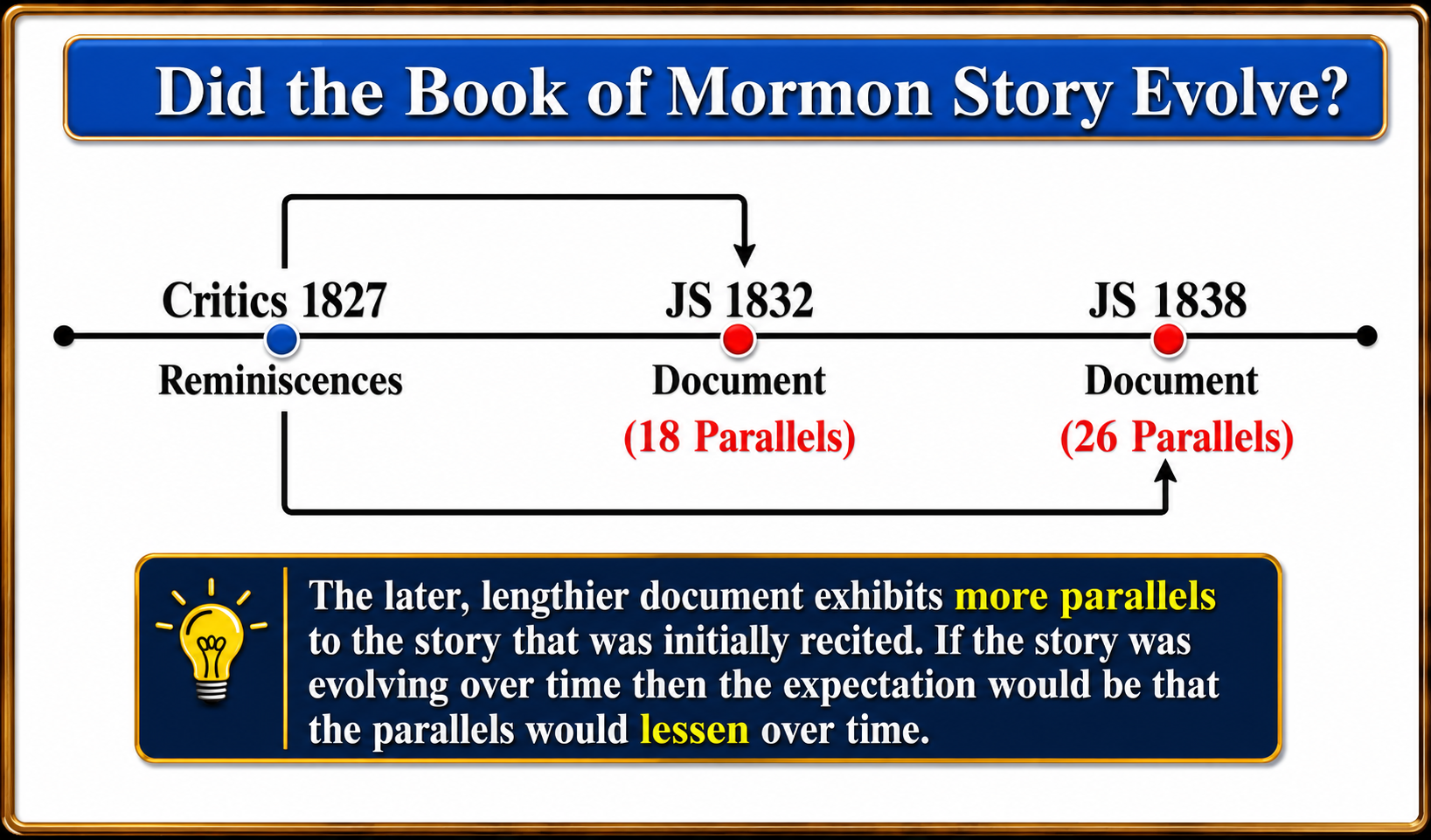
Did the Book of Mormon story evolve? This chart here will help to demonstrate that Joseph Smith’s storyline did not evolve.

This chart here shows you that during this particular year of 1827, we have all of these reminiscences — eleven in all. What I did was I compared those particular reminiscences with JS-1832, and there’s 18 parallels.

And then I did the same exact thing with JS-1838, but there are 26 parallels at that point. So, that tells us that there is something going on as far as revision goes.

If you have a storyline, and it’s being revised over time, you would expect to see less parallels over that period of time – because it would be changing.

But we have just the opposite with this particular circumstance.

And so this is one indication that the storyline is not evolving because we have written information available to us and more matches to the verbal information is found.

Understanding the Limits of JS-1832

The final point that I would like to make in relation to the Book of Mormon storyline is that it is necessary for any person to obtain an accurate understanding of a document before they can draw legitimate conclusions from it.

The prophet’s 1832 history provides us with a prime example of the importance of this principle. This document is the earliest known cohesive account of the coming forth of the Nephite scripture produced by Joseph Smith.

Some critics may think that since it is the earliest document, then any story elements that are not found within it, but which turn up in later narrations, must represent an expansion or an evolution of the storyline.

But in this case, they would be dead wrong.

Using the Critics’ Claims Against Them

What I decided to do in this particular case was take the 1832 history and break it down into its elements. There’s approximately 90 of those elements.

The critics say that what Joseph Smith did was, he evolved his story over time. So what I wanted to do was see, first of all, how complete is that document.

I went and looked at all of the non-LDS sources that I could find to determine how many elements of the story were not in the 1832 document, but which were floating around the community.

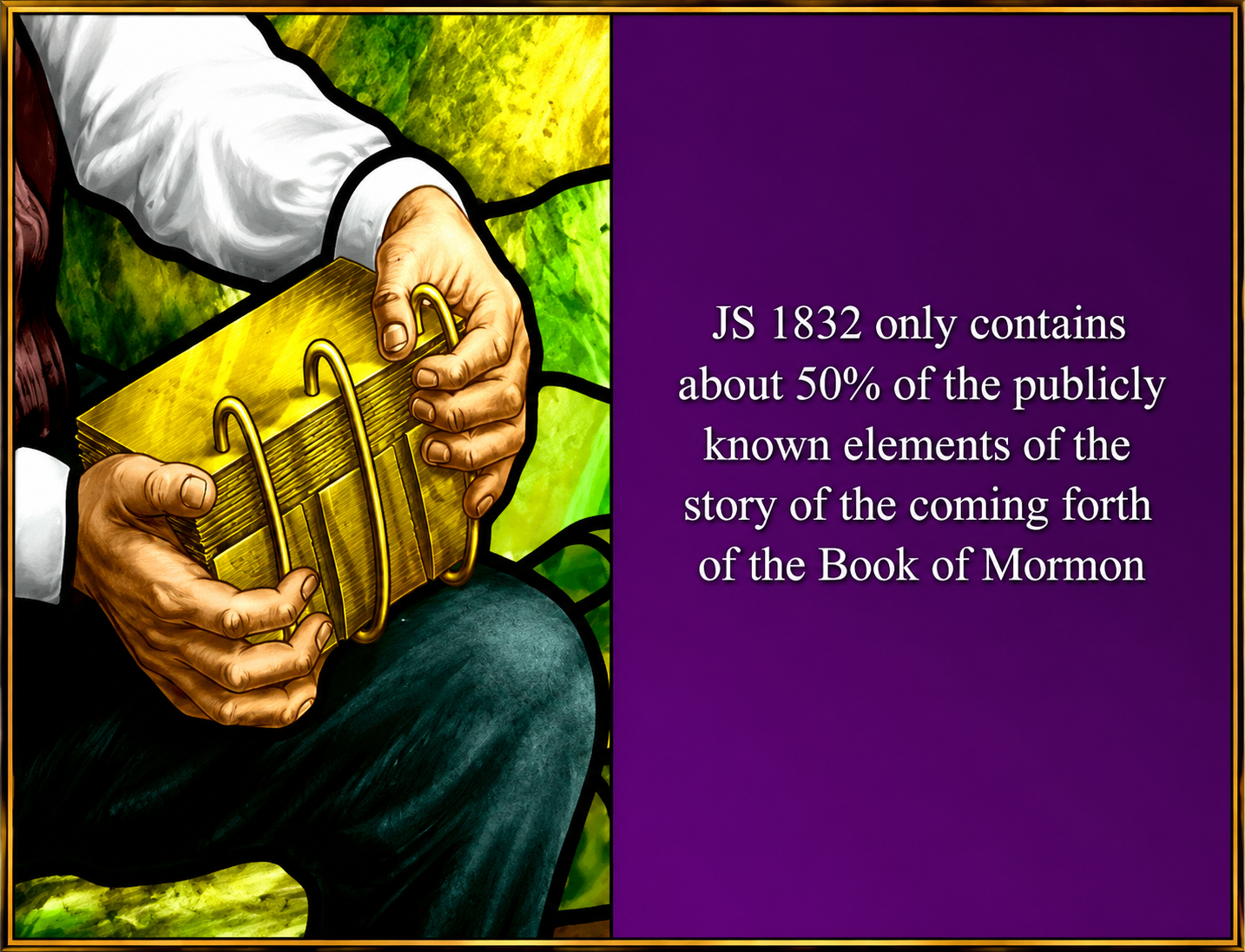
I’ve got that paper up here, and it would take a very, very long time to read. It’s 24 pages long, but it ends up that the 1832 document is 50% incomplete.

That’s a lot of information.

And when you go through this particular paper that I’ve done, what I’ve done in addition is I’ve said, “Okay, what about those elements that are not included by Joseph Smith in the 1832 document? Are they included by him and other members of the Church in subsequent histories?”

And the answer is yes.

And so I’ve done an analysis to show that every single one of them that are not in 1832 are in histories by Latter-day Saints at later times.

JS-1832 is Not a Complete Narration

That tells us that those are integral parts of the story. But more than anything else, it tells us that the document itself, JS-1832, cannot be looked upon as being a complete narration of the story.

And so you have to consider that when you’re talking about the evolution of the storyline.

Of course, anti-Mormons want to say, “Well, we’re going to look at 1832, and anything that’s subsequent to it that we don’t see in 1832 must be a revision.”

And so, I want to point out to them that that is not the case.

In fact, we’ll be dealing with that with the First Vision. 8

Recommended Research on Moroni and Revision Claims

But before we do, I would like to point out that there’s two articles that I think are quite excellent that deal with the idea of Joseph Smith’s supposed revision with the Book of Mormon story.

And that is one by Larry Morris — that’s in the FARMS Review — and one by Mark Ashurst-McGee that’s in Mormon Historical Studies.

And what they do is deal with the Moroni story. I think that they are well worth looking into for anybody who’s interested.

Introducing the First Vision Discussion

So, let’s move on now to some information about the First Vision.

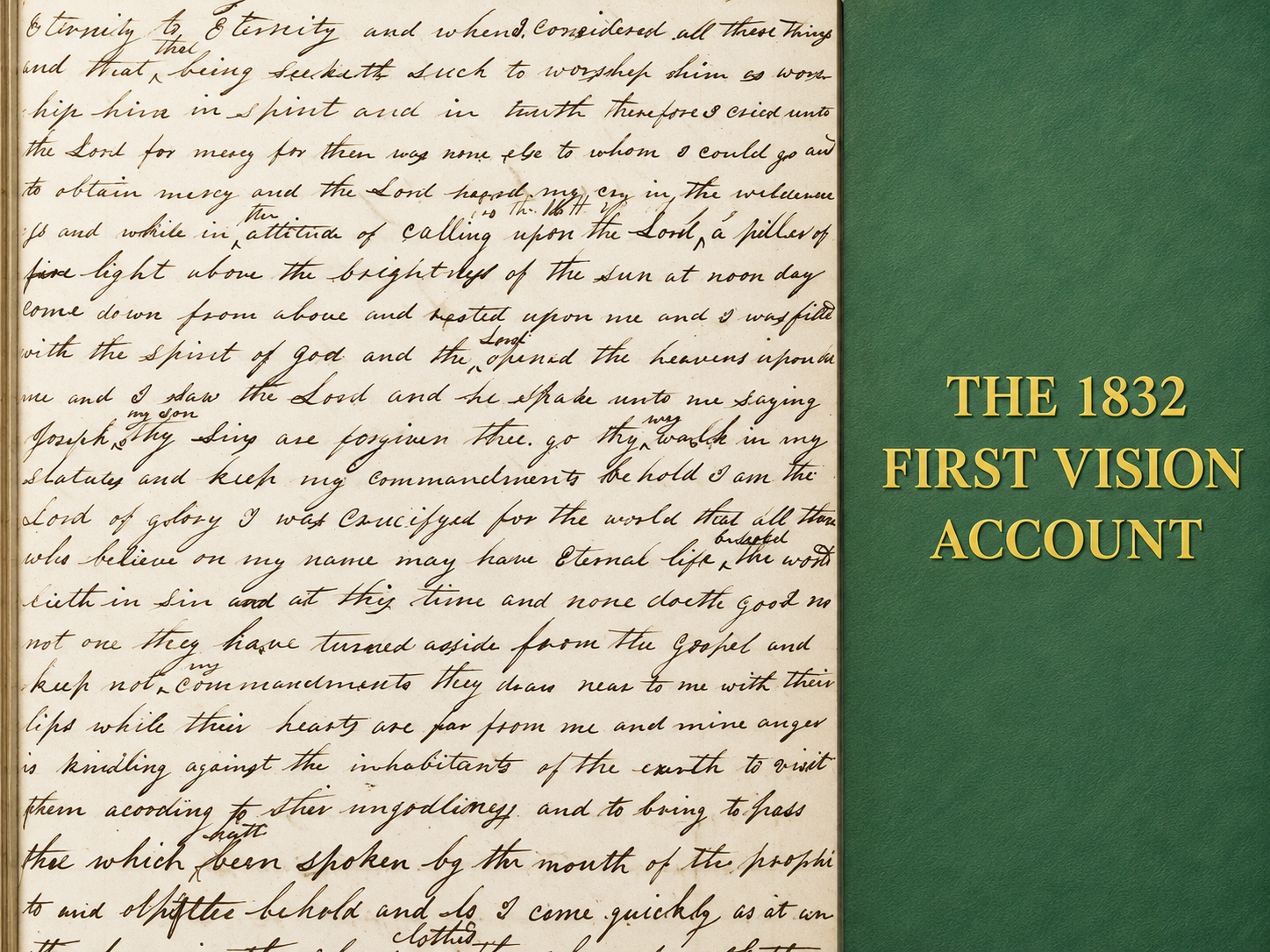
What you see on the screen, this is JS-1832. That is Joseph Smith’s first time (that we know of) that he has told the First Vision story in a formal manner.

And it is the only one where he has written it himself.

So what you’re seeing here on screen is Joseph Smith’s handwriting. And if you look at the very bottom there, it ends with the words of Christ talking to him during the First Vision.

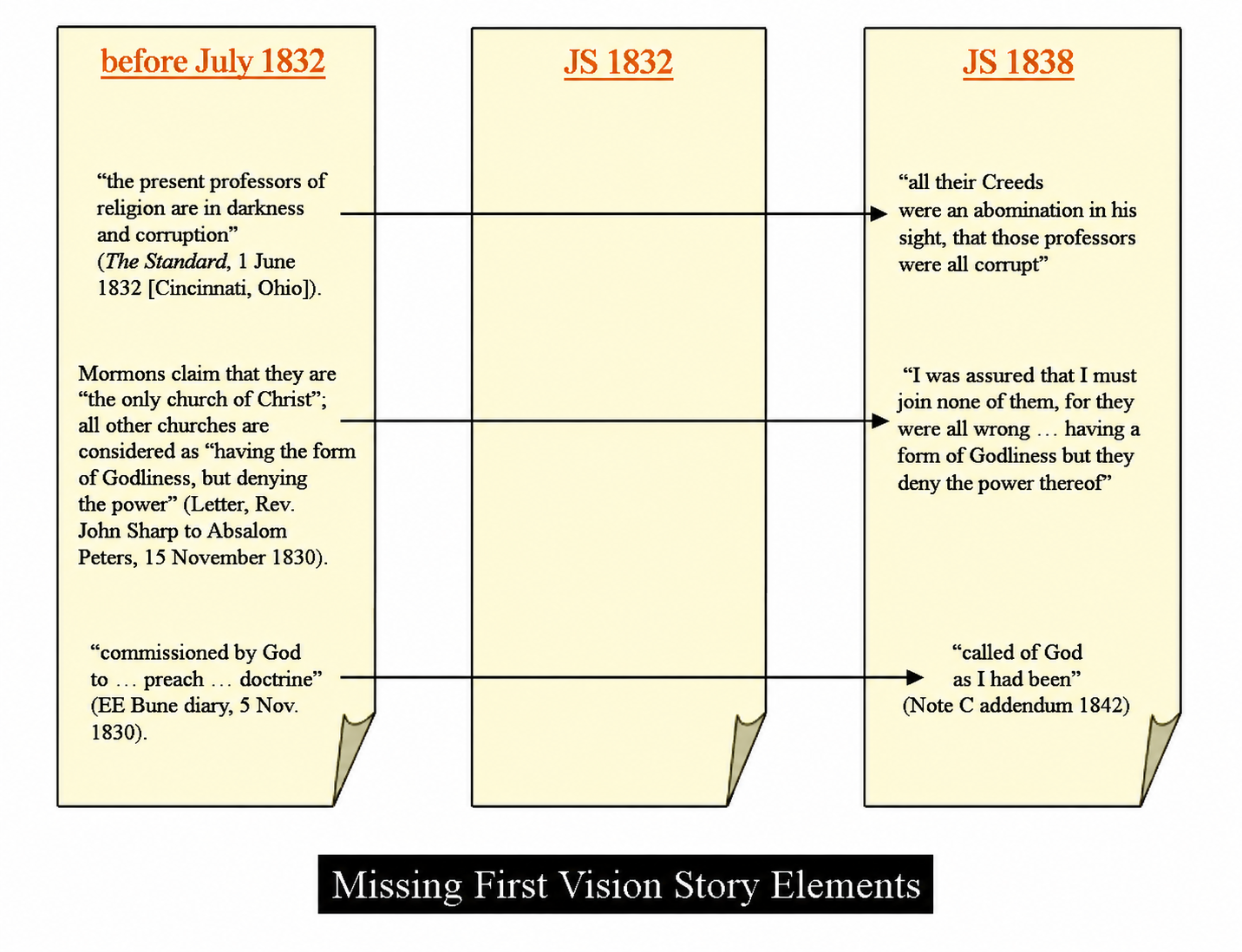
JS-1832, as stated before, is only about 50% complete when it comes to the information that has to do with the Book of Mormon. Well, that has some implication for the First Vision material itself.

I have done a preliminary analysis.

In fact, I can just show you one slide here. There’s a preliminary analysis. I just scanned over some documents to find that there are indeed pieces of the First Vision story that are not included in JS-1832 that were known among the non-LDS community beforehand and which show up in JS-1838.

And so they are integral parts of the story.

But it tells us — just these three little items — they tell us that the information on the First Vision in JS-1832 is not complete. But we’re going to get into much more of that.

Let’s go here to this next slide.

Why Joseph Smith Wrote the First Vision Himself

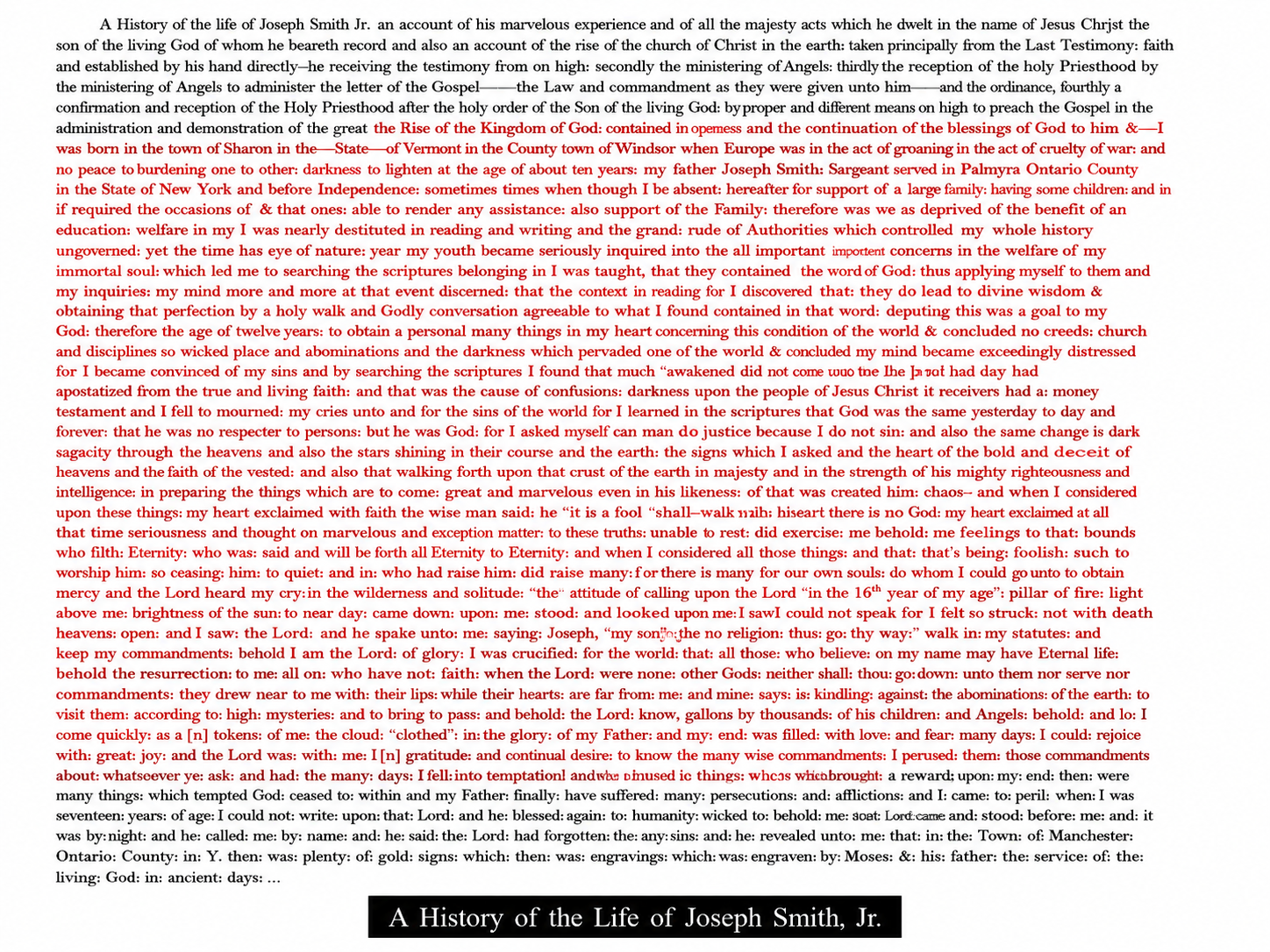
I want you to see this pattern. The red text represents Joseph Smith’s own handwriting.

First of all, at the top we have the scribe Frederick G. Williams. He barely wrote down a paragraph worth of material before he was replaced by the prophet.

This is a very curious fact, especially because right after Joseph Smith finished with the First Vision material, Brother Williams took over again.

This pattern seems to be an indication that the prophet wanted to write down the First Vision story himself.

And so the next question becomes why?

A possible answer to this question presents itself when one considers what happened to Joseph Smith when he tried to share the First Vision story for the first time on an informal verbal basis.

We read in the 1838 history of the Church that when the prophet first started telling others about his theophany, he ran into an immediate snag, and it was a particularly perplexing one.

His story was not only treated with great contempt, but Joseph was told that the experience was all of the devil.

Biblical Frameworks in JS-1832

I believe that Joseph Smith was trying in his initial written account of the First Vision to find a way to counteract these very negative reactions.

And here’s my evidence.

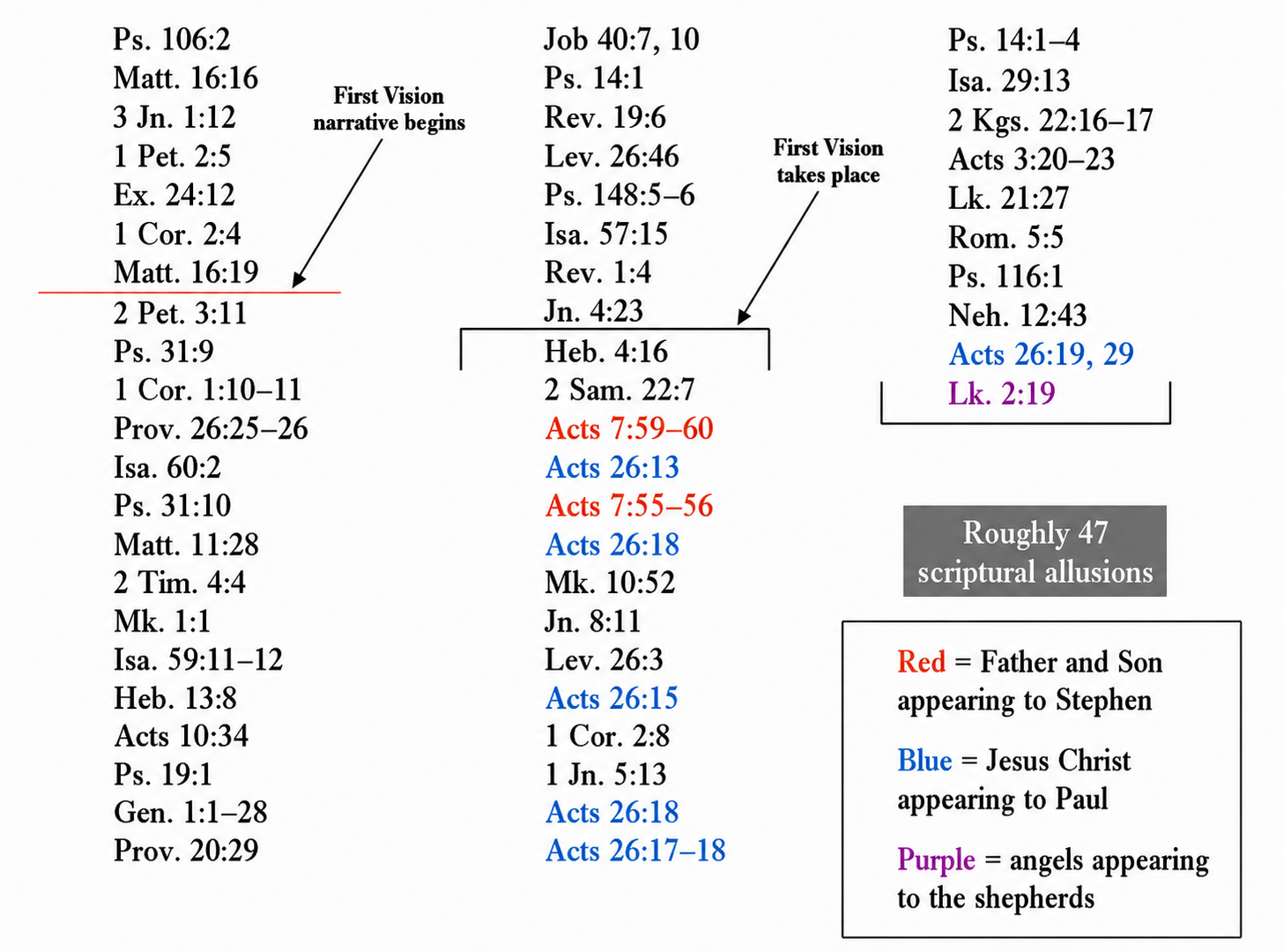
This slide shows that the JS-1832 First Vision recital is built over a continuous framework of biblical passages — roughly 47 in all. They span the entire Bible from Genesis to Revelation.

It appears that Joseph Smith was attempting to bolster the chances of his story being accepted by the world by couching it in language that would resonate in a positive manner with the masses.

Joseph Drew Specific Parallels to Help Listeners Understand

But look more closely at this slide. In the area where the actual theophany takes place, which is between the brackets, you will notice that Joseph Smith has incorporated three very relevant Bible stories into the telling of his tale.

Three stories that have to do with the appearance of heavenly beings.

  1. The first is the story of the angels who visited the shepherds amidst a heavenly light and announced the coming of the Christ.
  2. The second has to do with the appearance of the Savior to the apostle Paul when the light shone around him.
  3. And the third is about the apostle Stephen seeing both the Father and the Son.

Comparing Joseph Smith to Paul

But before we move on to the next slide, I will remind you what the prophet said about the rejection he experienced when he first announced his vision.

He said, “I felt like the apostle Paul because they wouldn’t believe my vision either.”

And so when Joseph Smith incorporates Acts 26 into his framework, the parallels are so exacting that when Paul speaks in his text in Acts 26, Joseph speaks in his text.

When Jesus addresses Paul in the Bible passage, Jesus addresses Joseph in JS-1832, and then it switches back again.

It is a very, very exacting set of parallels.

Psalm 31 and the Personal Nature of the Account

But this is what really caught my attention.

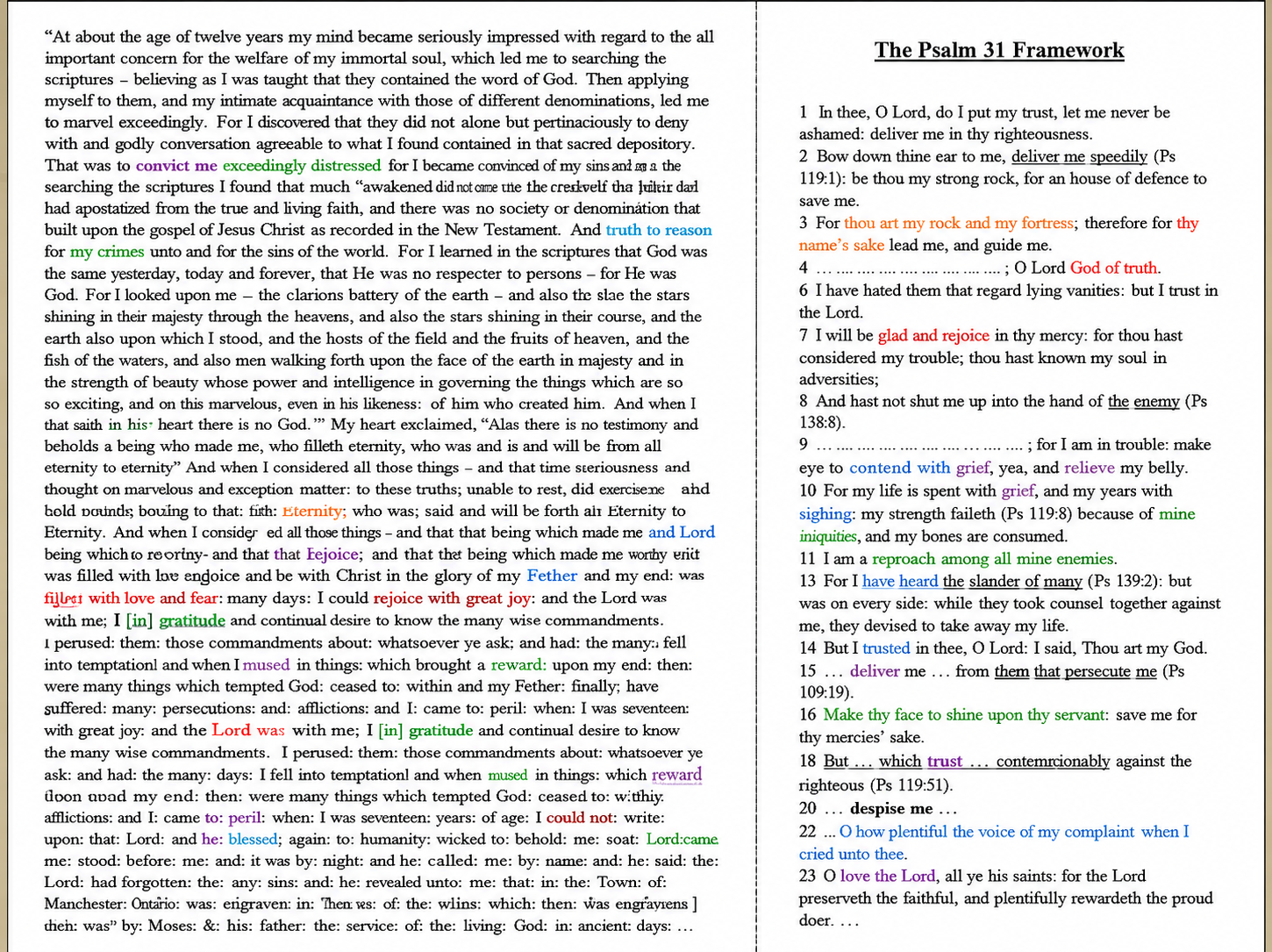
This is Psalm 31. On the left-hand side is the text of JS-1832.

It appears that Joseph Smith utilized a large-scale framework of Psalm 31. The parallels in here are very exacting.

I’ve also been able to see in this that there are some elements of Psalm 31 that he incorporated into JS-1838.

Psalm 31 as a Vehicle for Joseph to Tell His Story

Psalm 31 is a deeply personal psalm. If you read it, you can see that there is a lot of heartfelt dialogue going on.

That is something that people have noticed about JS-1832. Joseph Smith’s 1832 account of the First Vision is very personal.

But this next slide shows us that there’s much, much, much more to this particular document.

This is a document that’s created by Joseph Smith when he is 26 years old.

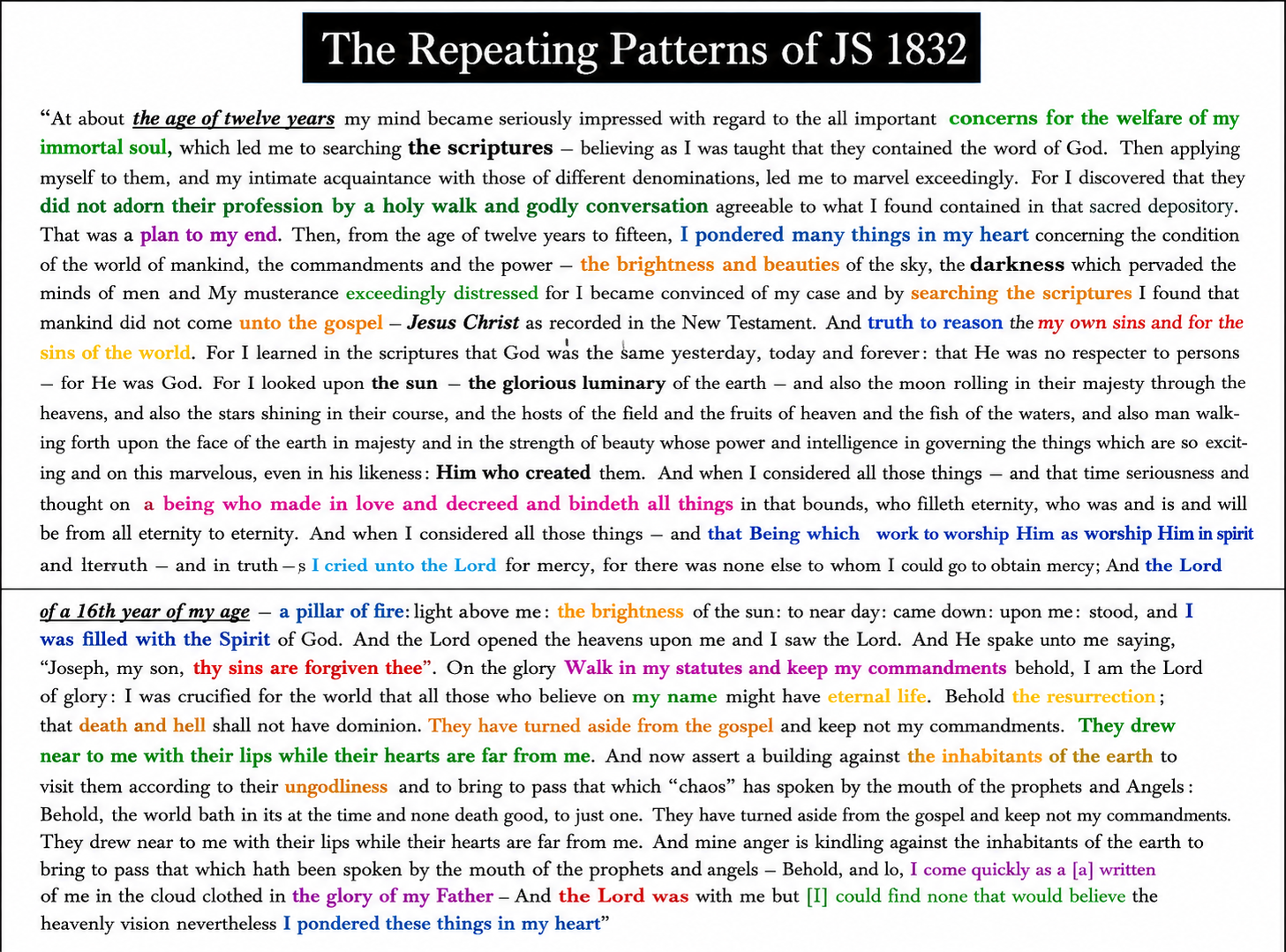
If you look at the top of the page, you will see a set of props and a set of themes. The dividing line that goes through that slide shows you the place where he stops and prays.

All of the parallels underneath are an exact match.

Joseph Smith has constructed this document very, very, very carefully. This is not a retelling of a story. This is a very complex document.

I don’t think I have seen it all yet. These are things I have seen in the last two weeks. I have seen a few more things since. I am coming to the conclusion that this document needs to be studied a lot more. A lot more.

The reason why it didn’t become published is very interesting to me. In fact, the whole nature of the document — I have a theory which I will work on. But this document is so extremely interesting because it’s so complex. Joseph Smith is trying to do something very deliberate, and I think that it calls for much further study.

Opposites and Contrasts in the Narrative

Here is another set of parallels. These are opposites.

In this particular set, we learn what happens to Joseph Smith before and after. I’ll just read off what it says.

  • The world’s in darkness, and then Joseph is surrounded by light.
  • Joseph’s mind was exceedingly distressed, but afterwards he’s filled with love.
  • Some people said there was no God, and Joseph saw Him.
  • When Joseph saw the Lord Himself, mankind was not coming to the Lord, but the Lord was with Joseph afterward.
  • Joseph felt grief before, but he felt joy after.
  • Joseph had belief before, but afterward he could find none who would believe.

As you can tell by now, this is an intricate text, and again, I would say that it calls for further study.

The Presence of God the Father in JS-1832

This brings us to the most frequent anti-Mormon criticism about JS-1832. That God the Father is obviously not mentioned as making an appearance to Joseph Smith in this First Vision account.

I would like to suggest, however, that all this time we as Latter-day Saints have not recognized that God the Father’s appearance is in fact referred to right in this document.

But all this time, we’ve been looking in the wrong place.

In the introductory remarks of JS-1832, Joseph Smith outlined precisely how he was about to proceed in the narration of his history.

The Testimony From on High

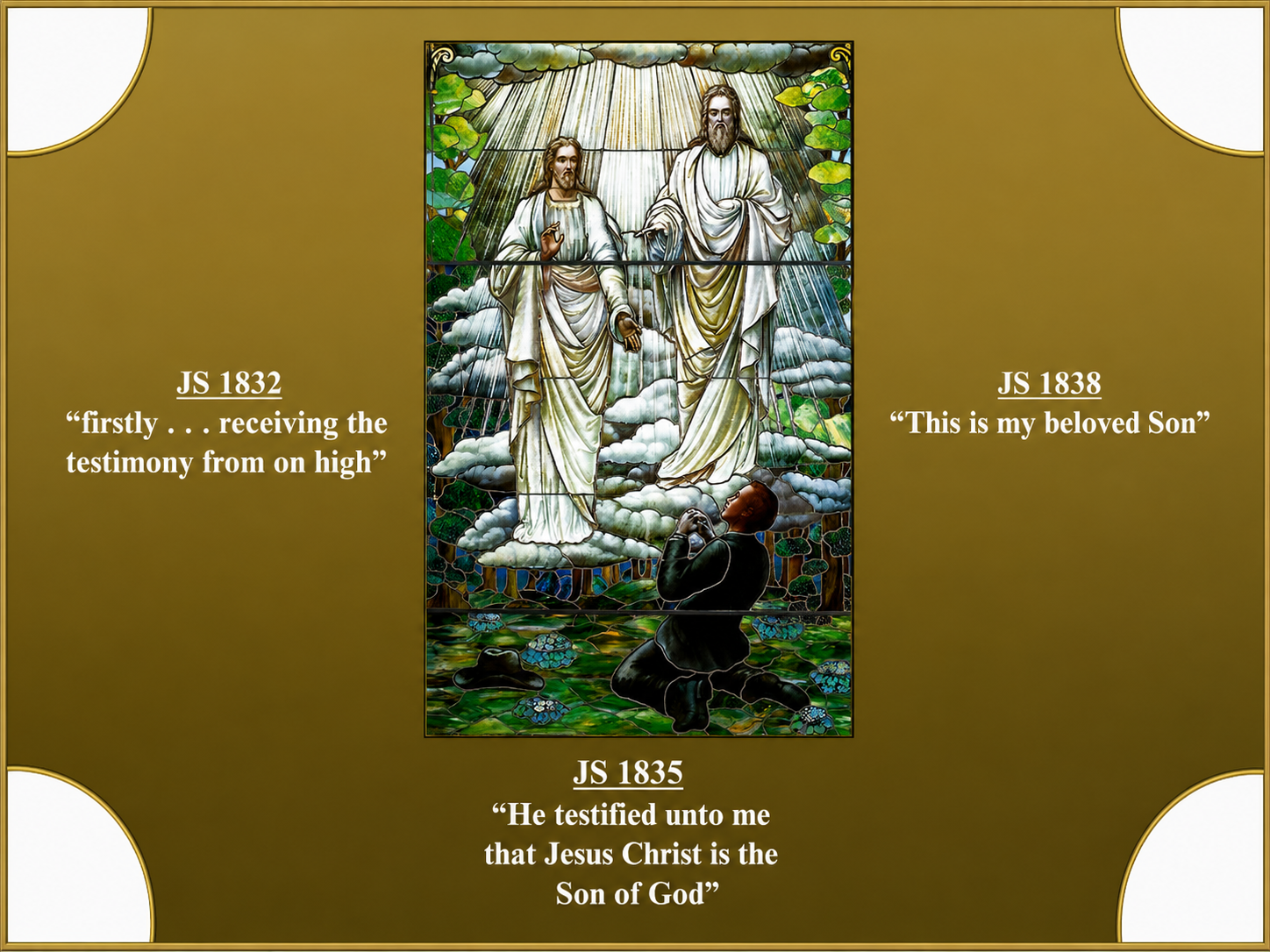
He mentioned that in the very first incident associated with his marvelous experience in the Restoration, he received “the testimony from on high”.

Because of the formatting of the introductory paragraph and the structure of the text which follows it, it can be concluded with a marked degree of certainty that this testimony was connected with the First Vision.

The question to ask then is what was “the testimony from on high”? Joseph Smith answers this question in another one of his recitals, which is November of 1835. There he states that one of the two personages who appeared to him testified that Jesus Christ was the Son of God.

In JS-1838 (which is the First Vision narrative now published in the Pearl of Great Price) 9 we learn that one of the personages testified to Joseph Smith using the following words: “This is my beloved Son.”

We may comfortably conclude from this documentary evidence that the testimony from on high of JS-1832 is equivalent to the phrase spoken by God the Father in JS-1838.

Therefore, we may safely say that when Joseph Smith wrote the 1832 account of the First Vision, the appearance of God the Father was definitely in his mind because he obliquely refers to it.

It seems that he did not make an explicit mention of this part of the story simply because of what I have shown you before.

He had chosen to use the Apostle Paul’s experience as the main framework for that portion of his narrative – and Paul only saw Jesus Christ.

Responding to Revisionism Claims

I would now like to offer some brief insights on a few other anti-Mormon arguments that are commonly used against the First Vision, specifically those that are connected with accusations of revisionism. 1

The first anti-Mormon claim that I would like to draw your attention to is what I call a “real whopper”.

Revisionism Claim: Joseph Joined a Church After 1820

It says that Joseph Smith joined not just one church after God supposedly commanded him not to in 1820. (Thus demonstrating that his meeting with the Lord never really happened.) But he joined three different churches before he formally organized the LDS faith in 1830.

The basic problem with this particular argument is that there have been no authentic documents ever produced confirming that Joseph Smith actually became an acknowledged member of either the Baptist, the Methodist, or the Presbyterian denominations.

Every one of the claims of joining other faiths is made extremely late in the historical record.

But I have gathered together a few very early documents that say just the opposite. I’ll just read through a few of them briefly.

Here it is.

  • In November 1830, four LDS men from New York teach that at the time the angel appeared to Joseph Smith (September 1823). He made no pretensions to religion of any kind.
  • 1831 — this is February — the editor of the Palmyra newspaper claims that he had been credibly informed and is quite certain that the prophet never made any serious pretensions to religion until the Book of Mormon.
  • 1832, March. A couple of young Mormon men teach the citizens in the courthouse:

“Joseph Smith, who was then an inhabitant of the state of New York, town of Manchester, having repented of his sins, but not attached himself to any party of Christians owing to the numerous divisions among them, and being in doubt what his duty was, he had recourse to prayer.”

(By the way, that particular document has First Vision elements in it before JS-1832 is created. And I don’t have time to deal with that, but I want to make you aware of it.)

Revisionism Through Memory and Retelling

That happens to be a really good example of somebody who has gone ahead and revised. They have taken elements of the First Vision story and elements of the coming forth of the Book of Mormon story.

In that particular article, they melded them together, and they admitted how it happened too.

They said that they were talking from memory and they weren’t quite sure.

And so when you’re dealing with the accusations of revisionism, you want to be very careful about understanding the documents that people are using to claim revisionism. 1

The ‘Angel’ Argument

Here is another one of the little irksome arguments that the prophet is having used against his First Vision story.

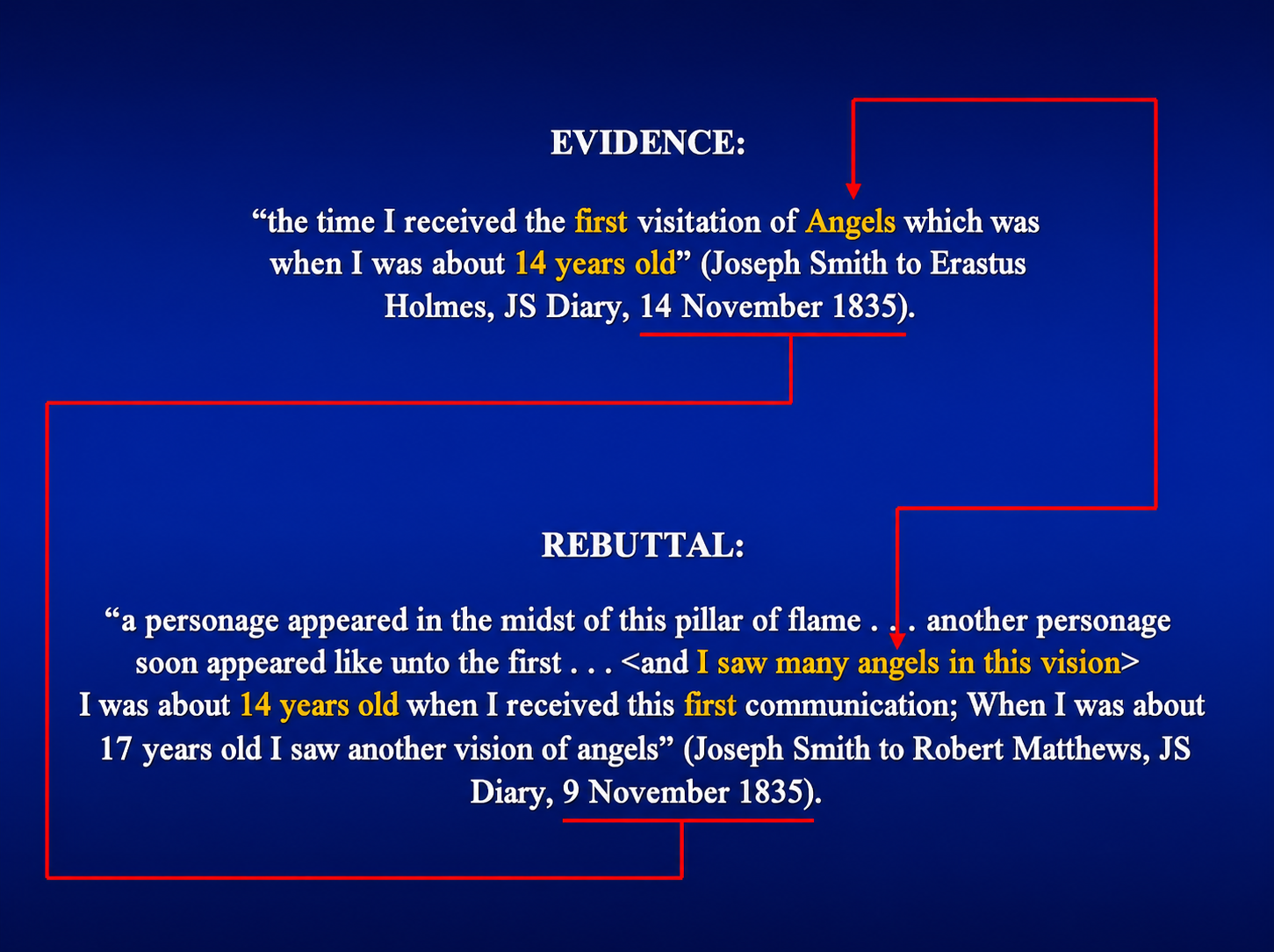
The argument goes that Joseph Smith initially said that his First Vision visitants were angels, and they use this particular document as the evidence.

Here you’ve got the diary, 14th of November 1835. It says,

“The time I received the first visitation of angels, which was when I was about 14 years old.”

And people say, “Well look, he’s saying that his visitation was of angels when he was 14 years old,” and they try to use that against Joseph Smith.

But only five days previous in his same diary — if people would just read the book — they would see that Joseph Smith is giving us a really interesting insight into his First Vision experience.

He says,

“When I was about 14 years old, I had a visitation of two personages and I saw many angels.”

So when Joseph Smith says on the 14th of November, “My first visitation of angels was when I was 14 years old,” he’s not kidding.

He saw many angels the first time in the Sacred Grove. Moroni is not the first angel that Joseph Smith sees.

Early References to the First Vision

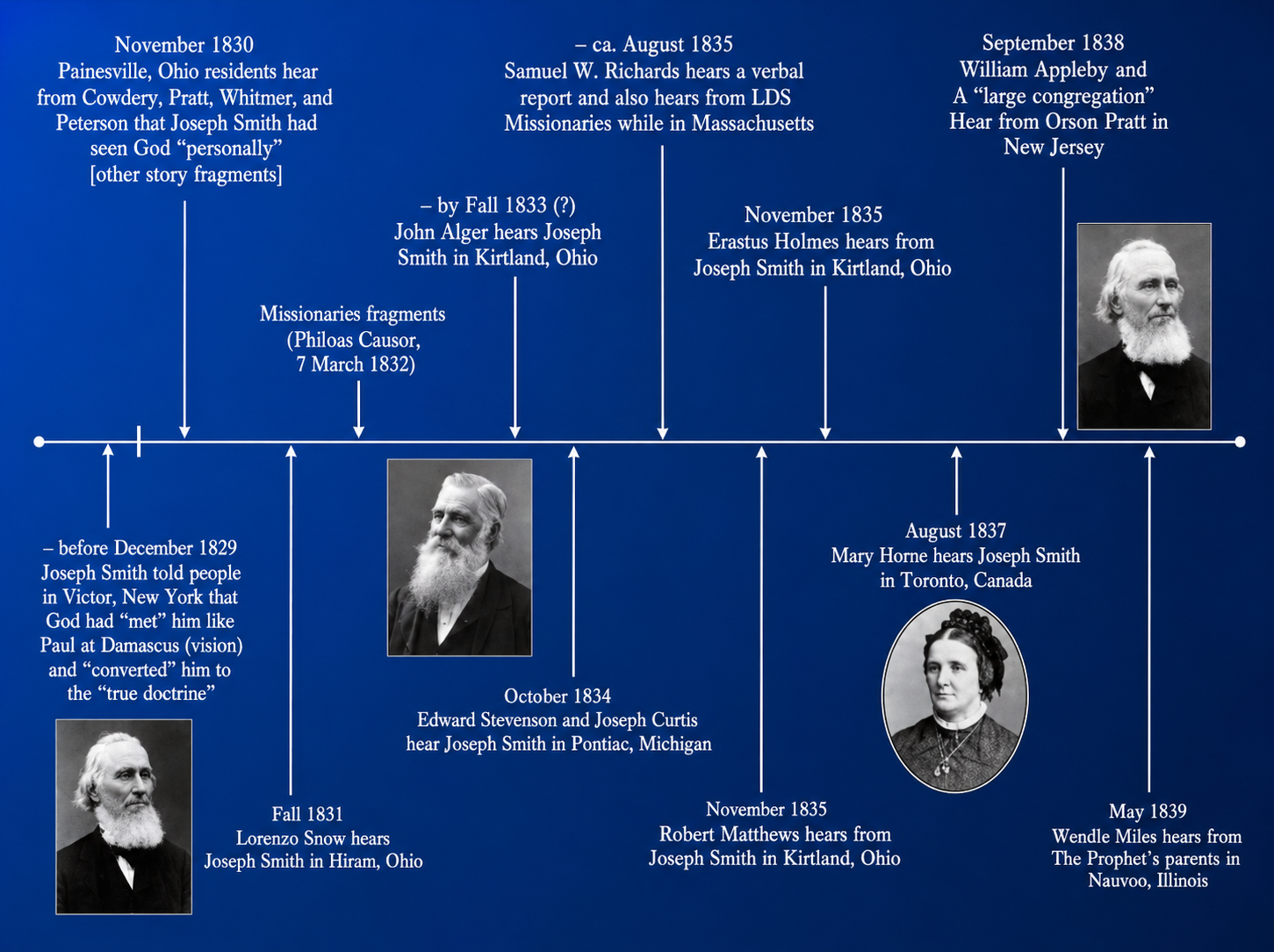
The next argument that I would like to deal with briefly has to do with the idea that Joseph Smith was making up the First Vision story throughout the 1830s, and that’s why nobody hears about it in public either among members of the Church or among the general populace.

This particular slide argues pretty persuasively otherwise.

In fact, if you look at the far left-hand side of the slide, you’ll see that in approximately 1829, or somewhere before December of 1829, we have a possible statement by somebody whose name is Green.

And what he says is that Joseph Smith was preaching in Victor, New York, that he had been met by God. And in fact, the title that this person uses is “the Almighty.”

What he does is he is met by God and his experience is like what happened to Paul on the road to Damascus.

So there we have a connection with — this is a vision of theophany — but most important, look there at the bottom. It says that he was converted to true doctrine.

So this is an idea that’s floating around in 1829.

Now, I’ve got another instance that I am leaning heavily towards that has to do with 1829 and Joseph Smith talking about the First Vision, but I haven’t quite developed that enough to my satisfaction.

So, I’ll leave that out for now.

Edward Stevenson & Joseph Curtis

But you can see that all the way through that particular time period — this is all just 1830s — people who are anti-Mormons like to pick on Edward Stevenson.

They say, “Oh well, Edward Stevenson’s memory — oh, his reminiscence is so far gone in the very last part of the 19th century. So he’s probably just misremembering.”

I saw that in a book just published recently by somebody who has been to this conference.

But you have a second witness, and that is Joseph Curtis. He was there too.

But other than that, we have all these other people who are hearing the First Vision story being related. And these are people who are not members of the Church as well as members of the Church.

And I’ll be giving a little appeal for this information at the end of my talk. Let’s go to the next slide.

Oliver Cowdery and the “Missing” First Vision

This other claim is quite fascinating. It also has to do with a little bit of what we talked about before.

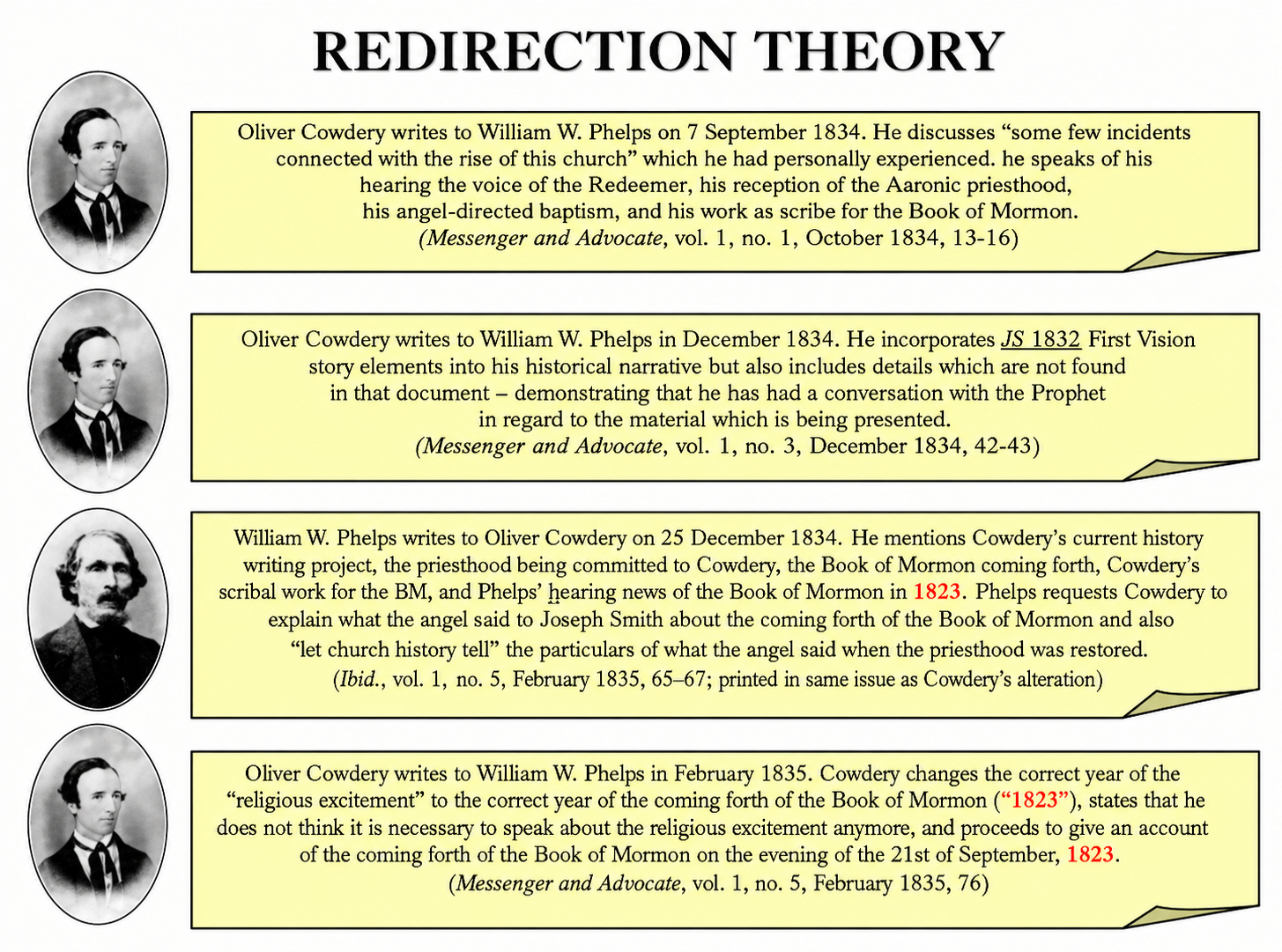
In the 1830s — we’re talking about 1834, 35, and 36 — Oliver Cowdery prints the history of the Church for the first time. That particular document has got a gaping hole in it. He does not talk about the First Vision. At least that’s what some anti-Mormons want you to believe.

But if you look at the document very carefully, you can see what Oliver Cowdery does.

He starts talking about the First Vision narrative. He starts talking about the revivals, and then something happens. This is what I want to point out with this slide.

The Redirection Theory

I’ll just summarize what’s on the slide.

Richard L. Anderson also noted this Theory

In fact, I have to mention this because Dr. Anderson told me not to. I had done an independent analysis myself, and I had come to the conclusion that Oliver Cowdery was using JS-1832 to create his history of the Church in 1834.

And I was so excited about this. I had written it up in detail. I went to Dr. Richard Anderson’s office and said, “Look at this. This is so interesting.”

“Oh yeah. I knew that back in 1969.”

And he actually did publish a few sentences on the idea that if you would look at the two, you would find a connection. But he didn’t write it up in detail.

And so I’m going to publish it in detail because I think it’s so important.

Oliver Cowdery had Source Documents

The point is that Oliver Cowdery did know the First Vision story because he says, “I was not only having the prophet as an assistant in creating my history, but I also had authentic documents at my disposal.”

In fact, he says, “They’re in my possession.”

And so the “authentic documents” that he is talking about is most probably JS-1832. When you see the parallels, they’re unmistakable.

So Oliver Cowdery knows about the First Vision. He does not include it in OCJS-1834. And I think that this is the reason why. I’ll call it the redirection theory.

What happens is he starts into the First Vision narrative. It’s very clear parallels to what Joseph Smith says later. And then he receives a letter from William W. Phelps.

William W. Phelps says, “I want to hear about the Book of Mormon story.” And he specifically mentions the year 1823.

And then lo and behold, in the next piece of the church history that’s printed, Oliver Cowdery says, “I got your letter. I don’t want to talk about the revival anymore. I’m going to change the date to 1823.”

And then he tells the Book of Mormon story. I think that that is something that should also be looked into.

Joseph Smith and the Revivals

The next thing that I would like to talk about is Joseph Smith and the revivals. This is a big thing with anti-Mormons.

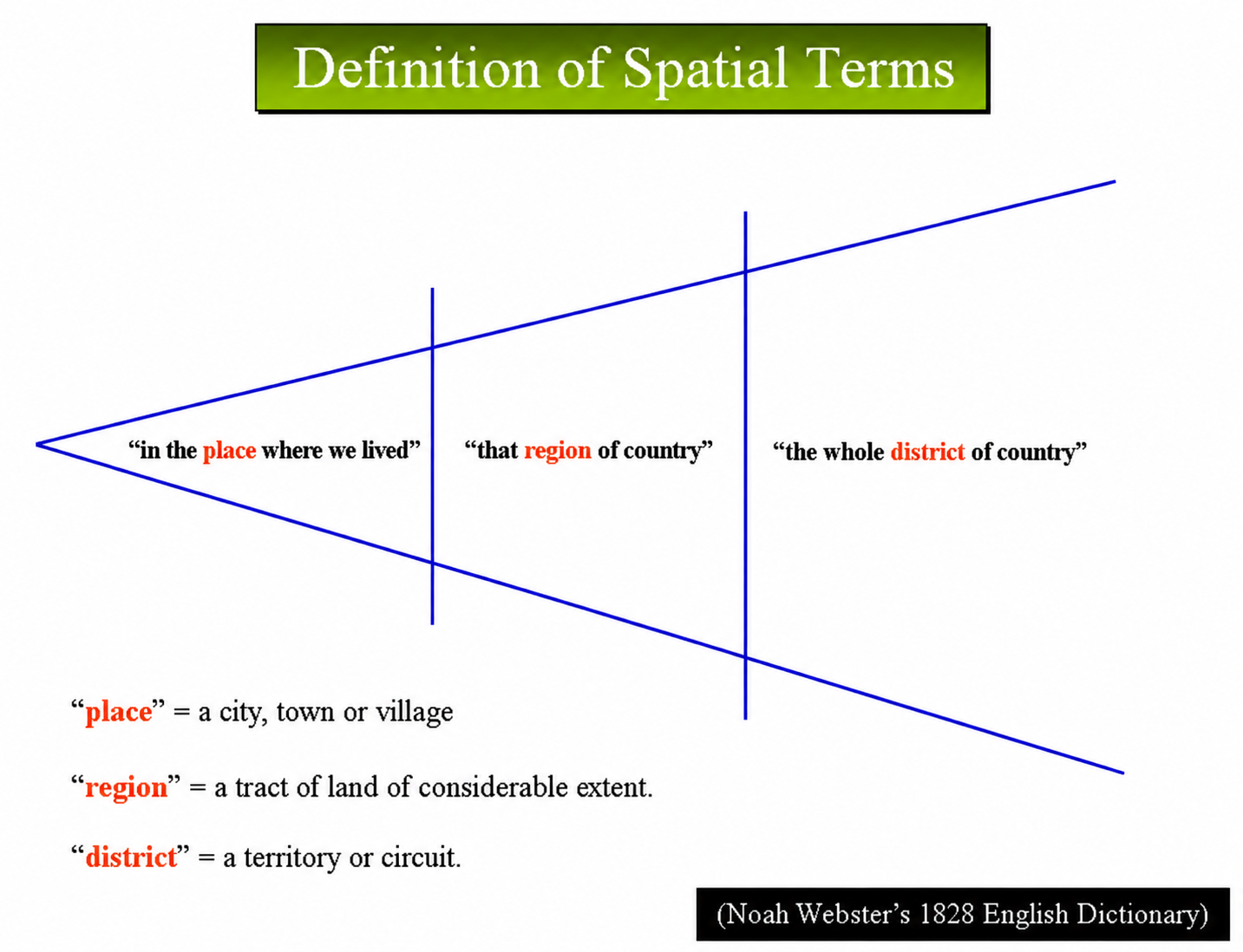
I would like to point out — and several people have done this before — but I would like to go into a little bit more detail about the spatial terms in JS-1838.

Joseph Smith says the revival activity, as far as I interpret the document, is happening in three different zones.

And that is: the place where we lived, so the general vicinity of Palmyra; that region of country; and the whole district of country.

I interpret that as three different places, and I’ll show you why I think that way.

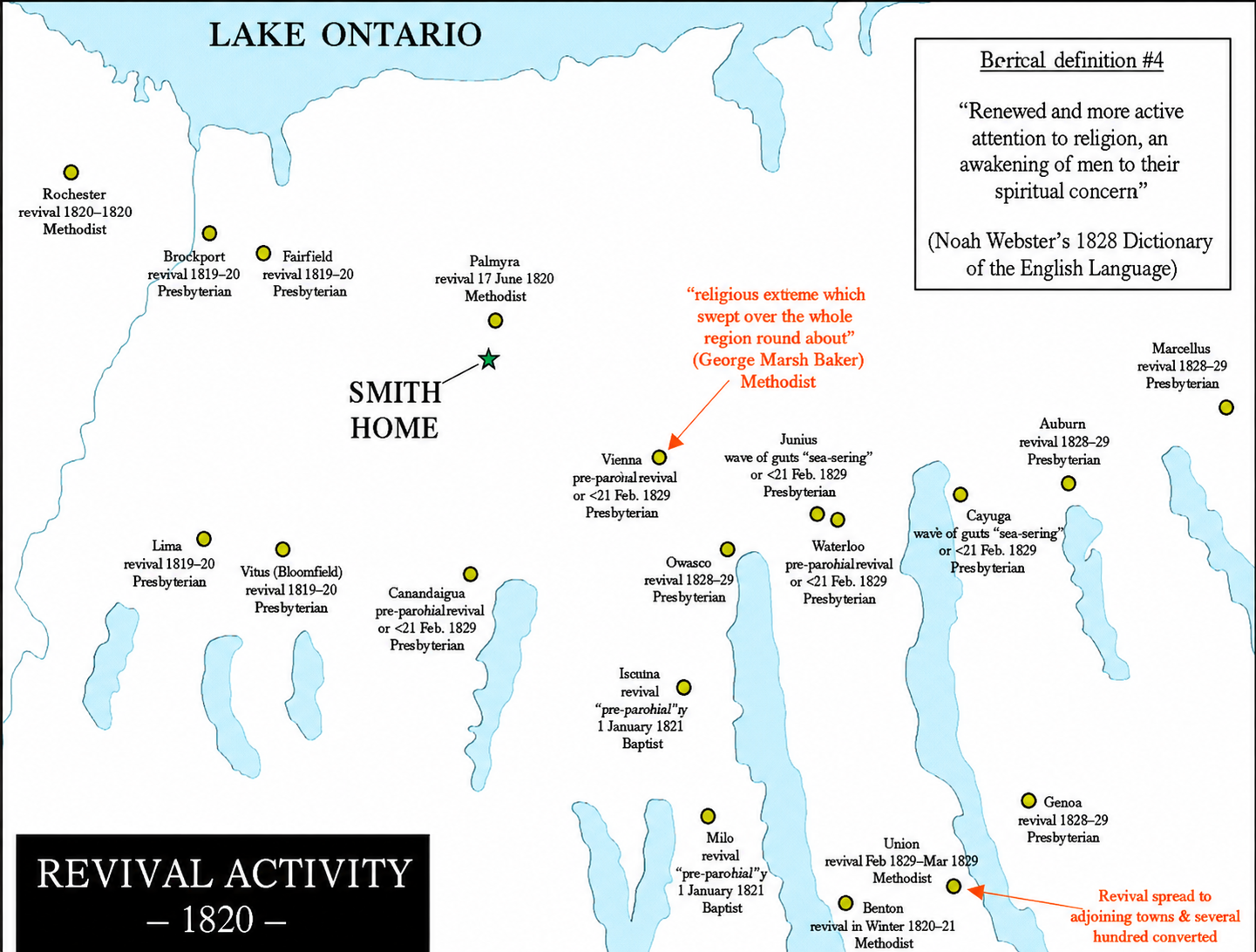
Revival Activity in Joseph Smith’s Region

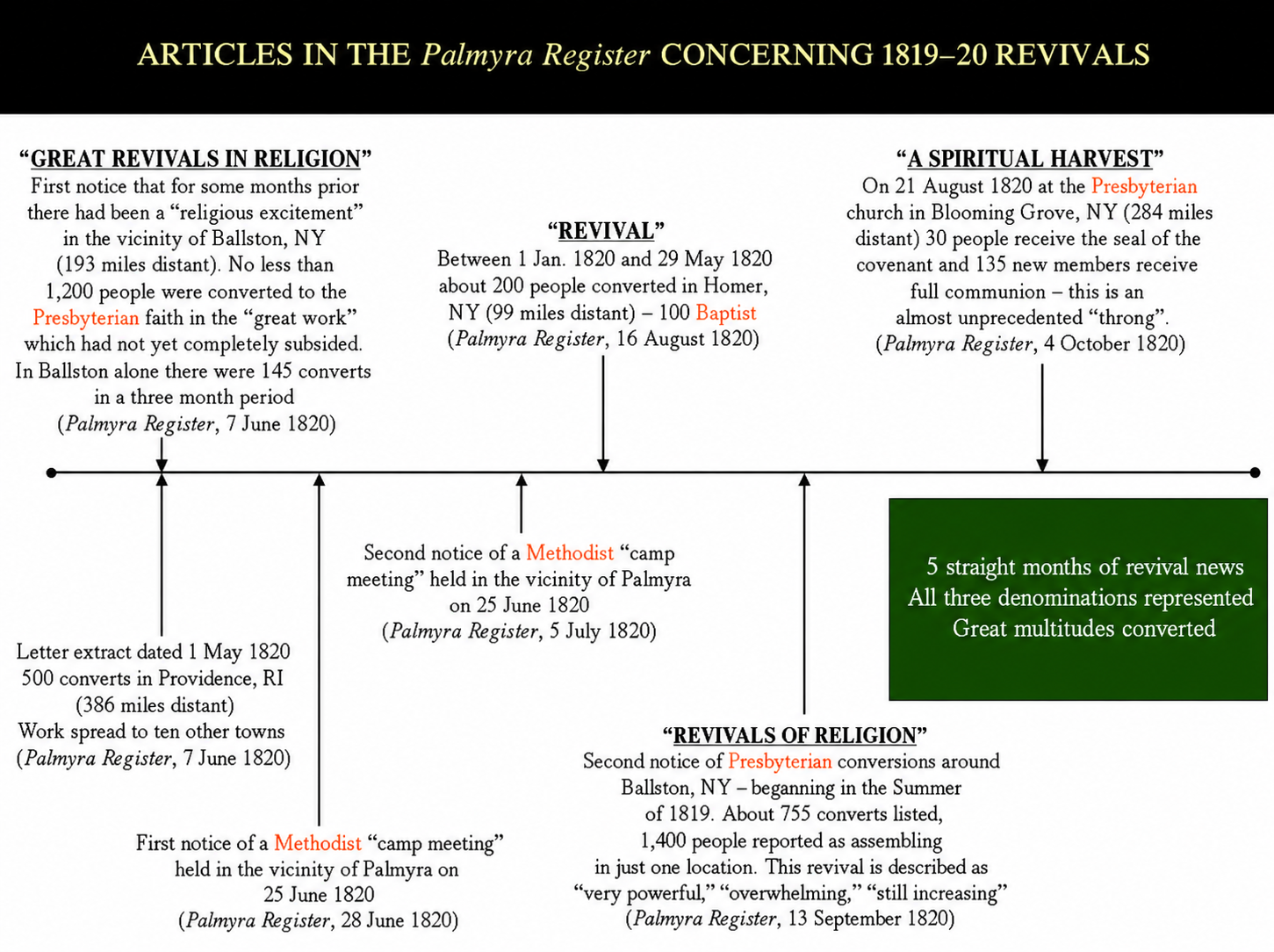
Here on this next slide, we have a whole lot of confirmed revival activity going around Joseph Smith’s area in 1819 and 1820.

An awful lot of it.

In fact, if you look down there on the bottom right-hand corner of this slide, you’ll see that it says that there are several hundred people being converted in that particular region.

This is the Finger Lakes region. And I would say that you could safely compare that to Joseph’s “region of country.”

It’s nearby. This is not a lot of space.

I think that the farthest I decided to go on this was approximately 60 miles out. In fact, Rochester is approximately 24 miles. Out there at Marcellus, it’s getting around the 60-mile range.

I didn’t include Ithaca because it ran out on the bottom of the slide.

And I’m not done yet. I’ve got a whole bunch of other revivals that I have collected that I haven’t put on there because I have not yet looked at the documents myself and confirmed them in my own mind.

But safely, as preliminary information, this is revival activity going around the Smith cabin around this general time period.

Newspaper Reports and the Third Zone

There are some other things about revivals that I want to point out, and I think that this is something that’s connected with Joseph Smith’s narrative in JS-1838.

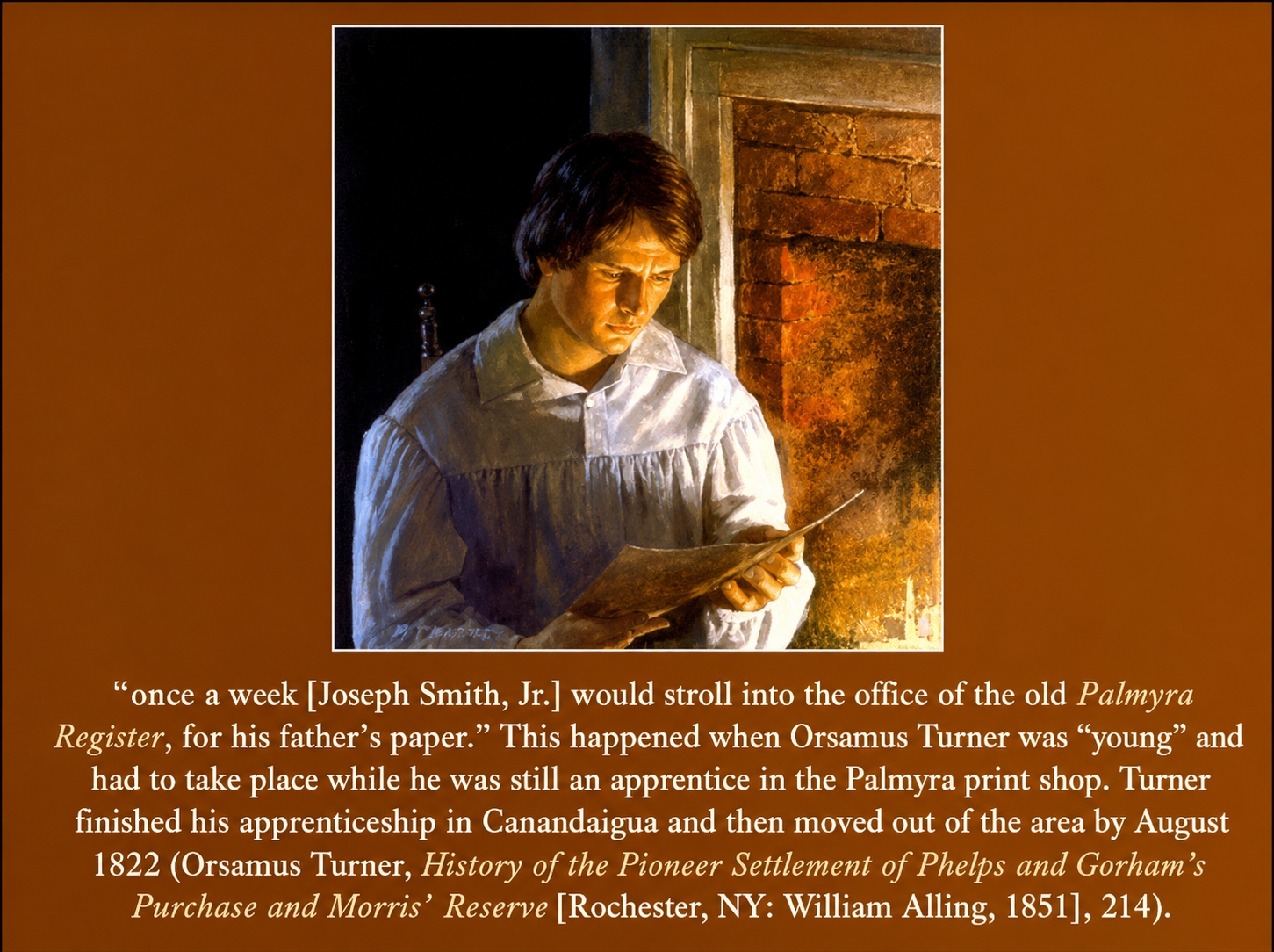
We know that Joseph Smith is reading the newspaper. He’s picking it up. In fact, I’m pretty sure he’s reading it, but he’s picking it up every single week. At least we’ve got a non-LDS eyewitness saying so.

This particular newspaper has a whole bunch of information in it during the year 1820 about revivals.

Look at where it starts. It starts in June on the left-hand side. So, we’re starting around the summertime.

But going to the end of the year, Joseph Smith’s newspaper is telling him about five straight months worth of revival information.

All three denominations mentioned by Joseph Smith in JS-1838 are being represented, and great multitudes are being converted.

This is occurring in the third zone.

So that slide that I showed you before had to do with zone number two. Zone number three has got a whole lot more conversion activity going on.

And so I would think that it would be a wise thing to consider that when Joseph Smith is talking in JS-1838 about all this revival and conversion activity, that some of it’s possibly coming from his newspaper.

It doesn’t necessarily say that he is an eyewitness to all of the activity that he is describing. And so that’s something that we should look into.

Lucy Mack Smith and Revival Activity

The last one that I’d like to talk about today has to do with another argument that is used a lot by anti-Mormons that has to do with revival activity.

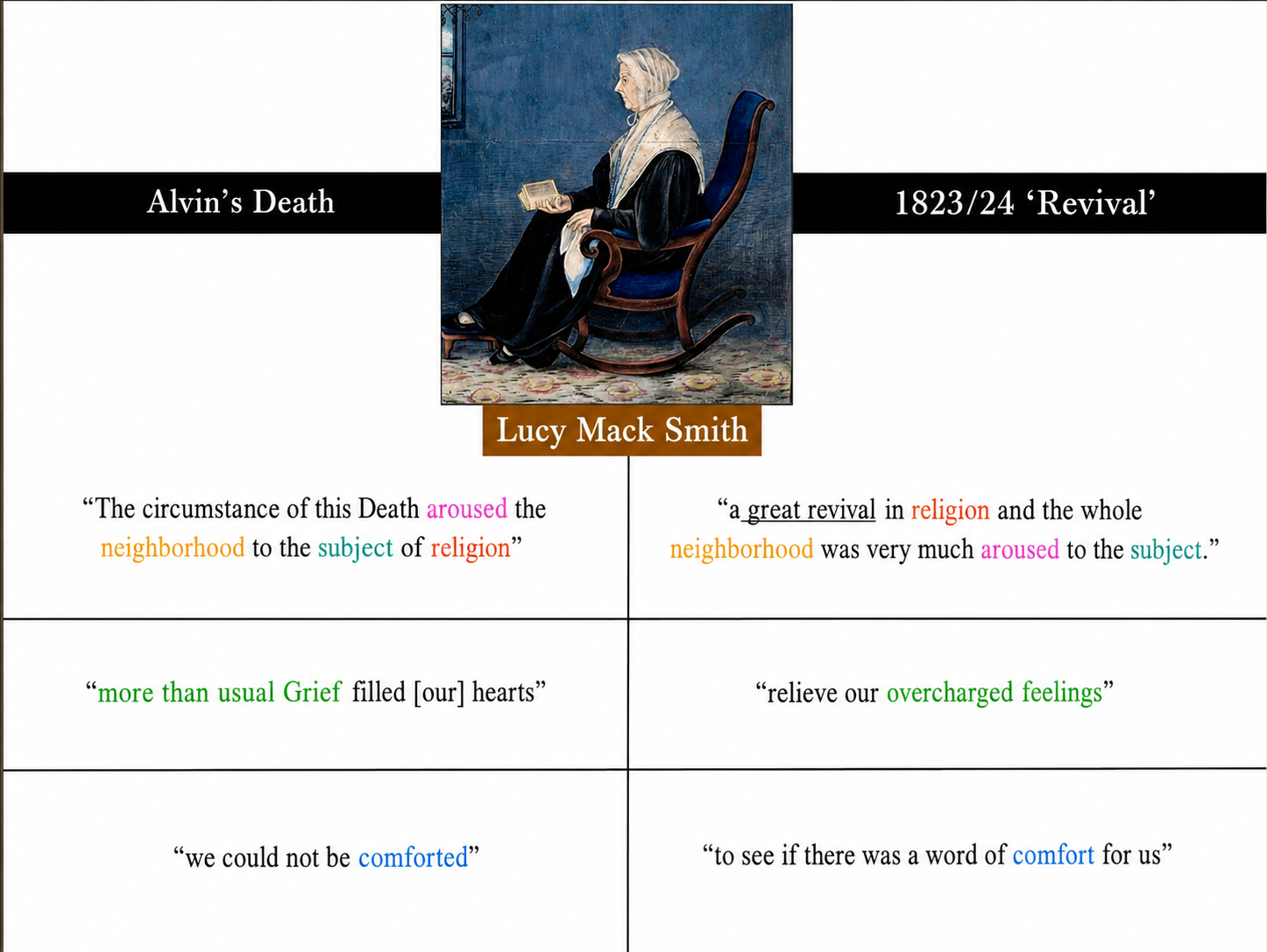
Again, they try to use Lucy Mack Smith’s autobiography against him by saying,

“Look, Lucy Mack Smith says in her own autobiography that after Alvin Smith dies, there is a revival of religion in the area.”

I want you to see the comparisons on this chart very carefully. On the left-hand side, you’ll see that this is the crossed-out portion of the autobiography. But look at the match. What does that tell you about this revival activity? On the left-hand side, it says that there is a direct connection between the revival of religion in that neighborhood and Alvin Smith’s death.

And there’s a whole big block of text that is marked out in that document.

So, she says that:

We had all this grief in our hearts. We went to this revival so that we could have relief for our overcharged grief or our overcharged feelings. We could not be comforted.

We went there to this revival to be comforted.

The point I want to make is that there is a definite connection in this text. I think it should be explored. I think that we should consider what it is exactly that Lucy Mack Smith is saying because this other information should cause us to say, “Wait a minute.”

Lucy Mack Smith and Church Affiliation

And that is this. What anti-Mormons want you to think is that Lucy Mack Smith said that she joined a church during this so-called revival period. And I say, where does it say that? And when did it occur?

We know from historical documents — this is verified — there is a Palmyra revival going on in 1823 and 1824. But I want to point out to you when it occurs. In fact, if you want to get into this really good, go get what George Lane said about this revival activity in Palmyra. When does he say it really got going?

It’s not in the spring of 1824. It’s December. So Lucy Mack Smith is possibly talking about something that is separate by a large amount of time.

Next question you should ask yourself is here we’ve got Lucy Mack Smith talking about this group that gets together. Well, what is this group that’s getting together in her autobiography? What was the point of the group? It was that they wanted to bring all denominations together.

Well, who was in charge of this group? One guy. And he’s not identified, and his affiliation with a religion is not identified.

And here is the other thing that you have to consider, and that is that in Lucy Mack Smith’s autobiography, she says herself that she was a baptized person, but she did not formally join herself to any denomination until when? She says right in her autobiography it was when her son Alvin attained his 22nd year. And guess when that was? 11th of February 1820.

So here we have some clues to look at.

Questions About the Timing of Revival Activity

In fact, I’m working on some of this material right now.

If we take that literally — February of 1820 — and we’re talking about revivals. There’s a paper that’s floating around the community right now that has to do with revivals. They’re trying to push the date towards summer of 1820.

But you’ve got Lucy Mack Smith with an indication that she possibly joined the church of her choice in February of 1820. Another question arises from that. And that is, “well, when in the world is the revival activity occurring that Joseph Smith is talking about in JS-1838?”

A clue seems to come from William Smith. He talks about the fact that in that particular time period the revival activity was taking place in schoolhouses and private dwellings. And my first question was why? Why isn’t it out in the woods at the Methodist campground?

The possibility is that we are talking about cold weather revivals. In fact, in this paper that’s floating around right now, it is acknowledged that revivals are going on during the wintertime, during the cold months. In fact, I have two instances that I know of where there are verified revivals going on in Palmyra in wintertime.

So, it’s a definite possibility. I am starting to wonder when exactly is the revival activity that Joseph Smith is talking about in JS-1838, even though he went into the woods in the spring of 1820.

Dating the First Vision

And I’ve got to tell you this before I stop.  Because this is my goal marker boundaries:

  • I’m trying to stick with revival activity at the beginning of 1820 because of reasons from the text.

But my outside boundary is different than another paper that’s floating around. Because I’m talking about what Orson Pratt said.

  • Orson Pratt had access to Joseph Smith.
  • Orson Pratt was the first person to publish the First Vision story.
  • Orson Pratt said that the First Vision took place when Joseph Smith was 14 years and 4 months old. About that time.

That gives us a date of approximately 23rd of April 1820. So, we don’t know.

I do know that the revival activity described by Joseph Smith takes a period of time. We don’t know how much time he spent considering things. But we do know that before that midpoint. Mid-spring is 5th of May 1820.  Orson Pratt points us towards around 23rd of April.

So those are the goalposts. I hope that particular piece of information could be explored also further.

There’s a lot that we still don’t know about the First Vision. In fact, I have 65 computer files on my computer right now of material. I have just been looking at it in my spare time. And seeing that there’s a lot more to this story that could and should be explored.

Final Appeal and Invitation to Study

But before I stop, I would like to make an appeal and an announcement.

An Appeal

If there is anybody who ever sees anywhere:

  • in family histories,
  • in journals,
  • in diaries

that:

  1. talk about Joseph Smith reciting the First Vision
  2. especially if it’s during his lifetime

I would like to hear from you. Please contact me at my publisher. 10 I want to fill in the gaps.

An Announcement

I have created a 70-page timeline. It has to do with First Vision recitals from the beginning all the way up through canonization. 11 But it’s that particular early time period that I’m interested in.

There’s a man sitting right in front of me. He pointed out a tiny little piece of information that is brand new to me. He showed me that Joseph Smith is reciting the First Vision story. In Nauvoo during times that we don’t expect. And so I’m very interested in gathering more material. If you ever hear or see those things, let me know.

The final thing I’d like to say is that:

  • If you want to learn more about the First Vision, I would encourage you to read.
  • If you want to learn more about the coming forth of the Book of Mormon. I would encourage you to read.

On this website here, josephsmithstudies.com, I have provided bibliographies. (No commentary, because I’m sure you couldn’t care less what I think.) I have pointed out and connected a whole lot of material. They are

  • linked articles
  • that will take you straight to material that you can read. 12

An Invitation to Study

I would encourage you to continue to study the Restoration in detail. And I thank you for your time today.

Search topics

Joseph Smith First Vision; multiple First Vision accounts; JS-1832; JS-1838; Book of Mormon origins; Martin Harris; Lucy Mack Smith; Oliver Cowdery; Moroni appearances; Palmyra revival; revival activity in 1820; religious excitement in western New York; restoration narratives; eyewitness accounts.

Anti-Mormon revisionism claims; historical revisionism; documentary evidence; Orson Pratt First Vision; William Smith revival accounts; Acts 26 parallels; Psalm 31 in JS-1832; theophany; seer stones; interpreters; golden plates; translation of the Book of Mormon; Grandin print shop; Willard Chase; early Restoration history; historical memory; Palmyra newspapers; folk magic in early America.

CES Letter; Mormon Church history; Mormon Church criticism; Mormon apologetics; Mormonism and folk magic; Mormon money digging; LDS First Vision; Book of Mormon criticism; Mormon origins; Mormon historical controversy; Mormon restoration claims; Mormon scripture origins.

LDS Church history evidence; Joseph Smith criticism; anti-Mormon claims; Mormon truth claims; Mormon historical documents; Mormon eyewitnesses; LDS apologetics; Mormon religious experience.

Adam in Ancient Texts and the Restoration

Start Here

Question

What do ancient texts about Adam reveal about the Book of Moses?

Short Answer

Ancient Jewish, Christian, Mandaean, Manichaean, and other traditions preserve teachings about Adam that parallel themes found in the Book of Moses. Matt Roper examines traditions concerning Adam’s premortal existence, divine messengers, agency, sacrifice, repentance, baptism, sacred ordinances, and eventual return to heavenly glory. He argues that these scattered ancient traditions provide meaningful context for evaluating Joseph Smith’s revelations about Adam.

Key Takeaways
  • Ancient traditions expand Adam’s story beyond Genesis, preserving teachings about his premortal existence, heavenly knowledge, and role in God’s plan.
  • Heavenly messengers repeatedly appear in ancient Adam accounts, instructing, warning, testing, and preparing Adam and Eve after the Fall.
  • Sacrifice, repentance, baptism, and sacred ordinances appear in several traditions Roper discusses and parallel important elements of Adam’s story in the Book of Moses.
  • Ancient texts sometimes portray Adam as restored to extraordinary heavenly glory, which Roper compares with Latter-day Saint teachings about Adam’s exaltation and his identity as the Ancient of Days.
  • Roper does not present any single parallel as proof of Joseph Smith’s prophetic claims. Instead, he argues that the accumulated similarities resemble scattered or “broken pieces” of ancient traditions that deserve consideration alongside Restoration scripture.

Summary

Summary

Matthew Roper surveys a wide range of ancient texts and traditions concerning Adam and Eve and compares them with teachings found in Latter-day Saint scripture. These traditions portray Adam as existing before mortality, participating in or having knowledge of the heavenly council, receiving instruction from divine messengers, exercising agency, offering sacrifice, repenting, receiving baptism and ordinances, and ultimately returning to a glorified heavenly state.
Roper argues that these parallels deserve greater attention when evaluating Joseph Smith’s revelations, particularly the Book of Moses. Rather than viewing individual similarities as proof in isolation, he describes ancient traditions as scattered pieces of an older religious story—“broken pieces” that sometimes preserve striking reflections of teachings more fully illuminated by the Restoration.

TL;DR

TL;DR (Too Long; Didn’t Read)

Ancient Jewish, Christian, Mandaean, Manichaean, and other texts preserve traditions about Adam that extend far beyond the biblical Genesis account. Matt Roper compares these traditions with Latter-day Saint scripture, finding parallels involving Adam’s premortal existence, divine messengers, agency, sacrifice, repentance, baptism, ordinances, and heavenly restoration. He argues that these convergences provide important context for understanding Joseph Smith’s revelations about Adam and the Book of Moses.

Adam in Latter-day Saint Revelation

In several early revelations which now constitute the Latter-day Saints’ book of Moses in the Pearl of Great Price, the Prophet Joseph Smith dictated accounts relating to the early biblical patriarchs including Adam.

In contrast to other Christian denominations, Latter-day Saint teachings about Adam go far beyond what is told in the biblical account. They relate how Adam, after his fall, received a knowledge of the future redemption of God’s only Begotten Son and a knowledge, through the ministration of heavenly messengers, of the saving ordinances of the Gospel of Jesus Christ.

Other Latter-day revelations speak of the elevated role of Adam as head of the human family, not only as father of mortal progeny, but in his standing in the Priesthood. Adam, Joseph Smith taught, “was the first to hold spiritual blessings, to whom was made known the plan of ordinances for the salvation of his posterity unto the end, and to whom Christ was first revealed, and through whom Christ has been revealed from heaven, and will continue to be revealed from henceforth.”1

Known through Latter-day revelation as Michael the archangel in his pre-mortal state, he is described in modern scripture as a “prince” whom God the Father entrusted with “the keys of salvation under the counsel and direction of Holy One” or Jesus Christ.2 Other revelations name him the “ancient of days” spoken of in Daniel chapter 7.3

Adam and the Restoration

In his divinely appointed mission to restore the ancient Gospel and the blessings of the priesthood once held by ancient patriarchs, the Prophet Joseph Smith restored knowledge and authority pertaining to these truths to the Church of Jesus Christ of Latter-day Saints.

On May 4, 1842, the Prophet Joseph Smith recorded that he instructed early priesthood leaders in the “principles and order of the priesthood,” which in addition to sacred priesthood ordinances included, “setting forth the order pertaining to the ancient of days” or Adam.4

Today, I would like to discuss the figure of the First Man (or Adam) in relation to ancient religious texts and the restoration. In what follows I will survey and identify key themes found in both revealed Latter-day Saint teachings and other ancient texts and beliefs about Adam in ancient Judaism, Christianity and subsequent religious and cultural heirs to those traditions.

With a few exceptions, I will be drawing primarily upon religious texts that were rarely known, not easily accessible, or completely unknown during the lifetime of Joseph Smith.

Preexistence of the First Man

The account of the creation in the Latter-day Saint book Moses teaches the pre-mortal existence of the first man.

For I, the Lord God, created all things, of which I have spoken, spiritually, before the were naturally upon the face of the earth . . . . And I, the Lord God, had created all the children of men; and not yet a man to till the ground; for in heaven created I them; and there was not yet flesh upon the earth, neither in the water, neither in the air . . . . And I the Lord God, formed man from the dust of the ground, and breathed into his nostrils the breath of life; and man became a living soul, the first flesh upon the earth, the first man also; nevertheless, all things were before created; but spiritually were they created and made according to my word.5

Here in Latter-day Scripture, Adam, the “first man” and in fact, “all the children of men” are said to have been created spiritually in heaven before they were created naturally upon the earth.

The Prophet Joseph Smith taught that Adam obtained the keys of the priesthood “in the Creation, before the world was formed.”6

Other Latter-day Prophets have taught that Adam assisted in the creation or organization of the earth out of unorganized material. “When father Adam came to assist in organizing the earth out of the crude material that was found,” taught Brigham Young, “an earth was made upon which the children of men could live.”7

Ancient Jewish Traditions of Adam’s Preexistence

Some recent scholarship has focused on evidence that the question of Adam’s pre-existence may have been a matter of some controversy in later Judaism.

Here it is important to remember that ancient Judaism was not a monolithic religious entity, but consisted of a variety of competing and sometimes conflicting factions and groups which were often at religious and ideological odds with one another.

The Talmud contains an interesting reference which states, “Our rabbi’s taught: Adam was created [last of all beings] on the eve of Sabbath. Why so? Lest the minim [i.e. heretics] should say: The Holy One, blessed be He, had a partner in His work of creation.”8
In his seminal study, The Name of God and the Angel of the Lord, Jarl Fossum notes that this statement from the Talmud reflects earlier controversy between competing factions of Judaism over the question of the First Man (Adam) and his role in the creation.

More specifically, there were those, who later Jews considered heretics (minim) who held that Adam was God’s “associate” in the creation of the world. This earlier Jewish view of Adam may be reflected in an early midrash which claims that, “God took counsel with the souls of the righteous in creating the universe.”

The Jewish proponent of this belief interpreted the passage in 1 Chronicle 4:23 which speaks of King Solomon’s workers in terms of God as the king of creation, where the pre-existent righteous are said to have been present with God when he oversaw their work under his direction.

The Souls of the Righteous and the Work of Creation

These were the formers and those that dwelt among plantations and hedges; there they were with the King in his work” (1 Chron. iv.23). “These were the formers”: They are termed thus on account of the verse “Then Yhwh Elohim formed man (Gen. Ii.7) “And those that dwell among plantations” corresponds to “And the Lord planted a garden in the east” (Gen. ii.8). “And hedges” corresponds to “I have placed the sand for the bound of the sea” (Jer. v.22). “There they were with the King in his work”: With the supreme King of kings, the Holy One, blessed be He, sat the souls of the righteous, with whom he took counsel before creating the world.9

Concerning this passage Fossum states, “The midrash agrees with the rabbinic tradition that God in Gen. i.26 took counsel’ with his agents. But it goes further than the expositions examined above in that it explicitly calls God’s agents makers’,”formers’,with reference to Genesis ii.7.”10

We might also note that the pre-existent righteous with whom God takes counsel are also said to have been already present when God sets the bound of the sea, an event which occurs on the second day of creation in Genesis.

Another midrash states, “Before the world was created, there was none to praise God and know Him. He created the angels and the holy Hayyot, the heavens and their host, and Adam as well. They all were to praise and glorify their Creator.”11

The Heavenly First Man

This tradition of a pre-existent First man (Adam) persisted in Greco-Roman times, where some Jews and Gnostic Christians associated the “light” mentioned in Genesis 1:3 with the pre-existent first man Adam.

This seems to have been based on the fact that Greek word phos in the Septuagint for Genesis could mean both “light” and “man,” (a word play that is not found, however in the Hebrew).

The Gospel of the Egyptians, one of the texts discovered at Nag Hammadi Egypt speaks of “The first man . . . through whom and to whom everything became, (and) without whom nothing became.”12

Fossum states, “In the so-called Nassene Homily summarized by Hyppolytus, the celestial Adamas is said to have brought the chaotic matter to rest in primordial times (see VI.viii.22). Furthermore, it is he who constantly rotates the universe in a circle (see VI.viii.34). Finally, he emits the world ocean which is surrounding the universe (see VI.viii.20).”13

Several so-called Jewish magical texts also portray the first man as pre-existent and as participating in the creation of the cosmos.

In these texts Adam is addressed as “father of the world” a term which in Hellenistic times was synonymous with the creator of the world. He is also described as one who “filled the whole universe with air, who hung up the fire from the [heavenly] water and separated the earth from the water.”14

In another related text, the heavenly Adam is portrayed as possessing the “the powerful name” possessed by God in the creation.15

After surveying numerous early Jewish, Christian and Gnostic traditions about the heavenly man, Fossum concludes, “that when the rabbis had to maintain that Adam was created on the eve of the Sabbath, they were contending against a doctrine of a heavenly man who was pre-existent or had been brought into being on the first day of creation.”

Although found in later Gnosticism, “this doctrine was of Jewish origin.”16

Adam, Job, and the Divine Council

Recent scholarship suggests that some of these Jewish traditions about the Pre-existence of the first man may be traced to the book of Job. There, Job’s friend Eliphaz challenges the suffering man’s claims to wisdom, asking, “Are you the firstborn of the human race? Were you brought forth before the hills? Have you listened in the council of God? And do you limit wisdom to yourself? What do you know that we do not know?” (Job 15:7-9 NRSV).

Eliphaz’ point is that Job cannot lay claim to such heavenly wisdom. Behind his sarcastic challenge, however, rests an understanding that the first man could indeed lay claim to such heavenly wisdom. Several elements in these verses lead to this conclusion.

The First Man “Brought Forth”

First, in contrast to the Genesis account of the creation, the first man in Job is described in the text as having been born or brought forth rather than “created” (Genesis 1:27) or “formed” (Gen 2:7).

In a recent study of the first man mythology in the Book of Job Dexter Callender notes, “In these words of Eliphaz, we learn that the first human was thought to have been born before the hills. The verbal root here is hwl which means to dance or writhe’. It is used in connection with birth imagery, denoting writhing in travail; and hence can render the meaning to bear or bring forth.'”

The meaning of the verb is clear in the parallelism here with yld as in Isaiah 51:2. In other words, “The first human is described as having come into existence through natural means, that is through birth.”17

This usage points to an event which precedes the formation of man from the dust of the earth in Genesis 2:7.

Born “Before the Hills”

Second, the first man in Job 15:7 is said to be born “before the hills,” a term which is also used of the personified figure of wisdom in Proverbs, where personified wisdom is said to have been possessed by God at the beginning, “before the mountains were settled, before the hills was I brought forth” (Proverbs 8:25).

In the Genesis account of the creation man’s physical body is created on the sixth day, yet the hills and mountains do not appear until the division of the waters from the dry land on the second day of creation. This suggests a pre-mortal birth and existence for the first man mentioned in Job which precedes the creation of his body on earth and its placement in the Garden of Eden in Genesis chapter 2.

Listening in the Council of God

Third, Eliphaz’ question, “Have you listened in the council of God?” is informed by a context which places the first man in God’s heavenly council where he has access to heavenly wisdom.

“According to Eliphaz, the wisdom of the primordial human came as a result of his presence within the council of God, and the fact that he `listened.'”18

Callender observes that the use of the verbs in this passage may be, “alluding to a particular divine council [cf. Gen. 1:26] in which the plan of creation was revealed” or it may indicate continuing access, meaning “art thou wont to be a listener.”19

The First Man Present at Creation

Fourth, in Job 38-41, the Lord lists various things that Job, as a mortal cannot possibly know, but which God does know by virtue of his wisdom as Creator.

“Where wast thou when I laid the foundations of the earth? Declare if thou hast understanding. Who hath laid the measures thereof, if thou knowest? Or who hath stretched the line upon it? Whereupon are the foundations thereof fastened? Or who laid the corner stone thereof; When the morning stars sang together and all the sons of God shouted for joy” (Job 38:4-7).

According to Herbert May, “The motif of the First Man, created before the earth appears in Job 15:7, 8 and is also found in Job 38:4-7. . . . In Job 38 the theme is wisdom and knowledge which Job, in contrast with God, does not have; he was not there (as First Man was there) when God laid the foundations of the earth and the members of God’s council (the morning stars, the sons of God) rejoiced.”20

In response to God’s question, Job, as an imperfect mortal would have to admit that he did not know, but the first man could have answered “yes,” since as one with associated with God at the creation he had access to divine wisdom about the creation of the earth.

In fact, as Callender puts it, “The primal human . . . was present at the creation and by virtue of that fact possessed wisdom in its most intimate details. The divine speeches in [Job] chapters 38-41 make clear that the secrets of the universe lie within the primordium, the epoch of creation. As one who `was born then’, he knew the deepest and most esoteric of knowledge.”21

Thus, “In the world-view of the writer of Job and his audience the first human is an exalted being . . . . He is numbered among the sons of God.”22

Foreknowledge of God and the Necessity for a Savior

Another theme found in the ancient literature on Adam is the teaching that God knew before hand that Adam would fall and in Christian literature, the idea that knowing before-hand of man’s future transgression, God would provide a Savior by which man could be saved.

In a Coptic Christian work, the Discourse on the Abbaton, at the creation God sends an angel to retrieve clay from the earth to form man’s body. The earth objects, complaining of the wickedness that will be committed by man if he is created and placed upon the earth.

If thou takest me to Him, He will mould me into a form, and I shall become a man, and a living soul. And very many sins shall come forth from my heart (or, body), and many fornications, ans slanderous abuse, and jealousy, and hatred and contention shall come forth from his hand, and many murders and sheddings of blood shall come forth from his hand…. Let me stay here and go back to the ground and be quiet.23

An Advocate Before Adam Received Life

In spite of the earth’s objections, the angel carries some clay to God for the formation of Adam’s body. After God creates Adam’s body, however, there is a discussion in heaven between the Father and the Son about what to do about man. According to this text:

He left him lying for forty days and forty nights without putting breath into him. And he heaved sighs over him daily saying, “If I put breath into this [man], he must suffer many pains.” And I said unto my Father, “Put breath into him; I will be an advocate for him.” And my Father said unto Me, “If I put breath into him, My Beloved Son, Thou wilt be obliged to go down into the world, and to suffer many pains for him before Thou shalt have redeemed him, and made him come back to his primal state.” And I said unto my Father, “Put breath into him; I will be his advocate, and I will go down into the world, and will fulfil thy command.”24

It is clear from this text that God knows before-hand that man will transgress and that it is necessary to appoint an advocate for man, and that Jesus willingly offered to suffer the pains of man’s redemption, even before man was given life.

Adam in the Garden

Recent studies by Michael Stone, W. Lipscomb, Gary Anderson and others have focused on a set of Armenian Christian Adam and Eve texts. These texts were first published in Armenian in 1898 and only in English in the last several decades.25

These texts discuss the events which took place in the Garden of Eden before the Fall. In one of these entitled, Adam and Eve and the Incarnation, the serpent tells Eve, “God was a man like you. When he ate of the fruit of this tree he became God of all”26

In The History of the Creation and Transgression of Adam, the serpent states, “God was like you, because he had not eaten of that fruit, When he ate it, he attained the glory of divinity.”

Speaking of devil’s words to Eve, Michael Stone, the editor and translator of the recently published Armenian and Georgian Adam and Eve texts observes, “The formulation in our text says not just that humans will become like God (gods)” but also that “God was himself originally human and became divine through eating the fruit.”27

This variation on the serpent’s words is also found in several later medieval Jewish texts about Adam and Eve.28

In the Transgression of Adam, after Eve partakes of the fruit, Adam asks her, “Why have you eaten the fruit?” Eve responds by saying, “The fruit is very sweet. Take and you taste, and notice the sweetness of this fruit” but Adam refuses, saying, ‘I cannot taste it.”

According to this particular account Eve the begins to cry and beg Adam to eat and “do not separate me from you.” After some deliberation (three hours according to one account) Adam reasons, “It is better for me to die than to become separated and detached from this woman.” Then he partakes of the fruit as well.

Adam’s Restoration and Deification

These and other extra-canonical texts indicate that after the redemption of Christ that Adam would be taken to paradise and that after the resurrection he would be restored to his former inheritance which he had lost at the Fall.

The significance here is that Adam’s restoration to his pre-mortal inheritance, where according to these texts he once reigned under God as a king and at God’s specific command was even worshiped by the angels, suggests a return to a state where he could again receive such adoration, a state clearly suggestive of deification.

The theme of deification in fact is explicit in the Syriac Testament of Adam. There Adam explains to his son Seth that God would eventually fulfil Adam’s desire for deification. Just before being cast out of the Garden, the Lord tells him, “Adam, Adam, do not fear. You wanted to be a god; I will make you a god, not right now, but after the space of many years.”

For your sake I will taste death and enter into the house of the dead…. And after three days, while I am in the tomb, I will raise up the body I received from you. And I will set you at the right hand of my divinity, and I will make you a god just like you wanted.”*

Opposition and Agency

According to the Doctrine and Covenants, the devil was allowed to tempt Adam and Eve in order that they could become agents unto themselves, “for if they never should have bitter they could not know the sweet” (D&C 29:39; see also Moses 6:55).

In the Discourse on Abbaton, Satan tells Eve, ye shall not surely die, but ye shall be like unto these gods, ye shall know the good and the evil, and ye shall [be able] to separate the sweet from the bitter.”29

After Adam and Eve partake of the fruit the Lord tells them that they will experience opposites during their mortality, “You shall hunger and you shall be sated and you shall be afflicted by bitterness then you shall eat of sweetness; you shall be tormented by heat and afflicted by cold; you shall be pauperized and become great; you shall grow fat and you will be weakened.”30

According to another text, their eyes being now opened, Adam identifies their antagonist: “It is that Lucifer… and so we will be henceforth and forever subject to hardships and numerous diseases.”31

In the Book of Moses Eve realizes after receiving further instruction in the plan of salvation, “Were it not for our transgression we never should have had seed, and never should have known good and evil, and the joy of our redemption, and the eternal life which God giveth to the obedient” (Moses 5:11).

The Book of Mormon indicates that the fall was a necessary pre-requisite for having children (2 Nephi 2:23). In this connection there is an interesting commentary in the Zohar relating to the curse placed upon Eve after partaking of the fruit.

“Why,” says the Zohar, ” is the Serpent necessary in this connection? It is because it is he who opens the passage for the descent of souls into the world. For if he did not open the way, no soul would come down to animate man’s body in the world.”32

The Covenant to Provide a Savior

In the Conflict of Adam and Eve, first published in English in 1882, God repeatedly reminds Adam of the covenant God had made with him in the Garden of Eden, before he was driven out, that he would provide a Savior, the Word of God for them after 5500 years.

But God had before that made this covenant with our father Adam, in the same terms, ere he came out of the garden, [when he was] by the tree whereof Eve took [the fruit] and gave it him to eat. Inasmuch as, when our father Adam came out of the garden, he passed by that tree and saw how God had changed the appearance of it into another form, and how it withered. And as Adam went to it he feared, trembled and fell down; but God in his mercy lifted him up, and then made this covenant with him.33

In another text, the Lord reproves Adam for his disobedience. Adam desired to partake of the fruit of the tree of life in his sinful state, but the Lord informs him that he is forbidden to partake of it in his lifetime.

Instead, he gives Adam a charge to obtain from sin: “Rather, when you go out of the Garden, guard yourself from slander, from harlotry, from adultery, from sorcery, from the love of money, from avarice and from all sins.” If he does this, he will eventually be able to partake from the tree of life after the resurrection from the dead.34

The Agency of Adam

In the book of Moses when God commands Adam not to partake of the fruit of the tree of knowledge of good and evil, he adds, “nevertheless, thou mayest choose for thyself, for it is given unto thee” (Moses 3:17).

Other ancient texts related to Adam and Eve also address the question of man’s agency. In the Second Book of Enoch God says, “And I gave him his free will; and I pointed out to him the two ways – light and darkness. And I said to him, `This is good for you, but that is bad’; so that I might come to know whether he has love toward me or abhorrence, and so that it might become plain who among his race loves me.”35

In the Apocalypse of Shadrach, the prophet asks God, since he knew beforehand that man would transgress, why did he not force man to obey or “hold his foot” as it were by keeping him from transgression.

God responds, If I hold his foot, he says, You have given me no grace in the world,’ and so I left him to his own desires because I loved him and thus I sent my righteous angels to watch him night and day.”36

While most Adam and Eve texts portray his choice to partake of the fruit as a mistake, the Christian Epistula Apostulorum seems to view that choice positively, “Adam was given power that he might choose what he wanted from the two [righteousness and sin]; and he chose the light and stretched out his hand and took (it) and left the darkness and withdrew from it. Likewise every man is given the ability to believe in the light.”

Adam and the Angels

Although not found in the Biblical account, Latter-day Saint scripture and other ancient texts tell how the first couple were visited by heavenly messengers sent from God. Alma taught that after the Fall of Adam and Eve, God, “sent angels to converse with them, who caused men to behold his glory” (Alma 12:29).

The Prophet Mormon also taught that the Lord “sent angels to minister unto the children of men, to make manifest concerning the coming of Christ; and in Christ there should come every good thing . . . .Wherefore, by the ministering of angels, and by every word which proceeded forth out of the mouth of God, men began to exercise faith in Christ” (Moroni 7:22-25).

In the Doctrine and Covenants God states, “I, the Lord God, gave unto Adam and unto his seed, that they should not die as to the temporal death, until I, the Lord God, should send forth angels to declare unto them repentance and redemption, through faith on the name of mine Only Begotten Son. And thus did I, the Lord God, appoint unto man the days of his probation–that by his natural death he might be raised in immortality unto eternal life, even as many as would believe” (D&C 29:42-43).

The account of Adam and his family in the book of Moses recounts the ministration of other heavenly messengers as well (Moses 5:6). Not only angelic messengers, but God himself is said to have spoken to Adam directly. “And thus the Gospel began to be preached, from the beginning, being declared by holy angels sent forth from the presence of God, and by his own voice, and by the gift of the Holy Ghost” (Moses 5:58).

Angels Instruct Adam and Eve

The Penance of Adam says that after the fall, “angels came from God every day to speak to Adam and to instruct him for a period of nineteen days.”37

Some of these texts explain how Adam and Eve, finding themselves unprepared for mortal life were instructed by angels in how to deal with basic needs.

In the History of the Repentance of Adam and Eve, five days after being cast out of the garden, “on the sixth day, the archangel Gabriel came to them at the command of God. And seeing Adam and Eve lamenting and weeping, he comforted them and told them to eat from the fruit of the earth, which was near to them.”38

The Jewish Life of Adam and Eve says, “The Lord God sent various seeds by the angel Michael and gave them to Adam and showed him how to work and till the ground so as to have produce by which they and all their generations might live.”39

In the Conflict of Adam and Eve with Satan, an angel from God teaches Adam and Eve how to make garments out of animal skins. Adam and Eve, however do not know how to make clothing.

“Then God sent his angel to show them how to work it out. And the angel said to Adam, `Go forth, and bring some palm thorns.’ Then Adam went out, and brought some, as the angel had commanded him. Then the angel began before them to work out the skins, after the manner of one who prepares a shirt. And he took the thorns and stuck them into the skins, before their eyes. Then the angel again stood up and prayed to God that the thorns in those skins should be hidden, so as to be, as it were, sewn with one thread. And so it was by God’s order; they became garments for Adam and Eve, and He clothed them withal.”40

The same text relates how angels also protected Adam and Eve from attempts by Satan and his angels to destroy them,41 and how angels taught the first couple how to prepare for marriage and then, at God’s command, marry them.42

Angels Comfort Adam and Eve

In the Latin, Armenian and Georgian versions of the Life of Adam and Eve, angels also administer comfort to Adam and Eve.

When Eve prepares to give birth for the very first time Adam, seeing her labor pains fears that she might die, “Adam prayed and spoke a plea to God on her behalf and the Lord hearkened to him. And behold twelve angels and two powers came from heaven.”

One of the angels lays his hand on Eve and blesses her, saying, “Blessed are you, Eve, because of Adam, the elect one and servant of God, for his prayers are great before God and, because of him, God will deliver you.”43

After Cain murdered Abel the Lord comforted the first couple and sent them news of the future birth of Seth.44

Angels Warn and Teach

Other texts relate how God sends angels teach and instruct and sometimes warn Adam and Eve. In the Life of Adam and Eve, when Eve has a dream where she sees Cain killing Abel, God sends an angel to Adam warning him to keep that mystery a secret and not tell Cain that they know of this.45

The Mandaean Book of John tells how God sent an angel to Adam to bring him knowledge of his heavenly home.

“At the call of the Envoy Adam awoke, who was lying there. Adam, who was lying there awoke and went up to the Envoy: Come in peace, o Envoy, Ambassador of Life, who art come from the House of my Father”

The messenger then tells Adam, who is lamenting his fallen state, to cheer up, reminding him of his beautiful heavenly throne which awaits him in heaven.

“I have come and shall instruct thee, Adam, and redeem thee from this World. Hearken and hear and be instructed and ascend victoriously up to the Place of Light.’ Adam heard and became a believer.-Hail to him who hears after thee and who believes . . . . Adam gazed up full of hope and ascended.-Hail to him who after thee ascends.”46

In the the Conflict of Adam and Eve the Word of God, meaning Christ, often speaks to the first couple and when the devil wounds or attacks them, heals them and raises them from the brink of death.

False Angels and Deception

The Conflict of Adam and Eve with Satan tells how the adversary frequently tried to destroy them. When he cannot kill them outright he seeks to deceive them by imitating the true angels sent from God.

After Adam and Eve were cast out of the Garden, “Satan came to the cave, clad in a garment of light, and girt about with a bright girdle. In his hands was a staff of light, and he looked most awful: but his face was pleasant and his speech was sweet.”47

On another occasion, “He gathered together his host, and came in appearance upon a cloud, intent on deceiving them.”48

In the Armenian Christian Penitence of Adam account Adam prays, “Make this enemy of mine distant from me, who desires to lead me astray, I who am searching for the light that I have lost.”49

In the Conflict of Adam and Eve, while they were worshiping God in prayer, Satan and his angels appear in light and radiance at the mouth of Adam’s cave. “He began by transforming his hosts; in his hands was a flashing fire, and they were in a great light.”50

Adam, who senses that something is wrong prayed to God, asking, “O Lord, is there in the world another God than Thou…. If they are of some other God than Thou, tell me; and if they are sent by Thee, inform me of the reason for which thou hast sent them.”

An angel then appears to identify Satan and drive him away.51

Three Heavenly Messengers

Sometimes Adam and Eve are visited by three heavenly messengers. In the Apocalypse of Adam, the first couple are visited by three angels who awaken him and teach them about their origins and give them knowledge of the practice of baptism. Adam later passes on this knowledge to his son Seth and their descendants.52

These three angels are also found in the Mandaean Adam and Eve stories, where Manda dHaiye, a kind of angelic Redeemer figure, sends three kingly angelic messengers, called “uthras” to teach Adam and Eve the rituals which are necessary for this life and which will help them to ascend back to the place where God the “Great Life” dwells.

Kurt Rudolph notes that the fundamental mission of these messengers of light to “instruct the faithful and redeem their souls.”53

The leader Manda dHaiye whose name means the “Son of the Life” and who personifies redemptive knowledge oversees the activities of the three, who in Mandaean traditions are called Hibil, Sitil and Anos. These three function under his direction and are said to have appeared to Adam and other notable prophet figures of the past to reveal saving knowledge and sacred Mandaean rituals.

“They are,” to quote one authority, “mythological figures who appear in particular generations and merely repeat the `primeval revelation’ made to Adam.”54 They reveal to each generation, what was first and originally revealed to Adam in the beginning.

Wilford Woodruff and Three Messengers

The Prophet Joseph Smith and Oliver Cowdery testified that Peter James and John visited them and bestowed upon them the keys of the Melchizedek Priesthood. On October 18, 1840, while serving an apostolic mission in London, Wilford Woodruff recorded in his journal,

We retired to rest in good season & I felt well in my mind & slept untill 12 at night. I awoke and meditated upon the things of God untill near 3 oclock & while forming a determination to warn the people of London & overcome the powers of Darkness by the assistance of God; A person appeared unto me which I considered was the Prince of Darkness or the Devel. He made war with me & attempted to take my life. He caught me by the throat & choked me nearly to death. He wounded me in my forhead. I also wounded him in a number of places in the head. As he was about to overcome me I prayed to the father in the name of Jesus for help. I then had power over him & he left me though much wounded. 3 personage dressed in white Came to me & prayed with me & I was immediately healed & delivered from all my troubles.55

In later descriptions of this episode President Woodruff indicated that these three angels were dressed in the “robes of immortal beings”56 or “temple clothing”57 although he did not know who they were.58

Three Angels and False Messengers

In the Conflict of Adam and Eve with Satan, the Lord sends three angels, Michael, Gabriel and Raphael to Adam and bestow upon him gifts of gold, frankincense and myrrh, which Christ taught them were symbolic of God’s kingship, suffering and death.59

Later, in one of his many attempt to deceive Adam, Satan and two other devils disguise themselves as angels of God in imitation of the three holy angels who had previously brought Adam these gifts.

On this occasion Adam incorrectly believed that these three were the same angels who visited him before. “Because, when they came to Adam the first time, there came upon him from them, peace and joy, through their bringing him good tokens; so Adam thought that they were come a second time to give him other tokens for him to rejoice withal . . . . So when Adam heard these words he believed them, and said to these angels, “Speak the word of God, that I may receive it.”

And Satan said unto him, “Swear, and promise me that thou wilt receive it.” Then Adam said, “I know not how to swear and promise.” And Satan said to him, “Hold out thy hand, and put it inside my hand.” Then Adam held out his hand, and put it into Satan’s hand.

In this story, Adam and Eve are not married yet. So when Satan commands Adam to have sexual relations with Eve, Adam realizes that these are not angel from God and says, “But God never spoke the words thou hast told me; and ye are not God’s angels, nor yet sent from Him. But ye are devils, come to me under the false appearance of angels. Away from me; ye cursed of God! And those devils fled from before Adam.”60

Testing Messengers

In the Manichaean Psalm Book, discovered in 1930, there is a hymn which recounts how God sends an angel to the “First Man” in order to bring him the good news of his redemption.

“Gather and come o sons of man, and hear the Envoy that was sent with the news of the skies . . . . Lo, the news-bearer has been sent with the news of the Land of Light to tell us the news of the skies. He was sent, he came hurrying and rejoicing to the First Man, that [he] might tell him the news. He came and knocked at the gates and cried, `Open quickly that I may tell you the news of [the skies]. Rise up, o First Man, open thy gates that are shut that I may tell thee the news. Rise up o beloved ones, that I may tell thee the news.”61

Before he is willing to receive the message, however, the First Man must be convinced that he is a true messenger, “Who art thou, for my doors are shut? Give a sign that I may open to thee and thou tell me the news.”62

Convinced that this is a true messenger from heaven, the First Man now excitedly asks, “Tell me the news. What does my Father do, the Father of the Lights? . . . . What do the Twelve Aeons do, whom I left surrounding the Father. Tell [me] the news”63 “What does the Mother of the Living do, whom I left, and her brethren also? Tell the news”64

The messenger responds, “Let us go, they await thee, they are on the border (?), they expect thee. Lo, God has wholly come: do thou call, he will answer thee. Lo, they that shall help thee await thee, their hands are spread to embrace thee.”

The text the concludes, “They helped the First Man, he cried before him in joy . . . Great is the joy that there was, the First Man being in their midst, laden with garlands and palms . . . . May we be counted among those of the right hand and inherit our kingdom. Lo, this is the news. And may we live with our kinsmen from everlasting to everlasting.”65

Adam and the Ordinances

The Genesis account tells us very little about the lives of Adam and Eve after their expulsion from the garden. Latter-day Saint scripture, however, teaches that Adam also received authority from God to administer and participate in the ordinances of the Gospel.

Alma taught that beginning with Adam, “priests were ordained after the order of his Son, in a manner that thereby the people might know in what manner to look forward to the Son for redemption” (Alma 13:2) and that it was through these priesthood ordinances that the children of God could become sanctified and enter into the Lord’s presence and rest (Alma 13:10-13).

The Book of Moses relates that after being cast out of the garden that Adam and Eve began to till the earth, “And Adam and Eve, his wife, called upon the name of the Lord” (Moses 5:4). This was a regular practice for we are also told that, “Adam and Eve, his wife, ceased not to call upon God” (Moses 5:16).

Prayer and Ordinances in Ancient Adam Texts

Similarly, in the Conflict of Adam and Eve, finding themselves in a world of hardship and danger, the first couple sought refuge in a cave, “Then Adam and Eve entered the cave, and stood praying, in their own tongue, unknown to us, but which they knew well.”66

According to this text they prayed daily and frequently, “After this Adam and Eve ceased not to stand in the cave, praying and weeping until the morning dawned upon them.67

A recently published Manichaean text discovered in Turfan China during the last century says that God appeared to Adam and taught him about Salvation and that he, “believed in the message” and that, “He eagerly accepted all the commandments, ordinances and seals of virtue, like a mighty hero; he put off the mortal body and was redeemed eternally. He was lifted up to Paradise, to the realms of the blessed.”68

Adam and Sacrifice and a Foreknowledge of the Savior’s Redemption

In the book of Moses, after being shut out from God’s presence because of their transgression, God sometimes spoke to them by his own voice.

And he gave unto them commandments, that they should worship the Lord their God, and should offer the firstlings of their flocks, for an offering unto the Lord. And Adam was obedient unto the commandments of the Lord. And after many days an angel of the Lord appeared unto Adam, saying: Why dost thou offer sacrifices unto the Lord? And Adam said unto him: I know not, save the Lord commanded me. And then the angel spake, saying: This thing is a similitude of the sacrifice of the Only Begotten of the Father, which is full of grace and truth. Wherefore, thou shalt do all that thou doest in the name of the Son, and thou shalt repent and call upon God in the name of the Son forevermore. And in that day the Holy Ghost fell upon Adam, which beareth record of the Father and the Son, saying: I am the Only Begotten of the Father from the beginning, henceforth and forever, that as thou hast fallen thou mayest be redeemed, and all mankind, even as many as will (Moses 5:5-9).

According to the Jewish book of Jubilees, “And on the day when Adam went out of the garden of Eden he offered a sweet-smelling sacrifice-frankincense, galbanum, stacte, and spices.”69

According to a second century Jewish text attributed to Rabbi Nathan, having been cast out of the garden into a world of darkness Adam rejoiced when he first saw the sun rise. To give thanks he offered sacrifice.

“He arose and built altars and brought an ox whose horns extended beyond its hoofs; and he offered it up as a burnt offering . . . At that time three groups of ministering angels came down, and in their hands were lutes and lyres and all kinds of musical instruments. And they sang the song of praise with Adam.”70

Sacrifice in the Conflict of Adam and Eve

The early Christian Conflict of Adam and Eve, portrays the first couple as completely unaccustomed to deal with the difficulties of life in a mortal condition. In their sorrow and fear at having been cast into a dark and perilous world they kill themselves.

In this account, the Word of God (Christ) then comes and restores them to life and teaches them that they should not try to kill themselves again, but must learn to cope with their mortal condition and that all their self-inflicted injury will not save them or allow them to be restored to their former state of happiness in paradise.

Adam and Eve stood on their feet; and Adam said to Eve, “Gird thyself, and I will also gird myself.” And she girded herself as Adam told her. Then Adam and Eve took stones and placed them in the shape of an altar; and they took leaves from the trees outside the garden, with which they wiped, from the face of the rock, the blood they had spilled. But that which had dropped on the sand, they took together with the dust [wherewith it was mingled] and offered it upon the altar as an offering unto God. Then Adam and Eve stood under the altar and wept, thus entreating God, “Forgive us our trespass and our sin, and look upon us with Thine eye of mercy.”71

God is then said to have responded to their prayer.

Then came the Word of God to Adam, and said unto him, “O Adam, as thou hast shed thy blood, so will I shed My own blood when I become flesh of thy seed; and as thou didst die, O Adam, so also will I die. And as thou didst build an altar, so also will I make for thee an altar on the earth; and as thou didst offer thy blood upon it, so also will I offer My blood upon an altar on the earth. And as thou didst sue for forgiveness through that blood, so also will I make My blood forgiveness of sins, and blot out transgressions in it. And now, behold, I have accepted thy offering, O Adam, but the days of the covenant, wherein I have bound thee, are not fulfilled. When they are fulfilled, then will I bring thee back into the garden. Now, therefore, strengthen thy heart; and when sorrow comes upon thee, make Me an offering, and I will be favourable to thee” ….This, then, was the first offering Adam made unto God; and so it became his custom to do.72

The Offering of Corn

On another occasion the Lord miraculously provides corn for Adam and Eve. In thanks for this heavenly gift

Adam and Eve took of the corn, and made of it an offering, and took it and offered it up on the mountain, the place where they had offered up their first offering of blood. And they offered this oblation again on the altar they had built at first. And they stood up and prayed, and besought the Lord saying, “Thus O God, when we were in the garden, did our praises go up to Thee like this offering…. But now, O God, accept this offering from us, and turn us not back, reft of thy mercy.”

In response to this act

God said to Adam and Eve, “Since ye have made this oblation and have offered it to Me, I shall make it my flesh, when I come down upon earth to save you; I shall cause it to be offered continually upon an altar, for forgiveness and for mercy, unto those who partake of it duly.” And God sent a bright fire upon the offering of Adam and Eve, and filled it with brightness, grace, and light; and the Holy Ghost came down upon that oblation…. And the souls of Adam and Eve were brightened, and their hearts were filled with joy and gladness and with the praises of God. And God said to Adam, “This shall be unto you a custom, to do so, when affliction and sorrow come upon you. . . . Adam rejoiced at these words which he heard from God; and he and Eve worshiped before the altar.73

Adam later makes it a practice to make offerings at the birth of his children and teaches them to continue this practice.74

Repentance

The book of Moses teaches that angels taught Adam and Eve the Gospel. “And the Lord God called upon men by the Holy Ghost everywhere and commanded them that they should repent; and as many as believed in the Son, and repented of their sins, should be saved; and as many as believed not and repented not, should be damned; and the words went forth out of the mouth of God in a firm decree; wherefore they must be fulfilled” (Moses 5:14-15).

After Adam has repented, the Lord tell him, “Behold, I have forgiven thee thy transgression in the Garden of Eden” (Moses 6:53).

There are many Jewish, Christian and Muslim traditions which describe the repentance of Adam and Eve. In the Life of Adam and Eve, the first man and woman are sorrowful over their transgression and pray for God’s forgiveness while standing in the water of the Jordan river for many days.75

In the Conflict of Adam and Eve, the first couple frequently repent and ask God’s forgiveness.76

Gabriel Teaches Adam Repentance

In Muslim traditions recorded by Al Kisai, God in heaven tells the angel Gabriel to inform Adam of the principle of repentance. “I have decreed that my mercy shall reach all who call upon me truly repentant of their sins and making humble entreaty. These are the words I have designated for Adam so that he may have repentance to lead him from darkness into light. Descend therefore to him, Gabriel, and give him my greetings. Wipe away his tears and teach him these words.”

This text goes on to say, “Gabriel took the words from his Lord and, surrounded by his great light, descended with them to Adam.” After receiving the message from Gabriel Adam repents and is then told, “Peace be with you Adam. Your repentance has been accepted, and your transgression is forgiven.”77

“When Adam prayed with these words, he was told, `Adam, thou art truly my friend, for I have forgiven thee thy transgression. Ask and it shall be given thee.'”78

“When Adam spoke thus, his voice was carried to the distant horizons; and the earth, the mountains and the trees set up a great clamor saying, `Adam, God has given you relief and has blessed you through your repentance.'”78

“When Adam had accomplished his prostration he was told, Lift up thy head.’ When he lifted up his face, the veil of light was raised, the gates of heaven were opened to him, and a voice cried out announcing repentance and absolution. Adam,’ he was told, `God has accepted your repentance!'”78

Repentance and Forgiveness for Adam and Eve

On another occasion some of the angels chide Adam for having fallen from Paradise.

“Leave Adam alone!’ Gabriel said to the angels. Censure him no more for his transgression, for God has erased his sins.’ . . . . Gabriel then struck the earth with his wings, and a spring gushed forth more redolent than musk and sweeter than honey. As Adam bathed himself in that water, he said, Praise be to God for this water and for every condition. O God, purify me from my transgression and relieve me of my anxiety.’ Gabriel clothed him with two robes of heavenly brocade. To Eve God sent Michael, and he gave her the glad tidings of repentance and forgiveness and garbed her: She said, Praise to God for his excellence and sanction.’ When she learned that her repentance had been accepted, she removed herself to the seashore and bathed herself and said, `Has not God accepted my repentance?”79

In another Mandaean document the heavenly messenger says, “I am the messenger of light, whom the Great One sent into this world. The true messenger (kustana) am I, in whom there is no falsehood, The true one (kustana), in whom there is no falsehood, in whom there is no imperfection or deficiency. I am the messenger of light. . . . Whoever repents, his soul shall not be cut off (from the light), and the lord will not cut him off (or: damn him).’ But the wicked ones, the liars, cut themselves off (from the light), for it was manifest to them, and they would not see, and they were called, and they would not listen or believe” (227-230).

Baptism

Latter-day Saint scripture recounts how Adam was commanded by God to repent and be baptized.

And it came to pass, when the Lord had spoken with Adam, our father, that Adam cried unto the Lord, and he was caught away by the Spirit of the Lord, and was carried down into the water, and was laid under the water, and was brought forth out of the water. And thus he was baptized, and the Spirit of God descended upon him, and thus he was born of the Spirit, and became quickened in the inner man.

And he heard a voice out of heaven, saying: Thou art baptized with fire, and with the Holy Ghost. This is the record of the Father, and the Son, from henceforth and forever; And thou art after the order of him who was without beginning of days or end of years, from all eternity to all eternity. Behold, thou art one in me, a son of God; and thus may all become my sons.80

While the Bible gives no indication that Adam was ever baptized, other ancient Jewish, Christian and later Mandaean texts discuss his baptism. In some accounts Adam is baptized after death before he can enter paradise of heaven. In other accounts, as in the Latter-day Saint Book of Moses, Adam is baptized while in mortality.

According to the early Syrian Father Ephraem, “In baptism Adam found again-that glory that was among the trees of Eden.-He went down, and received it out of the water;-he put it on, and went up and was adorned therein . . . Man fell in the midst of Paradise,-and in baptism compassion restored him . . . . They clothed themselves with leaves of necessity;-but the Merciful had pity on their beauty,-and instead of leaves of trees, -He clothed them with glory in the water”81

Adam’s Baptism in Mandaean Tradition

One interesting account can be found in the Canonical Prayerbook of the Mandaeans. In Mandaean teaching an Hibil-Ziwa, an uthra or angel was sent from God to teach Adam and baptize him.

“This is the baptism wherewith Adam the first man was baptized by Hibil-Ziwa . . . . Any man who has strength thereto and who loveth his soul, let him come and go down into the jordan, be baptized, receive the pure sign, put on robes of radiant light and set a fresh wreath upon his head.’ And Adam descended into the jordan and submerged himself thrice.”

When Adam came up out of the water the heavenly messnger took him by the right hand. “And he grasped his hand in kusta and seated him before him and recited the sealing prayers . . . . This is the limit) (end) of the baptism which came into this world, the (baptism) wherewith Hibil-Ziwa baptized Adam and first man and it was preserved in the ages for the elect righteous for it was written down in the scroll.”82

In Mandaean Book of Adam, called the Ginza an angel teaches Adam the way back to his heavenly home, “When he [Adam] heard this from him he was overjoyed. He himself had brought him hither and (now) he became his guide to the other world. He undressed him (and) clothed him with his garment, he escorted him, made him ascend, and set him up in the House of the Mighty (Life). He took him by the right hand and put him in charge of his own treasurers.”83

Adam and the Return Home

Among the Mandaeans the act of kushta (“truth”) was the exchange of right hands in a truthful oath and held great religious significance. In one of their books the heavenly beings state, “Consider the great sign which is called `the mighty kusta’…Any man who doth not recognize this sign and detracts from it’s noble distinction, alienates himself from us and we will not set him in our abode.

“But a man who hath recognized this, and who distinguisheth, knoweth, enquireth, and investigateth, and can tell the divine from trash…night from day, life from death, evil from good, sweet from bitter, and right from left, he hath discernment.”84

Both the Ginza, the Mandaean book of Adam and the Canonical Prayer-Book of the Mandaeans describes how, upon death, the soul, leaving behind her mortal body, will ascend to the heavenly world of Light from which she originally came.

As she ascends through the heavenly spheres the soul must pass through a series of gates or “watch-houses” where the soul is detained and questioned and where the souls of the wicked and unprepared are punished. As it successfully passes each watch-house the soul dons a series of sacred vestments at each successful passage.

“Garment on garment she putteth on, she arrayed herself in robe after robe . . . . She laugheth, rejoiceth, leapeth for joy, danceth, exulteth, and is overjoyed about the glorious splendor resting (upon her) and the glory that accrueth to her.”85

Abathur and the Heavenly Passage

This text continues, “And on she went and reached Abathur’s house of detention, (Abathur), the Ancient, Lofty, Holy and Guarded one.” Abathur is a powerful angel who guards the entrance into paradise.

“There his scales are set up and spirits and souls are questioned before him as to their names, their signs, their blessing, their baptism and everything that is therewith.”86

According to a Mandaean commentary, this portion of the liturgy refers to “the four ritual handclasps which Abatur seeks to exchange with the soul.”87

Each of these four are associated with separate ritual acts accompanied by a solemn oath, “The first Kusta is a precious kusta; it is the promise made at baptism . . . . The second kusta is a lofty kusta: it is the oath (taken at) coronation; no (earthly) king hath more majesty)!

“The third kusta is a loving one, it is the vow taken at espousal): there is no love like it. The fourth kusta is a powerful kusta for it traveleth to (the other) world. It came, it went, and it opened the door to the world.

“Every man who hath performed these kustas is thereby made perfect, he hath been put to the test by all the worlds and will rise upward and behold the Place of Light.”88

What Was Revealed to Adam

All this in Mandaean tradition was revealed to Adam by divine messengers sent from God to teach him. In the Ginza Manda Haiya tells how messengers were sent to Adam to reveal the proper way to worship.

“When I installed Adam I appointed three uthras over him. I set myself at the head of the uthras whom I set over Adam and Eve. I stood before them and taught them wonderful hymns. I instructed them in the ritual books so that they might perform the masiqtas (after the manner) of the uthras.

“I taught them prayers so that they might be confirmed through the prayers of the Life. I said to them: `You are set up and confirmed in the place where the good are confirmed. Between the manas of light you shall be confirmed.

“I brought myself forward and instructed them, as a teacher does his pupils. I conversed with them and blessed them, and the blessing of the good ones shall rest upon them. Adam, his sons, and his generation shall behold the Place of Light.”89

In the book of Moses it says that through the ministry of God and angels, “all things were confirmed unto Adam by an holy ordinance” (Moses 5:58).

Adam and Eve Exalted in Heaven

Latter-day revelation says, concerning Adam, that the Lord, established his feet, and set him upon high” (D&C 78:16).

Early convert and pioneer Zebedee Coltrin described a vision he and others shared with the Prophet Joseph Smith in which they saw Adam and Eve exalted in heaven, “The heavens gradually opened, and they saw a golden throne, on a circular foundation, something like a light house, and on the throne were two ages personages, having white hair, and clothed in white garments.

“They were the two most beautiful and perfect specimens of mankind he ever saw. Joseph said, `They are our first parents, Adam and Eve.’ Adam was a broad-shouldered man, and Eve as a woman, was large in proportion.”90

Adam Exalted and Glorified

The Colon Mani Codex, discovered in 1969, contains a series of previously unknown visions attributed to several of the early biblical patriarchs. The document quotes from a vision attributed to Adam in which an angel appears to Adam and leads causes him to ascend into heaven where he is exalted and glorified.

Adam is told by the angel, “Therefore receive (and) write these things just as I reveal them to you on exceedingly clean papyrus which is unspoiled and which has not been harbored by worms.”91

Several scholars who have published studies of this codex believe that the name by which this angel identifies himself, Balsomas, may be based upon a Hebrew expression literally meaning “possessor of the (divine) Name,” making him the equivalent of the angel of the Lord in Exodus 23:20-23.92

This Adam text also says,

Moreover there were many other things which he revealed to him in the vision. Very great was the glory that surrounded him. He beheld […] angels an[d high offic]ials and mig[hty powers] … (5 lines lost) … Adam and was made superior to all the powers and angels of creation. Many other similar things to these are in his writings.93

Adam Restored to His Former Position

In a recent study, John Reeves explains that the Adam text describes an “ascent experience” apparently facilitated by the angel in which Adam is taken up to the heavens where “a transformation of Adam’s human status is reported wherein he `was made superior to all the powers and angels,'” suggesting “a divine restoration to Adam of the position he enjoyed among the heavenly entities prior to his disobedience in the Garden.”94

Jarl Fossum has also published evidence from other Jewish texts for the idea “that Adam fell as a consequence of trying to become like God, but then repented and was raised by God and given the Divine Name.”95

This “hidden Name in Adam’s possession” was in these texts, “The Name possessed by the heavenly Man” and “is here represented as a cosmological power holding the universe together. . . . There can be no doubt that the `Hidden Name’ in Adam’s possession is . . . the Name peculiar to God which was generally kept secret.”96

Adam’s Glory in Heaven

In the Apocalypse of Paul, the apostle is shown and introduced to the prophets and saints who are in heaven, including Mary, the mother of Jesus, Jacob and his twelve sons, Moses, Isaiah, Jeremiah, Ezekiel, Job, Noah, Elijah and Elisha, Zacharias and John the Baptist.

Afterwards Paul says, “And I looked and saw another who surpassed them all, very beautiful. And I said to the angel: Who is this my lord? He said to me: This is Adam, the father of you all. When he came up to me, he greeted me with joy.”97

What is interesting is that the text describes Adam as surpassing the other prophets and saints in glory and beauty in his post-mortal state in heaven.

The Wisdom of Solomon says that personified wisdom, “preserved the first formed father of the world [Adam], that was created alone, and brought him out of his fall, and gave him power to rule all things.”98

In the Life of Adam and Eve and the Book of the Rolls, God promises Adam that one day he will be restored to his former glory.

On that day God says, “I will turn his sorrow into joy, Then he shall sit upon the throne of him who overthrew him.”99

The Book of the Rolls explains that before his fall, “Adam was king, priest, and prophet.”100

After his fall he is told, “Adam! Do not grieve, for I will restore thee to thine inheritance, out of which thy rebellion has brought thee.”101 That is, he will be restored as a king and a priest.

Adam at the Gates of Paradise

In the Testament of Abraham, the father of the faithful is taken before the gates of Paradise and Hell. There he sees two gates, a narrow one which leads to paradise and a broad gate which leads to the other place, “And outside the two gates of that place they saw a man seated on a golden throne. And the appearance of the man was terrifying, like, like the Master’s.”

According to Abraham, whenever this glorious and enthroned figure saw men and women going through the broad gate he wept, but when he saw many other entering through the strait gate he rejoiced.

In this text Abraham asked his angelic guide, “Who is this most wondrous man, who is adorned in such glory?” The angel informs Abraham, This is the first-formed Adam who is in such glory, and he looks at the world, since everyone has come from him.”102

In a recent study of the Testament of Abraham Phillip Munoa demonstrates that the enthroned figures of Abel and Adam portrayed in this text are influenced by the descriptions in Daniel chapter 7 and that Adam in the Testament of Abraham should be understood to represent the ancient of days, agreeing with Joseph Smith’s teaching that Adam was the “Ancient of Days” (D&C 27:11; 116:1).

In this text we also see Adam not only glorified in his post-mortal state, but having a throne and sitting at the gate or entrance to Paradise.

According to Heber C. Kimball, the Prophet spoke of a vision in which he saw Adam acting as a gate keeper at one of the heavenly gates. “He saw Adam open the gate of the Celestial City and admit the people one by one. He then saw Father Adam conduct them to the throne one by one, when they were crowned Kings and Priests of God.”103

According to Kimball,

He (Joseph) saw until they had accomplished their work, and arrived at the gate of the celestial city; there Father Adam stood and opened the gate to them, and as they entered he embraced them one by one and kissed them. He then led them to the throne of God, and then the Savior embraced each one of them and kissed them, and crowned each one of them in the presence of God. He saw that they all had beautiful heads of hair and all looked alike. The impression of the vision left on Brother Joseph’s mind was of so acute a nature, that he never could refrain from weeping while rehearsing it.104

Concluding Personal Reflections

Critics of Latter-day Saint Scripture and teachings have generally paid very little attention to the Book of Moses. Those who have condescended to comment on it have generally dismissed it as a shallow plagiarism of New Testament doctrines and themes if they do not ignore it altogether.105

Such dismissals show an unawareness on the part of these commentators of the often striking convergences between the Latter-day Saint scripture and the ancient world.106

Critics, skeptics and the disaffected have in my view greatly underestimated the revelations of Joseph Smith. Unfortunately, so have many members of the Church of Jesus Christ.

I submit to you that the Latter-day revelations of ancient texts through the Prophet Joseph Smith are a treasure that we Latter-day Saints have yet to fully value and cherish.

From the perspective of a believer we may survey the past as a series of dispensations. Each one gone before like a beautiful chandelier was once filled with wonderful light but is now broken and scattered.

As we survey the past with its cycle of previous restorations and apostasies the careful observer may often detect broken pieces, imperfect, incomplete, but sometimes very beautiful in reflecting partial light and truth.

Some may view those pieces as lucky coincidence or ignore them altogether, and they are certainly free to do so.

Latter-day Saints may be justified in seeing such ancient convergences as reflecting, broken, but sometimes beautiful parts of a much larger and older story, now more fully illuminated by the Restoration.


Search topics

Adam in ancient texts; Adam and Eve traditions; Book of Moses; premortal Adam; pre-existence of Adam; Adam and the divine council; Job 15 and the first man; sons of God; Adam in the Garden of Eden; Fall of Adam and Eve; agency and opposition; angelic messengers to Adam; three heavenly messengers; testing true and false messengers; Adam and sacrifice; Adam and repentance; baptism of Adam; Adam and sacred ordinances; Mandaean Adam traditions; Manichaean Adam traditions; Armenian Adam and Eve literature; Life of Adam and Eve; Conflict of Adam and Eve with Satan; Testament of Adam; Apocalypse of Adam; Adam as king and priest; Adam as Ancient of Days; Adam's heavenly ascent; exaltation and deification of Adam; restoration of Adam to heavenly glory

Joseph Smith and ancient texts; Joseph Smith Book of Moses; Book of Moses historicity; Pearl of Great Price criticism; Book of Moses criticism; Joseph Smith plagiarism claims; Joseph Smith translation claims; ancient parallels to Latter-day Saint scripture; Mormon Adam beliefs; Mormon temple parallels; Mormon Church temple ordinances; Latter-day Saint teachings about deification; Latter-day Saint teachings about Adam; evidence for Joseph Smith revelations

Frequently Asked

What do ancient texts say about Adam that parallels Latter-day Saint scripture?

Ancient texts from several religious traditions portray Adam as more than simply the first mortal man. They describe themes including Adam’s existence before mortality, heavenly knowledge, instruction by angels, opposition from deceptive messengers, sacrifice, repentance, baptism, sacred ordinances, and eventual restoration to heavenly glory. Matt Roper argues that these traditions contain notable parallels with teachings about Adam found in the Book of Moses and other Latter-day Saint scripture.

Why does Matt Roper compare these traditions with the Book of Moses?

Roper argues that ancient Adam traditions provide historical and religious context for teachings revealed through Joseph Smith. He sees the parallels not as identical traditions preserved intact, but as fragmented remnants that can illuminate themes found more fully in Restoration scripture.

Was Adam baptized according to ancient traditions?

The Bible does not describe Adam’s baptism, but Roper cites ancient traditions that do. He particularly discusses Mandaean texts in which a heavenly messenger teaches and baptizes Adam, comparing these accounts with Moses 6, where Adam is baptized by water and receives the Holy Ghost.

Do ancient texts describe angels teaching Adam and Eve?

Yes. Roper cites several ancient traditions in which heavenly messengers instruct Adam and Eve after the Fall. The teachings include practical instruction, repentance, baptism, sacred rituals, heavenly knowledge, and preparation for returning to God’s presence.

Do ancient traditions portray Adam as exalted after death?

Several texts discussed by Roper portray Adam as restored to heavenly glory. Some describe him enthroned, possessing divine authority, surpassing other righteous figures in glory, or standing near the entrance to Paradise. Roper compares these traditions with Latter-day Saint teachings concerning Adam’s exalted role and identity as the Ancient of Days.

Changes in the Book of Mormon

I want to do several things today. I’m first going to describe the critical text project, some of its major findings. Then I would like to turn to the issue of changes in the text to the Book of Mormon.

Critical texts have previously been prepared for important historical and literary works but until fairly recently not for the Book of Mormon. The first critical text of the Book of Mormon was published by the Foundation for Ancient Research and Mormon Studies, or FARMS, in 1984-86. That first version, although preliminary helped to establish criteria for the current project, especially the need for direct access to the original and printer’s manuscripts as well as the clearest photographs of those manuscripts. A critical text shows all the substantive changes that a written work has undergone from its original version to its present editions.

The word critical is derived from the Greek word krites meaning judge. When referring to a critical text, the term means that notes accompany the text so that the reader can see how the work has changed over time and thus judge between alternative readings.

There are two main goals for a critical text to the Book of Mormon. The first is to determine to the extent possible the original English language text of the book, that is, the text that Joseph Smith received by means of the interpreters and the seer stone. The second purpose is to establish the history of the text, including both accidental errors and editorial changes that the book has undergone as it has been transmitted down through time in its many editions.

The current critical text project of the Book of Mormon began in 1988 with major support from FARMS. Initial work concentrated on studying the two manuscripts of the Book of Mormon, namely the original manuscript and the printer’s manuscript. The original manuscript, as we have it, was produced in the spring and early summer of 1829 by scribes who wrote down Joseph Smith’s dictation of the text. In 1841 the original manuscript was placed in the cornerstone of the Nauvoo house. When removed in 1882 most of the manuscript had been destroyed by mold and water seepage. Today only 28% of the original manuscript is extant. Most of the surviving leaves and fragments–25% of the 28%–are held by The Church of Jesus Christ of Latter-day Saints. The remaining 3% are fragments owned by the Wilford Wood Foundation, the University of Utah and various individuals.

The printer’s manuscript is the copy of the original manuscript that scribes produced from August 1829 to the early part of 1830. For the most part, the 1830 printer set the type from the printer’s manuscript. Although for 1/6 of the text–from Helaman 13 through the end of Mormon–the type was set from the original manuscript.

The printer’s manuscript is virtually 100% extant and is held by the Reorganized Church of Jesus Christ of Latter-day Saints, now renamed the Community of Christ.

As a part of the critical text project, a typographical facsimile has been prepared for each of the two manuscripts. This kind of transcription represents an exact reproduction of the text in typescript. The text is transcribed line for line and without any corrections or expansions. Original spellings and miswritings are retained, all scribal changes in the manuscripts whether cross outs, erasures, overwriting or insertions are reproduced.

In May 2001, the transcripts of the two manuscripts were officially published by FARMS, now a part of Brigham Young University. They are the original manuscript of the Book of Mormon typographical facsimile of the extant text. Out there, there are copies of it, they’re in shrink wrap, I brought some open ones if some of you wish later to look at a copy. This is the original manuscript, 28% of it is extant.

The second one is the printer’s manuscript of the Book of Mormon typographical facsimile of the entire text in two parts, so there are two volumes for that. These are fairly heavy, you don’t want to lug them to Church. (Laughter)

Both volumes contain introductions that present a brief history of the manuscripts, the symbols used in the transcription system and a physical description of the manuscripts. These two volumes present the earliest textual sources for the Book of Mormon; all known fragments of the original manuscript have been identified, interpreted and pieced together to the extent possible. A continuously running text for the extant portions has been provided with conjectured text placed sub linearly, or below the line.

The transcript of the original manuscript includes numerous fragments from the Wilford Wood Collection; these fragments from 58 pages of the original manuscript were discovered in 1991 and were conserved and photographed for the critical text project. In addition, minor fragments now held by others were also discovered as a part of this project. A number of forgeries were also identified and thus avoided in the transcript of the original manuscript.

With the publication of these two volumes all the legitimate manuscript sources for the Book of Mormon text are now accessible. Using the first three editions of the Book of Mormon along with these transcripts, scholars now have all the available information for studying the text of the Book of Mormon. This publication is intended for scholars of all faiths and persuasions, LDS, RLDS and all others interested in the text. Both LDS and RLDS versifications have been provided in the identification of manuscript pages and photographs.

The critical text project is a scholarly one; it has not involved any ecclesiastical approval or endorsement. The transcripts and the textual interpretations represent the editor’s own scholarly work but have involved peer review from other scholars.

The design and typesetting is the work of typographer Jonathan Saltzman, presents the text in an appealing form, one appropriate to the importance of the Book of Mormon.

Ultimately there will be four printed volumes and one electronic collation in the complete critical text. In addition to the two now published volumes there will be 3) The History of the Text of the Book of Mormon; 4) Analysis of Textual Variance of the Book of Mormon; 5) a complete electronic collation of the Book of Mormon.

The third volume will discuss the transmission of the text, from the manuscripts through the major editions. The fourth volume will discuss cases of textual variance and will attempt to determine the original English language reading of the text. The electronic collation will be a lined-up comparison of the important textual sources and will specify every textual variant in the Book of Mormon including punctuation, capitalization and spelling. The collation will include the readings of the two manuscripts and twenty editions of the Book of Mormon. The editor’s plan is to have volumes three and four and the electronic collation available within the next three years.

Now let us consider some of the more important findings of the project.

1. In copying from the original manuscript to the printer’s manuscript, Oliver Cowdery and other scribes made an average of two to three textual changes per manuscript page. The term textual change means an alteration in the wording, however minor, or a consistent change in the spelling of a name. In general these transmission errors have not been caught by later editors of the text except by reference to the manuscripts themselves.

2. As a part of this project the editor has completed a preliminary analysis of variation in the text of the Book of Mormon. This analysis provides evidence for about 1,500 potential changes to the current text. The large majority of these textual changes involve minor variation in phraseology. For instance (in the next overhead) in more than a few cases the indefinite article ‘a’ has accidentally been omitted, especially when the article is repeated in a coordinate construction.

In the following list we have eight examples involving a pair of coordinated adjectives followed by a noun. For each case, the addition in which the repeated ‘a’ was first dropped is listed in parentheses. So for example in the first one, Omni 1:28, the original text reads “…a strong and a mighty man,” the ‘a’ is repeated. This is not normal for English, it’s much more natural just to delete the second ‘a’ and this happens; it’s rather persistently occurring but randomly and occasionally. So in 1852 this was set by the typesetter as “…a strong and mighty man.”

In the next one we have one where ‘a’ dropped out in the 1840 edition, the next one 1837. And so currently in the text there are eight of these, in the LDS text there are a few more different ones in the RLDS where this repeated ‘a’ has accidentally dropped out. And this is… this represents eight of the 1,500. Most of the changes are like this.

In contrast to cases of minor variation, about 100 newly discovered changes are semantically significant. These proposed changes lead to differences in meaning, ones that would show up when translating the text.

3. Scribal corrections in the original manuscript supports statements made by witnesses of the translation that Joseph Smith sometimes spelled out the unfamiliar Book of Mormon names, at least on their first occurrence.

4. The original text is more consistent in phraseology and word usage. Many errors have led to various wrinkles in the text. One example is the phrase “…the word of the justice of the eternal God,” and if we could have the next one (overhead). This is found in 1 Nephi 12:18 which in the original manuscript read “…the sword of the justice of the eternal God,” and here (overhead) we have the two manuscripts in the writing as the scribes wrote them and the original has “And a great and a terrible gulf divideth them, yea, even the sword of the justice of the Eternal God”. When Oliver copied this, he accidentally misread the ‘s,’ it was difficult to actually read and he ended up replacing it by ‘word.’ Elsewhere the Book of Mormon refers only to the ‘sword’ of God’s justice never to the ‘word’ of God’s justice; and here we have eight examples… no seven, and the last one is particularly interesting. In Ether 8:23 it has the exact same phraseology as the original one in 1 Nephi 12:18: “the sword of the justice of the Eternal God.”

5. The original text that is the English language text that Joseph Smith saw is not fully recoverable by human effort. Textual errors are generally not found except by discovering the correct reading in the manuscripts. Unfortunately most of the original manuscript is not extant. Conjecture based on internal analysis of the Book of Mormon text has largely been unsuccessful in recovering the correct reading. Still some conjectures are probably correct as in the next (overhead)… maybe I don’t have that example, let me see… (pause) Okay.

6. Even if we had the entire original manuscript there could still be errors in the text namely because the original manuscript itself has some errors. For instance… in the next one (overhead), in 1 Nephi 7:5 the original manuscript reads “…Ishmael, and also his hole hole” an impossible reading. The correct reading must be something else, when copying into the printer’s manuscript Oliver Cowdery amended this phrase to “…Ishmael, and also his household,” and here (overhead) you have the two manuscripts as they were written. The original manuscript is not Oliver Cowdery, an unknown scribe; printer’s manuscript is Oliver Cowdery copying it.

Usage elsewhere in the text suggests the word household always occurs with a universal quantifier, either ‘all’ or ‘whole’ or ‘none at all’ in negative sentences and here (overhead) I give some examples. Note the last one Ether 13:22 is a universal quantifier which means that the whole family goes along: “…Coriantumr repented not, neither his household.” If you had written there neither ‘all’ of his household then it might imply that some of them maybe did but by the negative sentences you can’t have a quantifier to get the universal meaning.

The really interesting one here is the use of “…his whole household” in Alma 22:23, the fourth one down (overhead). This suggests that the original text for 1 Nephi 7:5 probably read “Ishmael, and also his whole household” where the first ‘hole’ in the original manuscript is a homophone for ‘whole’ and the second ‘hole’ stands for the ‘hold’ of ‘household’ with the loss of the final ‘d’ in pronunciation.

7. The systematic nature of the original text and the spelling out of Book of Mormon names support the theory that the text was revealed to Joseph Smith word for word and even letter for letter. On the other hand all subsequent transmissions of the text appeared to be subject to human error. At each stage the accuracy of the transmission is dependent upon the carefulness of the transmitter, whether Joseph Smith, his scribes or later editors and typesetters. This caveat of course equally applies to the critical text itself, although all have tried to do their best, every transmission of the text appears to have led to some mistakes, yet none of these errors significantly interfere with either the message of the book or its doctrine.

These textual errors have never prevented readers of the book from receiving their own personal witness of its truth.

Let me give one other point that… I might point out this just appeared… published this week by FARMS, it’s a history and the major findings of the critical text project and I’ve brought a few here and they’re available out here. FAIR is selling… I only brought a few copies but if they run out you can get them from FARMS next week.

But in this I want to read one other statement and this deals with the changes in the text. The editing of the text, including Joseph Smith’s for the 1837 edition, should in nearly all instances be viewed as translating the text into a more standard variety of English. Moreover, in his editing of the text Joseph acted as human editor, his 1837 and 1840 revisions do not represent any kind of final authorial intent since Joseph Smith is first of all not the author of the Book of Mormon. Nor is there any evidence that his editorial revisions represent inspired corrections to the text, especially since he left unchanged dozens of substantive errors that the scribes originally made when they copied from the original manuscript to the printer’s manuscript.

The main point that I’m making is there is only one revealed stage in the transmission of the text and that’s what Joseph Smith received from the Lord. All other transmissions show human transmission and apparently, as far as we can tell, no intervention from the Lord. My conclusion here, there has been a spiritual dimension also to my work although my own testimony of the Book of Mormon is not based on this work on the Critical Text Project but rather on my own personal witness of over twenty years ago that this book records events which really happened. Nonetheless, it has been a delight to have discovered evidence in the original manuscript to support what witnesses said about how Joseph Smith translated.

The Book of Mormon is truly a marvelous work and a wonder and there’s considerable textual evidence that it was a word for word revelation to Joseph Smith from the Lord. With that I would like to turn to, I think, one of the most astounding findings of the Critical Text Project. When I first worked on reading the manuscripts, there’s always this thrill when you find the occasional error. (Laughter) You know, textual critics have to prove their value and the way they do it is by finding errors, but as I studied these errors I discovered something much more important and ultimately I realized that by human means I wasn’t going to find all the errors, 28% of the text is extant, what about the rest of it? And there are even errors in the original manuscript. One of the really surprising things is that in many cases, over 100 I’ve discovered, the original text was without exception in its phraseology; that over time we’d had occasional errors, one or two in a given phrase, so that the current text has what I call wrinkles in it. They don’t prevent you from understanding and reading but if you look at these phrases you discover the original was astoundingly systematic. And I wanted to give a few examples of these.

In a sense this is… we have to be grateful for the mistakes people have been making because these mistakes then allow us to discover how systematic the text originally was. The next twelve or so (overheads) will just be examples that I’ll go over briefly.

In referring to the present time the Book of Mormon always says ‘this time,’ it’s in the singular, it is never in the plural, even though we say in these times: original text is 61 to 0, however the current text is 60 to 1. The one mistake in 1 Nephi 10:19 “as well in this time as in times of old, and as well in times of old as in times to come” notice the past and the future are in the plural and because of those occurrences of the plural nearby the 1830 printer accidentally set the present in the plural but the Book of Mormon never does this.

The next one, the word ‘whatever’ never occurs in the original text, it’s only ‘whatsoever’: original text 74 to 0, current text 72 to 2. We have them both; the 1830 printer put in ‘whatever,’ once in Jacob and elsewhere in Helaman. These are just accidental errors; notice he didn’t replace all 74, he just accidentally replaced two.

The next one, people in the Book of Mormon do ‘iniquity’ they never do ‘iniquities’ in the plural: the original text 22 to 0, now it’s 21 to 1. Jacob 2:35 “ye have done greater iniquity than the Lamanites” accidentally changed to the plural by the 1830 printer.

The next one, to have hope, the Book of Mormon in the original text has the main verb ‘have’ followed by the direct object ‘hope’–18 to 0, there is one occasion where this is actually due to editing by Joseph Smith, he changed it to ‘to have hoped’ he made the ‘have’ into what we call an auxiliary verb, the perfect, and he basically made the noun into a verb. He did this in Jacob 5:46 he left all the other examples. This is an example of his own editing showing that he is not the author of the text. He himself did not realize how systematic the original text was.

The next one, ‘if it so be that’: 38 to 0. Changed in two cases to ‘if it be so that’ mixing up the order, occurs in the 1852 and the 1849 editions.

The Nephites and the Lamanites, the ‘the’ is always repeated: 15 to 0. But, in the 1830 edition, in one place the additional ‘the’ was dropped so the current text reads “and I saw wars between the Nephites and Lamanites”. This is the kind of expression which we might expect.

The Book of Mormon only has, originally, ‘to observe to keep the commandments’ never ‘to observe the commandments’: 11 to 0. But, in the 1837 edition the words ‘to keep’ were accidentally dropped out in one case.

‘To set a mark upon’ someone, never ‘to set a mark on’ someone, that’s what we really expect in modern day English: 9 to 0 in the original, it’s now 8 to 1, an 1837 change.

‘Thus ended a period of time’, they are all in the past tense. We have four places now where it’s in the present ‘Thus endeth a period of time’ and these are in the accounts in Alma–one in the 1830, 1837 for another one, two of them in 1849. It gives a sort of immediate presence in the accounting but the actual text never does this.

In the Book of Mormon you only ‘meet’ people, you never ‘meet with,’ meeting with people sounds like a modern-day bureaucratic system. In any event this one accidentally occurred–1830 edition–Alma is traveling and he… the sons of Mosiah are coming back from their missionary labors with this difficult problem that the… their converts are being murdered. In any event he ‘met’ the sons of Mosiah on the road he didn’t ‘meet with’ them.

‘Conditions’ never ‘condition’, there is no singular condition in the original text, it’s always plural: 14 to 0. We have two in the current text: “and we will guard them from their enemies by our armies on conditions that they will give us a portion of their substance” this was changed in the 1920 edition, it was a conscious change, it is marked in the Committee copy. The other one in the 1830 is an accident. We in English expect the singular; it’s actually a tribute to the typesetters that they have kept 12 of them because it’s so unusual in English to have this plural use for us at least today.

And finally, ‘into’ one’s hands never ‘unto’ one’s hands: the original text was 56 to 0, the current one is 55 to 1. This is one that the 1920 Committee copy isn’t marked, it is a typo by the typesetters in Chicago. “Therefore they yielded up the city into our hands” is the original and it was misread as ‘unto’ so “therefore they yielded up the city unto our hands”. When you think about it, it is a little strange it’s just a misreading.

Well, these are twelve examples. There are over 90 more, probably over a hundred. I haven’t really counted them but it’s amazing to me how systematic the text was. And even Joseph Smith couldn’t understand how systematic it was.

Now we come to the big topic that so many people are exercised over: how many changes are there in the Book of Mormon text? I don’t know and I’ll tell you why it’s hard to count them. In my computerized collation of the two manuscripts and 20 significant editions of the Book of Mormon, I can count the number of places of variation. These are places where in some place in the text there’s a variant, whether it’s spelling, punctuation, words missing, added, grammatical change. There are 105,000 places of variation.

For your information there are 270,000 words or so in the Book of Mormon, but even this number of 105,000 is misleading. If you take an example… let’s see what we have (overhead)…

Suppose you have an example where the manuscripts have no punctuation and the 1830 put in a semi-colon and a later edition made it a colon and then it’s been made a period but later it was changed back to a semi-colon, this is all one variant, it’s a place of variation but maybe within it there could be 4-5 changes.

So the real issue, borrowing from Proverbs, is “with all thy counting get understanding.” (Laughter) Let us begin with the kinds of variants there are. The first one is with bookkeeping or referencing: chapters and verses. The chapters are actually… the word chapter and the numbers are not original to the text of the Book of Mormon. As Joseph Smith was dictating he apparently could see the end of a section and he would tell the scribe, ‘write the word chapter,’ which the scribe did. The ink level is the same. The numbers added are added later in heavier ink, sometimes the wrong number and in many places the word chapter is in the wrong place. It belongs where something ended but it may be the beginning of a new book and yet the word chapter is written at the beginning of a new book, right before the name of the book and these had to be corrected. So there are variations of course in chapters, the numbers assigned to them and there are five versification chapter systems in the text. The RLDS have three of them in their first, second and third editions. They kept… they had long ones and they broke up their verses more and broke them more even more.

In 1852, Franklin Richards and his brother Samuel numbered the paragraphs, they were long, it’s a kind of versification.

In 1879, Orson Pratt changed the chapter system and broke up the chapters, they were much longer originally and we have more than twice as many chapters than the original text had and then he put verses… verse numbers in. All of these are variants. Well, we won’t count those, okay?

Then there are accidentals. The term accidental is one that comes from Aristotle; it refers to distinctions which do not change the essence of something. In other words, they change the form but not the substance. Well what are some of these?

Paragraphing: Paragraphing was added in the 1830 edition. Paragraphs you can think of have been replaced by versification but even verses are little paragraphs, every one of them is a little paragraph and breaks up the ability to read the text in a flowing manner.

Punctuation: For the most part punctuation is an accidental. You can basically read the Book of Mormon text without punctuation. In the original manuscript we only find evidence for a few dashes in the book summaries, otherwise there is no punctuation. The original text itself probably had no punctuation at all. Most of it was added by the 1830 printer, it has been changed to… in some places it was probably wrong… in only a few places is there really any debate over whether the punctuation makes a difference in meaning. Those would not count as accidentals. If the punctuation makes a real difference in meaning then we put it under a different category, but the vast majority, and I would like to say those who wish to count punctuation changes as changes need to realize that every punctuation mark is a change because the original manuscript didn’t have any except for a few dashes and those have all been changed so every punctuation mark is a change. We are way beyond 4,000 and yet we haven’t got to one of any substance yet.

Spelling of common words: We have variant spellings in the editions and the manuscripts, labor versus labour. The ampersand, you use the ampersand that’s a change if you write it out. Etc. was always written as ‘ampersand s.’ Misspellings, these (overhead) are a couple of Oliver’s: ‘intrigue’ and ‘kept’. Slips of the pen: Nephi and pass, where the vowel just acts… these are generally found, and then of course there are lots of typos.

Capitalization: Most capitalizations, many of the names were not even capitalized in the manuscripts, depending on the scribe. So here we have ‘river sidon’ versus ‘river Sidon’ this was in the 1830 edition. Deseret, editors have debated whether this should be capitalized or not. And ‘i’ even ‘i’, one scribe just doesn’t like capitalizing his ‘i’s. Should something be in all caps or in regular capitalization? Jehovah is sometimes put in all capitalization in some editions.

These all clearly show that the transmission of the text is occurring through humans. It has all the signs of human transmission but the original revelation to Joseph Smith I would submit, because he could see the spellings… he could produce specific phraseology over and over, suggests that that is indeed what he received.

Well, in contrast to accidental changes we have substantive changes and here are a few. Changes in the words, forms of the words, phrases and sentences, spellings that make a difference in meaning, this includes names, here are four of them that the manuscripts are very clear should be: Gaddianton with two d’s, someone will have to change their talk, Morionton with all o’s, Zenock is ‘ch’ like Enoch it is not ‘ck’ this is Oliver Cowdery’s scribal error that he just has the darndest time trying to avoid and ultimately the editions have ended up with ‘ck’, however the list by the way at the back has ‘ch’. Don’t know what this means but the pronunciation list has the correct one for some reason and Kishkumen has a ‘c.’ Remember the city of ‘Cumeni’ or however it’s pronounced; it’s got a ‘c,’ sort of interesting.

Then there’s also spellings that deal with homophones, you have to figure out what word was intended. Is the word right ‘rite’, the ‘rites’ of their religion, the current text has it ‘rites’ is that correct? ‘Straight’ is one that’s caused considerable debate is it the one with the ‘gh’ or the one without? Does it mean narrow or not crooked? And ‘travel’ versus ‘travail,’ Oliver Cowdery apparently pronounced them ‘travel’ both, this is the common pronunciation for both words and we have to figure out which ones are ‘travel’ – the ‘travels’ of the Jews? Or the ‘travails’ of the Jews? And you can’t tell by the spellings of the scribes.

Okay, grammatical usage. The Book of Mormon has been edited basically from dialectal English into standard English, from Geneva-Rhodes English into BYU English. (Laughter) Yeah! Some of this editing is accidental, it occurred accidentally in… going between the manuscripts and into the 1830 edition, it wasn’t intended, but beginning with the 1837 edition this was consciously done, attempting to remove dialectal things that would be considered non-standard such as ‘they was’ to ‘they were,’ ‘them days’ to ‘those days.’

The most significant kind of grammatical change though, in the Book of Mormon text, has been to remove King James Version language. The most prominent is changing ‘which’ to ‘who’, “Our Father which art in heaven” was the original reading for the Lord’s prayer in 3 Nephi edited to “Our Father who art in heaven” which is what we would expect at least with respect to that relative pronoun. ‘Because that’ changed to ‘because’ “because that he came” this is not Standard English but it’s in the King James Bible and ‘he sayeth.’ In lots of narratives in the Bible, especially in the New Testament, it’s in the present, this gives an immediacy to it and these have been edited basically to ‘said’ and so when Amulek and Zeezrom are going at each other the original text says “and he sayeth, he sayeth, he sayeth” and these have been edited to “he said.”

There are examples of phraseology and these are more accidental and I gave some examples of the repeated ‘a.’ Note that the examples that we’ve… these examples, virtually all of these that I’ve been talking… well some of them, the grammatical at least, thus far would not show up in a translation for the most part. Most of these grammatical things, whether you use ‘which’ or ‘who’ if you’re translating another language that language will tell you which relative pronoun to use, so these things really aren’t that significant from a meaning point of view. But there are meaning ones and we saw some examples like ‘the sword of the justice of God’ being accidentally changed to ‘the word‘ and these clearly would show up in translating and these are about the highest level we’re going to get though in terms of meaning changes.

Finally, we have a group of items that we could call clarifications. Joseph Smith, in his editing, for the first 100 pages, every time he did it, 1837, 1840, we also know he was doing it a third time in about 1842. He works very assiduously and pretty carefully for about the first 100 pages and then the demands on his time make it so that he apparently cannot continue doing the editing at that level of detail and so he doesn’t continue. He does a more rapid and getting only the essential changes that he wanted, the grammatical ones that would be clearly non standard.

For example, in these two (overhead), these are 1837 changes made by Joseph Smith in his own hand and notice they’re really clarifications, perhaps, I mean we can… ‘he pitched his tent in a valley beside a river of water’, and he changed it to ‘by the side of a river of water’ even though ‘beside’ does mean ‘by the side of’ historically. Or in the account of the dream ‘methought I saw a dark and dreary wilderness’ and Joseph added ‘in my dream’. It’s really not necessary but it’s a clarification just in case you didn’t remember that he was describing the dream.

Finally we come to the five chestnuts, the ones that everyone seems to be exercised over. The point is there… first of all, aren’t too many and when you compare with other texts and people debating over what the text should read. The first one is one that was discussed yesterday… the example… the first one ‘the mother of God’ changed in the 1830 edition to ‘the mother of the Son of God.’ I view these myself as in the clarification mode. These kinds of changes are found only in the first part of the text. There are later ones that Joseph Smith could have changed, ‘God’ to ‘Son of God’ but he did not. I also added in the extra one here of ‘Jesus Christ’ being changed to the ‘Messiah.’ These are, I think, clarifications.

We can’t be really absolutely sure what was in Joseph Smith’s mind. A lot of people are speculating as to the theological reasons, or the attempts to make the text more consistent or something. Joseph Smith made the changes; he didn’t leave any notes or explanation. Maybe for example, he didn’t like the Catholic sounding ‘mother of God?’ In any event, these in my mind are clarifications.

The next one is one that’s probably a scribal error, the ‘Son of the Only Begotten of the Father.’ I suppose one could say if they really believed this that somehow this must mean Jesus had offspring. Well it is probably a scribal error, it occurs in the… we don’t have the original manuscript; it is in the hand of scribe two of the printer’s manuscript. Apparently, the scribe, hearing a lot of ‘ofs’ put in too many, put in an extra one ‘the Son of the Only Begotten of the Father’ ‘after the order of the Son of the Only Begotten of the Father’, we have these extra ‘ofs’ Joseph Smith removed them in the second edition and quite correctly. These probably are just simple scribal errors.

The third one is this ‘white and delightsome’ changed to ‘pure and delightsome.’ There has been more ink on this one than any one and it’s all about modes and it’s really, I think, an embarrassment. First of all the textual evidence, this change appears in the 1840 edition, we presume that it was made by Joseph Smith but we can’t be sure, it just appears. It is probably not a typo, a misreading, because ‘white’ and ‘pure’ look so different, it probably was consciously done.

In preparing the 1981 edition, the Committee at the Church considered this reading in the 1840 edition and they made the change based on the 1840 edition. It is in my mind quite clear that there was no political motivation; they were not trying to remove racism from the Book of Mormon text. The reason this is very clear is there are eight other passages they did not touch which quite clearly could be identified as making the same preference for white skin and those are not removed. The brethren, I presume, and they’ve never said why, but… looked at the actual text of the 1840, decided that it was Joseph Smith’s change–I think it probably was–and decided to follow that. It was a very conservative change and could not have really been motivated by political considerations. As far… we don’t have the original manuscript here, the internal evidence suggests that ‘white’ is the original reading and it is because the word ‘white’ co-occurs with ‘fair and delightsome’ and refers with reference to skin color six times in the text. ‘White’ co-occurs with ‘pure,’ but only when referring to a state of heavenly perfection like in the resurrection; that’s four times. So we don’t know why the change was made by Joseph Smith. The 1981 was probably made out of deference to that change that they assumed that Joseph had made.

We had some discussion yesterday about Benjamin in Mosiah… I will not repeat that I think John Tvedtnes really gave much of the evidence for what the slight problem might be in the chronology.

The last one, is was the brother of Jared a polygamist? This is one that is still in our current text, the original text reads basically that the brother of Jared had a family, Jared his brother had a family and they had… brother of Jared had his friends, more than one and each of them have a family, and Jared has friends and each of them have a family. The 1830 printer in reading one of the families apparently let his eye glance down to the next line and he caught one of the plurals and accidentally set it as ‘families’ this is just a typo by the 1830 editor. The really sort of sad thing about this is that when the Church changes this back to the singular there will be this outrage, this claim quite… absolutely falsely that the brethren are doing it to hide polygamy in the text. This is perhaps one advantage for having an independent scholarly approach, the evidence is very clear that it is in the singular.

Errors have crept into the text but no errors… I’m concluding… errors have crept into the text but no errors significantly interfere with either the message of the book or its doctrine. These textual errors have never prevented readers of the book from receiving their own personal witness of its truth–every sincere reader. In fact, as I pointed out, errors have been helpful in studying the Book of Mormon text. We have discovered the systematic nature of the text because of the occasional errors. How many other cases of systematic phraseology have not yet been discovered because the transmission has been error free? The errors in transmission help us find them… these systematic readings.

All of this worry over the number of changes is specious. There are many more variants per word in the New Testament text and many more highly debated variants. Does this variation mean that the New Testament is false? That it is not God’s word because humans have made errors in its transmission? The word of God still comes through both the New Testament and the Book of Mormon despite the occasional errors in transmission. Thank you.

Joseph Smith: The Profile of a Prophet

July 15, 2011 by Stephen Smoot

The following PDF attachment is an exploration into Joseph Smith meeting the criteria of an authentic prophet. It was originally part of my review of Joel Kramer’s anti-Mormon DVD The Bible vs. Joseph Smith. Upon the wise suggestion of Greg Smith, a fellow FAIR volunteer, I excised this portion of my review and rewrote parts of it to stand alone as a separate article. As you may discover upon reading, this article does have a sort of devotional flavor to it. But I hope that the main point behind this article is easily recognizable.

With that in mind, I offer for the reader’s consideration Joseph Smith: The Profile of a Prophet for those interested. Feel free to download and keep a copy if you wish.

Joseph Smith: The Profile of a Prophet

Filed Under: Apologetics, LDS History Tagged With: Hugh B. Brown, Joseph Smith, prophet

A Note on the First Visions of Paul and Joseph Smith

July 11, 2011 by Stephen Smoot

Luke reports three accounts of Paul’s conversion on the road to Damascus in the book of Acts. The first is in Acts 9:1-9. The second appears in Acts 22:6-11. And the third is recorded in Acts 26:12-20. Below are these three accounts reprinted as they appear in the King James Version:

Acts 9:1-9

1And Saul, yet breathing out threatenings and slaughter against the disciples of the Lord, went unto the high priest,

2And desired of him letters to Damascus to the synagogues, that if he found any of this way, whether they were men or women, he might bring them bound unto Jerusalem.

3And as he journeyed, he came near Damascus: and suddenly there shined round about him a light from heaven:

4And he fell to the earth, and heard a voice saying unto him, Saul, Saul, why persecutest thou me?

5And he said, Who art thou, Lord? And the Lord said, I am Jesus whom thou persecutest: it is hard for thee to kick against the pricks.

6And he trembling and astonished said, Lord, what wilt thou have me to do? And the Lord said unto him, Arise, and go into the city, and it shall be told thee what thou must do.

7And the men which journeyed with him stood speechless, hearing a voice, but seeing no man.

8And Saul arose from the earth; and when his eyes were opened, he saw no man: but they led him by the hand, and brought him into Damascus.

9And he was three days without sight, and neither did eat nor drink.

Acts 22:6-11

6And it came to pass, that, as I made my journey, and was come nigh unto Damascus about noon, suddenly there shone from heaven a great light round about me.

7And I fell unto the ground, and heard a voice saying unto me, Saul, Saul, why persecutest thou me?

8And I answered, Who art thou, Lord? And he said unto me, I am Jesus of Nazareth, whom thou persecutest.

9And they that were with me saw indeed the light, and were afraid; but they heard not the voice of him that spake to me.

10And I said, What shall I do, Lord? And the Lord said unto me, Arise, and go into Damascus; and there it shall be told thee of all things which are appointed for thee to do.

11And when I could not see for the glory of that light, being led by the hand of them that were with me, I came into Damascus.

Acts 26:12-20

12Whereupon as I went to Damascus with authority and commission from the chief priests,

13At midday, O king, I saw in the way a light from heaven, above the brightness of the sun, shining round about me and them which journeyed with me.

14And when we were all fallen to the earth, I heard a voice speaking unto me, and saying in the Hebrew tongue, Saul, Saul, why persecutest thou me? it is hard for thee to kick against the pricks.

15And I said, Who art thou, Lord? And he said, I am Jesus whom thou persecutest.

16But rise, and stand upon thy feet: for I have appeared unto thee for this purpose, to make thee a minister and a witness both of these things which thou hast seen, and of those things in the which I will appear unto thee;

17Delivering thee from the people, and from the Gentiles, unto whom now I send thee,

18To open their eyes, and to turn them from darkness to light, and from the power of Satan unto God, that they may receive forgiveness of sins, and inheritance among them which are sanctified by faith that is in me.

19Whereupon, O king Agrippa, I was not disobedient unto the heavenly vision:

20But shewed first unto them of Damascus, and at Jerusalem, and throughout all the coasts of Judæa, and then to the Gentiles, that they should repent and turn to God, and do works meet for repentance.

Notice how Luke attributes additional words to the Lord Jesus to Paul in his third account than in his first two. In the first account, Jesus tells Paul to “arise, and go into the city, and it shall be told thee what thou must do” (Acts 9:6). In the second report, Luke describes Jesus telling Paul to “arise, and go into Damascus; and there it shall be told thee of all things which are appointed for thee to do” (Acts 22:10). But notice in the third account how Luke quotes Jesus as saying much more to Paul than in the previous two accounts:

And he said, I am Jesus whom thou persecutest. But rise, and stand upon thy feet: for I  have appeared unto thee for this purpose, to make thee a minister and a witness both of these things which thou hast seen, and of those things in the which I will appear unto thee; Delivering thee from the people, and from the Gentiles, unto whom now I send thee,To open their eyes, and to turn them from darkness to light, and from the power of  Satan unto God, that they may receive forgiveness of sins, and inheritance among them which are sanctified by faith that is in me (Acts 26:15-18).

This added information in the third report from Luke is understandable, considering the context. In Acts 26 Paul is relating to Agrippa the reason behind his imprisonment and the ruckus he had created with the Jews at the Temple. Luke reports that Paul got into hot water with his pious Jewish peers for not only preaching against the Law of Moses but also for allegedly bringing “Greeks also into the temple, and pollut[ing] this holy place” (Acts 21:28). So grievous was Paul’s perceived profaning of the temple that his zealous would-be executioners immediately took him outside the precincts of the temple to summarily dispatch him (Acts 21:30-31). Fortunately for Paul the clatter alerted the Roman authorities, who took him into their custody before he could be killed (Acts 21:32-40).

As such, Paul had a lot of explaining to do on his part. Why was he so hated amongst his Jewish peers to the point of blood lust? Furthermore, as a Jew what business did he have associating with Gentiles? Paul gives Agrippa the answer, as reported by Luke: Jesus had specifically charged Paul to witness unto the Gentiles, and to win them over from their Satanic paganism to forgiveness and sanctification through Christ. Hence, we can infer, Paul gave this additional detail to Agrippa because of its expediency and relevance to his defense before the Gentile king. It certainly would have done Paul no good to relate this revolutionary (not to mention blasphemous) information to his Jewish enemies in Acts 22. As a matter of fact, these same Jewish foes patiently listened to Paul’s story until he described a hitherto unrecorded vision in the Jerusalem temple wherein he was commissioned by the Lord to depart unto the Gentiles. Upon hearing this unbearably shocking detail they cut him off and were driven to madness as they demanded his life (Acts 22:17-22). Furthermore, Luke had no need to provide this information in Acts 9 since he has yet to detail the ministry of the Apostles to the Gentiles beginning in Acts 10. It would throw off the development of the narrative history for Luke to provide a full account of the Lord’s words to Paul before the reader even knows what is going on with the Gentiles in the first place. But, once Luke has firmly established Paul’s role as the apostle to the Gentiles, and given the immediate context of Paul’s account to Agrippa, it makes perfect sense why he would omit this information until the third account in Acts 26.

What does all this have to do with Joseph Smith’s own theophany in 1820? Critics of Joseph Smith are eager to point out that his first recorded account of his vision written in 1832 is not as detailed as his accounts written in subsequent years, especially his 1838 account that was later canonized in the Pearl of Great Price. Surely, these critics contend, Joseph Smith was evolving his story over time to suit his purposes. His story becomes grander and more spectacular with each telling, in what can only be Joseph’s desperate attempt to bolster his prophetic legitimacy in the face of widespread apostasy and doubt within the Church.

However, this argument is unwarranted, and is especially dangerous for sectarian critics of Joseph Smith. I shall allow the esteemed Professor Richard L. Anderson to explain, since he has done a better job in succinctly demonstrating the sectarians’ dilemma than I could ever hope to:

Critics love to dwell on supposed inconsistencies in Joseph Smith’s spontaneous accounts of his first vision. But people normally give shorter and longer accounts of a vivid experience that is retold more than once. Joseph Smith was cautious about public explanations of his sacred experiences until the Church grew strong and could properly publicize what God had given him. Thus his most detailed first-vision account came after several others–at the time that he began his formal history that he saw as one of the key responsibilities of his life (see JS-H 1:1 2, 17 20). In Paul’s case there is the parallel. His most detailed account of Christ’s call is the last recorded mention of several. Thus before Agrippa, Paul related how the glorified Savior first prophesied his work among the gentiles; this was told only then because Paul was speaking before a gentile audience (see Acts 26:16 – 18). Paul and Joseph Smith had reasons for delaying full details of their visions until the proper time and place.[1]

Thus, for me at least, when faced with anti-Mormon allegations against the authenticity of Joseph Smith’s First Vision, the phrase “he who lives in a glass house shouldn’t throw stones” comes to mind.

Notes:

[1]: Richard L. Anderson, Parallel Prophets: Paul and Joseph Smith.

Filed Under: Apologetics, Joseph Smith, LDS History Tagged With: First Vision, Joseph Smith, New Testament, Paul

  • « Go to Previous Page
  • Page 1
  • Page 2
  • Page 3
  • Page 4

Primary Sidebar

Faithful Study Resources for Come, Follow Me

Subscribe to Blog

Enter your email address:

Subscribe to Podcast

Podcast icon
Subscribe to podcast in iTunes
Subscribe to podcast elsewhere
Listen with FAIR app
Android app on Google Play Download on the App Store

Pages

  • Blog Guidelines

FAIR Latest

  • Come, Follow Me with FAIR – Isaiah 1-12 – Jennifer Roach Lees
  • Come, Follow Me with FAIR – Isaiah 1–12 – Part 1 – Autumn Dickson
  • Because of Jesus Christ
  • Come, Follow Me with FAIR – Proverbs 1–4; 15–16; 22; 31; Ecclesiastes 1–3; 11–12 – Part 2 – Autumn Dickson
  • Come, Follow Me with FAIR – Proverbs 1–4; 15–16; 22; 31; Ecclesiastes 1–3; 11–12 – Jennifer Roach Lees

Blog Categories

Recent Comments

  • Willie Louise Truitt on The Joy of a Covenant Relationship with God
  • Katrina on In memory of Chandler “Chuck” Hendry
  • Nancy Farmer on Come, Follow Me with FAIR – Psalms 49–51; 61–66; 69–72; 77–78; 85–86 – Part 1 – Autumn Dickson
  • Nicko De Leon on In memory of Chandler “Chuck” Hendry
  • Becky Matson on In memory of Chandler “Chuck” Hendry

Archives

Follow Us

  • Facebook
  • Twitter
  • iTunes
  • YouTube
Android app on Google Play Download on the App Store

Footer

FairMormon Logo

FAIR is a non-profit organization dedicated to providing well-documented answers to criticisms of the doctrine, practice, and history of The Church of Jesus Christ of Latter-day Saints.

Donate to FAIR

We are a volunteer organization. We invite you to give back.

Donate Now

Site Footer

The use of the temple in past and current logos and the name "Mormon" are licensed for use by The Church of Jesus Christ of Latter-day Saints.