• Skip to primary navigation
  • Skip to main content
  • Skip to primary sidebar
  • Skip to footer

FAIR

  • Find Answers
  • Blog
  • Media & Apps
  • Conference
  • Bookstore
  • Archive
  • About
  • Get Involved
  • Search

Joseph Smith

Why Was Joseph Smith Initially Prohibited from Publishing His Bible Translation? (Old Testament Gospel Doctrine 5A)

January 27, 2018 by Jeffrey M. Bradshaw

Liz Lemon Swindle, 1953-: Go with Me to Cumorah, 1997

An Old Testament KnoWhy for Gospel Doctrine Lesson 5: “If Thou Doest Well, Thou Shalt Be Accepted” (Moses 5-7) (JBOTL05A). See the link to video supplements for this lesson at the end of this article under “Further Reading.”

Question: For a while, the Lord prohibited Joseph Smith from sharing his Bible translation publicly. Also, Moses 1:42 explicitly says that the account of Moses’ vision should not be shown “unto any except them that believe.” Any guesses as to the reasons behind these restrictions?

Summary: I believe that these initial restrictions were due, at least in part, to the sacred content of many of the changes and additions in Joseph Smith’s Bible translation. This makes sense if we regard the knowledge that Joseph Smith received as he translated the Bible as part of a divine tutorial on priesthood and temple doctrines, authority, and ordinances. In fact, some parts of Genesis seem to contain echoes of what temple studies scholars would call a “temple text.” My study of the book of Moses and others of the initial revelations and teachings of Joseph Smith have convinced me that he knew early on much more about these matters than he taught publicly, contradicting the view of those who consider the fundamental doctrines, covenants, and teachings of the Nauvoo temple ordinances a late invention

The full article may be found at the Interpreter Foundation website: KnoWhy OTL05A — Why Was Joseph Smith Initially Prohibited from Publishing His Bible Translation?

For more discussion of evidence that Joseph Smith knew much about temple matters early on in his ministry, see the first video supplement to this lesson: “What Did Joseph Smith Know about Temple Ordinances by 1836?” (http://interpreterfoundation.org/conferences/2014-temple-on-mount-zion-conference/2014-temple-on-mount-zion-conference-videos/).

For a playlist of one-minute video clips discussing various aspects of Mormonism and Masonry in Nauvoo, see the second video supplement to this lesson at the FairMormon YouTube Channel (https://www.youtube.com/watch?v=X0zdSoYy_fg&list=PLw_Vkm1zYbIHW8n88zdpJuzK83caT7A2H).

Filed Under: Bible, Book of Abraham, Book of Moses, Joseph Smith, LDS History, LDS Scriptures, Lesson Aids, Masonry, Questions, Temples Tagged With: Gospel Doctrine: Old Testament, Joseph Smith Translation

Did Moses Write the Book of Genesis? (Old Testament Gospel Doctrine 3B)

January 19, 2018 by Jeffrey M. Bradshaw

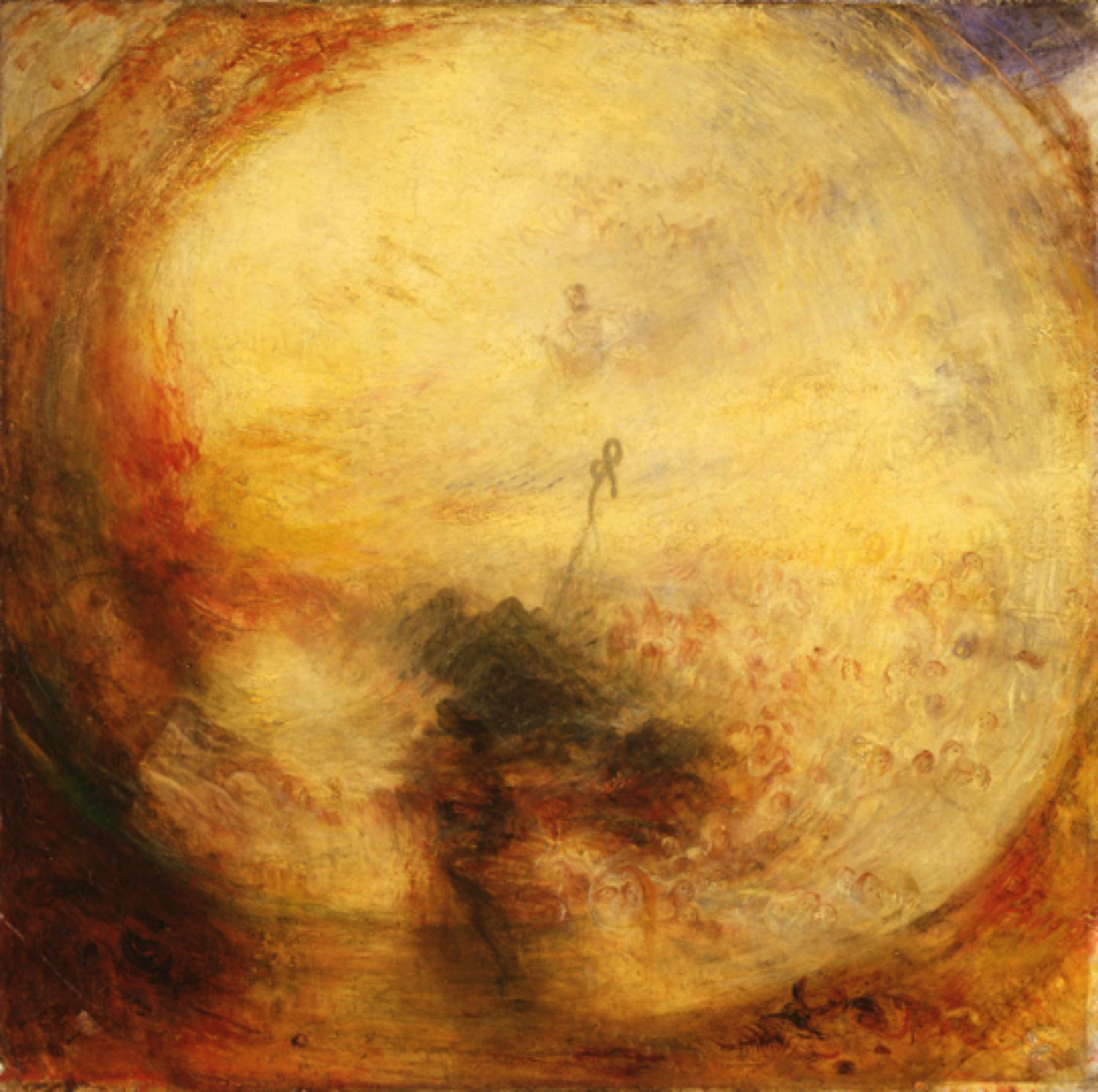
Joseph Mallord William Turner, 1775-1851: Light and Color: The Morning After the Deluge (Goethe’s Theory) — Moses Writing the Book of Genesis, 1843

 An Old Testament KnoWhy for Gospel Doctrine Lesson 3B: The Creation (Moses 1:27-42; 2-3) (JBOTL03B), 11 January 2018

Question: LDS teachings and scripture clearly imply that Moses learned of the Creation and the Fall in vision and was told to write what he saw. However, most modern scholars find evidence that the book of Genesis as we have it today was produced at a much later date than Moses could have lived. Can these views be reconciled?

Summary: Scholars have assembled impressive evidence that the first five books of the Bible were compiled in their current form at a relatively late date from multiple, overlapping sources of varying perspectives — and almost certainly with differing degrees of inspiration. This idea should not trouble believing readers of the Book of Mormon, who know that inspired editors wove separate, overlapping records covering many hundreds of years into a single work of scripture. In addition, the idea that Moses may not have written all that is attributed to him firsthand is not incompatible with the belief that he, along with other major Old Testament figures, were actual historical persons. Many of the Bible’s sources may go back to authentic traditions (whether oral or written) that are associated with figures such as Moses as authorities, even if they were not the direct authors. As a further witness of the reality of these figures, we have accounts of the Prophet having seen many of them personally. Moreover, we have the same witness within the Joseph Smith’s Bible translation efforts, the Book of Mormon, the book of Abraham, and several revelations in the Doctrine and Covenants. We are fortunate both to know that these lengthy additions to the record of the Old Testament are authentic reports of events originally experienced by ancient prophets and that they were also directly translated in our day by a modern prophet.

The full article may be found at the Interpreter Foundation website: KnoWhy OTL03B — Did Moses Write the Book of Genesis?

Filed Under: Bible, Book of Mormon, Book of Moses, Joseph Smith, LDS History, LDS Scriptures, Lesson Aids, Questions Tagged With: Bible Authorship, Documentary Hypothesis, Gospel Doctrine: Old Testament, Historicity, Joseph Smith Translation, Moses

FairMormon Conference Podcast – Keith Erekson, “Witnessing the Book of Mormon: The Testimonies of Three, Eight, and Millions”

December 28, 2017 by Trevor Holyoak

https://media.blubrry.com/mormonfaircast/www.fairlatterdaysaints.org/wp-content/uploads/2017/12/Keith-Erekson.mp3

Podcast: Download (93.7MB)

Subscribe: RSS

This is a new podcast series which will feature a FairMormon Conference presentation each month. If you would prefer to watch the videos, they can still be purchased here for the 2017 conference. Older conference presentation videos are available on our YouTube channel and FairMormon TV for Roku, Amazon Fire TV, and Android TV.

Keith Erekson, Witnessing the Book of Mormon: The Testimonies of Three, Eight, and Millions

Transcript available here.

Keith A. Erekson is an internationally acclaimed writer, speaker, and public historian. He currently serves as director of the Church History Library of The Church of Jesus Christ of Latter-day Saints. Erekson has authored numerous books and articles about public interest in over history, including book-length studies of popular commemoration of Abraham Lincoln and the recent debate over the social studies curriculum in Texas. His work has been published in numerous journals, including the Journal of American History, The History Teacher, the Journal of the Abraham Lincoln Association, the Oral History Review, and various Mormon studies journals. Before leading the Church History Library, Erekson was a tenured associate professor of history at The University of Texas at El Paso, where he also served as executive director of UTEP’s Centennial Celebration and founding director of UTEP’s Center for History Teaching & Learning. He possesses more than a decade of international management experience in higher education, scholarly publishing, and automotive manufacturing. He holds a bachelor’s and master’s degree from Brigham Young University, a doctoral degree in history from Indiana University, and a Master’s of Business Administration from the University of Texas at El Paso. Erekson grew up near Baltimore, Maryland, and now lives near Salt Lake City, Utah, with his wife and four daughters.

Filed Under: Apologetics, Book of Mormon, FAIR Conference, FairMormon Conference, Joseph Smith, LDS History, Podcast

Book Review: An Introduction to the Book of Abraham

October 6, 2017 by FAIR Staff

10% off at the FairMormon Bookstore

Click to purchase the book.

[Another FairMormon member, Rene Krywult, has contributed a second review of this book.]

“The goal with the Introduction to the Book of Abraham is to make reliable information about the Book of Abraham accessible to the general reader.” With these words, John Gee begins his new book.

And it is a high goal the well-known Egyptologist, professor of Egyptology at Brigham Young University and the William (Bill) Gay Research Chair, author of over a hundred academic papers on Egyptology and ancient scripture, and researcher of the Book of Abraham for more than 25 years, sets for himself. How to do justice to a topic that is specialized enough that only a few experts in the world can speak about it with authority, and how to do it in a language that the interested lay man can understand? How to do it, with a topic that has been controversially debated for the last 105 years, often with far more zeal than knowledge? How to do it, when there is so very much to discuss and to know on one hand, and yet the “common knowledge” is almost nonexistent?

So, the good thing here: This is an introduction. Gee is not only an expert on the Egyptian but also masters the English language. The book is very easy to read. Nevertheless, there is much information to impart, and Gee does so by introducing us to the topics, all with the well researched and documented footnotes one expect from a scholar of such caliber, only to follow up with an extensive “Further Reading” section at the end of each chapter, a bibliography with explanations. This way, he who wants to know more knows what books to buy and what articles to read.

To do this work justice, I decided to go through the chapters one by one. [Read more…] about Book Review: An Introduction to the Book of Abraham

Filed Under: Book of Abraham, Book reviews, Joseph Smith, LDS History

Book Review: An Introduction to the Book of Abraham

October 4, 2017 by Trevor Holyoak

10% off at the FairMormon Bookstore

Publisher: Religious Studies Center, Brigham Young University and Deseret Book
Author: John Gee
Number of Pages: 197
Binding: Hardcover
ISBN-13: 978-1-9443-9406-6
Price: $19.99
Click to purchase the book.

The Book of Abraham is my favorite book of scripture. Mostly it is because of chapter 3, which contains information that is not found anywhere else in LDS scripture. I also remember discovering the facsimiles as a child and thinking that they were really neat. Unfortunately, the Book of Abraham has also become a favorite for critics to attack, as it is the only book of scripture that Joseph Smith translated for which there appears to be any extant source material, and that material does not seem to match what is in the Book of Abraham. But it’s really much more complicated than that.

This book explains what is currently known about the Book of Abraham and its associated artifacts and documents, and why the critics are wrong. It is written by John Gee, who is a professor of Egyptology at BYU. He got his PhD in Egyptology at Yale and has written many research publications for professional journals as well as writing for LDS audiences. The book is written to be understandable by any reader (although an LDS background is very helpful) in a straightforward manner that actually makes for a fairly quick read.

The book contains 17 chapters, most of them fairly short, that build on each other. At the end is a series of questions and answers that basically provides a summary of the book. It also has photos of the extant papyri, maps, charts, diagrams, and other helpful or interesting illustrations scattered throughout. At the end of most chapters is a list of “Further Reading” with notes about each item. Unfortunately, there are not many footnotes in the book; they only exist to provide sources for quotes. So you have to refer to the notes in the “Further Reading” section to deduce where some of the information came from. This did lead me to find one inconsistency – on page 97, it says “The Book of Abraham begins much like other autobiographies from Abraham’s time and place.” However, on page 103 in “Further Reading,” there is an entry that says, “This essay is a comparison of the Book of Abraham with the only other autobiographical inscription to survive from the approximate time and place of Abraham.”

After the introduction, the book begins with a historical overview which explains how Joseph Smith got the papyri and then what happened to them after his death, with the church finally receiving surviving fragments in 1967 (most of what Joseph had in his possession ended up burning in the Chicago Fire of 1871). “To the disappointment of many, although these remaining fragments contained the illustration that served as the basis for Facsimile 1, they were not the portion of the papyri that contained the text of the Book of Abraham” (page 9).
The next chapter is about the translation. Some have thought that Joseph may have used a seer stone (see my review of Joseph Smith’s Seer Stones), but Gee says that “Some thirdhand accounts claim he did, but those accounts do not come from anyone who actually observed the translation” and that “By the time that Joseph finished translating the Book of Mormon in 1829, he no longer needed to use the Urim and Thummim to receive revelation” (page 20.) What is known is that much more was translated than what ended up being published (the rest has been lost), and that it was done without using a dictionary or grammar as a conventional translation normally would. It does appear that W. W. Phelps attempted to compile an Egyptian grammar after the translation, but the extent of Joseph’s involvement in that is unknown. [Read more…] about Book Review: An Introduction to the Book of Abraham

Filed Under: Apologetics, Book of Abraham, Book reviews, Doctrine, Evidences, Joseph Smith, LDS History, Racial Issues, Temples

Book Review: The Council of Fifty: What the Records Reveal about Mormon History

September 4, 2017 by Trevor Holyoak

Publisher: Religious Studies Center, Brigham Young University
Editors: Matthew J. Grow & R. Eric Smith
Date Available: September 4, 2017
Number of Pages: 201
Binding: Hardcover
ISBN-13: 978-1-9443-9421-9
Price: $21.99

On October 3, 2016, the Joseph Smith Papers Project published a volume called Administrative Records: Council of Fifty, Minutes, March 1844-January 1846 (reviewed and explained here). It is a massive tome of around 800 pages containing information that had never before been published or studied. It contains many insights that help fill in gaps in Mormon history during this period. The Council of Fifty: What the Records Reveal about Mormon History is an introduction to some of those insights, or it can also serve as a summary of them for those that would rather not peruse the vast source material.

This book contains 15 chapters, each of which is a separate paper written by historians (many of which have worked on the Joseph Smith Project) such as Richard Bushman, Richard Turley, Patrick Mason, Gerrit Dirkmaat, Matthew Grow, Matthew Godfrey, Richard Bennett, Jedediah Rogers, and Paul Reeve. Like a sacrament meeting where each speaker is given the same topic, there is some overlap among many of the papers, yet each writer brings their own perspective and expertise. [Read more…] about Book Review: The Council of Fifty: What the Records Reveal about Mormon History

Filed Under: Book reviews, FAIR Conference, Joseph Smith, LDS History, Prophets, Temples

Book Review: The Joseph Smith Papers: Documents Volume 5: October 1835 – January 1838

May 15, 2017 by Trevor Holyoak

Publisher: The Church Historian’s Press
Date Available: May 15, 2017
Number of Pages: 768
Binding: Hardcover
ISBN-13: 978-1629723129
Price: $54.95

(Page numbers are from an Advance Review Copy, and may be different in the published version.)

This volume covers an interesting period of Joseph Smith’s life that includes the finishing and dedication of the Kirtland Temple and the associated visions, work on the Book of Abraham, the Kirtland Safety Society, and persecution and apostasy. Some of the documents included are from Joseph Smith’s journals, and so have already been published in Journals, Volume 1:1832-1839. Others are from Minute Book 1, archival collections, periodicals, other peoples’ diaries, legal records, etc. There are no journals available covering April 1836 to January 1838, so some of the best contemporary sources were chosen to try to fill things in.

The book starts with the usual material for this series, including a timeline of Joseph Smith’s life, maps, an explanation of the Joseph Smith Papers Project, a volume introduction, and an explanation of the editorial method. The book is then divided into seven parts, based on time periods. There is an appendix with blessings to Don Carlos Smith, Oliver Cowdery, Frederick G. Williams, and Sidney Rigdon. And then there is the usual reference material with source notes, a chronology, geographical directory and maps, pedigree chart, biographical directory, organizational charts, essay on sources, works cited, a cross-reference with the Doctrine and Covenants, index, etc. At the very back is a note about resources available on the Joseph Smith Papers website that relate to the series as well as this particular book.

Most of the first and second chapters of the Book of Abraham are included as “Book of Abraham Manuscript, circa Early June – circa November 1835-A [Abraham 1:4-2:6].” There is a historical introduction that explains how the papyri were obtained and what is known about the translation, as well as the publication in Times and Seasons. A footnote points out that “Though a notice printed in the 1 February 1843 issue of the Times and Seasons suggested that JS would publish ‘further extracts’ from the Book of Abraham, there is no documentary evidence that other extracts were produced. All extant manuscripts generated by JS and his associates during their study of the Egyptian papyri, dated circa 1835 to circa 1842, are available at the Joseph Smith Papers website, josephsmithpapers.org.” (page 77) [Read more…] about Book Review: The Joseph Smith Papers: Documents Volume 5: October 1835 – January 1838

Filed Under: Book of Abraham, Book reviews, Joseph Smith, LDS History, Temples

Book Review: What You Don’t Know About the 100 Most Important Events in Church History

April 19, 2017 by Trevor Holyoak


Authors: Casey Paul Griffiths, Susan Easton Black, Mary Jane Woodger
Publisher: Deseret Book
Genre: Nonfiction
Year Published: 2017
Number of Pages: 336
Binding: Paperback
ISBN: 978-1629722467
Price: $22.99

I really don’t like the title of this book. It is the sort of title that is often referred to as “clickbait,” to get people to read an online article. It is also an insult to the reader’s intelligence for an author to assume what they don’t know. The preface indicates that the authors are at least somewhat aware of this, and begins almost with an apology, admitting that “such lists present an excuse for sensationalized writing and shallow analysis.” However, it goes on to explain that the book was inspired by another book called “The 100 Most Important Events in Christian History,” and that such lists “can impel a person to think critically about events, stories, and people.” Casey Griffiths decided to create a list for the history of the Latter-day Saints, enlisting the help of Mary Jane Woodger and Susan Easton Black. They also received assistance from their colleagues at BYU and used resources such as the Joseph Smith Papers.

The book is a large format paperback, printed on fairly cheap-feeling paper. There are small photographs accompanying each of the 100 short (mostly 2 to 3 pages) chapters, but they are all black and white and sadly most are not very high quality, possibly due to the paper used. This might have made a good coffee table book in a different format, but I suppose it’s more likely to be read in this form.

The book lists the events in chronological order. Many should be quite well known, in which case they have tried to include lesser known information. For instance, for the First Vision (event number 1), they include details from multiple accounts from Joseph Smith and his contemporaries, concluding by noting that “the details are less significant than the central message of the reality of God the Father and his Son Jesus Christ and of the Savior’s infinite atonement. President Henry B. Eyring said that the First Vision ‘represents that moment when Joseph learned there was a way for the power of the Atonement of Jesus Christ to be unlocked fully. Because of what Joseph saw and what began at this moment, the Savior was able, through this great and valiant servant and through others that He sent, to restore power and privilege. That power and privilege allows us, and all who will live, to have the benefits of Jesus Christ’s Atonement work in our lives’” (page 3). [Read more…] about Book Review: What You Don’t Know About the 100 Most Important Events in Church History

Filed Under: Apologetics, Bible, Book of Mormon, Book reviews, First Vision, Joseph Smith, LDS History, LDS Scriptures, Polygamy, Prophets, Temples, Women

Book Review: Joseph Smith’s Revelations: A Doctrine and Covenants Study Companion from the Joseph Smith Papers

March 30, 2017 by Trevor Holyoak

This book is part of the Joseph Smith Papers Project, but it’s different than the other volumes that have been produced. It combines the previously published canonized revelations and their accompanying contextual material and puts them in the same order as the current LDS edition of the Doctrine & Covenants, also adding verse numbers for ease of reading. The result provides a very interesting way to read this book of scripture.

I have to admit I was initially disappointed to find that this is only available as an e-book. But it turns out there is a reason for this. It currently only contains content up through 1835 (and one thing from 1838) at this point. But as work on the Joseph Smith Papers Project progresses, updates to the e-book are promised. My guess is that they also realized this would be a great resource for this year’s Sunday School curriculum and were able to put it together quickly as an e-book. And they took advantage of the ability to link to the JSP website to provide access to higher resolution charts and further information in many places.

As with all the JSP books, the introductory material includes lists of illustrations and maps, an introduction and statement of editorial procedures, and a timeline of Joseph Smith’s life. It also includes a chronology of texts in today’s edition of the D&C and a correspondence chart to the JSP volumes. The introduction from Revelations and Translations, Volume 1: Manuscript Revelation Books is included as an appendix, as is the introduction to Revelations and Translations, Volume 2: Published Revelations.
[Read more…] about Book Review: Joseph Smith’s Revelations: A Doctrine and Covenants Study Companion from the Joseph Smith Papers

Filed Under: Book reviews, Joseph Smith, LDS History, LDS Scriptures

The Joseph Smith Papers: Administrative Records: Council of Fifty, Minutes, March 1844-January 1846

December 13, 2016 by Trevor Holyoak

[For more information on the Council of Fifty, see Matthew J. Grow’s 2016 FairMormon Conference presentation.]

In September 2013, it was announced that the minutes from the Council of Fifty would be published as part of the Joseph Smith Papers project. This was significant because they had not been available for research, and so most of what was known of the council had been gleaned from journal entries of members and rumors spread by publications such as the Nauvoo Expositor, which were repeated over the years by each generation of critics. Besides being able to put these hyperbolic claims to rest, we now have new information about what happened during the Nauvoo period, and some new statements made by Joseph Smith and other early members of the Church.

The Council of Fifty was a secret organization formed in Nauvoo, made up of the leaders of the Church, as well as other men, including some nonmembers, with Joseph Smith at the head. Their purpose was to do civil business, separate from the ecclesiastical business done elsewhere. Under Joseph Smith, the three major functions involved Joseph’s presidential campaign, planning a “theodemocracy [that] would protect liberty and freedom ‘for the benefit of ALL’” [page xxxvi], and to find a place of refuge away from the government of the United States, which had failed them.

After the death of Joseph Smith the council was reconvened under Brigham Young, and dealt with the repeal of the Nauvoo charter, completing the temple, and finding a new place to settle. It was later reconvened in 1848, after settling in Salt Lake City, and functioned off and on until 1885. This book contains the minutes through January, 1846, and there are currently no plans to publish the rest, which would be beyond the scope of the Joseph Smith Papers. [Read more…] about The Joseph Smith Papers: Administrative Records: Council of Fifty, Minutes, March 1844-January 1846

Filed Under: Anti-Mormon critics, Book reviews, FAIR Conference, Joseph Smith, LDS History, Politics, Temples

  • « Go to Previous Page
  • Go to page 1
  • Interim pages omitted …
  • Go to page 28
  • Go to page 29
  • Go to page 30
  • Go to page 31
  • Go to page 32
  • Interim pages omitted …
  • Go to page 41
  • Go to Next Page »

Primary Sidebar

Faithful Study Resources for Come, Follow Me

Subscribe to Blog

Enter your email address:

Subscribe to Podcast

Podcast icon
Subscribe to podcast in iTunes
Subscribe to podcast elsewhere
Listen with FAIR app
Android app on Google Play Download on the App Store

Pages

  • Blog Guidelines

FAIR Latest

  • Come, Follow Me with FAIR – Doctrine and Covenants 137–138 – Part 2 – Autumn Dickson
  • Come, Follow Me with FAIR – Doctrine and Covenants 137–138 – Mike Parker
  • FAIR December Newsletter
  • Come, Follow Me with FAIR – Doctrine and Covenants 137–138 – Part 1 – Autumn Dickson
  • Prophets of God 

Blog Categories

Recent Comments

  • LHL on Come, Follow Me with FAIR – Doctrine and Covenants 132 – Mike Parker
  • Stephen Johnsen on Come, Follow Me with FAIR – Doctrine and Covenants 132 – Mike Parker
  • Bruce B Hill on Come, Follow Me with FAIR – Doctrine and Covenants 124 – Part 1 – Autumn Dickson
  • Gabriel Hess on Join us Oct 9–11 for our FREE virtual conference on the Old Testament
  • JC on When the Gospel “Doesn’t Work”

Archives

Follow Us

  • Facebook
  • Twitter
  • iTunes
  • YouTube
Android app on Google Play Download on the App Store

Footer

FairMormon Logo

FAIR is a non-profit organization dedicated to providing well-documented answers to criticisms of the doctrine, practice, and history of The Church of Jesus Christ of Latter-day Saints.

Donate to FAIR

We are a volunteer organization. We invite you to give back.

Donate Now

Site Footer