• Skip to primary navigation
  • Skip to main content
  • Skip to primary sidebar
  • Skip to footer

FAIR

  • Find Answers
  • Blog
  • Media & Apps
  • Conference
  • Bookstore
  • Archive
  • About
  • Get Involved
  • Search

Prophets

The Coming Revolution of Virtual Missionaries: Review of Books by Greg Trimble

May 3, 2018 by Trevor Holyoak

Available from the FairMormon Bookstore at 15% off

If I remember correctly, I first came across Greg Trimble’s blog by seeing his post “Quit Acting Like Christ Was Accepting of Everyone and Everything” shared by a friend on Facebook, apparently some time in 2014. I liked it enough that I shared it in a few places as well. He has since written a bunch of other posts that have also been shared widely, so most LDS people online are probably familiar with his name.

In the last year, Trimble has started publishing books. His first one, Dads Who Stay and Fight: How to Be a Hero to Your Family, showed up on Audible’s website, so I thought I’d give it a listen. It is a book about being a good father written by a young father, so it does have its weak spots. A lot of the chapters could have used fewer stories and more concrete examples. But there were some really good ones that made the whole thing worthwhile, in particular the ones on marriage, technology, and protecting your family from worldly influences.

A few months ago, I saw that he had published another book, The Coming Revolution Inside of Mormonism. I was curious enough about the title that I wanted to take a look at it, and I requested a review copy. When it arrived, it was accompanied by The Virtual Missionary: The Power of Your Digital Testimony, which had also recently been published. Since then, The Coming Revolution Inside of Mormonism has been retitled to The Cultural Evolution Inside of Mormonism, apparently because the original title had caused a lot of confusion. In order to avoid confusion here, I will refer to the book by its new title (and assume that none of the actual content has changed). [Read more…] about The Coming Revolution of Virtual Missionaries: Review of Books by Greg Trimble

Filed Under: Anti-Mormon critics, Apologetics, Atheism, Book of Mormon, Book reviews, Conversion, Doctrine, Faith Crisis, Interfaith Dialogue, Joseph Smith, LDS Culture, LDS History, Polygamy, Power of Testimony, Prophets, Questions, Resources, Temples, Testimonies Tagged With: blog, blogging, book review, digital missionary, Greg Trimble, Trevor Holyoak

Have There Been Any Latter-Day Parallels to Balaam’s Blessing? (Gospel Doctrine Lesson 16A)

April 26, 2018 by Jeffrey M. Bradshaw

Balaam Son of Beor Inscription from Deir ʿAllah. This fragment, dating to several centuries after the events of Numbers, recounts a night vision of Balaam, son of Beor, a “seer of the gods.” Though the content of the vision has nothing to do with the Bible story, the text provides evidence that stories surrounding the figure of Balaam were known anciently outside the Bible among peoples who lived in the area east of the River Jordan.


An Old Testament KnoWhy relating to the reading assignment for Gospel Doctrine Lesson 16: “I Cannot Go Beyond the Word of the Lord” (Numbers 22-24; 31:1-16) (JBOTL16A)


Question: Have there been any latter-day parallels to Balaam’s blessing?

Summary: In 1898, Dr. John M. Reiner, a Roman Catholic scholar, visited Utah. In a talk given at the Salt Lake Tabernacle at the invitation of President Wilford Woodruff, he described in striking terms the parallels he found between ancient and modern Israel. Throughout his talk, he wove in colorful and informative allusions to the story of Balaam, who had blessed Israel in spite of himself. Reiner also spoke vigorously of the strength of the claims of apostolic authority that, in his view, had been credibly put forth by only two churches: the Roman Catholics and the Mormons. Although not claiming the gift of prophecy, Reiner’s eloquent words of appreciation and friendship for the Latter-day Saints were sincere and generous. His little-known discourse drawing out modern day parallels to the story of Balaam and Israel deserves to be better known.


The full article may be found at the Interpreter Foundation website: KnoWhy OTL16A — Have There Been Any Latter-Day Parallels to Balaam’s Blessing?

Filed Under: Apologetics, Bible, Interfaith Dialogue, LDS History, Lesson Aids, Prophets, Questions, Resources Tagged With: apostolic succession, Balaam, Gospel Doctrine: Old Testament, John M. Reiner, Numbers, priesthood, prophetic authority

Was Noah Drunk or in a Vision? (Old Testament Gospel Doctrine 6B)

February 3, 2018 by Jeffrey M. Bradshaw

Noah in His Vineyard, Holkham Bible, ca. 1325-1350. Here we see an industrious Noah diligently tending his vineyard, in striking contrast to a later depiction in the same Bible chapter that features him in an inebriated stupor. Scholars have noted the odd inconsistency between these two scenes.

An Old Testament KnoWhy for Gospel Doctrine Lesson 6: “Noah … Prepared an Ark to the Saving of His House” (Moses 8:19-30; Genesis 6-9; 11:1-9) (JBOTL06B)

Question: In Genesis 6:9, Noah is described as “a just man and perfect in his generations,” a noble patriarch who, like Enoch, “walked with God.” However, the story of Noah finishes in a puzzling way. Immediately after Noah makes his covenant with God, his sons find him “drunken” and “uncovered within his tent.” Can these two opposing pictures of Noah be reconciled?

Summary: It is difficult to know whether this contradiction is the result of different traditions, textual misunderstanding, or the abbreviated nature of the biblical account. Some scholars even wonder whether there was a deliberate effort to defame or belittle the character of Noah. What seems certain is that the biblical author deliberately framed this sequel to Noah’s Creation and Garden story as a replay of the scene of the Adam and Eve’s Fall and consequent judgment in Eden. Most often the instigator of this “Fall” is seen to be Noah, who, it is reported, succumbed to the intoxicating influence of wine from his vineyard. However, it is significant that the scriptures omit any hint of wrongdoing by Noah and put all the blame on Ham and his son Canaan. In the admittedly tentative interpretation given in this article, I will discuss the possibility that Ham’s wrongdoing consisted in his having approached, without authorization, the inner curtains of the sacred tent where Noah was enwrapped in vision. Some ancient traditions viewed Ham’s actions as part of an effort to steal Noah’s priesthood garment and undermine his authority.


The full article may be found at the Interpreter Foundation website: KnoWhy OTL06B — Was Noah Drunk or in a Vision?

As a video supplement to this lesson with additional details and artwork not included in this article, see Jeffrey M. Bradshaw, “The Ark and the Tent: Temple Symbolism in the Story of Noah” on the YouTube Interpreter Foundation channel (https://www.youtube.com/watch?v=kIfArfB54Mk ).

Filed Under: Bible, Joseph Smith, Lesson Aids, Prophets, Questions, Racial Issues, Temples Tagged With: Flood, Gospel Doctrine: Old Testament, Noah

What if People with Red Hair Were Denied the Priesthood?

September 25, 2017 by Scott Gordon

Scott Gordon as a red-haired boy

Note – From the mid-1840s until 1978 people of African descent were generally not allowed to have the priesthood or attend the temple in the LDS Church. (Attending the temple is different from going to Church in the LDS faith.) This is in spite of prior practices and temple rules that said they could. Since the primary difference between people with African roots and people with northern European roots is skin color, what if the situation were reversed? This post tries to use humor to address this serious issue. This should not be taken as evidence that the author considers anything about the topic of racism or priesthood to be less than serious. This role reversal is designed to make us think about the issue in a different light.

I was born a redhead. Yes, I’ve “blonded” out a bit as I’ve aged, but both of my daughters were born with deep red hair. So, I know all about red heads. Sometimes we are also known as “gingers.”

While the red hair can attract attention, it isn’t the red hair that is the issue for me. It is the redheads’ skin color. Let me explain.

People with red hair have very fair skin coloring. We have almost no melanin in our skin.  Melanin is the substance that makes skin darker. I joke with my kids that our skin is so transparent that we can see the blood rushing beneath it.  I often look with jealously at my Hispanic or black friends who have such beautiful, uniform skin tones. My skin is reddish and blotchy with a few dots called freckles. In high school I was constantly asked, “Are you blushing?” “No, I just walked up a few stairs, thank you very much.”

A redhead’s skin is very sensitive to sunlight. You may notice if you go walking with a redhead, they sometimes seem to jump from shadow to shadow. We all avoid sunlight. When we read a Twilight novel, we understand how the vampires feel—the sun is not our friend! I often take out my SPF 50 sunscreen and slather it on before I will go out into the sun. It is supposed to allow me to stay in the sun 50 times longer than usual. For me – let’s see now — 50 times what I can usually stay in the sun for without getting a sunburn…that would be……ummm, doing the math here…carry the one…….Hmmm……about 7 and a half minutes before I start to burn.

“But, you are just ‘white’!” you may say. No, my wife is white. Her family comes from Norway and Sweden. She is white. Blindingly white. Her skin looks different than mine. She is white with white and yellow undertones. My ‘white’ is blotchy reddish-white, just like most other redheads. She can go out in the sun. She can lie on the beach. She can go swimming. If I go out in the sun, I will burn. If I lie on the beach, I will burn.  If I go swimming, I will burn.  I tell my students my goal in life is to walk from my office to my car without getting a sunburn.

That said, it isn’t all bad having redhead skin. My skin tone is GREAT for collecting vitamin D in a fogbank. And when I visit Scotland, I have to wear my coat anyway – so it’s not a liability.

My daughter teaches in first grade. She has very red hair. One of her students, whose family came from Africa, was having difficulties with one teacher. We will call this six-year-old student Jamal (not his real name). When asked about it, he said, “She just don’t like me. She’s white and white people don’t like black people like me.” My daughter responded, “That’s not true, Jamal. I’m white and I like you.” “No, Miss Gordon. You’re not white,” responded Jamal. “You’re PINK!” Even a six-year-old can see the difference.

The difference between people we label as “black” and people like me is how much melanin is in our skin. The more melanin, the darker the skin tone. I don’t have very much melanin, so that is why I am the color I am. Some of you may say, “But there are other differences besides skin color!” Yeah, that’s true – my hair is red and theirs is black. But again, that is simply caused by the amount of melanin. My hair is straight and theirs is curly. True. But, my wife’s hair is very curly, and she has family members whose hair would look right at home on someone of African descent (except that they are blond). As for other traits, you can find a wide variety of looks throughout both the white and black communities. In other words, there is as much diversity within each community as there is between the two communities.

So, here’s a thought exercise: What would happen if The Church announced that there was a ban on redheads having the priesthood?

What if it was melanin-deficient people who couldn’t get the priesthood, while melanin-rich people could? What if Gingers went thought a period of slavery because of our skin color? What if we were discriminated against during the 1950s and not allowed to eat in certain places, get certain jobs, use certain bathrooms, or ride in a taxi with someone who had more melanin then we do?

I can just image the conversations in the ward.

“Oh look, a red-haired girl just moved into the ward. Finally, someone you can date!”

“Can you help me with my Northern European History class? You know all that stuff, right?”

“Can I touch your hair? I’ve never seen red hair before. Does it feel different?”

“I was doing family history work last week and was horrified to find out that some red-haired genes got in there somehow. Old great-grandad or grandma must have been cavorting with the field help!”

Yeah, those would be terrible conversations. And yet, I have heard all of those comments from church members.

“But, it isn’t skin color. It’s lineage!” you cry.  So let’s talk about lineage a bit. There are those who believe there is a tie between redheads and Neanderthals.[1] Neanderthals are in the redhead’s linage. Apparently, Neanderthals had red hair, and some Neanderthal genes are found in northern Europeans. They know there was interbreeding between Homo Sapiens and Neanderthals.[2] They just are not sure if the red hair trait came from the Neanderthal, or if it developed independently. If Neanderthal man had red hair along with the red-hair skin tones, it would explain one of the great scientific mysteries of why the Neanderthals died out: obviously, the sun came out!

More evidence of having a different lineage is studies that show “people with red hair need larger doses of anesthesia and are often resistant to local pain blockers.”[3]  My first response to this information is “Well, duh! We are used to pain because we walk around sunburned all the time.” But, it turns out it has more to do with our genes.[4] Just ask any operating room nurse or OB nurse how comfortable they feel when a redhead comes in. I have been told by several nurses that if there is going to be a problem, it will probably be with the redhead. So, we are a bit different from other people. Whether this comes from our homegrown genes, or from Neanderthal genes, it certainly shows that our lineage might be different from others—we are demonstrably different than other people. If something is to be restricted based on lineage, it could just as easily be restricted against us redheads.

It’s important to think about what it would be like if the shoe were on the other foot. I often hear the refrain, “The Levites were the only ones who had the priesthood at the time of Jesus. So that was a priesthood restriction just like the blacks being restricted in modern times.”

That situation is totally different. With the Levites, only one group held the priesthood and nobody else did. With the modern priesthood restriction, everybody had the priesthood except for one group.

Think of it this way. Everyone understands that in sports there needs to be a team captain to communicate effectively. But, that is totally different than everyone being allowed to play the game except for one player who is forced to sit on the bench. Our brothers and sisters of African descent were forced to sit on the bench. How would that make you feel?

“But, the priesthood ban was a long time ago. What do you want me to do about it?”

I first recommend reading this short article on LDS.org on Race and the Priesthood. https://www.lds.org/topics/race-and-the-priesthood?lang=eng

Secondly, if someone asks if Mormon were racists, the correct answer – the only possible answer — is yes. There is no need to get defensive about it. Of course they were! By modern standards, everyone who came through that period would be considered racist today. It is, however, unfair to judge them harshly for their views. It was what they were taught. It was the norm. They did the best they could. Using modern standards, even Abraham Lincoln would be considered racist by many. Additionally, racism doesn’t only exist in the United States. It is a world-wide issue of us vs. them. Skin color has simply been used as an easy identifier of “them.”

Racism has always been with us. Our better selves understand that we need to move beyond that. If someone asks if there was racism in the church, simply say “Sure, and we are trying to repent!”

Third, if someone then asks, how could we have had a prophet if we had such a racist policy? Think about this: if you think that prophets don’t work in a world filled with prejudice and racism, you need to go back and reread the Bible and Book of Mormon. Think of the Samaritans, the Lamanites, the people of Nineveh, and the Philistines. God only gives us what we are willing to accept. It is up to us to try to become more like him.

Many members of the Church believe the ban came from God, or at least that God used the ban for a wise purpose. These positions are speculative. No written revelation has been found that explains the priesthood and temple ban. Some quote scriptures to justify the ban, but historically those scriptures were pulled in as explanations after the ban was already in effect.

Why was there the ban? We don’t know. I can make an educated guess, but my guess would be as valid as your guess—and just as speculative.

Instead of guessing and speculating, let’s simply reach out to each other and embrace one another as brothers and sisters—even redheads! Let’s acknowledge that racism exists and has existed even within the Church. Let’s not nit-pick over how much melanin we have in our skin. Does it really matter? Do you differentiate between your blond children your brown-haired children and your red-haired children? Is there a difference between them?

No, I don’t think so either.

Now please hand me my hat and sunscreen. I have to go outside again.


[1] Red hair a legacy of Neanderthal man http://www.dhamurian.org.au/anthropology/neanderthal1.html

[2] http://humanorigins.si.edu/evidence/genetics/ancient-dna-and-neanderthals/interbreeding

[3] https://well.blogs.nytimes.com/2009/08/06/the-pain-of-being-a-redhead/

[4] http://healthland.time.com/2010/12/10/why-surgeons-dread-red-heads/


Filed Under: Perspective, Prophets, Racial Issues

Book Review: The Council of Fifty: What the Records Reveal about Mormon History

September 4, 2017 by Trevor Holyoak

Publisher: Religious Studies Center, Brigham Young University
Editors: Matthew J. Grow & R. Eric Smith
Date Available: September 4, 2017
Number of Pages: 201
Binding: Hardcover
ISBN-13: 978-1-9443-9421-9
Price: $21.99

On October 3, 2016, the Joseph Smith Papers Project published a volume called Administrative Records: Council of Fifty, Minutes, March 1844-January 1846 (reviewed and explained here). It is a massive tome of around 800 pages containing information that had never before been published or studied. It contains many insights that help fill in gaps in Mormon history during this period. The Council of Fifty: What the Records Reveal about Mormon History is an introduction to some of those insights, or it can also serve as a summary of them for those that would rather not peruse the vast source material.

This book contains 15 chapters, each of which is a separate paper written by historians (many of which have worked on the Joseph Smith Project) such as Richard Bushman, Richard Turley, Patrick Mason, Gerrit Dirkmaat, Matthew Grow, Matthew Godfrey, Richard Bennett, Jedediah Rogers, and Paul Reeve. Like a sacrament meeting where each speaker is given the same topic, there is some overlap among many of the papers, yet each writer brings their own perspective and expertise. [Read more…] about Book Review: The Council of Fifty: What the Records Reveal about Mormon History

Filed Under: Book reviews, FAIR Conference, Joseph Smith, LDS History, Prophets, Temples

Book Review: What You Don’t Know About the 100 Most Important Events in Church History

April 19, 2017 by Trevor Holyoak


Authors: Casey Paul Griffiths, Susan Easton Black, Mary Jane Woodger
Publisher: Deseret Book
Genre: Nonfiction
Year Published: 2017
Number of Pages: 336
Binding: Paperback
ISBN: 978-1629722467
Price: $22.99

I really don’t like the title of this book. It is the sort of title that is often referred to as “clickbait,” to get people to read an online article. It is also an insult to the reader’s intelligence for an author to assume what they don’t know. The preface indicates that the authors are at least somewhat aware of this, and begins almost with an apology, admitting that “such lists present an excuse for sensationalized writing and shallow analysis.” However, it goes on to explain that the book was inspired by another book called “The 100 Most Important Events in Christian History,” and that such lists “can impel a person to think critically about events, stories, and people.” Casey Griffiths decided to create a list for the history of the Latter-day Saints, enlisting the help of Mary Jane Woodger and Susan Easton Black. They also received assistance from their colleagues at BYU and used resources such as the Joseph Smith Papers.

The book is a large format paperback, printed on fairly cheap-feeling paper. There are small photographs accompanying each of the 100 short (mostly 2 to 3 pages) chapters, but they are all black and white and sadly most are not very high quality, possibly due to the paper used. This might have made a good coffee table book in a different format, but I suppose it’s more likely to be read in this form.

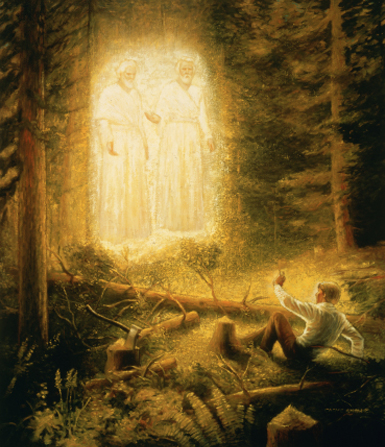
The book lists the events in chronological order. Many should be quite well known, in which case they have tried to include lesser known information. For instance, for the First Vision (event number 1), they include details from multiple accounts from Joseph Smith and his contemporaries, concluding by noting that “the details are less significant than the central message of the reality of God the Father and his Son Jesus Christ and of the Savior’s infinite atonement. President Henry B. Eyring said that the First Vision ‘represents that moment when Joseph learned there was a way for the power of the Atonement of Jesus Christ to be unlocked fully. Because of what Joseph saw and what began at this moment, the Savior was able, through this great and valiant servant and through others that He sent, to restore power and privilege. That power and privilege allows us, and all who will live, to have the benefits of Jesus Christ’s Atonement work in our lives’” (page 3). [Read more…] about Book Review: What You Don’t Know About the 100 Most Important Events in Church History

Filed Under: Apologetics, Bible, Book of Mormon, Book reviews, First Vision, Joseph Smith, LDS History, LDS Scriptures, Polygamy, Prophets, Temples, Women

Book Review: A Reason for Faith: Navigating LDS Doctrine & Church History

September 16, 2016 by Trevor Holyoak

Available from the FairMormon bookstore at 20% off

In the prologue of A Reason for Faith, the editor, Laura Hales, lays out the purpose of the book. Members of the church sometimes come across new information in an unfriendly setting that damages their faith. This book is a compilation of articles about many of the topics that are not often discussed in a church or family setting, and can be difficult to understand. They are laid out by scholars in an honest but faithful manner, and while they can’t possibly cover the topics completely in the amount of space given, they are meant to be a springboard for further study where necessary.

The first chapter is by Richard Bushman, on “Joseph Smith and Money Digging.” He recounts the history of scholarship in this area, where it was originally denied by those inside the church due to being based on accounts thought to be unreliable published by critics of the church. As he began his own research, he found evidence that convinced him that Joseph was indeed involved with folk magic and seer stones, and that these things were too common in the 19th century to invalidate Joseph’s prophetic claims or be scandalous. [Read more…] about Book Review: A Reason for Faith: Navigating LDS Doctrine & Church History

Filed Under: Apologetics, Bible, Book of Abraham, Book of Mormon, Book reviews, Chastity, DNA, Faith Crisis, Gender Issues, Homosexuality, Joseph Smith, LDS History, LDS Scriptures, Masonry, Polygamy, Prophets, Racial Issues, Science, Temples, Women

The Ancient Art of Misleading by Selective Citation

April 29, 2016 by Gregory Smith

Books

A recent article was posted in which a woman struggling with her faith reported a “punch in the gut feeling” because Elder L. Whitney Clayton of the Seventy told BYU grads:

A few of you may have run into some who cease to hold fast to the iron rod wandered off the straight and narrow path, and have become lost. …. We should disconnect immediately and completely from …those who have lost their faith” [Citation as provided, no text omitted] [1]

All is not well

Our first clue that all is not right is the presence of the ellipsis: the three dots that represent omitted material: … [Read more…] about The Ancient Art of Misleading by Selective Citation

Filed Under: Anti-Mormon critics, Faith Crisis, Prophets Tagged With: apologetics, discipleship, doubt, Elder L. Whitney Clayton, Greg Smith

Fair Issues 97: Proof is in the eye of the Beholder

April 17, 2016 by Ned Scarisbrick

https://media.blubrry.com/mormonfaircast/www.fairlatterdaysaints.org/wp-content/uploads/2016/04/Fair-Issues-97-Pod.mp3

Podcast: Download (11.6MB)

Subscribe: RSS

Ash (newer) PictureIn this instalment brother Ash sets for forth evidences, proofs and faith concerning the Book of Mormon archaeology.

The full text of this article can be found at Deseret News online.

Brother Ash is author of the book Shaken Faith Syndrome: Strengthening One’s Testimony in the Face of Criticism and Doubt, as well as the book, of Faith and Reason: 80 Evidences Supporting the Prophet Joseph Smith. Both books are available for purchase online through the FairMormon Bookstore. Tell your friends about the Mormon Fair-Cast. Share a link on your Facebook page and help increase the popularity of the Mormon Fair-Cast by subscribing to this podcast in iTunes, and by rating it and writing a review.

The views and opinions expressed in the podcast may not reflect those of the Church of Jesus Christ of Latter-day Saints or that of FairMormon


Filed Under: Anti-Mormon critics, Apologetics, Book of Mormon, Evidences, Fair Issues, General, Hosts, Joseph Smith, Michael R. Ash, Ned Scarisbrick, Podcast, Prophets Tagged With: Book of Mormon evidences

Book Review: “The Joseph Smith Papers: Journals: Volume 3: May 1843 – June 1844”

January 24, 2016 by Trevor Holyoak

Available from the FairMormon Bookstore at 15% off
In 1992, the second volume of Dean C. Jesse’s “The Papers of Joseph Smith” was published, containing the journal entries of 1832-1842. Many of us waited for years for the third volume, which would cover the remainder of Joseph’s life, before finally finding out that Jesse’s work was being expanded into the Joseph Smith Papers Project. Finally, with the recent release of volume 3 of the Journals series, the journals have all been published.

The volume begins with a timeline of Joseph Smith’s life, maps, an introduction that outlines the events of the last year of a very busy life, and the usual explanation of the editorial method being used for the Joseph Smith Papers Project. It then contains the text of the journals followed by three appendixes which are relevant excerpts from journals kept by Willard Richards and William Clayton detailing Joseph Smith’s activities during this time period. There is also a section of reference materials containing things like a chronology, pedigree chart, glossary, and organizational charts of the church and Nauvoo. There is a full index of all three volumes in the Journals series. (Previous volumes didn’t contain an index due to this planned combined index, but individual indexes can be found online and were provided in print on request.) There are also photos scattered throughout of things like the actual journals, the Kinderhook plates, the first issue of the Nuavoo Neighbor, a list of marriages and sealings that was added at the end of one of the journals later, and the guns in the possession of Joseph and Hyrum Smith at Carthage Jail.

[Read more…] about Book Review: “The Joseph Smith Papers: Journals: Volume 3: May 1843 – June 1844”

Filed Under: Book reviews, Joseph Smith, LDS History, Polygamy, Prophets, Temples

  • « Go to Previous Page
  • Go to page 1
  • Interim pages omitted …
  • Go to page 20
  • Go to page 21
  • Go to page 22
  • Go to page 23
  • Go to Next Page »

Primary Sidebar

Faithful Study Resources for Come, Follow Me

Subscribe to Blog

Enter your email address:

Subscribe to Podcast

Podcast icon
Subscribe to podcast in iTunes
Subscribe to podcast elsewhere
Listen with FAIR app
Android app on Google Play Download on the App Store

Pages

  • Blog Guidelines

FAIR Latest

  • Come, Follow Me with FAIR – Doctrine and Covenants 137–138 – Part 2 – Autumn Dickson
  • Come, Follow Me with FAIR – Doctrine and Covenants 137–138 – Mike Parker
  • FAIR December Newsletter
  • Come, Follow Me with FAIR – Doctrine and Covenants 137–138 – Part 1 – Autumn Dickson
  • Prophets of God 

Blog Categories

Recent Comments

  • LHL on Come, Follow Me with FAIR – Doctrine and Covenants 132 – Mike Parker
  • Stephen Johnsen on Come, Follow Me with FAIR – Doctrine and Covenants 132 – Mike Parker
  • Bruce B Hill on Come, Follow Me with FAIR – Doctrine and Covenants 124 – Part 1 – Autumn Dickson
  • Gabriel Hess on Join us Oct 9–11 for our FREE virtual conference on the Old Testament
  • JC on When the Gospel “Doesn’t Work”

Archives

Follow Us

  • Facebook
  • Twitter
  • iTunes
  • YouTube
Android app on Google Play Download on the App Store

Footer

FairMormon Logo

FAIR is a non-profit organization dedicated to providing well-documented answers to criticisms of the doctrine, practice, and history of The Church of Jesus Christ of Latter-day Saints.

Donate to FAIR

We are a volunteer organization. We invite you to give back.

Donate Now

Site Footer