• Skip to primary navigation
  • Skip to main content
  • Skip to primary sidebar
  • Skip to footer

FAIR

  • Find Answers
  • Blog
  • Media & Apps
  • Conference
  • Bookstore
  • Archive
  • About
  • Get Involved
  • Search

Science

Book Review: Mormon’s Codex: An Ancient American Book

April 6, 2014 by Trevor Holyoak

Title: Mormon’s Codex: An Ancient American BookMormon's Codex
Author: John L. Sorenson
Publisher: Deseret Book
Genre: Nonfiction
Year Published: 2013
Number of Pages: 826 pages
Binding: Hardcover
ISBN13: 978-1609073992
List Price: $59.99 (currently available from FairMormon bookstore for $50.99)

Reviewed by Trevor Holyoak

John L. Sorenson has been studying the relationship of the Book of Mormon to Mesoamerica for over 60 years. He received an MA in archaeology from BYU and a PhD in anthropology from UCLA. His best known book prior to this was “An Ancient American Setting for the Book of Mormon,” published in 1985.

“Mormon’s Codex” is the culmination of his studies. It begins with a Foreword by Terryl Givens and then has three main sections followed by an appendix. At the center of the book are colorful maps and photographs of places and artifacts. There are also black and white photos interspersed throughout the text.

Part 1 is called “Orientation.” It introduces the Book of Mormon and its orgins and tells us about problems with archaeology. One way archaeologists have been able to base the Bible in reality is through finding convergences where the text agrees with archaeological findings. This book investigates the same type of convergences between the Book of Mormon and Mesoamerica. This is not easy, because “only a fraction of the material that was left behind by ancient peoples has been preserved and is waiting to be found” (page 11). There is also the problem that only a fraction of what has been discovered has been excavated, and only a fraction of the items found have been studied and published. In spite of this, there is a tendency among archaeologists to “speak as if their data were complete and their inferences were facts” (page 12).

Sorenson lists key places from the Book of Mormon text and then places them on the map. He has found that a limited Mesoamerican geography is the best fit, specifically around Guatemala. He has gone as far as to identify plausible locations for many places, such as the narrow neck of land, the east and west seas, the river Sidon, the city of Nephi, and the final Nephite and Jaredite battleground (this is the only Jaredite place that he is very certain about). He concludes that the text of the Book of Mormon fits this area so well that it only could have been produced by people living in that place and time.

The histories of the Jaredites and Nephites are laid out, followed by a parallel history of Mesoamerica. It is also pointed out that there is a limited amount of history to go on from the Book of Mormon (three centuries are covered in a mere four pages, for instance).

Part 2 covers “Correspondences by Topic.” It first lays out geographical correspondences, such as distances and characteristics of the land. This is where a possible site for Jerusalem is first mentioned, a submerged city called Samabaj that was discovered recently in Lake Atitlan.

Evidence for transoceanic voyages is laid out, with a list of some of the plants that have been found in both hemispheres. This is followed by a similar list of diseases, as well as a discussion of languages, records, and writing systems. Also covered are human biology, political economy, society, population and distribution, material culture, government and political processes, warfare, knowledge systems, and ideology and religion.

Part 3 has “Correspondences from Archaeology and History.” I found this part to be the most interesting. It is split up into four time periods: before 600 BC, between 600 and 1 BC, between AD 1 and 200, and between AD 200 and 400. One of the things discussed is the apparent absence of fortifications, since they are a common part of the war chapters. There have actually been more found than is commonly recognized. Sorenson has tabulated 75 named sites that date before AD 400. (It hasn’t been published because the project kept expanding.) He tells how it took generations of work at Tikal before they realized an embankment was actually a wall. It took over 30 years to trace the miles of wall found, and it may not yet be fully revealed.

A possible location for Bountiful has been identified, based on geography, but it has not yet been studied, so Sorenson still considers such correspondence to be premature. However, Santa Rosa is a good candidate for Zarahemla, all the way down to evidence of destruction from the right time period preceding Christ’s visit in 3rd Nephi. In fact, corresponding evidence such as volcanic ash has been found in the same time period in many places in the area. This also includes the city of Jerusalem being covered with water as mentioned previously. In addition, there is evidence of significant cultural and religious
upheaval at that time which corresponds with the Book of Mormon text.

Sorenson explains how the codex (the plates) may have been transported to New York from Mesoamerica by relating the story of English sailors who trekked 3,000 miles from Mexico to Nova Scotia in 1589 over a period of nine months. And near the end of the 20th century, an adventurer named David Ingram walked 4,000 miles from Maine to Tampico in 11 months.

In the appendix, Sorenson explains how he has modified his views of the Jaredites since the publication of “An Ancient American Setting for the Book of Mormon.” He now sets them in Veracruz, with the three main lands in Jalapa, Cordoba, and Tuxtepec. And he has changed his mind to an Atlantic Ocean crossing instead of the North Pacific. However, he notes that all this still remains tentative.

I would have preferred if the book were laid out a bit differently – he tends to explain Book of Mormon history and Mesoamerican history separately and then gives a summary conclusion. He explains that “to recapitulate detailed parallels would be tedious; an alert reader can identify further general and specific correspondences” (page 665). While this may be the case, I believe it would better suit the purpose of the book to combine the parallel information, pointing out correspondences in more detail as it goes. On the other hand, I appreciate that in places where the evidence is weak or still lacking, he is quick to point it out.

This book is a treasure trove of information about New World archaeology and how it may relate to the Book of Mormon. It probably won’t convince critics (although it will be harder for them to say there is no evidence), but as a believer in the Book of Mormon as scripture and as real history, it helped me better visualize the events and people it contains. I highly recommend it to anyone interested in physical evidence for the Book of Mormon and placing it on the map.

Filed Under: Apologetics, Book of Mormon, Book reviews, Evidences, Geography, Science

Fair Issues 49: More Limitations in Book of Mormon DNA study

March 28, 2014 by Ned Scarisbrick

https://media.blubrry.com/mormonfaircast/www.fairlatterdaysaints.org/wp-content/uploads/2014/03/Fair-Issues-49-Pod.mp3

Podcast: Download (7.5MB)

Subscribe: RSS

Ash (newer) PictureIn this podcast brother Ash explains how DNA studies are inconclusive to establish a direct link between Book of Mormon peoples and there ancestry because of the “molecular clock” of mtDNA and the Y chromosome Cohen marker.

The full text of this article can be found at Deseret News online.

Brother Ash is author of the book Shaken Faith Syndrome: Strengthening One’s Testimony in the Face of Criticism and Doubt, as well as the book, of Faith and Reason: 80 Evidences Supporting the Prophet Joseph Smith. Both books are available for purchase online through the FairMormon Bookstore.

Tell your friends about the Mormon Fair-Cast. Share a link on your Facebook page and help increase the popularity of the Mormon Fair-Cast by subscribing to this podcast in iTunes, and by rating it and writing a review.

The view and opinions expressed in the podcast may not reflect those of the Church of Jesus Christ of Latter-day Saints or that of FairMormon.

Filed Under: Anti-Mormon critics, Apologetics, Book of Mormon, DNA, Evidences, Faith Crisis, General, Hosts, Joseph Smith, Mormon Voices, Ned Scarisbrick, Podcast, Power of Testimony, Science

Fair Issues 48: Founder effect, genetic drift, bottlenecks and the Book of Mormon

March 22, 2014 by Ned Scarisbrick

https://media.blubrry.com/mormonfaircast/www.fairlatterdaysaints.org/wp-content/uploads/2014/03/Fair-Issues-48-Pod.mp3

Podcast: Download (7.8MB)

Subscribe: RSS

Ash (newer) PictureIn this discussion brother Ash relates the effects on population as it pertains to mtDNA and Y-chromosome inherited from our ancestors.  Other factors include founder effect, genetic drift and bottlenecks.

The full text of this article can be found at Deseret News online.

Brother Ash is author of the book Shaken Faith Syndrome: Strengthening One’s Testimony in the Face of Criticism and Doubt, as well as the book, of Faith and Reason: 80 Evidences Supporting the Prophet Joseph Smith. Both books are available for purchase online through the FairMormon Bookstore.

Tell your friends about the Mormon Fair-Cast. Share a link on your Facebook page and help increase the popularity of the Mormon Fair-Cast by subscribing to this podcast in iTunes, and by rating it and writing a review.

The view and opinions expressed in the podcast may not reflect those of the Church of Jesus Christ of Latter-day Saints or that of FairMormon.


Filed Under: Anti-Mormon critics, Apologetics, Book of Mormon, DNA, Evidences, General, Hosts, Mormon Voices, Ned Scarisbrick, Podcast, Science

Fair Issues 42: Dismissing Book of Mormon Geography Inaccuracies

February 7, 2014 by Ned Scarisbrick

https://media.blubrry.com/mormonfaircast/www.fairlatterdaysaints.org/wp-content/uploads/2014/02/Fair-Issue-42-Pod.mp3

Podcast: Download (6.8MB)

Subscribe: RSS

Ash (newer) PictureThe traditional LDS folk-belief asserts that the Lehites arrived to a nearly vacant New World,…this assumption – like many other assumptions about the about the Book of Mormon – comes from a naïve reading of the text that was filtered through the 19th century misunderstanding of the human migrations that populated the ancient New World.

In this article brother Ash explains this common error and extends our understanding of this important issue.

The full text of this article can be found at Deseret News online.

Brother Ash is author of the book Shaken Faith Syndrome: Strengthening One’s Testimony in the Face of Criticism and Doubt, as well as the book, of Faith and Reason: 80 Evidences Supporting the Prophet Joseph Smith. Both books are available for purchase online through the FairMormon Bookstore.

Tell your friends about the Mormon Fair-Cast. Share a link on your Facebook page and help increase the popularity of the Mormon Fair-Cast by subscribing to this podcast in iTunes, and by rating it and writing a review.


Filed Under: Anti-Mormon critics, Apologetics, Book of Mormon, Evidences, FAIR Conference, Faith Crisis, Geography, Hosts, Ned Scarisbrick, Podcast, Science

A New Church History Seminary Manual

February 5, 2014 by Stephen Smoot

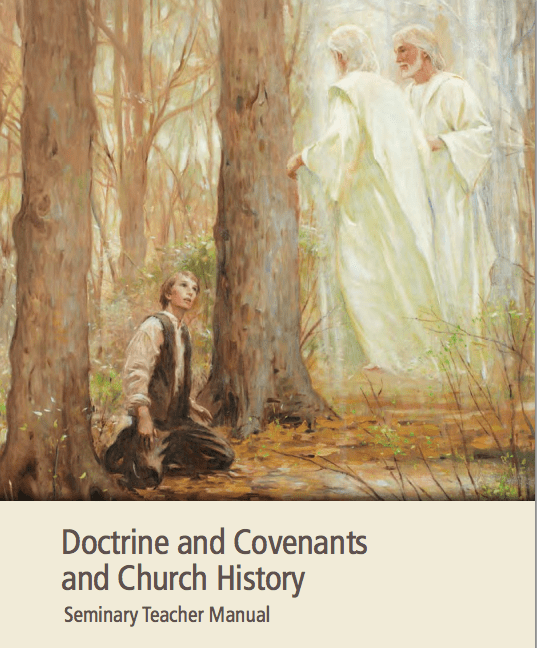
Screen Shot 2014-02-05 at 11.17.54 PM
The cover page of the new edition of the Doctrine and Covenants and Church History seminary manual.

[Cross-posted from Ploni Almoni: Mr. So-and-So’s Mormon Blog.]

The Church has released a new edition of the Doctrine and Covenants and Church History manual for seminary students. One of the remarkable aspects of the new manual is that it includes a discussion of several sensitive topics in church history. These topics include the following.

1. The various accounts of the First Vision are highlighted in the new manual. “There are nine known accounts of the First Vision—four written or dictated by Joseph Smith and five written by others retelling his experience,” the manual states (p. 20).

The multiple accounts of the First Vision were prepared at different times and for different audiences. In these accounts, Joseph Smith emphasized different aspects of his experience of the First Vision, but the accounts all agree in the essential truth that Joseph Smith did indeed have the heavens opened to him and see divine messengers, including God the Father and the Lord Jesus Christ. Because the 1838 account was part of Joseph Smith’s official history and testimony to the world, it was included in the Pearl of Great Price as scripture. (p. 20)

The manual then recommends students to read articles by Milton Backman and Richard Lloyd Anderson published in the Ensign discussing the various accounts of the First Vision (pp. 20, 22).

2. There is an entire chapter devoted to the Mountain Meadows Massacre and the Utah War (Lesson 151). The manual gives a brief historical overview of the events leading up to the massacre and acknowledges the participation of “Latter-day Saint leaders and settlers” in the crime (p. 523). Besides citing an article on the Mountain Meadows Massacre published in theEnsign, the manual also reproduces this quote given by President Henry B. Eyring at the 150 year anniversary of the massacre.

The gospel of Jesus Christ that we espouse, abhors the cold-blooded killing of men, women, and children. Indeed, it advocates peace and forgiveness. What was done [at the Mountain Meadows] long ago by members of our Church represents a terrible and inexcusable departure from Christian teaching and conduct.

3. In a chapter on the history of the Pearl of Great Price there is a brief overview of the history of the Book of Abraham, including the loss and recovery of several papyrus fragments once in the possession of Joseph Smith (pp. 524–526). Included in the discussion about the Book of Abraham is this (which is actually reprinted from the Church’s Pearl of Great Price Student Manual).

In 1966 eleven fragments of papyri once possessed by the Prophet Joseph Smith were discovered in the Metropolitan Museum of Art in New York City. They were given to the Church and have been analyzed by scholars who date them between about 100 B.C. and A.D. 100. A common objection to the authenticity of the book of Abraham is that the manuscripts are not old enough to have been written by Abraham, who lived almost two thousand years before Christ. Joseph Smith never claimed that the papyri were autographic (written by Abraham himself), nor that they dated from the time of Abraham. It is common to refer to an author’s works as ‘his’ writings, whether he penned them himself, dictated them to others, or others copied his writings later. (p. 525)

(Incidentally, yours truly has written a thing or two on this subject over at the Interpreter blog, which you can access here.) The manual also states, “Although we do not know the exact method Joseph Smith used to translate the writings, we do know that he translated the book of Abraham by the gift and power of God” (p. 525).

4. The new manual has material covering the practice of plural marriage, including an entire chapter on Joseph Smith’s plural marriage (Lesson 140) and a mentioning of Post-Manifesto plural marriage. Below are a few pertinent excerpts from the manual.

In this dispensation the Lord commanded some of the early Saints to practice plural marriage. The Prophet Joseph Smith and many other Church leaders found this commandment difficult, but they obeyed it. After receiving revelation, President Wilford Woodruff issued the Manifesto, which was accepted by the Church as authoritative and binding on October 6, 1890. This led to the end of the practice of plural marriage in the Church (see Official Declaration 1). (p. 204)

While Joseph Smith was working on the inspired translation of the Old Testament in 1831, he read about some of the ancient prophets practicing plural marriage (also called polygamy). Under this practice, one man is married to more than one living wife. The Prophet studied the scriptures, pondered what he learned, and eventually took his questions about plural marriage to Heavenly Father in prayer. . . . the Prophet Joseph Smith was reluctant to begin the practice of plural marriage. He stated that he did not begin the practice until he was warned that he would be destroyed if he did not obey. . . . Because of a lack of historical documentation, we do not know about Joseph Smith’s early attempts to comply with the commandment. However, by 1841 the Prophet had begun to obey the commandment and to teach it to some members of the Church, and over the next three years he married additional wives in accordance with the Lord’s commands. The Prophet Joseph Smith’s obedience to the Lord’s commandment to practice plural marriage was a trial of faith for him and his wife Emma, whom he loved dearly. (pp. 477–478)

Practicing plural marriage brought additional challenges. Because the practice was initially kept very quiet, rumors began to spread about Church leaders marrying additional wives. These rumors greatly distorted the truth, slandered the names of the Prophet and other Church leaders, and contributed to increased persecution against the Saints. (p. 479)

A small number of Latter-day Saints continued to enter into new plural marriages after the Manifesto was given. In 1904, President Joseph F. Smith announced “that all [plural] marriages are prohibited, and if any officer or member of the Church shall assume to solemnize or enter into any such marriage he will be . . . excommunicated”. . . . This policy continues today. (p. 530)

Towards the end of the chapter on Joseph Smith’s plural marriage, the manual warns, “Much unreliable information pertaining to plural marriage exists on the Internet and in many print sources. Be cautious and wise with such information. Some authors who write about the Church and its history present information out of context or include partial truths that can be misleading. The intent of some of these writings is to destroy faith” (p. 479). I myself have raised a similar point in this post. The manual then concludes by recommending, “Reliable historical research concerning the practice of plural marriage can be found at josephsmithpapers.org and byustudies.byu.edu” (p. 480).

5. On describing the nature of the Joseph Smith Translation, the manual says the following.

Around the fall of 1830, Joseph Smith was commanded by the Lord to translate the Bible. He did not translate the Bible from one language to another; nor did he have an original biblical manuscript to work from. Instead, Joseph would read and study passages from the King James Version of the Bible and then make corrections and additions as inspired by the Holy Ghost. Thus, the translation was more of an inspired revision than a traditional translation.The Joseph Smith Translation is estimated to have affected at least 3,400 verses in the King James Version of the Bible. These differences include additions (to clarify meaning or context), deletions, rearranged verses, and complete restructurings of certain chapters. The Joseph Smith Translation clarified doctrinal content, especially the mission of Jesus Christ, the nature of God, the nature of man, the Abrahamic covenant, the priesthood, and the Restoration of the gospel. (pp. 180–181)

6. The historical circumstances surrounding the priesthood ban and President Spencer W. Kimball’s 1978 revelation are discussed in a chapter on Official Declaration 2 (Lesson 157). As part of this discussion, the manual reprints the introductory material to OD 2 printed in the 2013 edition of the scriptures.

The Book of Mormon teaches that ‘all are alike unto God,’ including ‘black and white, bond and free, male and female’ (2 Nephi 26:33). Throughout the history of the Church, people of every race and ethnicity in many countries have been baptized and have lived as faithful members of the Church. During Joseph Smith’s lifetime, a few black male members of the Church were ordained to the priesthood. Early in its history, Church leaders stopped conferring the priesthood on black males of African descent. Church records offer no clear insights into the origins of this practice.

There is also the recommendation at the end of the chapter for students to “go to Gospel Topics on LDS.org and search for ‘race and the priesthood'” to learn more about the priesthood ban (p. 545).

7. Finally, in discussing section 77 of the Doctrine and Covenants, the manual straightforwardly says, “The 7,000 years [in vv. 6–7]  refers to the time since the Fall of Adam and Eve. It is not referring to the actual age of the earth including the periods of creation” (p. 280).

I am sure there is more that could be said about the new manual, but suffice it to say from the above examples that the Church is implementing productive measures towards introducing these sort of issues in a faith-promoting, safe, and positive environment (seminary). This will hopefully serve to “inoculate,” to use the popular metaphor, seminary students against the often highly debatable claims and negative information one can currently find on the Internet. While one might perhaps quibble over how certain issues are addressed in the new manual, that there is even a discussion at all in Church curriculum is, in my estimation, a step in the right direction.

Filed Under: Apologetics, Book of Abraham, Book reviews, Faith Crisis, First Vision, Joseph Smith, LDS History, LDS Scriptures, Polygamy, Racial Issues, Science Tagged With: Blacks and the Priesthood, Book of Abraham, Church History, Doctrine and Covenants, First Vision, Joseph Smith Translation, Plural Marriage, seminary

Fair Issues 41: Real Science, truth coincide

January 31, 2014 by Ned Scarisbrick

https://media.blubrry.com/mormonfaircast/www.fairlatterdaysaints.org/wp-content/uploads/2014/01/Fair-Issue-41-Pod.mp3

Podcast: Download (7.1MB)

Subscribe: RSS

Ash (newer) PictureMichael R. Ash relates how real science, truth coincide with real Mormon scholarship.  While science is unable to answer the questions about the purpose for life, the hereafter, or many other thing that must be taken on faith, accurate science is necessary for the telling us about the world in which we live.  As Elder John A. Widtsoe said: “Truth is truth forever. Scientific truth cannot be a theological lie.”

The full text of this article can be found at Deseret News online.

Brother Ash is author of the book Shaken Faith Syndrome: Strengthening One’s Testimony in the Face of Criticism and Doubt, as well as the book, of Faith and Reason: 80 Evidences Supporting the Prophet Joseph Smith. Both books are available for purchase online through the FairMormon Bookstore.

Tell your friends about the Mormon Fair-Cast. Share a link on your Facebook page and help increase the popularity of the Mormon Fair-Cast by subscribing to this podcast in iTunes, and by rating it and writing a review.


Filed Under: Apologetics, Book of Mormon, Evidences, Hosts, Ned Scarisbrick, Podcast, Science

Book Review: Letters to a Young Mormon

January 9, 2014 by Trevor Holyoak

Title: Letters to a Young Mormon
Author: Adam S. Miller
Publisher: Neal A. Maxwell Institute for Religious Scholarship
Genre: Religion – Faith
Year Published: 2014
Number of Pages: 78 pages
Binding: Paperback
ISBN-10: 0842528563
ISBN-13: 978-0842528566
Price: $9.95

Reviewed by Trevor Holyoak

This is the first book in a new “Living Faith” series from the Maxwell Institute. While reading it, I struggled to determine just who the “young Mormon” is that the book is aimed at. Is it for teenagers, or perhaps for 20-somethings? I think I actually understand it much better as a 40 year old father than I would have at a younger age, mostly due to the knowledge and experience I have since gained. Then I discovered, thanks to Amazon, that there has been a whole crop recently of books entitled “Letters to a Young XXXXX” (for example, Letters to a Young Contrarian by the late atheist Christopher Hitchens). Briefly looking at some of them, it appears that this book may have been loosely modeled after them. However I still question exactly who the intended audience is.

The book covers a wide range of topics of interest to Mormons, including agency, work, sin, faith, scripture, prayer, history, science, hunger, sex, temples, and eternal life. While I did find some new insights in some of these letters, much of what is contained is vague enough that any parent who shares the book with their teenage child may want to read it themselves so they can discuss it together. The chapter on sex, in particular, warrants this, as the only thing really clear in it is an admonition to avoid pornography, and then only for some of what I consider to be the right reasons.

I asked my two teenage daughters to read a couple chapters each. My 17 year old chose the chapters on history and hunger and thought they were too vague and wished the author had connected the dots. She is probably more familiar with some of the things mentioned (but not explained) in the history letter – such as “Joseph Smith’s clandestine practice of polygamy, Brigham Young’s strong-armed experiments in theocracy, or George Albert Smith’s mental illness” (page 48) – than many young LDS people her age because I have tried to teach her about some of the more difficult topics, yet she had questions about the usage of the word “clandestine” and about George Albert Smith. In fact, with that kind of loaded wording, someone picking it up off the shelf and glancing casually at the page might get the initial impression that it is anti-Mormon material. This chapter may provide an opportunity for a parent to teach their child how to find trustworthy answers for any questions that are raised.

On the other hand, my 16 year old (who doesn’t like to read and appreciated the shortness of the sections) read the prayer and the temple sections, and found she could actually relate to some of it. I think the temple chapter is one of the better ones in the book, and it was particularly timely for her because the material in it complemented what I told her in a discussion we recently had after she stumbled upon a critical video on YouTube.

There are a few other places in the book where I feel good answers are given to common issues. One example is an explanation for the seemingly unscientific account of the creation found in Genesis. The author begins by explaining that the Hebrews “thought the world was basically a giant snow globe. When God wanted to reveal his hand in the creation of their world, he borrowed and repurposed the commonsense cosmology they already had. He wasn’t worried about its inaccuracies, he was worried about showing his hand at work in shaping their world as they knew it” (page 53). Miller continues through the creation sequence as the Hebrews would have understood it, and then follows up by relating his experience in changing his point of view from a literal one that he retained beyond his mission to one that allows more for the scientific explanations of today.

In regard to some of the struggles we might have when learning about church history, he points out that “it’s a false dilemma to claim that either God works through practically flawless people or God doesn’t work at all…. To demand that church leaders, past and present, show us only a mask of angelic pseudo-perfection is to deny the gospel’s most basic claim: that God’s grace works through our weakness. We need prophets, not idols” (page 47).

Where Miller is clear on things, he excels by providing much food for thought and discussion. And in spite of its weaknesses, the bright spots in this book make it a worthwhile read for people who will not be troubled by its overwhelming vagueness, although I do believe a parental advisory may be in order.

Filed Under: Apologetics, Book reviews, LDS Culture, LDS History, LDS Scriptures, pornography, Science, Temples

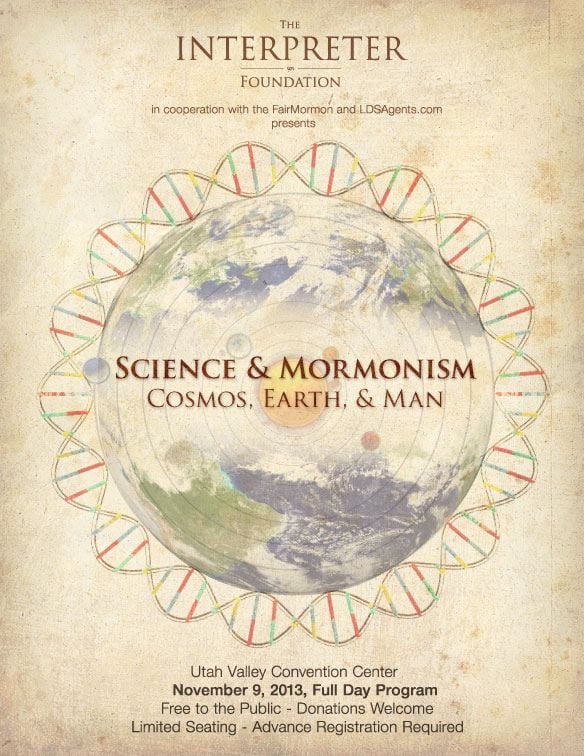
Science & Mormonism: Cosmos, Earth, & Man

October 13, 2013 by SteveDensleyJr

science-mormonism2Registration is closed for the first Interpreter Foundation symposium (co-sponsored by FairMormon and LDSAgents.com). However, the event will be streamed live on YouTube.

It will take place on November 9 and will begin at 8:30 MST.

Science and Mormonism have nearly always been on very friendly terms, with Church members sharing the deep conviction that, as expressed by former scientist and apostle Elder James E. Talmage, “within the gospel of Jesus Christ there is room and place for every truth thus far learned by man, or yet to be made known.” Subsequent Presidents and General Authorities of the Church have advanced similar views about the ultimate compatibility of religious and scientific truths and, with notably few exceptions, have maintained markedly positive attitudes toward both the methods and conclusions of mainstream science and the advance of modern technology.

This symposium will feature the personal perspectives of prominent LDS scientists addressing the theme of “Cosmos, Earth, and Man.” Through presentations, panels, and interactive discussions, attendees will hear concise and colorful summaries of the state-of-the-art in scientific research relating to these topics and will gain a deeper appreciation of the unique contributions of LDS doctrine to the ongoing conversation.

For more details, see: http://www.mormoninterpreter.com/events/2013-symposium-science-mormonism-cosmos-earth-man/

Filed Under: News from FAIR, Science

Mormon FAIR-Cast 146: Science and Religion

May 8, 2013 by SteveDensleyJr

https://media.blubrry.com/mormonfaircast/www.fairlatterdaysaints.org/wp-content/uploads/2013/03/Religion-Today-for-Sunday-October-1.mp3

Podcast: Download (9.1MB)

Subscribe: RSS

In this episode of Religion Today, which originally aired on KSL Radio on October 14, 2012, Martin Tanner discusses our pursuit of truth and the way in which science and religion both help us in this pursuit.

This recording was used by permission of KSL Radio and does not necessarily represent the views of The Church of Jesus Christ of Latter-day Saints or of FAIR.

Filed Under: Podcast, Science

Science vs. Religion?

May 2, 2013 by Mike Ash

Ash Picture“One of the grand fundamental principles of Mormonism is to receive truth, let it come from whence it may,” (Discourses of the Prophet Joseph Smith, p. 199)

In order to approach the scriptures from a realistic perspective we need to take a side trip into the secular world of science and scholarship. Wise and informed Latter-day Saints recognize that truth is truth regardless the source. The very fact that Joseph Smith admonished his followers to receive truth from all sources acknowledges that not all truth comes through spiritual mediations. In reality, the majority of truth comes through secular sources (perhaps sparked—even if unconsciously—from divine inspiration).

Although religion can open our hearts to receive the most important truths, the percentage of truths we learn from religion is miniscule compared to the truths that are discovered by secular means. Without secular truths we wouldn’t have cars, medications, clothes, computers, or sports. We are privileged to live in a world where science has made tremendous leaps in our understanding of nature, history, medicine, and technology.

In a previous installment I explained that Roman Catholics take a three-legged tripod-like approach to determining truth—Scripture, Tradition, and the Pope. I believe that we Latter-day Saints are asked to take a four-legged approach to truth, like the four legs of a stool. These would include: Scripture, Prophets, Personal Revelation, and Reason. By utilizing the methodologies for all four of these tools, we have a better chance of accurately determining what is true.

“Each of us,” said Elder Boyd K. Packer, “must accommodate the mixture of reason and revelation in our lives. The gospel not only permits it, but requires it.”[i] The Lord has instructed us to “seek learning even by study and also by faith” (D&C 88:118), and we are counseled to not only learn gospel principles, but secular theories in astronomy, history, geology, archaeology, and politics (v. 79).

Science, however, does not know everything and sometimes gets things wrong. In a way, I hate to make such claims and I’ll explain why below. It is a fact, however, that despite great advances in scientific acumen, we are a long way from knowing everything about the human body, the heavens, the earth, or our earthly co-inhabitants. I have the utmost respect for science and scholarship and have faith (no pun intended) that science will eventually arrive at all possible temporal truths. For the foreseeable future, however, there are many areas of science that reside in a state of flux, are hindered by un-resolvable variant interpretations, are un-knowable with current scientific tools.

Unfortunately, too many Latter-day Saints (as well as members of other religions) retreat into anti-science and anti-intellectual positions when they think that their doctrines (which are typically assumptions rather than doctrines) are challenged by science or secular scholarship. The claim that “science doesn’t know everything,” is the frequent leitmotif of those who are anti-science.

A related problem is the “God-of-the-Gaps” fallacy. Some claim that if science cannot explain a thing then the gap is filled by the workings of God (or is even proof of God). Isaac Newton, for example, recognized that there had to be some degree of gravitational interaction between Earth and Mars as they passed each other in their individual orbits. Newton believed that this interaction could be devastating to the solar system if not for God’s intervention. He was also unable to see any reason why most of the planets circled the Sun on a similar plane and in the same direction other than by divine decree. Since there appeared to be no scientific explanation for what he observed (a “gap” in the available knowledge) Newton attributed the actions to God.

The problem with such an approach is that these gaps are often closed with increased scientific knowledge. There is a difference between recognizing that science doesn’t have all the answers and claiming that where science is silent, we see proof of God.

There’s an interesting parallel to the God-of-the-Gaps problem in science, however. Since the general scientific paradigm is one that deals exclusively with what can be known empirically (there by excluding by default anything supernatural—and therefore God), all gaps in scientific knowledge are confidently seen as questions that can one day be answered by science (and not by religion).

While science is not infallible we need to be careful not to simply brush all conflicting information under the rug of “science-could-be-wrong.” Generally speaking the more established the scientific theories the more likely they are to be confirmed by various disciples of science—in a convergence of evidence—that not only depend on, but support the original theory.

The wonderful thing about science is that it is self-correcting. Some erroneous ideas or false assumptions take longer to fall than others, but with continued rigor the scientific community in general has demonstrated that mistakes, over-sights, and all other errors will eventually be replaced with superior, more adequate, and more accurate information.

It’s also important, however, to realize that “science” is not a single discipline that can be measured equally and with the same methods to check for accuracy and verisimilitude. There are “hard” sciences and “soft” sciences. Hard sciences are thenatural sciences and typically include fields like math, chemistry, and physics, whereas soft sciences are the social sciences such as psychology, history, archaeology, and anthropology.

As explained on Wikipedia: “The hard sciences are characterized as relying on quantifiable empirical data, relying on the scientific method, and focusing on accuracy and objectivity.” The soft sciences are more prone to conclusions based on interpretation.

A related aspect of the hard versus soft distinction has to do with the ease of drawing strong conclusions. In soft sciences, there are often numerous variables that might have an influence on some variable of interest, and many of those variables either may be non-quantifiable or may be quantifiable but difficult to obtain data on; but further, even with plentiful data, it may be difficult to disentangle the effects of such a large number of variables. In contrast, typically in the hard sciences there are only a few, readily identified, causative variables, making it easier to infer specific causative effects.[ii]

With the exception of “miracles” and currently un-measureable issues such as the existence of God, nearly all Mormon-related issues with which skeptics have problems, have to do with the subjectively-interpretive soft sciences rather than hard sciences.

If truth is really truth, in the end all truths in our world must harmonize. LDS scientist Henry Eyring once wrote: “Is there any conflict between science and religion? There is no conflict in the mind of God, but often there is conflict in the minds of men.”[iii]  When it comes to a conflict between what we have learned from religion and science we must step back and take a look at what the conflict is actually about. If the conflict is over core doctrines, science and scholarship can offer opinions, suggestions, and even evidence, but it cannot unseat true doctrines.

More often, however, science conflicts with our weak and often naive assumptions of history, scripture, or things which are peripheral to actual doctrines. When this happens, it is wise for us to reexamine our assumptions in light of scientific knowledge. If we do, we will generally find that we can embrace the secular scientific and scholarly teachings without abandoning the saving doctrines that have been confirmed by the Spirit.

*This article also appears in Meridian Magazine.

[i] Boyd K. Packer, “I Say Unto You, Be One” (BYU Devotional, 12 February 1991)(accessed 25 April 2013).

[ii] http://en.wikipedia.org/wiki/Hard_and_soft_science (accessed 18 December 2012).

[iii] Henry Eyring, Reflections of a Scientist (Salt Lake City: Deseret Book, 1983), 2.

Filed Under: Science

  • « Go to Previous Page
  • Go to page 1
  • Interim pages omitted …
  • Go to page 3
  • Go to page 4
  • Go to page 5
  • Go to page 6
  • Go to Next Page »

Primary Sidebar

Faithful Study Resources for Come, Follow Me

Subscribe to Blog

Enter your email address:

Subscribe to Podcast

Podcast icon
Subscribe to podcast in iTunes
Subscribe to podcast elsewhere
Listen with FAIR app
Android app on Google Play Download on the App Store

Pages

  • Blog Guidelines

FAIR Latest

  • Come, Follow Me with FAIR – Doctrine and Covenants 137–138 – Part 2 – Autumn Dickson
  • Come, Follow Me with FAIR – Doctrine and Covenants 137–138 – Mike Parker
  • FAIR December Newsletter
  • Come, Follow Me with FAIR – Doctrine and Covenants 137–138 – Part 1 – Autumn Dickson
  • Prophets of God 

Blog Categories

Recent Comments

  • LHL on Come, Follow Me with FAIR – Doctrine and Covenants 132 – Mike Parker
  • Stephen Johnsen on Come, Follow Me with FAIR – Doctrine and Covenants 132 – Mike Parker
  • Bruce B Hill on Come, Follow Me with FAIR – Doctrine and Covenants 124 – Part 1 – Autumn Dickson
  • Gabriel Hess on Join us Oct 9–11 for our FREE virtual conference on the Old Testament
  • JC on When the Gospel “Doesn’t Work”

Archives

Follow Us

  • Facebook
  • Twitter
  • iTunes
  • YouTube
Android app on Google Play Download on the App Store

Footer

FairMormon Logo

FAIR is a non-profit organization dedicated to providing well-documented answers to criticisms of the doctrine, practice, and history of The Church of Jesus Christ of Latter-day Saints.

Donate to FAIR

We are a volunteer organization. We invite you to give back.

Donate Now

Site Footer