• Skip to primary navigation
  • Skip to main content
  • Skip to primary sidebar
  • Skip to footer

FAIR

  • Find Answers
  • Blog
  • Media & Apps
  • Conference
  • Bookstore
  • Archive
  • About
  • Get Involved
  • Search

Science

FairMormon Conference Podcast #31 – Wade Miller, “The Presence of Pre-Columbian Horses in America”

July 8, 2019 by Trevor Holyoak

https://media.blubrry.com/mormonfaircast/www.fairlatterdaysaints.org/wp-content/uploads/2019/07/Wade-Miller.mp3

Podcast: Download (45.6MB)

Subscribe: RSS

This podcast series features past FairMormon Conference presentations. Please join us for the 2019 FairMormon Conference coming up August 7-9! You can attend in person or purchase the video streaming.

Wade Miller, The Presence of Pre-Columbian Horses in America

Transcript available here.

Wade E. Miller is a professor of geology and paleontology, retired from Brigham Young University. He earned his MS in geology from the University of Arizona and his Ph.D. in paleontology from UC Berkeley. Besides teaching at BYU, Wade has taught at Fullerton Junior College and at Santa Ana College. He has served, at various times, as paleontological advisor for the U.S. Bureau of Land Management, the State of Utah, the Las Vegas Natural History Museum, the University of Mexico, and the University of Hidalgo (Mexico). During his career Wade published or co-published over 80 scientific articles or books. He is currently a research associate at the Natural History Museum of Los Angeles County. Wade has served in numerous callings, including as a teacher and a bishop. He is married to the former Patricia Haws and is the father of three children (all sons).

Audio Copyright © 2018 The Foundation for Apologetic Information and Research, Inc. Any reproduction or transcription of this material without prior express written permission is prohibited.


Filed Under: Book of Mormon, Evidences, FAIR Conference, FairMormon Conference, Podcast, Science

Book Review – Who is Truth? Reframing Our Questions for a Richer Faith

June 12, 2019 by Trevor Holyoak

Available in the FairMormon Bookstore

Jesus said, “I am the way, the truth, and the life” (John 14:6). We take this literally for the words “way” and “life,” but what if we also took it literally for the word “truth”? In their book Who What is Truth? Reframing Our Questions for a Richer Faith, that is exactly what authors Jeffrey L. Thayne and Edwin E. Gantt encourage us to do, changing our way of thinking from truth as an idea (this turns out to be rooted in Greek philosophy) to truth as a person (Hebrew thought).

The chapter headings give a good summary of what is covered: “What if truth is a person?,” “The ancient roots of person-truth,” “Faith in ideas, or faithfulness to a Person?,” “Knowing God vs. believing ideas about Him,” “Person-truth does not give us control,” “Knowing person-truth through covenant,” “Our on-and-off relationship with person-truth,” “What it means to be an authority on truth,” “The archnemesis of person-truth,” “What is sin, if truth is a person?,” “Rethinking the atonement of Christ,” and “Person-truth in a world of science and reason.” There is also a conclusion chapter, a list of further readings, and appendixes with more on Greek and Hebrew thought and questions and answers.

I was initially skeptical when offered this book to review. But it claimed to offer help for those having a faith crisis, and to strengthen faith in Jesus Christ and the Restoration, so I thought it would be worth a look. I was pleasantly surprised, and found myself agreeing with the conclusions (the good fruit being brought forth), even as I am still processing the explanations that led up to them. The authors anticipated skepticism, and they addressed all the potential red flags that came up in my mind as I read. [Read more…] about Book Review – Who is Truth? Reframing Our Questions for a Richer Faith

Filed Under: Anti-Mormon critics, Apologetics, Apostasy, Bible, Book of Mormon, Book reviews, Conversion, Doctrine, Early Christianity, Faith Crisis, Perspective, Philosophy, Power of Testimony, Prophets, Questions, Resources, Science, Temples, Testimonies

FairMormon Conference Podcast #12 – Scott Petersen, “Jesus Christ, the Same Yesterday, Today, and Forever: A Restoration of Primitive Christianity”

August 14, 2018 by Trevor Holyoak

https://media.blubrry.com/mormonfaircast/www.fairlatterdaysaints.org/wp-content/uploads/2018/08/Scott-Peterson.mp3

Podcast: Download (83.2MB)

Subscribe: RSS

This podcast series features past FairMormon Conference presentations. This episode is a presentation from 2017. If you would like to watch the presentations from the conference we had earlier this month, you can still purchase video streaming.

Scott Petersen, Jesus Christ, the Same Yesterday, Today, and Forever: A Restoration of Primitive Christianity

Transcript available here.

Scott is the Executive Director of the Rollins Center for Entrepreneurship & Technology at BYU. Under his leadership the program has been ranked in the top five of all collegiate entrepreneurship programs for each of the past seven years, ranking #2 in 2016. He is also the Founder and Chairman of Omadi, Inc., a venture backed SaaS mobile CRM platform for workforce management, serving the towing/transportation markets. Scott is a long time entrepreneur having co-founded or partnered in building seven companies (harvesting four), including several current ventures. Additionally, he serves on several business and private foundation boards. In 2005, Scott published a significant work, titled Where Have All The Prophets Gone?, a historical, theological book on early Christianity using the Bible, the Pseudepigrapha, the Apocrypha, the Dead Seas Scrolls, the Nag Hammadi Library, and all of the extant early Christian writings. In 2014 Scott published his second book, Do the Mormons Have a Leg to Stand On?: a Critical Look at LDS Doctrines in the Light of the Bible and the Teachings of the Early Christian Church. Scott and his wife Marilyn are the parents of 5 married children and they have 15 grandchildren. Scott serves as Stake President of the Provo Utah YSA 4th Stake.

Audio and Video Copyright © 2017 The Foundation for Apologetic Information and Research, Inc. Any reproduction or transcription of this material without prior express written permission is prohibited.

Filed Under: Apologetics, Apostasy, Bible, Book of Mormon, Dead Sea Scrolls, Early Christianity, FAIR Conference, FairMormon Conference, Faith Crisis, Homosexuality, Joseph Smith, LDS History, Media, Podcast, Prophets, Science

FairMormon Conference Podcast #11 – Michael Ash, “After the Manner of Their Language: The Key to Wisdom”

July 30, 2018 by Trevor Holyoak

https://media.blubrry.com/mormonfaircast/www.fairlatterdaysaints.org/wp-content/uploads/2018/07/Michael-Ash.mp3

Podcast: Download (81.1MB)

Subscribe: RSS

This podcast series features past FairMormon Conference presentations. Please join us for the 2018 FairMormon Conference coming up August 1-3! You can attend in person or purchase the video streaming.

Michael Ash, After the Manner of Their Language: The Key to Wisdom

Transcript available here.

Michael R. Ash is the author of Shaken Faith Syndrome: Strengthening One’s Testimony in the Face of Criticism and Doubt, Of Faith Reason: 80 Evidences Supporting the Prophet Joseph Smith, as well as Bamboozled by the “CES Letter.” A former columnist for the Deseret News’ Mormon Times, he has also been a frequent contributor to the online blogs, Meridian Magazine, as well as the Mormon Hub. Mike has been published in the Ensign, Sunstone Magazine, Dialogue: A Journal of Mormon Thought, in the FARMS Review, and most recently contributed a chapter to Kofford Book’s Perspectives in Mormon Theology: Apologetics. Joining FairMormon in the year 2000, Mike delivered a paper at the 2nd annual FairMormon conference and has contributed papers to seven additional conferences (including this one) since. Mike and his wife Chris live in Ogden and are the parents of three daughters and the grandparents of six grandchildren.


Audio and Video Copyright © 2017 The Foundation for Apologetic Information and Research, Inc. Any reproduction or transcription of this material without prior express written permission is prohibited.

Filed Under: Bible, Book of Abraham, Book of Mormon, FAIR Conference, FairMormon Conference, Faith Crisis, Joseph Smith, LDS History, LDS Scriptures, Michael R. Ash, Perspective, Podcast, Prophets, Racial Issues, Science

Why and How Should We Study the Old Testament? (Gospel Doctrine Lesson 19A)

May 15, 2018 by Jeffrey M. Bradshaw

Details of Saturn’s atmosphere and rings

An Old Testament KnoWhy relating to the reading assignment for Gospel Doctrine Lesson 19: The Reign of the Judges (Judges 2; 4; 6-7; 13-16) (JBOTL19A)

Question: The Bible account of Creation explains very little about the formation of the solar system or the biological origin of life. Archaeological evidence sometimes directly contradicts it, its laws of diet and purity seem irrelevant, and its prophecies are largely unintelligible. Why should I spend my time studying the Old Testament when I could be focusing my attention instead on up-to-date history and science or on the practical, ethical teachings of Jesus that teach us how we should live.

Summary: Having most recently discussed archaeological findings that relate to the books of Joshua and Judges, and having written prior to that on the historical context of the Exodus, I would now like to consider the larger question of why and how one might study the Old Testament. Specifically, in this article, I will explain why I think it is important to counterbalance the study of scripture in its historical and scientific context with traditional forms of scripture reading. First, it should not be forgotten that the Old Testament provides essential background not only for Jesus’ teachings on how we should live from day to day but also on His words about the meaning and purpose of life from an eternal perspective. Relatively little of the rest of scripture — whether ancient or modern — can be adequately understood without reference to its Old Testament backdrop. Sadly, given the common tendency today to treat the stories of the Old Testament as targets of humor and caricature (when they are not ignored altogether), it is difficult for some people to take them seriously. However, serious study of the Old Testament will reveal not merely tales of “piety or … inspiring adventures” but in addition carefully crafted narratives from a highly sophisticated culture that frequently preserve “deep memories” of doctrinal understanding. We do an injustice both to these marvelous records and to ourselves when we treat them merely as pseudo-science, botched history, or careless editorial paste-up jobs. A doctrinal perspective on the Old Testament should always remain central to our efforts to appreciate and understand it, even while acknowledging the significant enrichment that historical, scientific, and textual studies can provide in a secondary role.

The full article may be found at the Interpreter Foundation website: KnoWhy OTL19A — Why and How Should We Study the Old Testament?

See https://www.youtube.com/watch?v=aXiVXmUBqn0 for a 15-minute excerpt from the 1960’s church film “The Search for Truth” posted on the Interpreter channel. It contains an opening statement by President David O. McKay on the value of science and the search for truth, followed by perspectives from prominent scientists, including Henry Eyring.

Filed Under: Bible, Doctrine, Lesson Aids, Questions, Resources, Science, Temples Tagged With: archaeology, Creation, Gospel Doctrine: Old Testament, Historicity, origin of life, Scriptures

FairMormon Conference Podcast #5 – Ugo Perego, “What does the Church believe about evolution?”

April 19, 2018 by Trevor Holyoak

https://media.blubrry.com/mormonfaircast/www.fairlatterdaysaints.org/wp-content/uploads/2018/04/Ugo-Perego.mp3

Podcast: Download (57.8MB)

Subscribe: RSS

This podcast series features a FairMormon Conference presentation each month. Please join us for the 2018 FairMormon Conference coming up August 1-3. You can attend in person or purchase the video streaming. You can watch older conference presentation videos on our YouTube channel and FairMormon TV for Roku, Amazon Fire TV, and Android TV. Transcripts for past presentations are available here.

Ugo Perego, What does the Church believe about evolution?

Ugo A. Perego received a BS and a MS in Health Sciences from Brigham Young University (Provo, Utah) and a PhD in Genetics and Biomolecular Sciences from the University of Pavia (Pavia, Italy) under the mentorship of Professor Antonio Torroni. He is the Director of the Rome Institute Campus, the S&I Coordinator for Central Italy and Malta, and a Visiting Scientist at the University of Pavia. During the past fifteen years, Ugo has given nearly 200 international lectures on DNA topics related to population migrations, ancestry, forensics, and history (including LDS history). Ugo has also authored and co-authored a number of publications, including: “Ancient individuals from the North American Northwest Coast reveal 10,000 years of regional genetic continuity” (in PNAS USA, 2017); “Finding Lehi in America through DNA Analysis” (in Laura Hales’ A Reason for Faith: Navigating LDS Doctrine & Church History, 2016); “The first peopling of South America: new evidences from the Y-chromosome haplogroup Q” (in Plos One, 2013); “Reconciling migration models to the Americas with the variation of North American native mitogenomes” (in PNAS USA, 2013); “The Mountain Meadows Massacre and ‘Poisoned Springs’: Scientific Testing of the More Recent, Anthrax Theory” (in International Journal of Legal Medicine, 2012); and “Joseph Smith Jr., the Question of Polygamous Offspring and DNA Analysis” (in Craig Foster and Newell Bringhurst’s The Persistence of Polygamy Vol. 1, 2010). A complete list of his publications is available at www.JosephSmithDNA.com.

Ugo is married to Jenna and they are the parents of four boys and a girl. They currently live in Rome, Italy.

Audio and Video Copyright © 2017 The Foundation for Apologetic Information and Research, Inc. Any reproduction or transcription of this material without prior express written permission is prohibited.

Filed Under: FAIR Conference, FairMormon Conference, Podcast, Science

Was Noah’s Ark Designed As a Floating Temple? (Old Testament Gospel Doctrine 6A)

February 3, 2018 by Jeffrey M. Bradshaw

Thomas Cole, 1801-1848: The Subsiding Waters of the Deluge, 1829

An Old Testament KnoWhy for Gospel Doctrine Lesson 6: “Noah … Prepared an Ark to the Saving of His House” (Moses 8:19-30; Genesis 6-9; 11:1-9) (JBOTL06A).

Question: In the Bible, Noah’s ark is described as a huge, rectangular box with three floors and a roof, which makes it sound more like a building than a boat. Was Noah’s ark designed as a floating “temple”?

Summary: In the Bible, God reveals the design of three man-made structures: two of these are temples and one is Noah’s ark. To ancient Israelites, the dimensions, shape, layout, materials, and function of the Ark would have immediately suggested that it, too, had been designed as a “temple.” In addition, the story of the Flood explicitly echoes the scenes of Creation and Eden found in the story of Adam and Eve, including the Ark’s final destination on the heights of a mountain.


The full article may be found at the Interpreter Foundation website: KnoWhy OTL06A — Was Noah’s Ark Designed As a Floating Temple?

As a video supplement to this lesson with additional details and artwork not included in this article, see Jeffrey M. Bradshaw, “The Ark and the Tent: Temple Symbolism in the Story of Noah” on the YouTube Interpreter Foundation channel (https://www.youtube.com/watch?v=kIfArfB54Mk ).

Filed Under: Bible, Book of Moses, LDS Scriptures, Lesson Aids, Questions, Science, Temples Tagged With: Flood, Gospel Doctrine: Old Testament, Joseph Smith Translation, Noah

What Can the Architecture of Israelite Temples Teach Us About Creation and the Garden of Eden? (Old Testament Gospel Doctrine 3A)

January 19, 2018 by Jeffrey M. Bradshaw

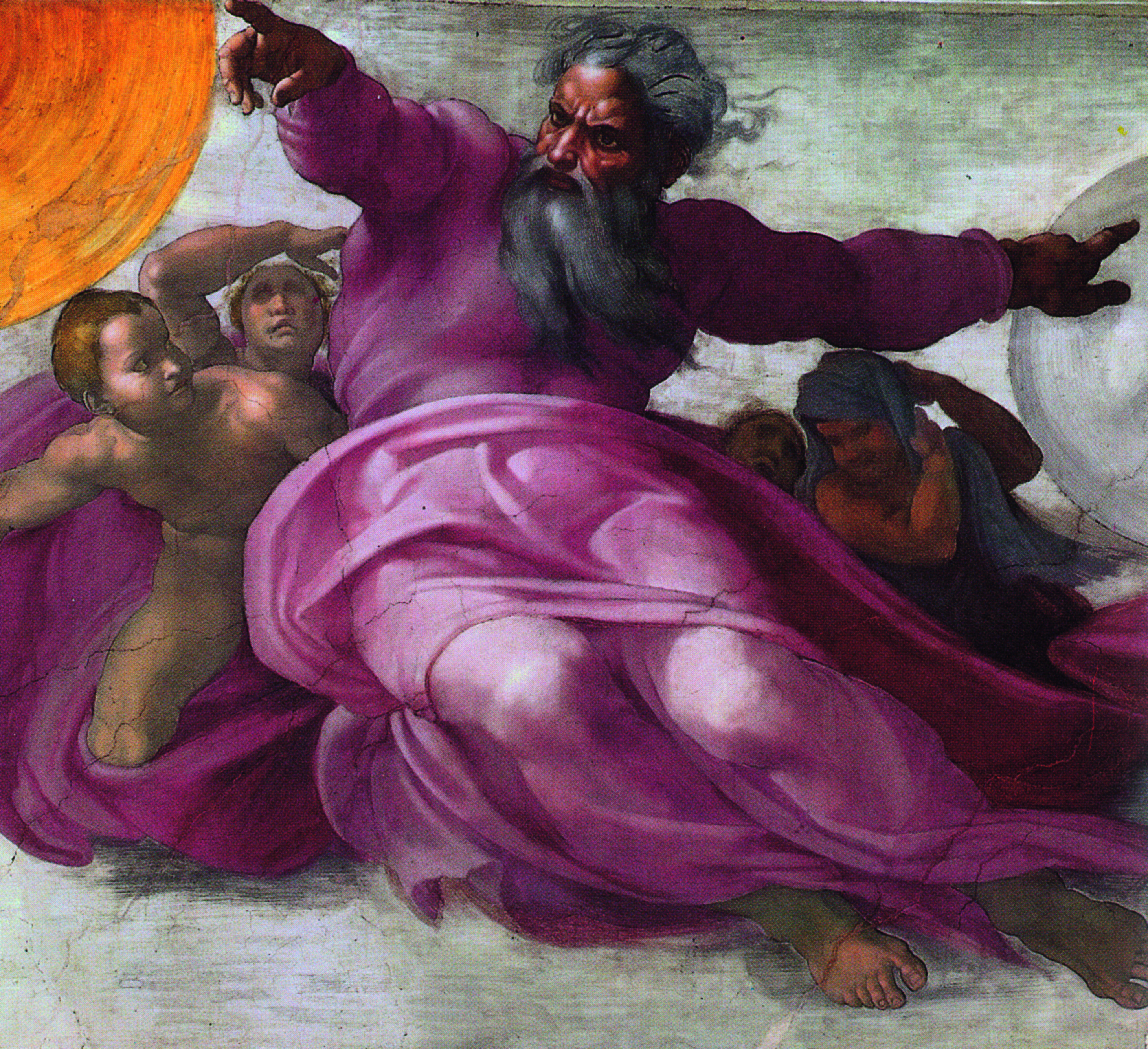
Michelangelo, 1475-1564: Creation of the Sun and Moon, 1511

An Old Testament KnoWhy for Gospel Doctrine Lesson 3: The Creation (Moses 1:27-42; 2-3) (JBOTL03A), 8 January 2018

Question: In reading the description of the seven days of Creation and the layout of the Garden of Eden, there seems to be more than meets the eye. What insights can be gained about these things from understanding the architecture of the Israelite temples?

Summary: The descriptions of the days of creation in Genesis and the book of Moses differ from those found in the book of Abraham and in modern temples. In contrast to the latter accounts, the narratives in Genesis and the book of Moses seem to have been deliberately shaped to highlight resemblances between the creation of the universe and the architecture of the Tabernacle and later Israelite temples. Understanding these parallels helps explain why, for example, in seeming contradiction to scientific understanding, the description of the creation of the sun and moon appears after, rather than before, the creation of light and of the earth. Careful study also reveals that not only the Creation, but also the Garden of Eden provided a model for the architecture of the temple.

The full article may be found at the Interpreter Foundation website: KnoWhy OTL03A — What Can the Architecture of Israelite Temples Teach Us About Creation and the Garden of Eden?

Filed Under: Bible, Book of Moses, LDS Scriptures, Lesson Aids, Questions, Science, Temples Tagged With: Creation, Garden of Eden, Gospel Doctrine: Old Testament, Investiture Panel of Mari, Joseph Smith Translation

Book Review: A Reason for Faith: Navigating LDS Doctrine & Church History

September 16, 2016 by Trevor Holyoak

Available from the FairMormon bookstore at 20% off

In the prologue of A Reason for Faith, the editor, Laura Hales, lays out the purpose of the book. Members of the church sometimes come across new information in an unfriendly setting that damages their faith. This book is a compilation of articles about many of the topics that are not often discussed in a church or family setting, and can be difficult to understand. They are laid out by scholars in an honest but faithful manner, and while they can’t possibly cover the topics completely in the amount of space given, they are meant to be a springboard for further study where necessary.

The first chapter is by Richard Bushman, on “Joseph Smith and Money Digging.” He recounts the history of scholarship in this area, where it was originally denied by those inside the church due to being based on accounts thought to be unreliable published by critics of the church. As he began his own research, he found evidence that convinced him that Joseph was indeed involved with folk magic and seer stones, and that these things were too common in the 19th century to invalidate Joseph’s prophetic claims or be scandalous. [Read more…] about Book Review: A Reason for Faith: Navigating LDS Doctrine & Church History

Filed Under: Apologetics, Bible, Book of Abraham, Book of Mormon, Book reviews, Chastity, DNA, Faith Crisis, Gender Issues, Homosexuality, Joseph Smith, LDS History, LDS Scriptures, Masonry, Polygamy, Prophets, Racial Issues, Science, Temples, Women

Resolving the Conflict Between Science and Religion

October 28, 2015 by Mike Ash

MAThe following is part of a fictional dialogue between Shane and Doug, two former missionary companions many years after their missions. Shane writes to his friend Doug who has posted comments about his on-going faith crisis on Facebook. The characters are fictionalized composites of members who have faced these same dilemmas but the issues are based on very real problems which have caused some to stumble. Likewise, the responding arguments are based on the author’s own personal engagement with these same concerns as well as his discussion of these issues with other members who have struggled. (By Michael R. Ash, author of Shaken Faith Syndrome: Strengthening One’s Testimony in the Face of Criticism and Doubt,and Of Faith and Reason: 80 Evidences Supporting the Prophet Joseph Smith, and Director of Media Products for FairMormon.)

Dear Doug,

I’m glad you found value in my last letter discussing DNA and the Book of Mormon. I’m not sure, however, if you’ve accurately understood my position on the science vs. religion debate. So in this letter I hope to clarify my perspective.

I believe that conflict between science and religion really comes down to a conflict between the known and the unknown. LDS scientist Henry Eyring (the late father of current apostle Henry B. Eyring) explained: “Is there any conflict between science and religion? There is no conflict in the mind of God, but often there is conflict in the minds of men.”[i]

Secular atheists claim that there is only the natural; what we call “supernatural” is simply the point where we have yet to fully explain the natural mechanics of the event or cause. Eventually, they argue, all of the “gaps” in such mysteries disappear and are replaced with naturalexplanations.

I actually sort of agree, but would phrase it a bit differently. God said, “all things unto me are spiritual” (D&C 29:34). Obviously, this doesn’t mean that your chair is simply spirit; what I believe it means is that everything—and that means everything—is part of a divine essence. So from God’s advanced perspective, all things are naturally spiritual. Natural and spiritual are simply different perspectives and descriptions of the same thing. As Brigham Young explained, “…God is a scientific character… He lives by science or strict law….”[ii]

Truth is truth. Joseph Smith once said: “One of the grand fundamental principles of Mormonism is to receive truth, let it come from whence it may.”[iii]

There is not spiritual truth or natural truth, there is only truth. The “gaps” that we fill with natural explanations are all part of God’s one truth. The problem, of course, is man’s arrogance in thinking that we have such great scientific vision that those things which believers call “spiritual” cannot be part of the same natural law.

While science is constantly advancing in our understanding of the world and cosmos, comparing what we know to what we don’t know is like claiming that a grain of sand understands the planet Earth because all it can see is beach. Science grapples with understanding the intricacies of the mind, the body, gravity, dark matter, multiverses, and countless aspects of what makes the universe tick. Knowledge is limited but progress is constantly being made.

Science is able to discover those parts of the God’s natural/supernatural world through tools which can measure some of those things which appear to have a physical presence. Revelation can discover those parts of God’s natural/supernatural world through tools which can glimpse some (but relatively few) of those things which do not have a physical presence.

Both science and revelation are able to lead us to truth. Both are liable to make errors because they utilize imperfect tools in the hands of imperfect humans. But both, combined, eventually will self-correct and teach us more about God’s natural/supernatural world.

We Latter-day Saints tend to focus on the feelings of the “heart” when determining God’s truth. We cannot test, with any currently known secular tools, if God exists, if Jesus is the Christ, or if Joseph Smith saw the Father and Son in a vision.

It’s all well and good to recognize the power of the heart in receiving testimony on life’s most important questions, but the appreciation for the “heart” should not come with an exclusion for the appreciation of the “brain.” God gave us both, and all of our thoughts (and the way our bodies react to spiritual manifestations) must be filtered through our brains.

In the ancient world people did not understand the purpose of the brain. They believed that emotions, feelings, spiritual impressions, and thoughts all came from the heart. We find numerous passages in the scriptures which reflect this ancient perspective. Following are just a few examples.

“Repent therefore of this thy wickedness, and pray God, if perhaps the thought of thine heartmay be forgiven thee,” (Acts 8:22, emphasis added).

“And he said unto them, Why are ye troubled? and why do thoughts arise in your hearts?” (Luke 24:38).

“And he said unto them: Behold, I, Samuel, a Lamanite, do speak the words of the Lord which he doth put into my heart; and behold he hath put it into my heart to say unto this people that the sword of justice hangeth over this people,” (Helaman 13:5).

The oft-quoted verse from Moroni expresses this ancient mindset: “Behold, I would exhort you that when ye shall read these things, if it be wisdom in God that ye should read them, that ye would …ponder it in your hearts” (Moroni 10:3).

We ponder in our minds, not in our hearts. We may feel the testimony (in part) in our hearts, but the thought process goes on in the brain.

When Oliver Cowdery tried the translate the Book of Mormon the Lord told him that the mind was part of the process: “But, behold, I say unto you, that you must study it out in your mind; then you must ask me if it be right, and if it is right I will cause that your bosom shall burn within you; therefore, you shall feel that it is right” (D&C 9:8). As President Uchtdorf explained:

When we talk about testimony, we refer to feelings of our heart and mind rather than an accumulation of logical, sterile facts. It is a gift of the Spirit, a witness from the Holy Ghost that certain concepts are true.[iv]

I think that too often some Latter-day Saints tend to brush off science and scholarship as unreliable (the “arm of flesh”) when most of what drives our modern twenty-first century lives comes as the result of the power of that same science and scholarship.

In our search for truth we should embrace science and scholarship. Logic and historical precedence give us good reason why we shouldn’t demand the acceptance of all current points of scientific knowledge as final—we know that science can, has, and will make mistakes. Recognizing that mistakes have been made (and will undoubtedly be made again) is no excuse, however, to simply reject science when it conflicts with our interpretations of religious issues. Science is self-correcting and eventually truths are discovered.

Anti-science and anti-scholarship positions are not the paths to discovering truth and therefore are not, I believe, the way the Lord would want us to approach our quest for learning. The Lord suggested that we are to be “instructed more perfectly in theory, in principle, in doctrine”

“…Of things both in heaven and in the earth, and under the earth [geology, archaeology?]; things which have been [history], things which are [current events], things which must shortly come to pass [science]; things which are at home [local politics, culture, history?], things which are abroad [foreign politics, cultures, history?]; the wars and the perplexities of the nations, and the judgments which are on the land; and a knowledge also of countries and of kingdoms” (D&C 88:79).

Anti-science and anti-scholarship positions can damage us both physically as well as spiritually. It is an unfortunate fact, for example, that at least a few Latter-day Saints have joined with the anti-vaccination movement despite overwhelming scientific support for the benefit of vaccinations as well as an absence of scientific evidence supporting the myth that vaccinations cause autism. Those members who reject the science on the issue, also reject Church counsel which recommends that children should be vaccinated.[v]

Spiritual stumbling blocks can also be constructed of anti-intellectual bricks. The DNA topic we discussed earlier is a good example. For those members who reject science, which tells us that the Americas were populated 15,000 years ago (and that the Lehites would have been a small incursion into this larger population), the DNA argument can damage faith. For those who accept the anthropological and archaeological evidences, as well as modern DNA science, the basic premise of the Book of Mormon remains unscathed.

In closing this far-too-lengthy letter, I think it’s significant to recognize that all truth works line upon line and—if followed properly—becomes self-correcting. This means that both science and religious truths will run into dead-ends, or will make wrong turns. Prophets do not get a special handbook from God that contains the answers to all questions. Their revelation (like ours) comes typically by way of answers to prayers and then may come only piecemeal or through a glass darkly (1 Corin. 13:12).

We must be willing to shift or modify our religious paradigms to absorb the truths of science. Ourbasic spiritual foundation is immutable and can only be known through the spirit. God lives, Jesus is the Christ and atoned for our sins, and the Gospel has been restored and is led by modern-day prophets who hold keys to sacred covenants.

Most of the rest of the stuff—yes, even the religious stuff—is ancillary and can be better understood through the application of a combination of both spiritual and secular learning. Science (to use a general description designating the mass of intellectual insights) has taught me at least two very important points regarding my approach to religious beliefs:

1) There are secular evidences which support belief. The more we learn, the more convinced I am that Joseph Smith was a prophet of God and that the Book of Mormon is a translation of an authentic ancient text.

2) I, like every other human, have often assumed too much. As secular studies give us a clearer picture about the world and history of mankind, I have frequently needed to adjust my worldviews about ancient scripture and how God works with and through His children and through the physical laws which govern our planet.

While some members have resisted modifying their paradigms, or have painfully jettisoned false assumptions (and, at times, their testimonies), I find such modifications not only to be rewarding, but exciting. The more I know, the more I realize how much I don’t know. Each new bit of knowledge, however, as well as each new modification or liberation from a faulty assumption, increases my appreciation for God’s creations and how He accomplishes His purposes through the weakness of humanity.

If you like, we can discuss some of these examples in subsequent letters.

Your friend,
Shane

Notes

[i] Henry Eyring, Reflections of a Scientist (SLC: Deseret Book, 1983), 2.

[ii] Brigham Young, Journal of Discourses (13 Nov. 1870), 13:302.

[iii] Joseph Smith, quoted in History of the Church of Jesus Christ of Latter-day Saints, 2nd ed. (SLC: Deseret News Press, 1949), 5:499.

[iv] Dieter F. Uchtdorf, “The Power of Personal Testimony,” https://www.lds.org/general-conference/2006/10/the-power-of-a-personal-testimony?lang=eng

[v] See, for example, the Church’s official website here:https://www.lds.org/church/news/church-makes-immunizations-an-official-initiative-provides-social-mobilization as well an official Church video here: https://www.youtube.com/watch?v=myA2SJha7G0&feature=youtu.be. See also non-official sites which discuss official Church quotes such as the one here: http://www.ldsliving.com/Church-Leaders-on-Child-Immunization/s/78000 and http://www.mormonpress.com/mormon_vaccination.

Filed Under: Apologetics, Atheism, Science

  • « Go to Previous Page
  • Go to page 1
  • Go to page 2
  • Go to page 3
  • Go to page 4
  • Go to page 5
  • Go to page 6
  • Go to Next Page »

Primary Sidebar

Faithful Study Resources for Come, Follow Me

Subscribe to Blog

Enter your email address:

Subscribe to Podcast

Podcast icon
Subscribe to podcast in iTunes
Subscribe to podcast elsewhere
Listen with FAIR app
Android app on Google Play Download on the App Store

Pages

  • Blog Guidelines

FAIR Latest

  • Come, Follow Me with FAIR – Doctrine and Covenants 137–138 – Part 2 – Autumn Dickson
  • Come, Follow Me with FAIR – Doctrine and Covenants 137–138 – Mike Parker
  • FAIR December Newsletter
  • Come, Follow Me with FAIR – Doctrine and Covenants 137–138 – Part 1 – Autumn Dickson
  • Prophets of God 

Blog Categories

Recent Comments

  • LHL on Come, Follow Me with FAIR – Doctrine and Covenants 132 – Mike Parker
  • Stephen Johnsen on Come, Follow Me with FAIR – Doctrine and Covenants 132 – Mike Parker
  • Bruce B Hill on Come, Follow Me with FAIR – Doctrine and Covenants 124 – Part 1 – Autumn Dickson
  • Gabriel Hess on Join us Oct 9–11 for our FREE virtual conference on the Old Testament
  • JC on When the Gospel “Doesn’t Work”

Archives

Follow Us

  • Facebook
  • Twitter
  • iTunes
  • YouTube
Android app on Google Play Download on the App Store

Footer

FairMormon Logo

FAIR is a non-profit organization dedicated to providing well-documented answers to criticisms of the doctrine, practice, and history of The Church of Jesus Christ of Latter-day Saints.

Donate to FAIR

We are a volunteer organization. We invite you to give back.

Donate Now

Site Footer