• Skip to primary navigation
  • Skip to main content
  • Skip to primary sidebar
  • Skip to footer

FAIR

  • Find Answers
  • Blog
  • Media & Apps
  • Conference
  • Bookstore
  • Archive
  • About
  • Get Involved
  • Search

Apologetics

“A Most Remarkable Book”: Supplementary Reading

October 7, 2011 by Stephen Smoot

A Most Remarkable Book – Trailer

This week FAIR has released a new DVD exploring the issues surrounding the Book of Abraham. “A Most Remarkable Book: Evidence for the Divine Authenticity of the Book of Abraham” puts forth answers to various criticisms directed against the Book of Abraham, as well as provides evidence favorable to the Book of Abraham’s ancient authenticity.
[Read more…] about “A Most Remarkable Book”: Supplementary Reading

Filed Under: Anti-Mormon critics, Apologetics, Book of Abraham Tagged With: bibliography, Book of Abraham, critics, DVD, Joseph Smith Papyri, Pearl of Great Price

Best of FAIR 10: On Being An Apologist: Imperatives, Predicaments, Perils, and Blessings.

September 4, 2011 by SteveDensleyJr

https://media.blubrry.com/mormonfaircast/www.fairlatterdaysaints.org/wp-content/uploads/2011/08/On-Being-An-Apologist.mp3

Podcast: Download (28.2MB)

Subscribe: RSS

Robert White discusses his experience as a church leader and as an apologist. He explains why apologetics is important and cautions against some pitfalls of apologetics. As C.S. Lewis said, “nothing is more dangerous to one’s own faith than the work of an apologist. Because no doctrine of that Faith seems to me so spectral, so unreal as one that I have just successfully defended. . . . That is why we apologists take our lives in our hands and can be saved only by falling back continually from the web of our own arguments … from Christian apologetics [in]to Christ himself.  That is also why we need one another’s continual help — oremus pro invincem (let us pray for one another).”
He shares his thoughts on the idea of inoculating the saints against anti-Mormon arguments. In providing an inoculation, can we be sure we know what disease, or argument, each individual will be exposed to? Is it possible that we may do more harm than good in administering the wrong inoculation? He contrasted inoculations with transfusions. The Gospel Principles manual is designed “not [to] inoculate but transfuse into the lives of the Latter-day Saints the fundamental faith in the fundamental gospel restored through the Prophet.” If people know the Church is true, then they will be strengthened against the attacks of anti-Mormon arguments when encountered.

The full text of this address can be found here.

Robert B. White, Q.C., served a mission in Eastern Canada after which he returned to Edmonton and received degrees in finance (with distinction) and law (with distinction and the Silver Medal) at the University of Alberta. He is a senior partner and litigation practice group leader in a large, multi-national law firm with offices across Canada and in Japan. Robert works exclusively in trials and appeals and loves the law. He is listed in each of the three published, peer reviewed “Best Lawyers in Canada” lists. He was hired as an adjunct professor in law while in my third year of law school, and while practicing he taught for 18 years. He has written four law books, all published by Canada Law Book, with a second edition of one under way. Robert has served in many Church positions, including bishop, stake president, and area seventy. He is married to Lonni. They have six children and twenty grandchildren.

Filed Under: Apologetics, FAIR Conference, Podcast

Nephi and Goliath: A Reappraisal of the Use of the Old Testament in First Nephi

Start Here

Question
Did Nephi intentionally model parts of First Nephi on Old Testament narratives?

Short Answer
In this 2001 FAIR Conference presentation, Ben McGuire argues that Nephi deliberately drew upon Old Testament literary patterns when writing his record. He suggests that the account of obtaining the brass plates (1 Nephi 3–4) contains intentional parallels to both the story of David and Goliath and the Exodus narrative, inviting readers to recognize these scriptural connections.
Key Takeaways
  • McGuire argues that Nephi consciously used Old Testament literary patterns rather than accidentally echoing biblical stories.
  • The account of Nephi and Laban contains a sequence of parallels to David and Goliath, including:
    • A powerful adversary feared by others.
    • A faithful hero willing to act.
    • Divine deliverance into the hero’s hands.
    • The enemy being slain with his own sword.
  • Nephi’s narrative also reflects Exodus themes, portraying Lehi’s family as a covenant people journeying toward a promised land.
  • These parallels suggest that Nephi expected readers familiar with scripture to recognize and interpret these connections.
  • McGuire proposes that Nephi’s use of biblical patterns reinforces both his prophetic authority and his legitimacy as a ruler.
  • While literary parallels do not by themselves prove historicity, McGuire argues they demonstrate sophisticated scriptural awareness and intentional composition within the Book of Mormon text.

Summary

Summary

Ben McGuire explores how Nephi’s account of obtaining the brass plates may have been deliberately modeled after the biblical story of David and Goliath. By comparing narrative structure, language, and recurring themes, he identifies numerous parallels between the two stories, including the introduction of a powerful adversary, expressions of fear by others, divine deliverance, and the hero’s use of the enemy’s own sword.

The presentation also broadens the discussion to include Exodus imagery throughout First Nephi. McGuire argues that Nephi understood his family’s journey as part of a larger scriptural pattern and intentionally incorporated Old Testament motifs into his writings. These literary connections, he suggests, help explain Nephi’s emphasis on prophetic legitimacy, covenant identity, and kingship, while offering readers a deeper appreciation for the Book of Mormon’s engagement with biblical traditions.

TL;DR

TL;DR (Too Long; Didn’t Read)

Ben McGuire argues that Nephi intentionally patterned portions of First Nephi after Old Testament narratives, particularly David and Goliath and the Exodus. By comparing the account of obtaining the brass plates with biblical stories, McGuire identifies literary parallels that suggest Nephi expected readers to recognize and interpret these scriptural connections. The presentation explores how these patterns reinforce Nephi’s prophetic authority, kingship claims, and theological message.

Note About the Slides in this Presentation

Note on Visuals:

The original slides from Ben McGuire’s presentation were not available. The visuals included here were created with every effort to accurately reflect the speaker’s intent. However, any errors or oversimplifications are our own.

Download Ben McGuire's Paper

Download PDF

Introduction

Well, it’s a pleasure to be here. I’m actually a little bit nervous. There’s something different about talking in front of lots of people than there is about carefully crafting a response on the internet.

I actually started my foray into apologetics five or six years ago on the AOL discussion boards. 1

I don’t know how many of you participate in that. And I have done some stuff on the FAIR message boards. But not too much in the last year or so. I’ve been involved in a lot of other things which have taken a great deal of my time.

I kind of like to think of myself, not so much as going out finding lots of answers, but I do like to point out what I call “stupidity”. And sometimes people take offense. I’m not always wanting to jump into a discussion and pick a side. But when somebody comes up and says something that clearly is definitely wrong, I like to jump in.

Where This Topic Started

What I want to talk about today is some stuff that I’ve been working on for probably about two years now. And it came about in a funny kind of way. My dad and I were discussing some questions that he had about the death of Laban; in 1 Nephi, when Nephi kills him. Part of that was also because my mother is a big fan of Rene Girard. I don’t know how many of you have heard of him. He’s a philosopher who talks a lot about violence and social structures.

But my dad was asking me (about) when Nephi’s got Laban’s armor on. Nobody ever questions the fact that there probably should be a lot of blood because, you know, he’s just had his head chopped off. And then Nephi takes his armor off and puts it on.

So I got to thinking about it and I came up with just some unique ideas. And this has changed a lot. In my 50 minutes today I’m not going to have time to even get close to finishing all my notes in detail.

So for those of you who find this interesting, you know, I’ll put in a plug right now. You want to sign a sheet back there to receive your conference proceedings because the full paper will be in there.

Literary Forms in the Book of Mormon

Let me dig in. This is going to be something new for some of you. And if you do have questions, I don’t really have a problem with you getting up, even in the middle of my presentation, and asking them. A lot of times I’m going to make some leaps perhaps. So if you can’t follow it and you have some questions, just let me know.

This paper is about some of the literary forms of the Book of Mormon and about the Book of Mormon as literature. So I’m going to be talking about it in two perspectives. I don’t want you to take this to say that I don’t believe there isn’t a lot of historical detail and fact in the Book of Mormon. What I’m going to tell you is that these facts are being presented in a very specific way.

A number of years ago—well over the last, say, 20 years—we’ve got a number of new people writing about the literary aspects of the Book of Mormon. One of the big things that’s been a fun topic to read is this idea that we’re seeing all these very detailed parallels between the Exodus pattern in the Book of Mormon and the Exodus of ancient Israel out of Egypt.

As a base—and I’m not going to get too much into the works—I’m using as a foundation for this some of the writings of

  • S. Kent Brown,
  • George Tate,
  • Terry Szink, and
  • Noel Reynolds,

for those of you who read some of those. If you haven’t, look up some of their essays and stuff on the authorship of the Book of Mormon. They’re very fascinating.

The Exodus Pattern and Nephi

To begin with, Brown published an article entitled The Exodus Pattern of the Book of Mormon. In it he makes the following comment. He says:

“There is no fair statement indicating that the members of Lehi’s immediate family understood that their departure from Jerusalem was a reenactment of Israel’s flight for freedom. It is necessary, therefore, to sift through the evidence piece by piece.”

And a little bit later he continues and says:

“It was not Nephi or Jacob, members of Lehi’s immediate family, who made this connection explicitly, it was others who came 500 years later.”

I’m not sure whether he still stands by this viewpoint.

And I’m certain that he’s correct that the Exodus itself, that Lehi takes from Jerusalem, is not a conscious reenactment. However, I believe that his other assumption is incorrect.

My Goals for this Presentation

This first part of this paper is going to demonstrate that:

  1. Not only was Nephi aware of the parallels that existed between his exodus and that of Moses and the Israelites, but that
  2. He intentionally patterns his writings on the Old Testament text.

And this isn’t to say that he makes an explicit reference, because he doesn’t. But rather, that he expects us as his audience to draw these connections. Part of this is due to the fact of the revelation that he’s received about the nature of the Book of Mormon coming forth in the last days. And there can be no doubt that for us to see this connection was in his mind when he wrote it.

Tate similarly makes the determination that Nephi comes to realization on the Exodus pattern. He wrote this in his article, The Typology of the Exodus Pattern in the Book of Mormon:

“But at this point he cannot have known how apt the allusion really is. This is Nephi before he has the text in hand as a means of glossing his experience, before he realizes in what detail his own family will replicate the Exodus. As his awareness grows, he alludes with increasing frequency to the Exodus.”

And to that I respond that by focusing exclusively on these Exodus narratives in the Book of Mormon, Tate leaves behind a number of other indicators which demonstrate conclusively that there is not a growing awareness.

Extra-Exodus Parallels

In fact, Nephi begins his record by pulling heavily from the Old Testament as if he is assuming his work and the Old Testament will be read side by side. Because of this there are a number of earlier parallels in the Nephi material which Tate does not identify, particularly because they do not deal with the Exodus at all.

And once we see them for what they are in these passages, we see that Nephi was consistently relying on the brass plates.

The Brass Plates and Literary Dependence

I also want to make a quick mention of Szink’s work. He wrote To the Land of Promise, and it was really one of the first studies on the literary issues of the Book of Mormon that delved into language as an issue. Particularly, he talks about the use of the term murmuring and how the many times it is used in First and Second Nephi go back to the way that the Israelites murmured for Moses while traveling from Egypt to their promised land.

I’ve had to make a couple of the same assumptions that Szink makes when he does this. And clearly my paper here is not extensive enough—large enough in scope—to defend these assumptions. And I’ll mention this again in just a minute. But regardless, Szink adds to this growing evidence of text reliance.

One of the things, though, that he deals with is he speaks a lot of this verse in First Nephi 6:3–4. And he does it when he writes this. He says:

“The result does not represent a day-to-day or even a year-to-year account, but rather a highlight of main events with special emphasis on the things of God and a desire to persuade men to come to the God of Abraham, the God of Isaac, and the God of Jacob and be saved.”

Kingship and the Message of the Book of Mormon

One of the things that I’m going to point out is that for Nephi, there is no distinction between this concept that Jesus is the Christ and this concept that Nephi is a king and than Lehi is a prophet. All these things are represented as the same truth.

And so following Noel Reynolds in his Political Nephi, Nehi’s text has a number of very political elements and secular elements that don’t reflect the ministry at all, but instead deal with these issues of kingship and the right rule. He ties these together in such a way that the gospel then becomes the same message.

In fact, Noel Reynolds wrote this. He said:

“The two messages of the book are tied in such a way that whoever accepts the teachings of Christ accepts that Nephi was a legitimate ruler, and vice versa. Nephi carefully constructed what he wrote to convince his own later generations the Lord had selected him over his older brothers to be Lehi’s successor. Thus one interesting way to read the account is as a political tract produced to show that his rule was authoritative. What we tend to read as a story of flight from Jerusalem is really a carefully designed account showing to the successors why the religious faith of Christ and their political tradition—the kingship of Nephi—are both truly legitimate.”

And I think that some of the ideas I’m going to share may validate Brother Reynolds’ approach.

An Assumption About the King James Bible

Now before I jump into the text here in the Book of Mormon, I wanted to explore that one assumption that I mentioned is beyond the scope of this paper to defend.

Although I think that as this growing body of literature develops over the literary nature of the Book of Mormon, it’s going to have to be dealt with, and it will be invaluable to us when it does.

And that is just this: we all recognize that the language of the King James Version of the Bible is used extensively throughout the Book of Mormon.

The assumption that I make is that when the Book of Mormon uses similar phrases to the King James language of the Bible, that these passages are based on a language which is similar or identical in their original texts.

Now I admit that this assumption is pivotal to my work, but more than that it’s also very difficult if not impossible to prove conclusively simply because we don’t have the original text of the Book of Mormon to deal with.

The Four Elements of Scripture

I’m going to put some of the scripture references here. If you can’t read them, I’m sorry. I’m going to give you the references so that way you can look them up. The first one’s in 1 Nephi 5:11 through 1 Nephi 6:6.

And actually, we’re just going to read 5:11 to 5:14.

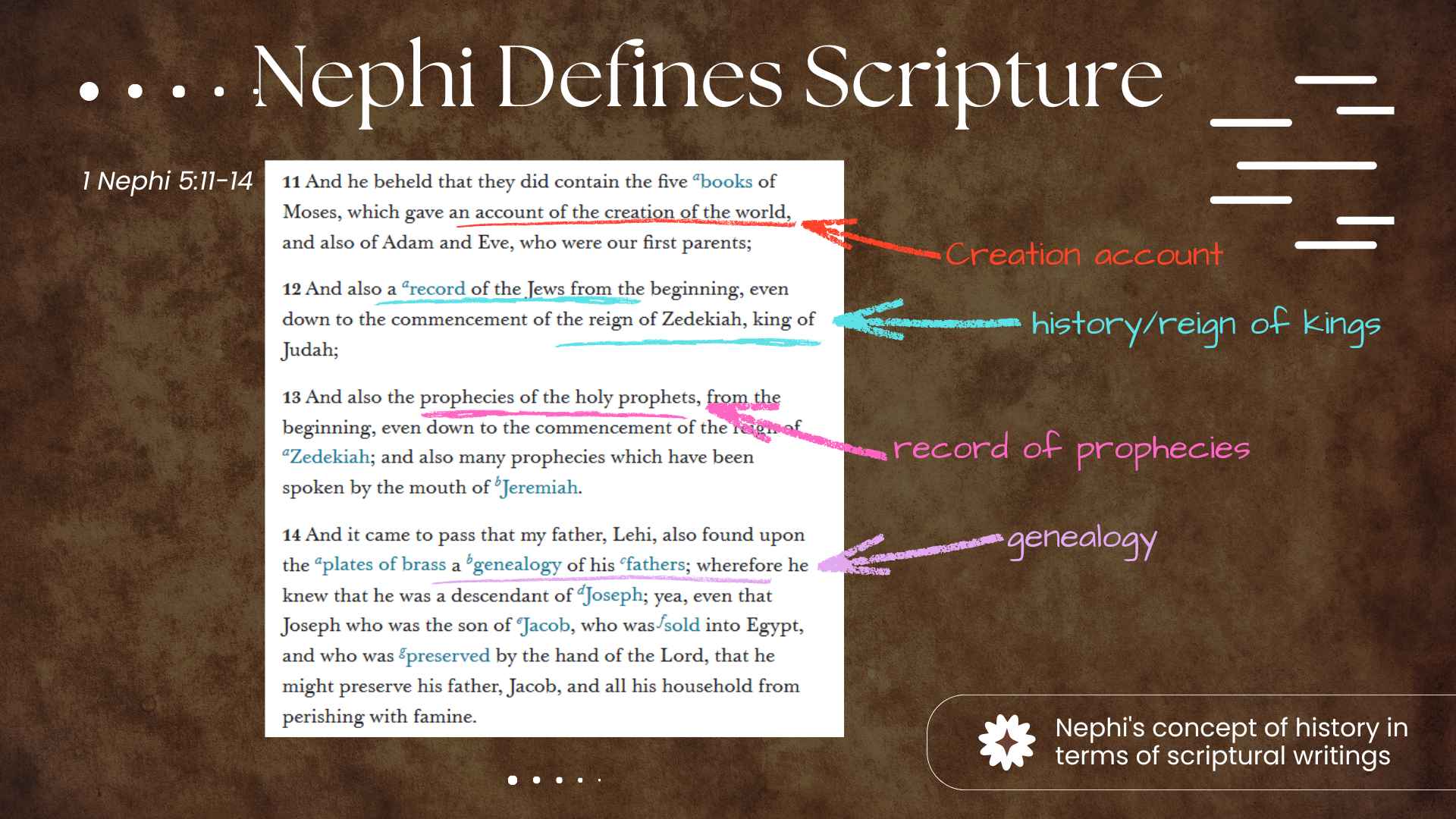
This deals with Nephi’s concept of history in terms of scriptural writings, and he tells us this. And you’re going to see as we continue that he’s very consistent in this viewpoint.

They get the brass plates back and Lehi goes through and reads them. And Lehi comes back and he tells his family what he found in them, and he covers four distinct areas.

The first, he says—and we’re going to start reading here in verse 11:

“And he beheld that it contained the five books of Moses, which gave an account of the creation of the world, and also of Adam and Eve, who were our first parents; and also a record of the Jews from the beginning even down to the commencement of the reign of Zedekiah, king of Judah; and also the prophecies of the holy prophets from the beginning even down to the commencement of the reign of Zedekiah; and also many prophecies which have been spoken by the mouth of Jeremiah.

And it came to pass that my father Lehi also found upon the plates of brass a genealogy of his fathers; wherefore he knew that he was a descendant of Joseph; yea, that Joseph who was the son of Jacob, who was sold into Egypt and who was preserved by the hand of the Lord, that he might preserve his father Jacob and all his household from perishing with famine.”

The Four Elements Explained

So now we’re going to notice that there are really four main elements that he discusses here.

  1. The first one is a creation account.
  2. The second one is a record of the people, which is a history—and more particularly a history of kings and the reign of people.
  3. The third part is a record of the prophecies, or as Nephi calls them in his own work, ‘the ministries’.
  4. And then fourth, we have a genealogy.

Nephi’s Own Record

Now it’s validated, this viewpoint, where Nephi discusses his own writings, which he clearly understands are going to be read as scripture.

All four of these parts are not included in the small plates of Nephi. And Nephi states specifically that he’s going to choose to include some of these components and not others.

Now let’s go ahead and move on. This is 1 Nephi 6:1.

And Nephi says this:

“And now I, Nephi, do not give the genealogy of my fathers in this part of my record; neither at any time shall I give it after upon these plates which I am writing, for it is given in the record which has been kept by my father; wherefore, I do not write it in this work.”

The Small Plates and the Large Plates

The Purpose of the Small Plates

The next one here is in 1 Nephi 9:2–4 and 10:1, and on this I’ll skip to the relevant verses there.

2 And now, as I have spoken concerning these plates, behold they are not the plates upon which I make a full account of the history of my people; for the plates upon which I make a full account of my people I have given the name of Nephi; wherefore, they are called the plates of Nephi, after mine own name; and these plates also are called the plates of Nephi.

3 Nevertheless, I have received a commandment of the Lord that I should make these plates, for the special purpose that there should be an account engraven of the ministry of my people.

4 Upon the other plates should be engraven an account of the reign of the kings, and the wars and contentions of my people; wherefore these plates are for the more part of the ministry; and the other plates are for the more part of the reign of the kings and the wars and contentions of my people.

1 And now I, Nephi, proceed to give an account upon these plates of my proceedings, and my reign and ministry; wherefore, to proceed with mine account, I must speak somewhat of the things of my father, and also of my brethren.

And then again in 1 Nephi 19:1–5:

1 And it came to pass that the Lord commanded me, wherefore I did make plates of ore that I might engraven upon them the record of my people. And upon the plates which I made I did engraven the record of my father, and also our journeyings in the wilderness, and the prophecies of my father; and also many of mine own prophecies have I engraven upon them.

2 And I knew not at the time when I made them that I should be commanded of the Lord to make these plates; wherefore, the record of my father, and the genealogy of his fathers, and the more part of all our proceedings in the wilderness are engraven upon those first plates of which I have spoken; wherefore, the things which transpired before I made these plates are, of a truth, more particularly made mention upon the first plates.

3 And after I had made these plates by way of commandment, I, Nephi, received a commandment that the ministry and the prophecies, the more plain and precious parts of them, should be written upon these plates; and that the things which were written should be kept for the instruction of my people, who should possess the land, and also for other wise purposes, which purposes are known unto the Lord.

The Purpose of the Large Plates

And then:

4 Wherefore, I, Nephi, did make a record upon the other plates, which gives an account, or which gives a greater account of the wars and contentions and destructions of my people.

Then finally in 2 Nephi 5:33 he goes over that again:

33 And if my people desire to know the more particular part of the history of my people they must search mine other plates.

Now if you take a look at this, with the exception of the first item in my list of four things—which is the creation account—the other three items are discussed a number of times relative to whether to include or exclude them in this record.

The Four Categories Revisited

The creation is a little different. It is referred to a number of times, and we are told that this narrative was included in the brass plates, that it was also recorded in the writings of the Jaredites and the twenty-four gold plates found by the people of King Limhi.

Nephi does not include it specifically, nor does any other writer in the Book of Mormon, but it is mentioned numerous times.

The second item, the history, Nephi tells us is recorded for the most part on his larger plates, but some parts are included in the small plates—specifically items that deal with the reign of Nephi, when he says that he wants to include things about his reign.

And I’m going to be getting into this quite a bit more in a few minutes because it has special relevance to the major passage that I’m presenting.

The third item listed is the ministry and revelations of the prophets, and this takes special consideration as the primary purpose of the small plates. This was by direct commandment and revelation.

And then finally, the fourth item: genealogy. He tells us consistently that he’s not going to include it because it’s already contained in the other scriptural records that are available to him.

Nephi’s Writings Alongside the Old Testament

I believe that clearly this is, in the case of the large plates, the objective: to make them “like unto the engravings which are on the plates of brass”. He’s kind of following the same pattern.

And here what I think you find is that on the small plates particularly, the historical pieces of information that he provides us to some extent deal with his reign and his ministry. And this is very significant.

I think it’s also true that Nephi, after his vision that he has very early in his life, sees his writings as being read alongside the writings which make up the Old Testament.

Nephi receives specific revelations to that effect, in 1 Nephi 13:41, where Nephi is told:

41 And they must come according to the words which shall be established by the mouth of the Lamb; and the words of the Lamb shall be made known in the records of thy seed, as well as in the records of the twelve apostles of the Lamb; wherefore they both shall be established in one; for there is one God and one Shepherd over all the earth.

And then a little later he says of John the Revelator:

21 Behold, he shall see and write the remainder of these things; yea, and also many things which have been.

Then, he also refers to the Old Testament that we have as being similar to the arrangement of the brass plates. As you recall, he also says “except that there are not so many”.

I think this idea—that the Book of Mormon writings that Nephi is preparing would stand alongside scripture—certainly affected their contents.

Nephi and the Old Testament

Now the historical narratives within the books of First and Second Nephi, I believe, contain elements which deal with these two themes that he discusses: his reign and his ministry, as I pointed out.

My objective is to show that the narratives presented by Nephi are often rooted in the stories of the Old Testament as found in the brass plates.

  1. We can identify specific parallels of the biblical texts.
  2. We have to use our traditional Bible to an extent because we don’t have a copy of the brass plates.
  3. We can then see that Nephi borrowed extensively, which would only be natural – but only from texts within his possession.

Introducing “Nephi and Goliath”

By now you’re probably wondering why I titled this paper Nephi and Goliath.

And my objective here is to show that Nephi, in writing this literary unit—that is, the story of his encounter with Laban and killing Laban—was actually patterned in very detailed fashion on the story of David killing Goliath in the Old Testament.

I’m going to start by using the story in the Book of Mormon as a primary source material, along with the King James Version. And I want to show that:

  • the form of the story,
  • the language,
  • the events that occur, and
  • the fact that these parallels occur in chronological order—

I’m going to build a case that there’s a great deal of literary reliance between the two texts.

Introducing the Parallel: Nephi and Goliath

And then when I get done, I want to point out some interesting details in relation to the text that Nephi used. Assuming that he’s using the brass plates, how it’s different from the traditional text that we have, and how this reflects back on the authenticity of the Book of Mormon.

Now, my paper here—I’ve actually got the entire stories printed out. So you’ll have to come and look at it. We’re not going to have time to read through it all, but I’m going to provide a summary of two stories.

Nephi Arranging the Narrative How He Wants Us to See It

Nephi and his brothers, of course, are sent back to Jerusalem to get these brass plates. The first couple of attempts fail. That’s very interesting. You know, sometimes we look at this and we get this perception the way that Nephi wants us to see it.

For all we know, the first time back they might have gone and taken Laban out to the bar and sat down, given him a few earrings and then asked, you know, for brass plates: “Hey, can you help us out here?”

So really we are going to get very much a first-person perspective—or a third-person perspective—depending on which part of the story we’re dealing with.

But after the first couple of attempts fail, including trying to trade all their wealth for the brass plates, we get to the point where Laman and Lemuel are basically beating their brothers into submission.

And then the angel shows up and tells them that God’s going to take care of it all. Then after the angel disappears, Laman and Lemuel begin their normal murmuring cycle. And Nephi says, “Well, let’s go do it.”

So Nephi heads back on his own, and he finds, of course, Laban laying there on the ground, passed out. (Nephi) chops off his head, takes his armor, and goes and retrieves the brass plates using Laban’s identity.

The Story of David and Goliath

We’re all probably also familiar with the story of David and Goliath, which is a pretty lengthy thing. We have this Goliath of Gath that gets up every morning and they’re in the middle of this war. He comes out to the field of battle and says, “If you send somebody out to fight me one-on-one, let’s decide this battle and we’ll be all set. Whoever wins, they’ll win the war.”

Of course everybody’s terrified of Goliath, who is a giant of a man, clearly very well trained in military arts.

“All of Israel” they say, “is afraid.” David shows up and says, “I’ll go and face down the Philistine.” He ends up going out there and killing him.

Now what we’re going to do is I’m going to be putting up here on the overhead projection a series of scriptural passages I’m going to talk about, and these are going to be my sequence of parallels. So we’ll quickly flip to the next one.

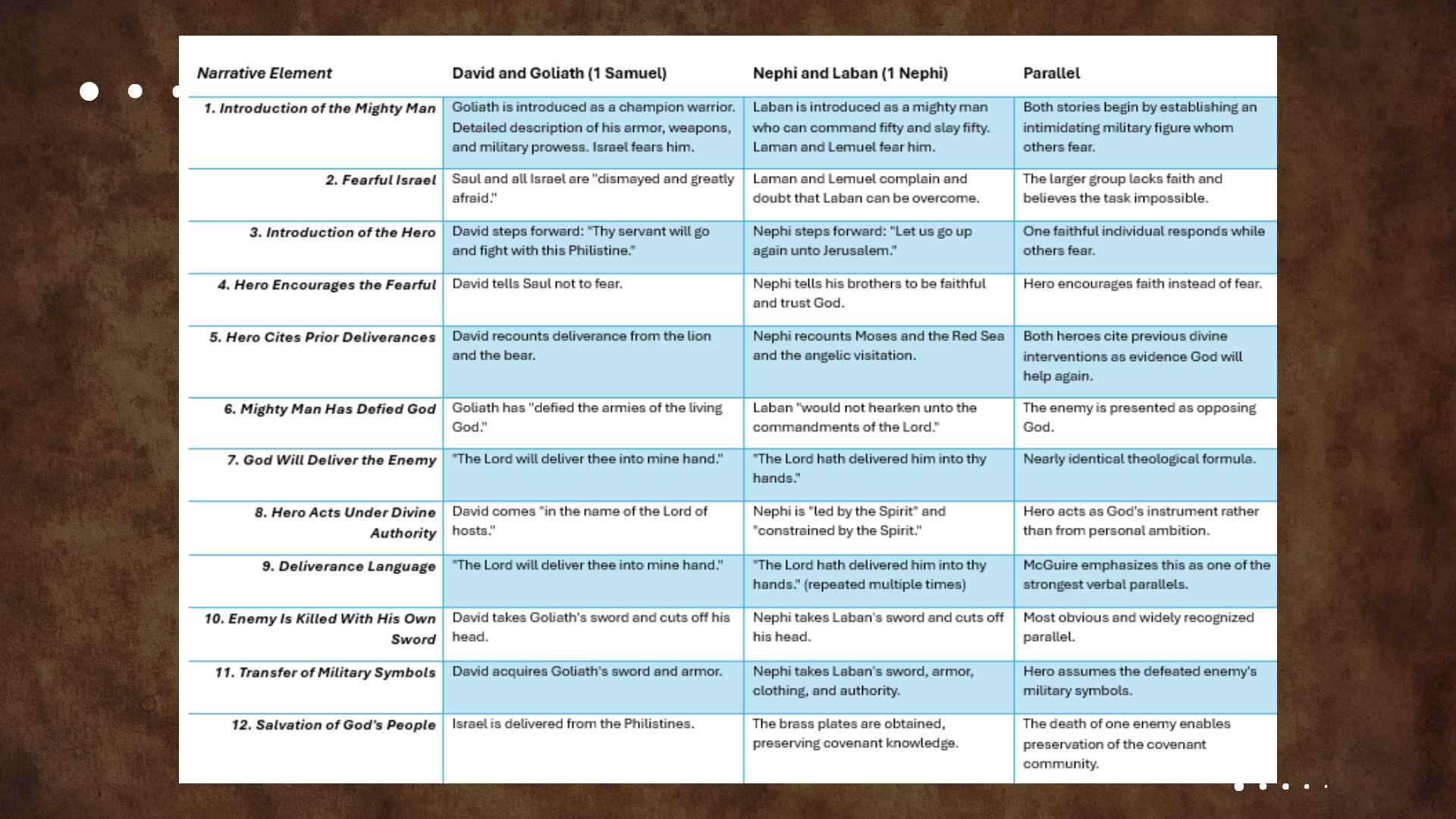
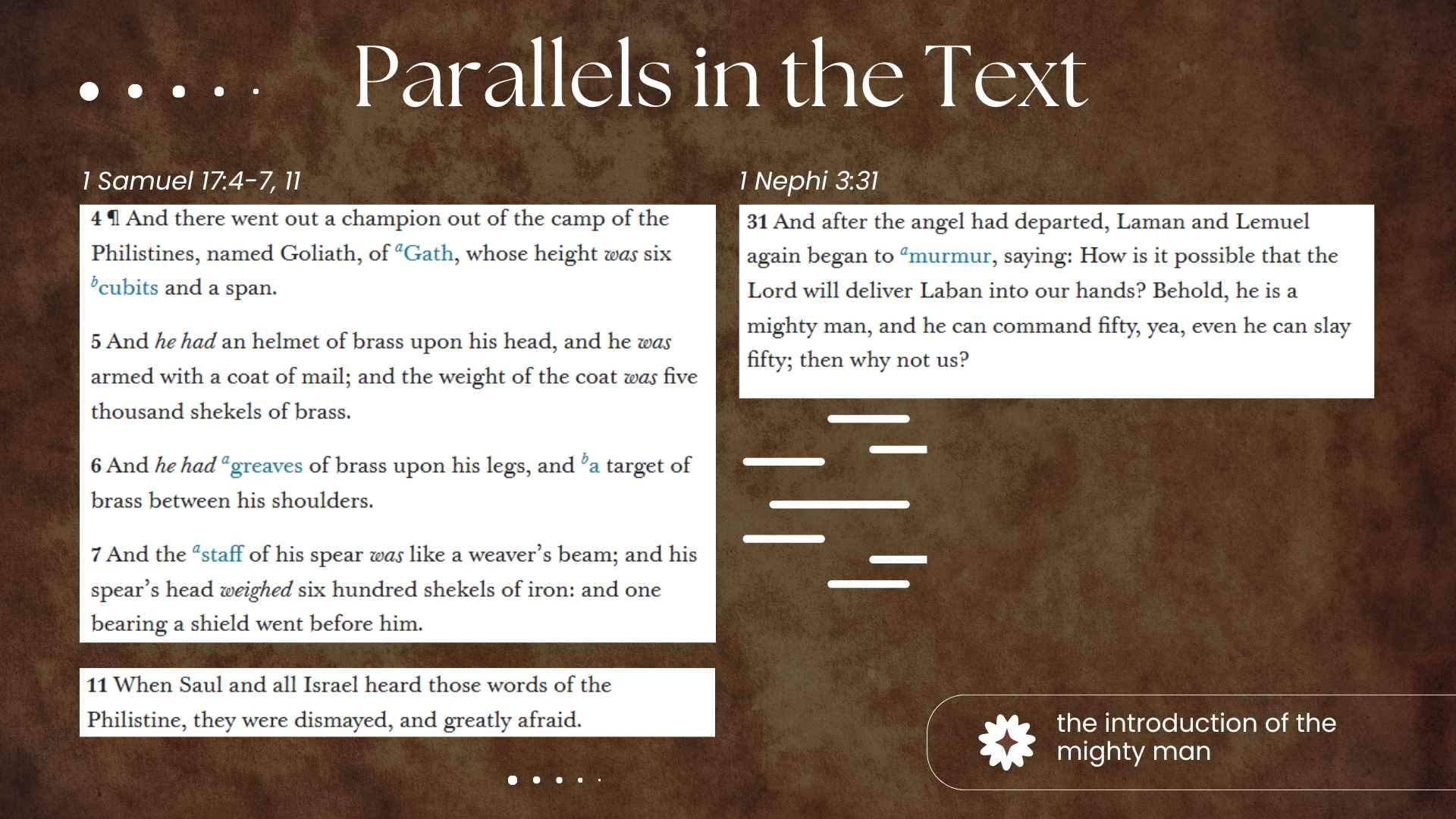
Parallel #1: The Mighty Man

The first parallel I want to talk about is the very beginning. I want to say that Nephi’s use of this Old Testament storyline begins in 1 Samuel 17.

In verses 4–11 (1 Samuel 17) talks really about the military might of Goliath. And I’m going to read it. I’m going to be skipping verses 8, 9 and 10.

“And there went out a champion out of the camp of the Philistines, named Goliath of Gath, whose height was six cubits and a span. And he had a helmet of brass upon his head, and he was armed with a coat of mail; and the weight of the coat was five thousand shekels of brass. And he had greaves of brass upon his legs, and a target of brass between his shoulders.

And the staff of his spear was like a weaver’s beam; and his spear’s head weighed six hundred shekels of iron: and one bearing a shield went before him.”

“When Saul and all Israel heard the words of the Philistine, they were dismayed, and greatly afraid.”

Then I’m putting that against 1 Nephi 3:31, the last verse of chapter 3:

“And after the angel had departed, Laman began to murmur, saying: How is it possible that the Lord will deliver Laban into our hands? Behold, he is a mighty man, and he can command fifty; yea, even he can slay fifty; then why not us?”

For lack of a better term, I’m going to use Nephi’s term here throughout the rest of this storyline. I call this the introduction of the mighty man.

In the Old Testament story, it’s Goliath. In 1 Nephi, it’s Laban.

Of course, we have the second set of cast members. In the Old Testament, we have Saul and all Israel. In the Book of Mormon, we have Laman and Lemuel.

And I think there’s a distinct parallel Nephi will continue to reinforce later on. We have this concept of faithless Israel, and we see it on both sides.

We have, on one hand, the Israelites who are ready to run at the drop of a hat. And here’s Laman and Lemuel, who don’t really want to be there in the first place, who are convinced that they’re all going to end up dead if they continue to pursue this course of action.

It’s also worthy of note that both of these mighty men are described in terms of military might and prowess:

  • Laban in terms of how many men he commands in the field;
  • Goliath in terms of his equipment. And it’s been pointed out often that this detailed description of his armor and weaponry really just serves to show that he was an experienced warrior.

Parallel #2: The Hero Appears

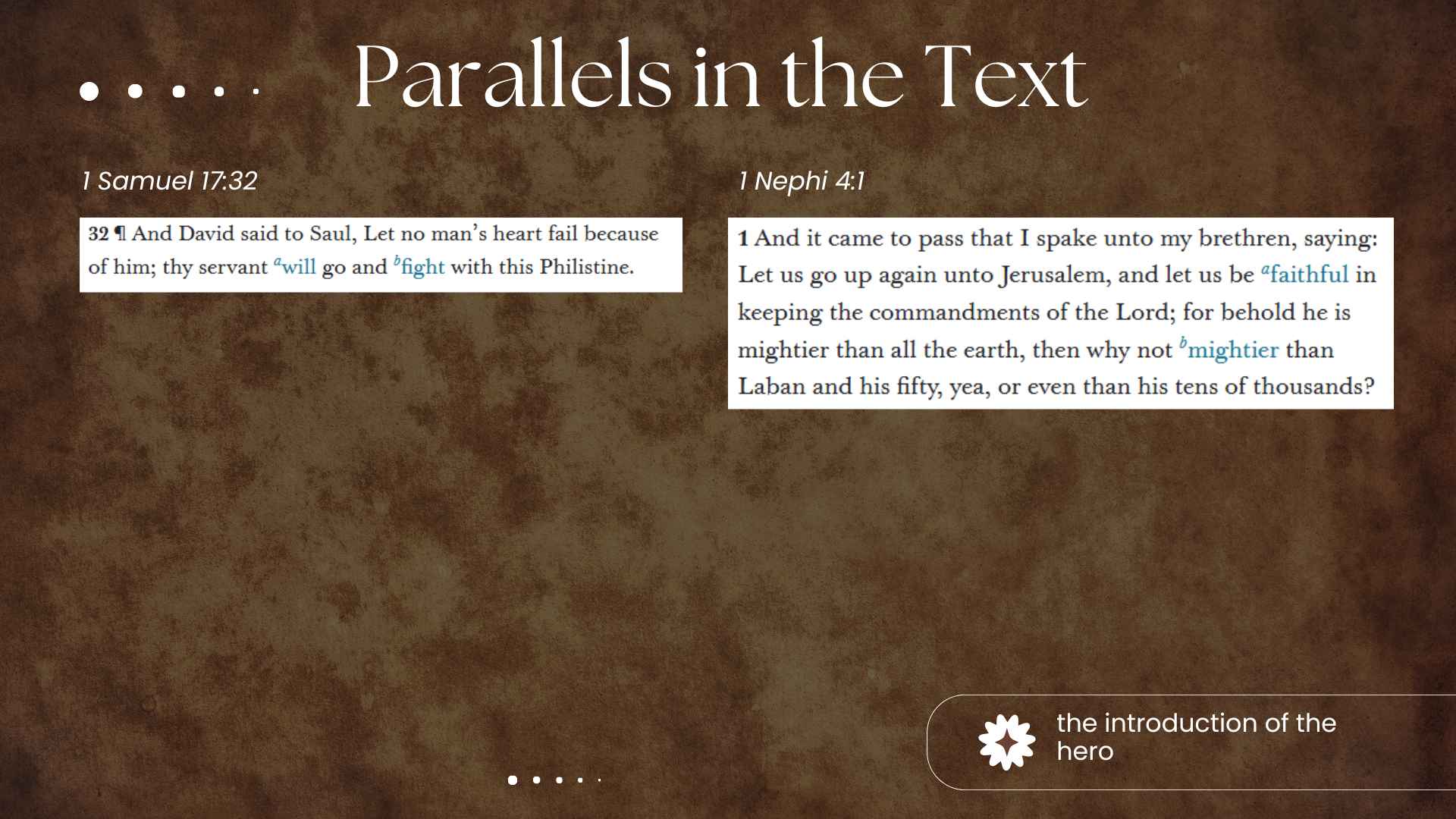
Let’s go ahead and continue now and we’re going to move to 1 Samuel 17:32 and 1 Nephi 4:1.

And David said to Saul:

“Let no man’s heart fail because of him; thy servant will go and fight with this Philistine.”

And then Nephi says:

“And it came to pass that I spake unto my brethren, saying: Let us go up again unto Jerusalem, and let us be faithful in keeping the commandments of the Lord; for behold he is mightier than all the earth, then why not mightier than Laban and his fifty, yea, or even than his tens of thousands?”

Now, this is the introduction of the hero.

David, of course, is the hero in the Old Testament text, while Nephi fills that role in his own account. And in his first appearance, the hero goes to faithless Israel and encourages them in their task, saying that there’s nothing to fear. The hero is willing to challenge the mighty man.

Parallel #3: Miracles as the Basis of Faith

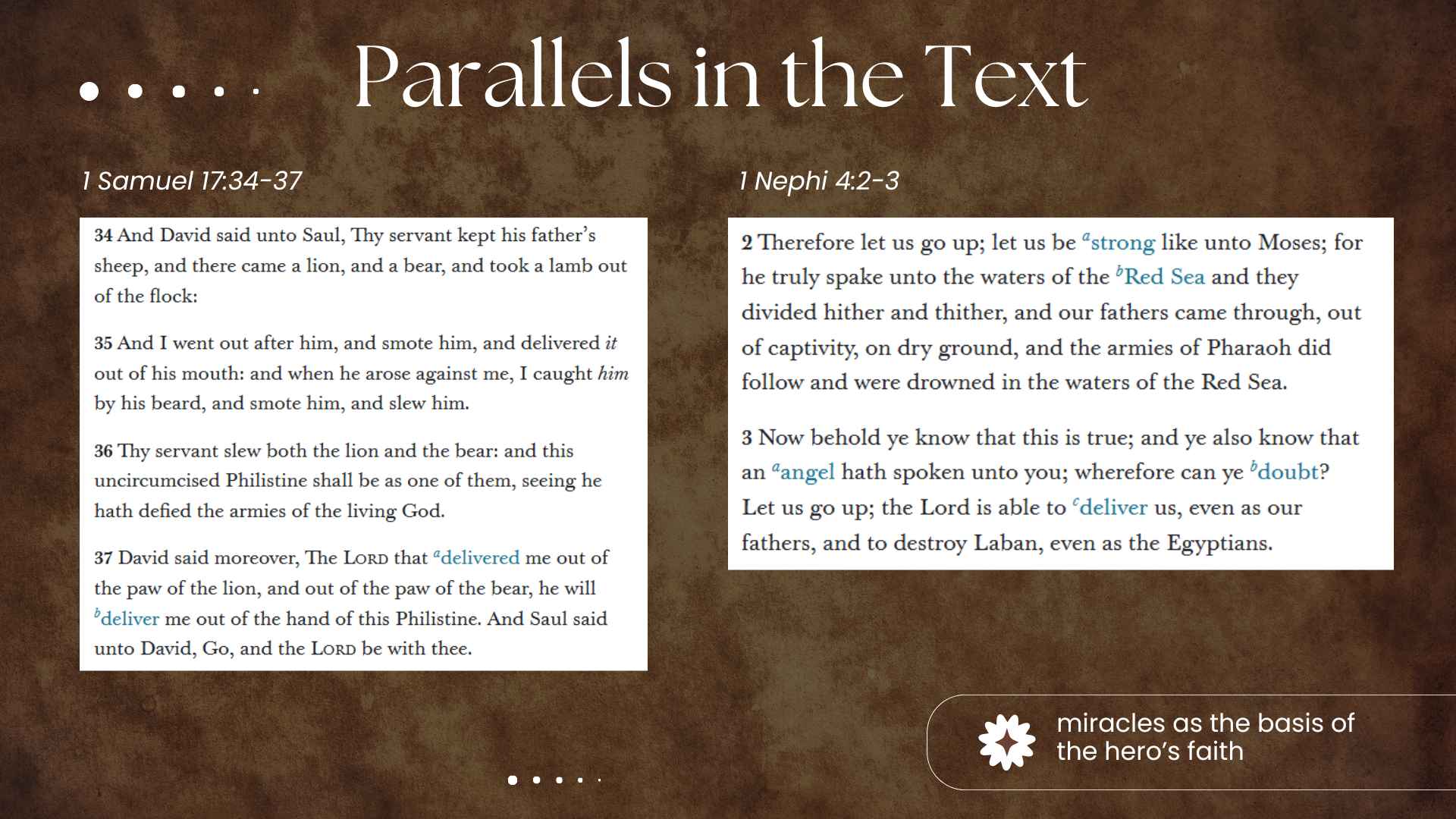
Now let’s go ahead. Both heroes then cite, as the basis for their faith in their course of action, two miracles.

David cites two instances from his own life. Nephi cites one from the history of Israel and one from his own life.

Both of these miracles are significant from the hero’s point of view.

In both cases, the hero concludes by remarking that just as God performed these two miracles, God will then deliver them from the hands of the mighty man.

Miracles Revealed in the Narrative

So we read now from the Old Testament.

34 And David said unto Saul, Thy servant kept his father’s sheep, and there came a lion, and a bear, and took a lamb out of the flock:

35 And I went out after him, and smote him, and delivered it out of his mouth: and when he arose against me, I caught him by his beard, and smote him, and slew him.

36 Thy servant slew both the lion and the bear: and this uncircumcised Philistine shall be as one of them, seeing he hath defied the armies of the living God.

37 David said moreover, The Lord that delivered me out of the paw of the lion, and out of the paw of the bear, he will deliver me out of the hand of this Philistine. And Saul said unto David, Go, and the Lord be with thee.

And this is what Nephi says to his brothers. He says:

2 Therefore let us go up; let us be strong like unto Moses; for he truly spake unto the waters of the Red Sea and they divided hither and thither, and our fathers came through, out of captivity, on dry ground, and the armies of Pharaoh did follow and were drowned in the waters of the Red Sea.

3 Now behold ye know that this is true; and ye also know that an angel hath spoken unto you; wherefore can ye doubt? Let us go up; the Lord is able to deliver us, even as our fathers, and to destroy Laban, even as the Egyptians.

Now, David’s two miracles were being saved from two animals bent on killing him. Likewise he claims God would treat Goliath as merely one of these animals.

The two miracles for Nephi are:

  1. first, the destruction of the Egyptians when Moses parts the Red Sea; and
  2. second, the visitation of an angel. An angel, among other things, mentions that they will overcome Laban.

We’ll come back to the angel in a little bit, as he plays a larger role in explaining why Nephi includes this particular episode.

Exodus Imagery

The part you see is also significant as it serves to show God destroying the enemies of Israel while they’re leaving for their promised land. It’s coming back to the same Exodus topic that Nephi continues to use over and over again, particularly the further we go into the text.

And the other thing that we see is that the brothers have just mentioned Laban and his tens of thousands.

This is being subtly compared to by Nephi as the armies of the Egyptians. So now Laban becomes representative not necessarily only of the Philistines, but also this concept of the Egyptians and their armies chasing after Israel in the wilderness.

The idea that Laban is an obstacle that stands between Israel and their promised land—between Nephi and Lehi and their promised land—is quite clear. And just as in the Exodus, Nephi is claiming that God will fight the battles.

Parallel #4: God Delivers the Mighty Man

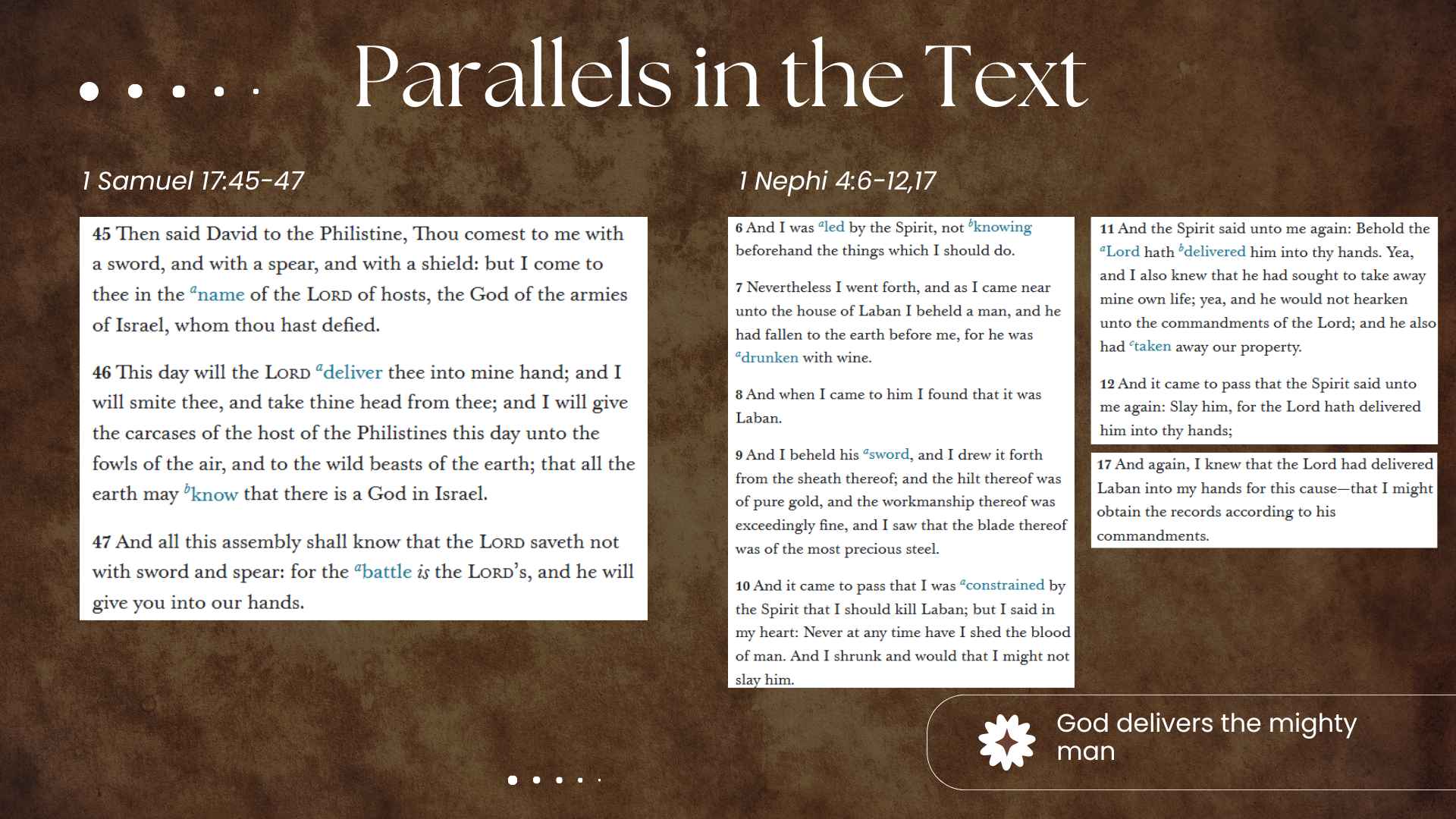
Now next we have remarks where the hero comes according to the will of God and that God delivers into the hero’s hands the mighty man.

So let’s move ahead. (I think this is the previous one. So let’s jump one more.)

Now I’m going to read through the First Samuel account, then we’ll jump into the First Nephi one. This is 1 Samuel 17:45–47.

45 Then said David to the Philistine, Thou comest to me with a sword, and with a spear, and with a shield: but I come to thee in the name of the Lord of hosts, the God of the armies of Israel, whom thou hast defied.

46 This day will the Lord deliver thee into mine hand; and I will smite thee, and take thine head from thee; and I will give the carcases of the host of the Philistines this day unto the fowls of the air, and to the wild beasts of the earth; that all the earth may know that there is a God in Israel.

47 And all this assembly shall know that the Lord saveth not with sword and spear: for the battle is the Lord’s, and he will give you into our hands.

And then in 1 Nephi—this is from chapter 4, verses 6–12 and 17:

6 And I was led by the Spirit, not knowing beforehand the things which I should do.

7 Nevertheless I went forth, and as I came near unto the house of Laban I beheld a man, and he had fallen to the earth before me, for he was drunken with wine.

8 And when I came to him I found that it was Laban.

9 And I beheld his sword, and I drew it forth from the sheath thereof; and the hilt thereof was of pure gold, and the workmanship thereof was exceedingly fine, and I saw that the blade thereof was of the most precious steel.

10 And it came to pass that I was constrained by the Spirit that I should kill Laban; but I said in my heart: Never at any time have I shed the blood of man. And I shrunk and would that I might not slay him.

11 And the Spirit said unto me again: Behold the Lord hath delivered him into thy hands. Yea, and I also knew that he had sought to take away mine own life; yea, and he would not hearken unto the commandments of the Lord; and he also had taken away our property.

12 And it came to pass that the Spirit said unto me again: Slay him, for the Lord hath delivered him into thy hands;

17 And again, I knew that the Lord had delivered Laban into my hands for this cause—that I might obtain the records according to his commandments.

Now, I find this especially significant.

Delivering the ‘Mighty’ Into the Hands of the Hero

This type of language is not uncommon in the Old Testament. It’s used rather regularly, actually. However, this is the only place in the Book of Mormon where this concept occurs.

Whenever we use this idea of deliverance in the Book of Mormon, it’s always that you’re being delivered from evil, or delivered from the grave, or from the hands of your enemy.

Here, in both stories, we have God delivering the mighty man into the hands of the hero.

It is possible, of course, that the phrasing in First Nephi is based somewhat in Exodus 21:13, especially given the context.

Exodus 21:13 deals with accidental death—the laws regarding revenge in dealing with accidental death, as you recall. It actually says:

“And if a man lie not in wait, but God deliver him into his hands; then I will appoint thee a place whither he shall flee.”

There is some appropriateness to this context here.

However, I believe that just as Szink pointed out phraseology and other parts of the Book of Mormon show this literary dependence on the Old Testament, that here it has a stronger argument and textual basis, especially given this list of parallel similarities.

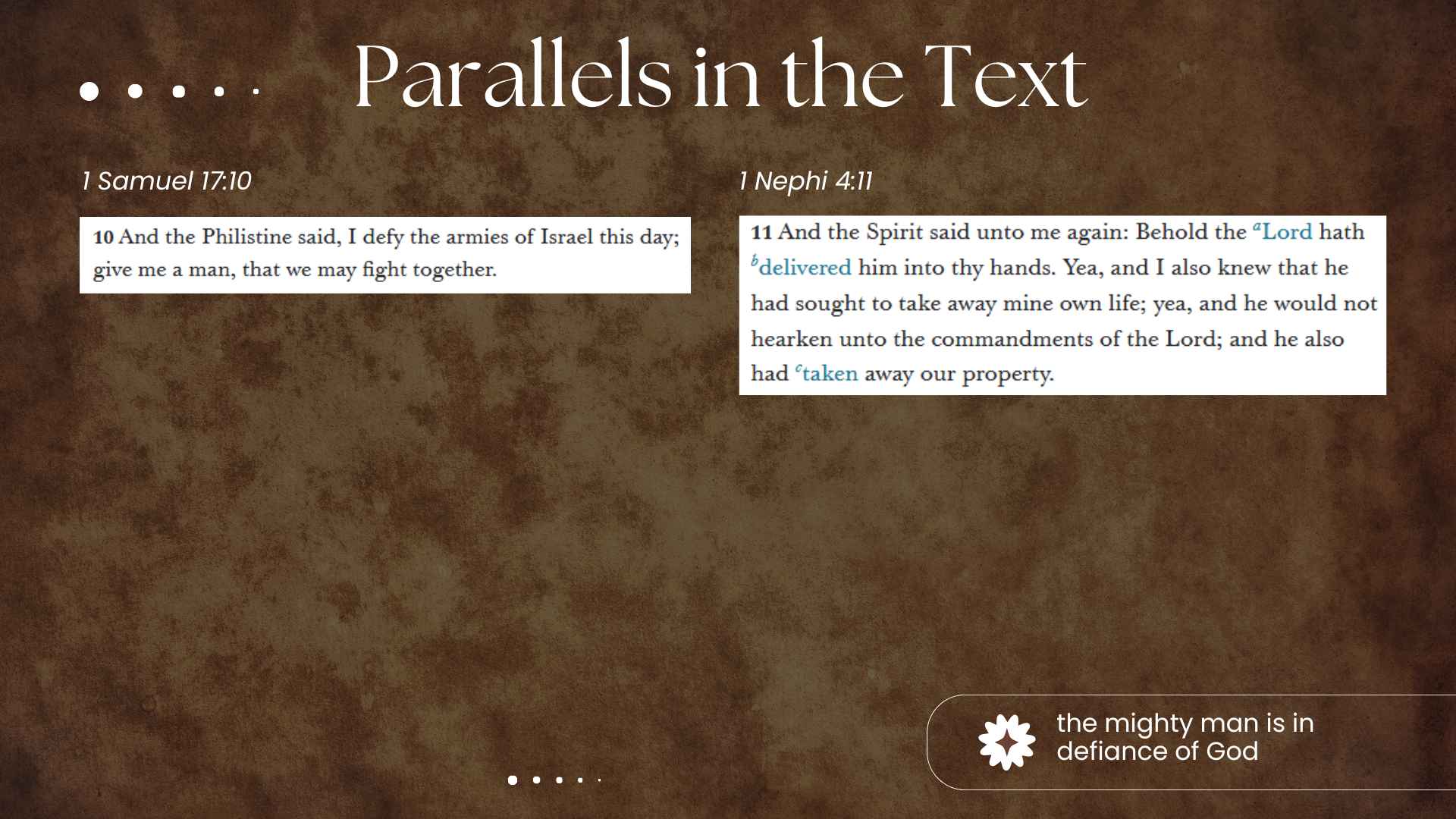
Parallel #5: The Mighty Man Defies God

Lastly, in that last section—which we won’t have up, and I probably can’t go back to, but that’s okay—

You’ll notice that in both cases we have this concept that the mighty man has defied the will of God.

We have, in the one case, Goliath, who is standing in defiance of the armies of the God of Israel. And in First Nephi’s account, there in verse 11, it says that Laban “would not hearken unto the commandments of the Lord.”

So we also have this recognition that the mighty man is not a man of righteousness. There’s some deserving – this is divine retribution for his activities in his life.

Okay, we’re going to continue on to the last step here.

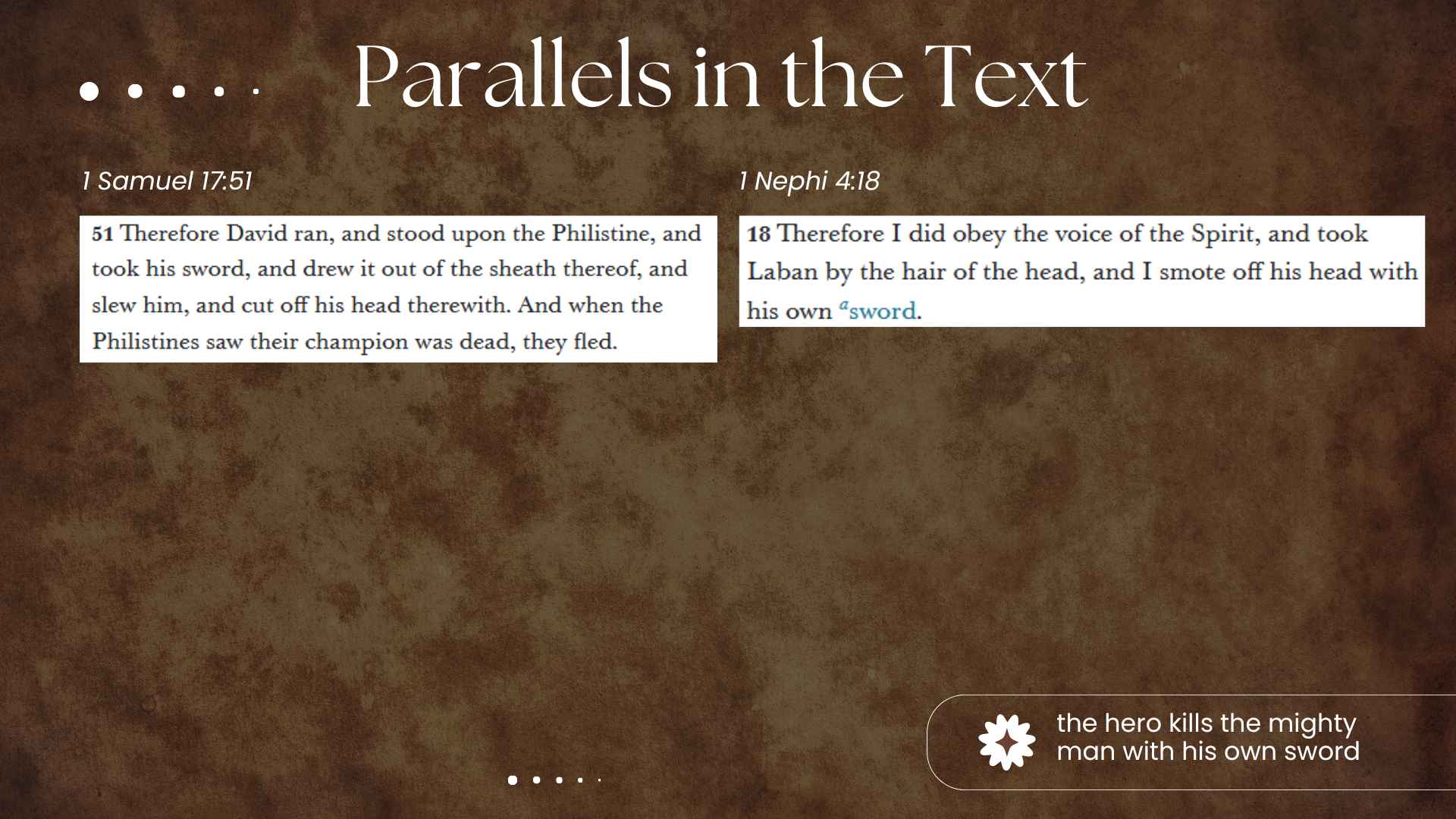
Parallel #6: The Hero Kills the Mighty Man with His Own Sword

First Samuel 17:51:

“Therefore David ran, and stood upon the Philistine, and took his sword, and drew it out of the sheath thereof, and slew him, and cut off his head therewith.”

And in 1 Nephi 4:18:

“Therefore I did obey the voice of the Spirit, and took Laban by the hair of the head, and I smote off his head with his own sword.”

These parallels in those two verses have been widely recognized. And a really neat additional comment is that the hero kills the mighty man with his own sword. He decapitates him in both cases.

Why Does Nephi Include This Story?

Now, the next direction I want to take this is this question of why Nephi includes this in the Book of Mormon. It seems kind of an odd scene.

This deals largely with Nephi’s authority as ruler and king of the Nephite peoples. And as was pointed out earlier—and any other groups that they’re with—clearly there’s something to be said for putting yourself in the role of King David as the preeminent king of all Israel, going through the same steps.

First, he’s chosen by a heavenly messenger in much the same way. You know, who cares about your brothers? You’re the chosen guy.

And then he’s following through in some of these similar actions.

The Question of Kingship

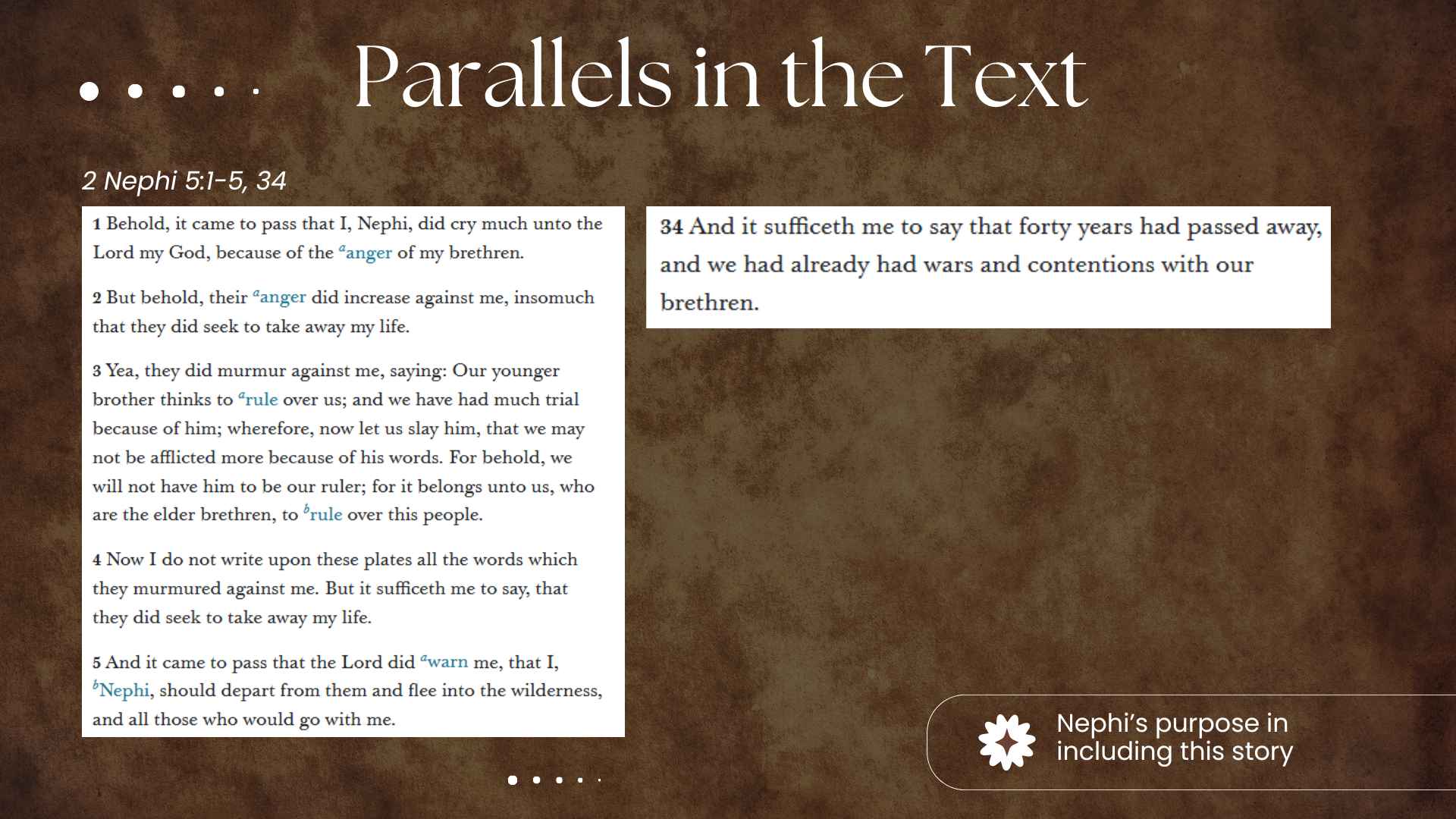
And I especially wanted to point out that, as recorded in 2 Nephi 5 (2 Nephi 5:1-5, 34), this whole issue of who has the right to rule is critical to Nephi at this point in time.

In verse 34 there he says:

“And it sufficeth me to say that forty years had passed away, and we had already had wars and contentions with our brethren.”

Over this right of rulership.

The third point I want to make here is that, following the second aspect of this inclusion, we realize that the story, rather than dealing with the ministry, deals with this reign and kingship.

I wanted to add this point: the stories of David and Solomon and other early Israelite leaders were well known to the Lehite peoples as part of the brass plates.

And I think this is significant. They often use examples. I mean, there’s that famous thing in Jacob where they’re dealing with the whole polygamy issue, where they justify it based on the activities of Solomon and David.

They are aware of the lives of these men, and so we can assume they have some familiarity.

Early and Late Sources in David and Goliath

Now let’s jump to something really fascinating here.

If we take a look at some of the higher criticism of the story of David and Goliath in the Old Testament, I believe it’s fair to say there is a scholarly consensus that there are, in fact, two different source materials: an early source and a later source.

The composite early source consists of:

  • 1 Samuel 16:14–23
  • 1 Samuel 17:1–11
  • 1 Samuel 17:32–40
  • 1 Samuel 17:42–48a
  • 1 Samuel 17:49
  • 1 Samuel 17:51–54

With the later source containing all the rest of the material.

This identification actually was not very difficult for scholars because the Septuagint actually omits most of that material, representing the former tradition.

If we go back to my list of sources that I use for the parallels, what you’re going to notice is that Nephi quotes chapter 17:4–11, which is the first part there.

He then jumps immediately to a parallel in 17:32, and then 17:34–37, and so on and so forth. And what you’ll notice is that every one of the references that he parallels is from that early source material. In fact, he doesn’t seem to recognize that any of the later source material exists, which is highly fascinating.

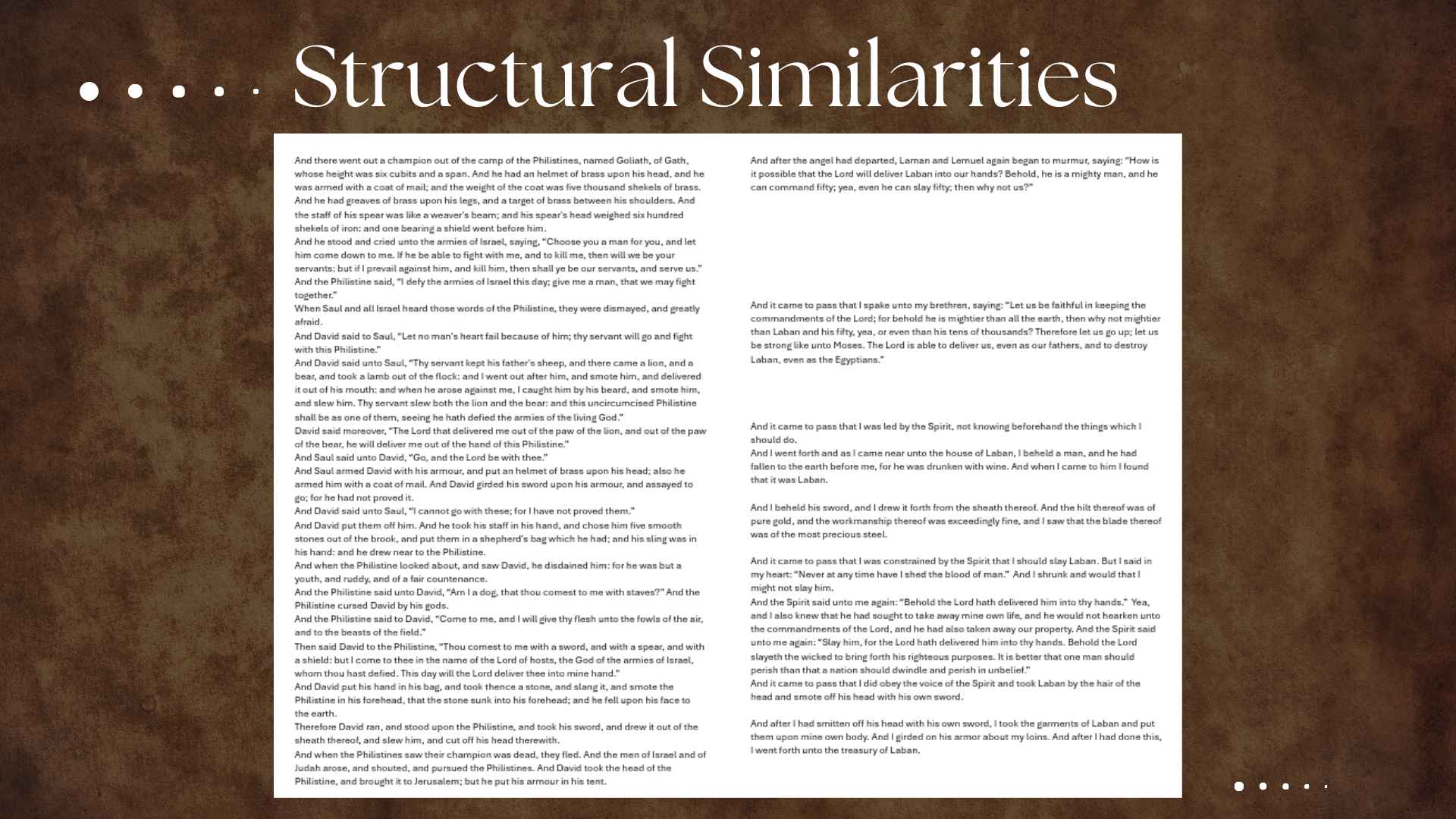
Structural Similarities Between the Texts

I put this here because I wanted to put something into perspective. And that is this. On the left side is the David and Goliath story of the Old Testament once the later source material is removed.

And you’ll notice that the stuff in the Book of Mormon is very similar in structure, both in length and item following item. He actually seems to be following this story in a very detailed fashion, as if he’s got one open in front of him while he’s writing the other.

And following that, going back to what I told you about Brother Brown, when he said that he sees this increasing frequency of parallels in the Exodus material, I believe it’s because Nephi is borrowing from other sources.

It gets into the Exodus as they really get into their journey. Before that, he doesn’t. I have a lot more material here that deals with some of the earlier stuff, and so I’m going to cover just one or two points. And then for the rest of it you’ll have to go out and buy the proceedings of this conference.

The Caiaphas Parallel

Going back to this, it does a couple of interesting things though.

One of the things I want to point out is this: there’s a long-standing anachronism claim in the Book of Mormon where we have this quote, apparently by Nephi when he’s getting ready to kill Laban:

“It is better that one man should perish than that a nation should dwindle and perish in unbelief.”

We’re all familiar with that.

And then that same passage is more or less quoted verbatim by Caiaphas regarding Jesus Christ in the New Testament.

If Nephi is borrowing here from an Old Testament tradition of David and Goliath, it stands to reason that there is the possibility that, in fact, Caiaphas is also borrowing from a tradition of David and Goliath in an environment in which a quote like this stands to make absolute sense.

How many people expected David to go out there and kill Goliath?

There was only one, as I recall, and that was David himself.

And so, in a sense, Israel is sending out one man to perish that the nation would not.

It’s an interesting tie-in.

Additional Implications of Textual Reliance

Second—and this is something else that’s interesting here, and I’m just going to make an aside. Here we have another evidence that the brass plates were slightly different.

Moses speaks, of course, to the Red Sea, he parts it. In the Old Testament, he doesn’t speak at all; he just waves his arms and the water goes through.

The point is that if we can assume textual reliance here, we can probably assume it elsewhere.

Lehi and the Call of Moses

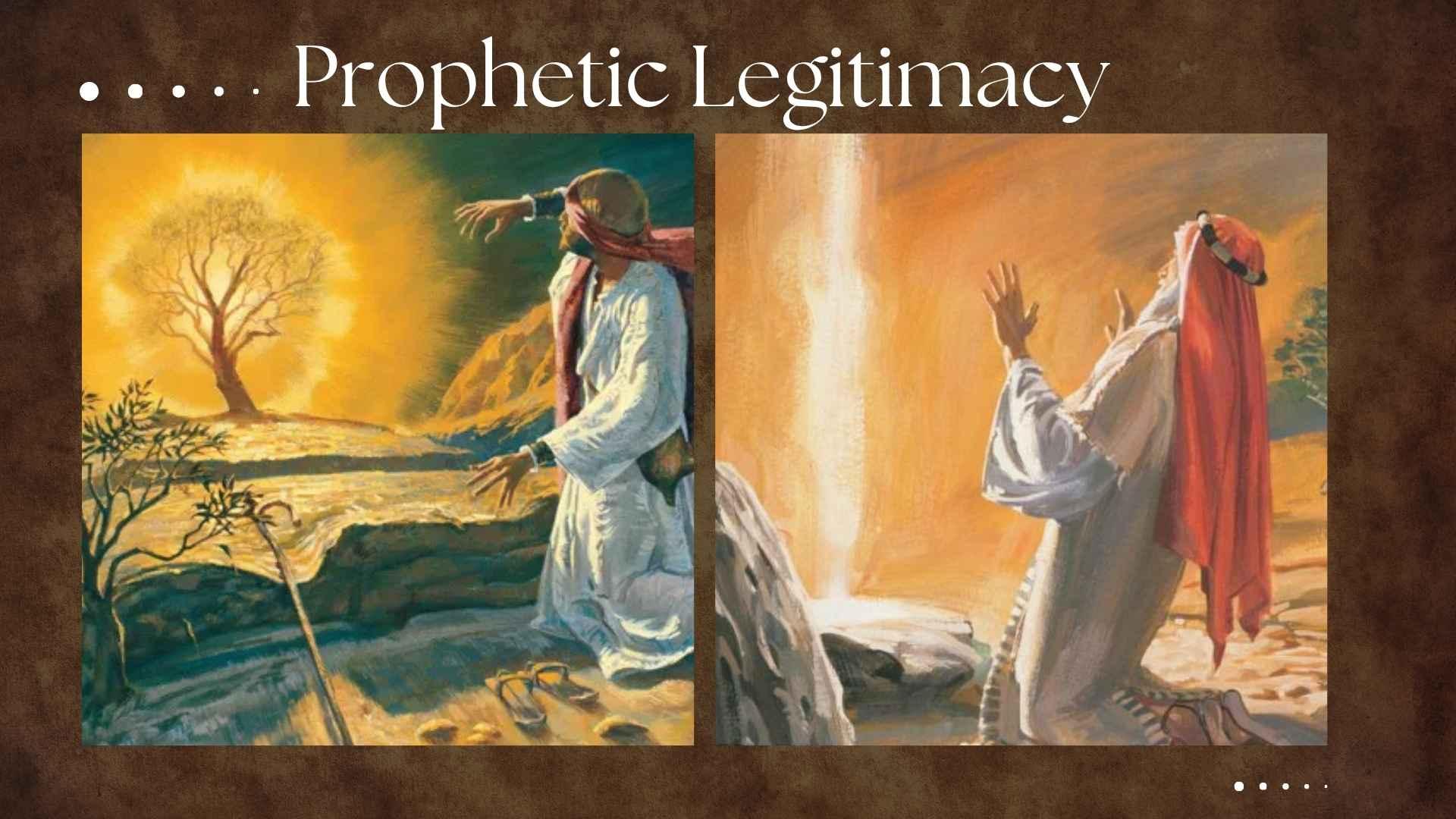
So, we go back to the beginning of Lehi’s calling. I call this literary section “the call of Moses and the trip to Sinai” at the very beginning of First Nephi chapters 1 and 2.

It’s kind of funny. There’s this footnote in First Nephi dealing with a pillar of fire that comes before Lehi on a rock. Do you remember that? This pillar shows up on a rock. We have this little footnote at the bottom. It was added some years ago in our scriptures. It points us back to the pillar of fire that led the Israelites out of Egypt.

Well, the truth is that, according to my understanding, Lehi is in fact going through the same process that Moses went through when he became a prophet.

Remember, this goes back to recognizing Nephi and Lehi as legitimate prophets. He’s following the steps of Moses. And so this pillar of fire is actually the burning bush.

Numbers 12 and Prophetic Legitimacy

Now what’s interesting about this is that Nephi seems to be basing this part of the text on a passage in Numbers 12:6.

At one moment we have Moses, whose wife has passed, and he goes out and marries a new wife. It’s this Ethiopian woman, and his family—his brother and sister—immediately get all upset and offended at what he’s done.

And they come out and they say, “Well, clearly he’s not a prophet anymore. We’re all prophets, too. We can lead the people.”

And the Lord calls all three of them out from the tribes of Israel and chooses out Miriam and Aaron and says to them this. This is Numbers 12:6:

“Hear now my words: If there be a prophet among you, I the Lord will make myself known unto him in a vision, and will speak unto him in a dream.”

The Relevance of Lehi’s Vision

Of course, in First Nephi we have this passage, right?

Lehi goes home after seeing a pillar of fire on a rock. It says:

“And it came to pass that as he prayed unto the Lord, there came a pillar of fire and dwelt upon a rock before him; and he saw and heard much; and because of the things which he saw and heard he did quake and tremble exceedingly.”

He goes home and throws himself on his bed. And it says:

“And thus being overcome with the Spirit, he was carried away in a vision, even that he saw the heavens open, and he thought he saw God sitting upon his throne, surrounded with numberless concourses of angels in the attitude of singing and praising their God.”

Then I’m going to jump forward to 1 Nephi 2:1:

“For behold, it came to pass that the Lord spake unto my father, yea, even in a dream, and said unto him: Blessed art thou, Lehi, because of the things which thou hast done; and because thou hast been faithful and declared unto this people the things which I commanded thee, behold, they seek to take away thy life.”

Nephi here is following some very distinct Old Testament patterns to prove the legitimacy of his father’s prophetic calling.

The Three-Day Journey into the Wilderness

The last thing I want to mention just briefly is this—and this is kind of funny because this has come up a couple of times in this conference—and that is this three-day trip that they take into the wilderness.

It’s interesting. Eugene England—the quote that I had here—says this:

The route and times were quite specific, even somewhat mysteriously so: (and he quotes:) “He came down by the borders which are nearer the Red Sea and he traveled in the wilderness in the borders which are nearer the Red Sea; and he did travel in the wilderness with his family, which consisted of my mother, Sariah, and my elder brothers.” and then “when he had traveled three days in the wilderness, he pitched his tent in a valley by the side of a river of water …”.

This literal interpretation of three days has long been accepted and understood in LDS circles as being a helpful tidbit in determining the geography of Lehi’s trek to the coast of the sea, where they then sail to the New World.

Instead of viewing this as a literal approach, what I like to look at is this three-day trip in Exodus 3:18 where, after Moses has been called as a prophet, his first command is to go back to Egypt, to the Israelites, and then to tell Pharaoh:

“The Lord God of the Hebrews hath met with us: and now let us go, we beseech thee, three days’ journey into the wilderness, that we may sacrifice to the Lord our God.”

Now, this is mentioned over and over again in the next several chapters in the Old Testament.

Egypt to Marah

This three-day journey actually occurred. It was a trip between Egypt and Marah, which is interesting—the fact that they have this body of water there, by which the place is named because the water was bitter. So they called the place bitterness.

And there were a number of other issues there.

Among them was the fact that when Pharaoh says, “Why do you have to go so far?” Moses responds, “Well, if we stay here and offer burnt offerings—which are an abomination to you Egyptians—you’ll kill us all because we’re inside your cultic holiness area.”

The same could be true of Lehi and Nephi.

For them to go out and offer burnt offerings and renew this new covenant they’re making with the Lord in downtown Jerusalem would certainly cause some significant difficulties for them.

Other Types Nephi Draws On

I’m going to close since I’ve pretty much expended my time.

The truth is I haven’t had enough time to take these ideas to a logical conclusion. And I think we can find dozens of additional details and parallels. It could be that these things all fall into that nebulous category of “typing” the Book of Mormon.

I think, however, that when Nephi tells us that he likens all scriptures unto himself, he actually is doing that. Not only with the scriptures he’s reading, but the scriptures he’s writing.

And we can find these parallels. We have several very distinct Noah parallels as he builds his boat.

There’s even more with the story of Joseph going into Egypt. We have the binding in the wilderness, the slaying of beasts. We have this whole concept of Nephi as an interpreter of dreams, which is very interesting.

He starts with his father’s dream. It’s just bits and pieces. “Whoops, we’re all done with this. Now, let’s talk about this.” And the first thing that happens: his brothers come up and say to him, “What’s the meaning of this?” And he explains it to them.

Concluding Reflections

I think perhaps that it may be difficult to reconstruct various textual reliance between the brass plates and the Book of Mormon. Because we don’t really have the brass plates to compare.

But the Book of Mormon can give us additional insight into the scriptures they carried with them. We can see that not only do they have more in some areas and less in others. But it can also give us a better understanding of the Bible. And where it’s at in terms of how it’s been preserved in that picture.

I’d like to close just by stating that this apologetics work that I’ve been involved in through FAIR has been a great source of joy and personal satisfaction. In dealing with the gospel in new ways and learning new ideas and ways of looking at things.

And I think that this is the type of stuff that we as Saints need to be doing. Building our own personal testimonies of the gospel and answering these questions for ourselves.

And I’ll close in the name of Jesus Christ, amen.

Question and Answer Session

We do have time for maybe one or two questions. If you want to ask me, then we’ll take our break.

Question: What About Blood on Laban’s Armor?

Question

Earlier you alluded to the fact that, yeah, there’d be blood all over Laban’s armor and so forth. But you never did explain that.

Answer

My personal ideas about that are quite a bit off the beaten track.

Based on the fact that he’s writing the story to prove a point. That means that he probably got some of the details out of chronological order as they actually occurred historically.

And that maybe it’s much more likely that

  1. Nephi finds Laban laying there, passed out drunk in the middle of the road,
  2. takes off his armor,
  3. gets ready to go back to the brass plates
  4. and that’s when the Spirit says, “No, wait a minute—you better go back and finish the job here.”

So I believe that that’s not really an issue. It only becomes an issue because these parts of the stories are right next to each other when in fact it’s not necessarily a chronological series.

That’s my own personal feeling. I’ll stop there.

Question: If Nephi Is Alluding to David and Goliath, Why Does He Do It This Way?

Question

If Nephi is alluding to the story of David and Goliath, why [indistinguishable]?

Answer

Well, it’s a good question.

I think that for starters, Nephi says that they’ve got the brass plates. The only time he ever really directly uses them is when he quotes all this Isaiah material.

And that’s another oddity. You would think that he and his descendants would have the brass plates right there. He wouldn’t need to put it all down.

I think there’s two reasons why he doesn’t directly allude to it.

Nephi’s Audience is Not 100% Israelites

One of them goes back to one of the other papers that was presented at this conference. Nephi’s audience is not 100% Israelites at the time that he’s writing.

  • There’s been some cultural merging.
  • There’s a larger group of people that they’re dealing with.
  • There’s no way that just Nephi and his family could split into two groups. Large enough to have had a number of wars and contentions over this rulership issue.

So I think rather than:

  • going back and
  • having to retell the story to everybody and
  • then saying, “And just like David and Goliath.”

He’s putting his story out in a way that shows that there’s some stuff going on here.

Some of the group is going to immediately recognize these parallels, and some isn’t. It just depends on who you’re talking to.

The Brass Plates as a Type for the Spoils of Egypt

Another interesting thing that I didn’t bring up, that I think might also go along with this. Is this whole concept of the brass plates being worth more than all of their wealth.

Going back to the Exodus. It’s quite possible that Nephi saw his taking the brass plates as the spoiling of Egypt.

When they leave Egypt they take all this wealth with them. Though he’s leaving Jerusalem, he’s taking something that’s worth far more than anything he had. But he doesn’t see it as stealing. He’s taking the stuff that the Lord wants him to take.

Thank you.

FAQ / Common Questions

What is the main argument of this presentation?

Ben McGuire argues that Nephi intentionally incorporated Old Testament literary patterns into his record, especially parallels to David and Goliath and the Exodus.

Why does McGuire compare Nephi and Laban to David and Goliath?

He identifies a sequence of narrative similarities, including a powerful enemy, a faithful hero, divine deliverance, and the use of the enemy’s own sword.

Does the presentation claim Nephi copied the Bible?

No. McGuire argues that Nephi consciously drew upon scriptural traditions preserved on the brass plates and expected readers to recognize those connections.

How does the Exodus relate to First Nephi?

McGuire suggests that Lehi’s departure from Jerusalem and journey into the wilderness mirrors Israel’s Exodus from Egypt and that Nephi intentionally emphasizes these parallels.

Why is the brass plates narrative important?

According to McGuire, it serves multiple purposes: preserving sacred records, establishing Nephi’s legitimacy as a leader, and connecting his story to familiar scriptural patterns.

Search topics

Nephi and Goliath; Ben McGuire FAIR Conference 2001; First Nephi literary analysis; David and Goliath parallels; Nephi and Laban comparison; brass plates narrative; Old Testament in the Book of Mormon; Exodus typology in First Nephi; Lehi exodus from Jerusalem; literary patterns in scripture; Book of Mormon narrative structure; Nephi as king and prophet; brass plates traditions; biblical typology; scriptural allusions in the Book of Mormon; Nephi's authorship; prophetic legitimacy in First Nephi; kingship in the Book of Mormon; Davidic themes in Nephite writings; Lehi prophetic call; Book of Mormon literary studies; covenant themes in First Nephi; Moses and Nephi parallels; scriptural interpretation; Book of Mormon and Old Testament connections

CES Letter; Book of Mormon criticism; Book of Mormon historicity; Mormon apologetics; LDS apologetics; Mormon scripture origins; Book of Mormon evidence; Mormon truth claims; Mormon Church criticism; Joseph Smith and the Book of Mormon; Book of Mormon authorship; Book of Mormon literary complexity; criticism of Nephi and Laban; Mormon historical claims; LDS faith questions; evidence for the Book of Mormon; Mormon intellectual tradition; Book of Mormon scholarship; anti-Mormon claims; Restoration truth claims

Mormonism in the Early Jewish Christian Milieu

Barry R. Bickmore

Roman Catholic apologist Patrick Madrid recently posed a challenging question for Latter-day Saints. That is, if Mormonism is essentially a “restoration” of primitive Christianity, where can we find historical evidence for some ancient Christian group that “was identical to the Mormon Church of today”? He goes on, “We have records of many controversies that raged in the early days of the ChurchÖ, and there just is no evidence-none at all-that Mormonism existed prior to the 1830s.”1 Whether Mr. Madrid is adequately informed about LDS claims and the state of the evidence concerning them, is beside the point. If Latter-day Saints want to make a rigorous historical case for our faith, we need to demonstrate at least some probability that a group of “Former-day Saints” really existed. What evidence for such a group should we expect to find, and what evidence is there? In this paper I attempt to answer these questions, at least in part, and show a high probability for the proposition that a group of “Former-day Saints” existed within the early Jewish Christian milieu.

The Spectrum of Early Christian Belief

What was the “early Jewish Christian milieu” and what was its relationship to other forms of Christianity? It is an irrefutable fact that the first Christians were Jewish Christians, and consequently their theology made use of Jewish thought-forms and Jewish categories. Since the discovery of the Dead Sea Scrolls, it has become increasingly apparent that the Christianity of the New Testament had clear ties to the kind of Apocalyptic Judaism2 represented by the Essenes of Qumran.3 In his landmark study of Jewish Christian theology, Jean DaniÈlou writes, “The thesis is that there was a first form of Christian theology expressed in Jewish-Semitic terms.”4 And with reference to the first Christians, J.N.D. Kelly writes that their theology “was taking shape in predominantly Judaistic moulds.”5

The Jews of the diaspora “provided the initial basis for church growth during the first and early second centuries.”6 However, by the mid-second century we can speak of three major movements within Christianity-Jewish Christianity, Hellenistic or “Gentile” Christianity, and Gnosticism. It must be remembered that these are artificial categories, and in reality there was a spectrum of belief. That is, there were Jewish Gnostic Christians, Gentile Christians with Gnostic tendencies, Gentile Christians who retained many Jewish Christian traditions, etc. In Latter-day Saint belief, all of these groups participated in or fell victim to the general apostasy. How did this happen?

The Apostasy in Jewish Christianity

The New Testament gives evidence that certain factions within Jewish Christianity rebelled against the authority of the Apostles, and refused to accept the fact that Christ had fulfilled the Law of Moses. As the missionary efforts of the Church moved beyond Palestine, the question came up as to whether Gentile converts should be circumcised and be subject to the Law of Moses. Acts 15 describes a council in Jerusalem where the “Apostles and elders” considered the matter and decided that the converts did not have to keep the ritual requirements of the Law. However, many of those who had originally insisted on the continuity of the Law would not accept this decision, and insisted on preaching their views to the churches. For instance, Paul complained that the Galatians had turned to “another Gospel” (Galatians 1:6), and specifically censured those who desired “to be under the law.” (Galatians 4:21) Paul also dealt with this issue in other letters, such as his Epistle to the Romans, and he further warned Titus against “giving heed to Jewish fables.” (Titus 1:14) It is clear that New Testament Christianity grew from the soil of Apocalyptic Judaism, but there were a great number of competing and contradictory apocalyptic traditions which some Jewish Christians may have inherited and been unwilling to give up.

DaniÈlou7 describes a host of Jewish Christian heretical sects, including the Ebionites, Elkesaites, Cerinthians, and others. These ranged from strictly Jewish groups who merely believed in Jesus as the greatest of the prophets-the son of Joseph and Mary8, to quasi-Gnostic speculations that drew heavily on miscellaneous Jewish apocalyptic traditions. Apart from these were more moderate strains of Jewish Christianity known to us from the New Testament, miscellaneous apocryphal texts, as well as such writings as Barnabas, the Pastor of Hermas,9 and miscellaneous traditions scattered throughout the writings of more Hellenized Christians. Gradually, these groups lost their vitality and were melded into the Hellenized congregations.10

The Gnostic Heretics

For a few centuries there existed alongside the Catholic Christian tradition various heretical groups categorized as “Gnostic.”11 This name comes from gnosis, the Greek word for “knowledge.” Hans Jonas explains that Gnostics believed they were saved by knowledge, specifically the knowledge of God, or that knowledge was the form of salvation itself.12

While it may be tempting to equate this sentiment to Jesus ‘statement: “Ye shall know the truth, and the truth shall make you free” (John 8:32) or to Joseph Smith’s that “a man is saved no faster than he gets knowledge,”13 upon further reflection it becomes obvious that the Gnostic belief was very different from the original Christian teaching. Knowledge itself cannot save without the atonement of Jesus Christ. On the other hand, in Gnostic circles Christ’s incarnation and atonement were thought to have been illusory, since Gnosticism radicalized the common Hellenistic notion that matter is a lesser reality into the doctrine that matter is evil. (If matter is evil, how could a divine being associate himself with it?) And while true Christians viewed the physical body as necessary, the Gnostics thought of it as a prison into which the pre-existent spirit had fallen and from which it must escape.14 In order to promote their reputations as masters of hidden knowledge, the Gnostic teachers put together a bewildering array of eclectic theologies utilizing a hodgepodge of “oriental mythologies, astrological doctrines, Iranian theology, elements of Jewish tradition,ÖChristian salvation-eschatology, [and] Platonic terms and concepts.”15

The birth of the Gnostic Christian movement took place during the Apostolic period, but Gnostics probably never became terribly prevalent at that time because the Apostles actively combated this heresy, calling it the “knowledge falsely so called.” (1 Timothy 6:20) John condemned these “docetists” (from the Greek dokein = “to seem”) who claimed Jesus only “seemed” to come in the flesh as antichrists. “And every spirit that confesseth not that Jesus Christ is come in the flesh is not of God: and this is that spirit of antichristÖ.” (1 John 4:3) But according to Eusebius (a fourth century Catholic historian), Gnostic teachers came out of the woodwork in great profusion after the Apostles were all gone.16

The “Hellenization” of Christianity

Hellenized Christianity grew out of the original Jewish Christianity as the faith moved more and more into a Gentile world saturated by Greek, or “Hellenistic” culture and thought. As Adolf von Harnack observed, this move catalyzed “the greatest transformation which the new religion ever experienced.”17

Certainly the entire Mediterranean world was touched to one degree or another by Hellenistic culture and thought, and Israel was no exception, but the Palestinian Jews proved to be a particularly resistant group, and in large part retained their own distinctive thought-forms and traditions.18 Therefore, when Gentiles and Hellenized Jews outside of Palestine came to form the majority of the Christians, it was natural that some would attempt to make the Christian message more palatable to the Greek mind by building bridges with the popular philosophy of the day, which was an amalgamation of the thought of various Greek philosophical schools, especially the Middle Platonists and the Stoics.

At first, Christian thought was quite foreign to Greek philosophy, although there were certainly important points of contact upon which the Christian missionaries capitalized.19 As Harnack notes, “Yet we cannot say that the earliest Christian writings, let alone the gospel, show, to any considerable extent, the presence of a Greek element.”20 For instance, Paul warned, “Beware lest any man spoil you through philosophy and vain deceit, after the tradition of men, after the rudiments of the world, and not after Christ.” (Colossians 2:8) Referring to this passage, James Shiel of the University of Sussex writes, “Saint Paul’s letters [contain] a severe warning against Greek philosophy as a dangerous deception”21 Cardinal DaniÈlou writes that “If we now examine the forms of thought and philosophical systems current at the time when Christianity first made its appearance in the world, it is clear that they were by no means ready to assimilate this Christian conception: on the contrary, they were wholly antagonistic thereto.”22 However, Shiel notes that a few generations after the Apostles, one “comes upon a reversed situation. The religious message is now framed in philosopher’s language, reminiscent at every turn of Heraclitus or Plato or Aristotle or Cleanthes or Epictetus. Indeed, the Christian religion is now occasionally called a philosophy and its founder described as a philosopher.”23

Beginning in the mid-second century, this shift in attitude was accomplished thanks to the efforts of a class of Christian writers later historians have dubbed the “Apologists.” These included Aristides, Justin, Tatian, Athenagoras, and others. Intellectuals themselves, they sought to express their faith in intellectually respectable terms, but the net result of their labors was not just to translate Christian ideas into a Hellenistic idiom. Rather, they imported philosophical ideas into their thought that had been anathema to the original Christians.24 One can certainly understand the temptation to make such accommodations, since the Greeks normally saw the Christians as intellectually feeble barbarians, but in the end Rebecca Lyman notes that “the efforts of the apologists succeeded in enabling Christianity to be labeled a third-rate philosophy rather than a first-rate superstition.”25

The philosophical assumptions and definitions these early Apologists adopted have profoundly affected Christian theology to this day. Edwin Hatch summarizes:

A large part of what are sometimes called Christian doctrines, and many usages which have prevailed and continue to prevail in the Christian Church, are in reality Greek theories and Greek usages changed in form and colour by the influence of primitive Christianity, but in their essence Greek still.26

It should be clear from the foregoing discussion that the various branches of early Christianity based their thinking upon fundamentally different sets of axioms, and each branch was not entirely homogenous. However, if Joseph Smith was correct in his claim to restore the original Christian theology, we must look for historical confirmation among the specifically Jewish Christian documents and traditions. As DaniÈlou stated, Jewish Christian teaching was the “first form of Christian theology”.

Limitations of This Study

There are certianly limitations to our inquiry. Few Jewish Christian documents have survived, and those that have are from a range of different groups within that milieu. In any case Joseph Smith said that things would be revealed in this dispensation which have been “kept hid from before the foundation of the world,” (D&C 124:41) so some LDS doctrines may not have been taught by the ancient Saints. We should also expect some cultural differences to affect some matters of interpretation and practice. The prophet Alma wrote, “For behold, the Lord doth grant unto all nations, of their own nation and tongue, to teach his word, yea, in wisdom, all that he seeth fit that they should have; therefore we see that the Lord doth counsel in wisdom, according to that which is just and true.” (Alma 29:8) Nevertheless, it is clear that in most of the basics, at least, our hypothetical “Former-day Saints” would have to have been very much like the Latter-day Saints, so we can expect to find a good deal of Latter-day Saint doctrine and practice within the ancient documents. The balance of this paper will demonstrate that this is, indeed, the case.

Jewish Christian and LDS Theology/Anthropology

W.D. Davies of Duke University observed that “Mormonism is the Jewish-Christian tradition in an American keyÖ. What it did was to re-Judaize a Christianity that had been too much Hellenized.”27 This is true with respect to any number of issues, but in order to keep this study to an acceptable length, we will restrict ourselves to matters of theology and anthropology. It is our doctrines regarding the nature of God, the nature of man, and the relationship between the two, that differentiate LDS thought most strikingly from mainstream Christianity. While there are many important commonalities, close analysis reveals a chasm between the two worldviews that profoundly affects many other areas of doctrine. And yet, nearly every major tenet of LDS theology and anthropology can be found within the early Jewish Christian milieu.

The Anthropomorphic God

What kind of being is God? How can He be described? Joseph Smith preached that “if you were to see [God] today, you would see him like a man in form,”28 and that “the Father has a body of flesh and bones as tangible as man’s; the Son also.” (D&C 130:22)

On the other hand, mainstream Christians generally accept definitions such as that promulgated by the Vatican Council, where God was said to be “eternal, immense, incomprehensible, Öwho, being a unique spiritual substance by nature, absolutely simple and unchangeable, must be declared distinct from the world in fact and by essence.”29 This sort of definition was readily accepted among second-century Gentile Christians because it exactly coincided with those being taught by the contemporary Greek philosophers. For instance, the Middle Platonist philosopher Plutarch wrote the following:

Socrates and Plato held that (God is) the One, the single self-existent nature, the monadic, the real Being, the good: and all this variety of names points immediately to mind. God therefore is mind, a separate species, that is to say what is purely immaterial and unconnected with anything passible.30

Gentile Christian thinkers frankly admitted this correspondence, and in fact promoted the doctrine as a ready defense against the attacks of pagan critics. Tertullian wrote, “Whatever attributes therefore you require as worthy of God, must be found in the Father, who is invisible and unapproachable, and placid, and (so to speak) the God of the philosophers.”31

This was not, however, the case for the Jews or the Jewish Christians, except insofar as they had been influenced by Hellenistic thought. Thus, even in the third century Origen could say, “The Jews indeed, but also some of our people, supposed that God should be understood as a man, that is, adorned with human members and human appearance. But the philosophers despise these stories as fabulous and formed in the likeness of poetic fictions.”32 Notice that Origen did not appeal to unanimous Christian tradition to establish his doctrine of the incorporeality of God, but to the philosophers. Indeed, in another passage Origen admitted this was the subject of some confusion among Christians. “For it is also to be a subject of investigation how God himself is to be understood-whether as corporeal, and formed according to some shape, or of a different nature from bodies-a point which is not clearly indicated in our teaching.”33

A second-century Jewish Christian document, the Clementine Homilies, explicitly taught anthropomorphism. The following is part of a conversation that is said to have occurred between Simon Magus and Peter. “And Simon said: ‘I should like to know, Peter, if you really believe that the shape of man has been moulded after the shape of God.’ And Peter said: ‘I am really quite certain, Simon, that this is the caseÖ. It is the shape of the just God.'”34

The anthropomorphic teaching of the Jews and Jewish Christians was based upon a literal interpretation of the Bible. Many examples of anthropomorphic Bible passages could be cited, but for now a few explicit statements will suffice. Ezekiel’s vision of the heavenly throne is described thus: “Above the vault over their heads there appeared, as it were, a sapphire in the shape of a throne, and high above all, upon the throne, a form in human likeness.” (Ezekiel 1:26 NEB) Just prior to his martyrdom, Stephen said, “Behold, I see the heavens opened, and the Son of man standing on the right hand of God.” (Acts 7:56) John reported a similar vision of God. “And immediately I was in the spirit: and, behold, a throne was set in heaven, and one sat on the throne.” (Revelation 4:2) Edmond LaB. Cherbonnier of Trinity College summarizes this phenomenon as follows: “In short, to use the forbidden word, the biblical God is clearly anthropomorphic-not apologetically so, but proudly, even militantly.”35 Christopher Stead of the Cambridge Divinity School agrees that, “The HebrewsÖpictured the God whom they worshipped as having a body and mind like our own, though transcending humanity in the splendour of his appearance, in his power, his wisdom, and the constancy of his care for his creatures.”36

Mainstream Christians usually interpret the Biblical statements allegorically, and offer two major points of scriptural evidence. First, they cite John 4:24, “God is Spirit” or “God is a Spirit.” If God is a Spirit, they say, He cannot have a body. However, John’s statement “God is Spirit” is parallel to two passages in his first epistle, “God is light” (1 John 1:5) and “God is love” (1 John 4:8) In context, all of these passages seem to be referring to God’s activity toward men rather than to the nature of His “Being”. Furthermore, Christopher Stead explains how such statements would have been interpreted within ancient Judaism. “By saying that God is spiritual, we do not mean that he has no bodyÖbut rather that he is the source of a mysterious life-giving power and energy that animates the human body, and himself possesses this energy in the fullest measure.”37

Second, mainstream Christians appeal to passages like John 1:18. “No man hath seen God at any time.” Latter-day Saints can harmonize these passages with those that describe visions of the Father by referring to Moses’ vision of God, as described in the Pearl of Great Price. “And he saw God face to face, and he talked with him, and the glory of God was upon Moses; therefore Moses could endure his presenceÖ. [Moses said] For behold, I could not look upon God, except his glory should come upon me, and I were transfigured before him.” (Moses 1:2, 14) An identical solution is offered by Peter in the Jewish Christian Clementine Homilies.

For I maintain that the eyes of mortals cannot see the incorporeal form of the Father or Son, because it is illumined by exceeding great light.ÖFor he who sees God cannot live. For the excess of light dissolves the flesh of him who sees; unless by the secret power of God the flesh be changed into the nature of light, so that it can see light.38

The point of these passages is not that no one has or will have a vision of God’s person, but rather that men cannot see God as He is. We must be changed and protected by the grace of God to withstand His presence. However, this will not always be the case. As John further wrote, “Beloved, now are we the sons of God, and it doth not yet appear what we shall be: but we know that, when he shall appear, we shall be like him; for we shall see him as he is.” (1 John 3:2, emphasis added)

The Unity of the Godhead

One feature of the New Testament all Christians must come to terms with is the fact that in some passages the Father is represented as “the only true God” (John 17:3), while in others the Son and Holy Spirit are also called “God” (John 1:1; John 14:26; Acts 13:2). How can this apparent contradiction be resolved? It can readily be seen that the two disparate definitions of God discussed above must lead to different conclusions regarding this question.

In harmony with their definition of God as an indivisible, eternal, unchanging spiritual “essence”, mainstream Christians say that the members of the Trinity are separate “persons” who share a single “Divine Being”. All three persons have always existed in the same relationship to one another, and there is no hierarchy within the Trinity. That is, the Father, Son, and Holy Spirit do not differ in rank or glory. On the other hand, Latter-day Saints believe the members of the Godhead are separate beings, and so in a sense we believe in more than one God. However, Latter-day Saints also speak of “one God” in two senses. First, the Godhead is “one” in will, purpose, love, and covenant. Second, the Father is the absolute monarch of the known Universe, and all others are subject to Him.

In order to find a historical basis for the Latter-day Saint doctrine of the Divine Unity, we need not look exclusively among the Jewish Christians, because it was almost universally accepted among Christians before the Nicene Council of 325 A.D. that the Father, Son, and Holy Ghost were united in will, but separate in rank and glory. J.N.D. Kelly of Oxford University notes that even at the Council of Nicea the majority party believed “that there are three divine hypostases [or “persons”], separate in rank and glory but united in harmony of will.”39 This doctrine is called “subordinationism”, and R.P.C. Hansen writes, “Indeed, until Athanasius began writing, every single theologian, East and West, had postulated some form of Subordinationism. It could, about the year 300, have been described as a fixed part of catholic theology.”40 Henry Bettenson writes that “‘subordinationism’Öwas pre-Nicene orthodoxy.”41 Paul wrote that the Father is “the God and Father of our Lord Jesus Christ” (Romans 15:6, NEB), and revealed that after the resurrection Jesus will “be subject unto him [the Father] that put all things under him, that God may be all in all.” (1 Corinthians 15:24-28) Indeed, Jesus Himself said, “My Father is greater than I.” (John 14:28)

This doctrine took various forms, depending on the particular concept of God involved. Within Jewish Christianity, where God was often conceived of as having a body in human form, Jesus and the Holy Spirit were described both as gods, worthy of worship, and the chief among the archangels.42 While Latter-day Saints generally do not refer to the Son and Spirit as “angels”, such a designation is consistent with our belief that Jesus, the Holy Spirit, and all angels and men are “sons of God” (Job 38:7), differing in degree and power, but not in essential nature. This belief is graphically illustrated in the Jewish Christian apocryphal text, The Ascension of Isaiah:

Then the angel who conducted me said to me, “Worship this one”; so I worshiped and praised. And the angel said to me, “This is the Lord of all glory whom you have seen”.ÖAnd while the angel was still speaking, I saw another glorious one, like to him, and the righteous drew near to him, worshiped, and sang praise.ÖAnd I saw the Lord and the second angel, and they were standing; but the second one whom I saw was on the left of my Lord. And I asked, “Who is this?” and he said to me, “Worship him, for this is the angel of the Holy Spirit”.ÖSo my Lord drew near to me, and the angel of the Spirit and said, “Behold, now it is granted to you to behold God, and on your account is power given to the angel with you.” And I saw how my Lord worshiped, and the angel of the Holy Spirit, and how both together praised God.43

An early second century Jewish Christian document, the Shepherd of Hermas spoke of “the angel of the prophetic Spirit”44 and Jesus as the “‘gloriousÖangel’ or ‘most venerableÖangel’Ö.”45 Justin Martyr, a converted philosopher who lived in Rome in the mid-second century, was no Jewish Christian, but Robert M. Grant suggests that in passages like the following, he was influenced by the Jewish Christian writings of Hermas, who lived in the same congregation.46 Justin Martyr wrote that the “first-begotten,” the Logos, is the “first force after the Father:” he is “a second God, second numerically but not in will,” doing only the Father’s pleasure.47 He designated the Son as “this power which the prophetic word calls GodÖand Angel”48, and in the same vein stated the following. “We reverence and worship Him and the Son who came forth from Him and taught us these things, and the host of other good angels who are about Him and are made quite like Him, and the Prophetic Spirit.”49 He also maintained that the Son is “in the second place, and the prophetic Spirit in the third.”50 Finally, the Jewish Christian Clementine Recognitions had this to say regarding Jesus’ status:

For the Most High God, who alone holds the power of all things, has divided all the nations of the earth into seventy-two parts, and over these He hath appointed angels as princes. But to the one among the archangels who is greatest, was committed the government of those who, before all others, received the worship and knowledge of the Most High GodÖ. Thus the princes of the several nations are called gods. But Christ is God of princes, who is Judge of all.51

The Names of God

The above-mentioned text from the Clementine Recognitions brings up the issue of how Latter-day Saints use the names of God in the Bible. Four names or titles are commonly used to connote God in the Old Testament-El (“God”), Elohim (“God” or “gods”), Elyon (“Most High”), and Yahweh (equivalent to “Jehovah”).52 Most mainline Christians see all these designations as referring to one divine being. However, the Latter-day Saint usage is much more complicated. On one hand, the Divine names can refer to specific Persons, i.e. El or Elohim usually refers to the Father, and “Yahweh” usually refers to the Son. On the other hand, they have also been used as titles in reference to more than one Divine Person. Both the Father and the Son have been called “Jehovah” or Yahweh (D&C 109:34, 42, 68; D&C 110:3)53, and it is believed that the Bible passages which link Yahweh with Elohim or Elyon (e.g. Isaiah 43:12-13; Isaiah 45:21-22 NEB) refer to a “divine investiture of authority”, where the Son is allowed to speak in the first person as the Father.54

When one examines the context of passages such as the foregoing reference to the Clementine Recognitions, it becomes clear that the usage of the Divine Names/Titles was similarly complicated in the Jewish Apocalyptic and Jewish Christian traditions. The Recognitions was referring to a particular passage which occurs in both the Septuagint and Dead Sea Scrolls manuscripts of Deuteronomy. “When the Most High parcelled out the nations, when he dispersed all mankind, he laid down the boundaries of every people according to the number of the sons of God; but the LORD’s [Yahweh’s] share was his own people, Jacob was his allotted portion.” (Deuteronomy 32:8-9 NEB) Based on this and other passages, some Biblical scholars now conclude that the Israelites originally believed El to be the high God, and Yahweh to be the chief among the “sons of El”-the second God and chief archangel who had special responsibility for Israel.55

Certainly this is a debated point, and beyond the scope of this paper, but it is beyond debate that this was a standard early Christian interpretation of the passage. As late as the fourth century, the great historian and bishop, Eusebius of Caesarea, could write:

In these words [Deut. 32:8] surely he names first the Most High God, the Supreme God of the Universe, and then as Lord His Word, Whom we call Lord in the second degree after the God of the Universe. And their import is that all the nations and the sons of men, here called sons of Adam, were distributed among the invisible guardians of the nations, that is the angels, by the decision of the Most High God, and His secret counsel unknown to us. Whereas to One beyond comparison with them, the Head and King of the Universe, I mean to Christ Himself, as being the Only-begotten Son, was handed over that part of humanity denominated Jacob and Israel, that is to say, the whole division which has vision and piety.56

According to Alan Segal, in a number of Jewish Apocalyptic texts there were actually two Yahwehs. Both the High God and principal angel were so designated.57 Similarly, in the Jewish Christian Apocalypse of Abraham, preserved only in the Slavonic language, God is designated both as El and “Jaoil”, and in some manuscripts the angel accompanying Abraham is also named “Jaoil”.58 Indeed, Segal notes that during the first Christian centuries, the rabbis engaged in debates with various sects, including the Christians, who all seem to have claimed there was a second God, in many cases identifying him with Yahweh or “the bearer of the divine name.”59 Significantly, Jean DaniÈlou writes that “the Name of God” was one of the principal designations of the Son within Jewish Christianity.60

Creation from Unformed Matter

The idea that there are multiple Divine Beings who have material bodies with human form is sharply at odds with the axiom of the theologians that God’s “Essence” is “wholly other” than the rest of the universe. This assumption on the part of mainstream Christians is based on the doctrine of creatio ex nihilo – creation from nothing. In his 1990 Presidential address to the British Association for Jewish Studies, Peter Hayman asserted the following:

Nearly all recent studies on the origin of the doctrine of creatio ex nihilo have come to the conclusion that this doctrine is not native to Judaism, is nowhere attested in the Hebrew Bible, and probably arose in Christianity in the second century C.E. in the course of its fierce battle with Gnosticism. The one scholar who continues to maintain that the doctrine is native to Judaism, namely Jonathan Goldstein, thinks that it first appears at the end of the first century C.E., but has recently conceded the weakness of his position in the course of debate with David Winston.61

The Apostle Peter was quite explicit about his belief in creation from a watery chaos, rather than from nothingness. He wrote, “There were heavens and earth long ago, created by God’s word out of water and with water.” (2 Peter 3:5 NEB) The background for this passage is the first two verses of Genesis: “In the beginning of creationÖthe earth was without form and void, with darkness over the face of the abyss, and a mighty wind that swept over the surface of the waters.” (Genesis 1:1-2 NEB) David Winston writes that the Rabbis presupposed the same watery chaos. For instance, he notes that Mekilta, Shirta 8 states that “to make a roof man requires wood, stones, dirt, and water, whereas God has made a roof for his world out of water. God’s first act of creation thus presupposes the existence of water.”62 Similarly, the Sefer Yesira states, “He formed substance from chaos and made it with fire and it exists, and he hewed out great columns from intangible air.”63 In the Bereshit Rabba we find, “R. Huna said,Ö’If it were not written explicitly in Scripture, it would not be possible to say it: God created the heaven and the earth. From the earth was chaos, etc.'”64

However, the interpretation of some of the early texts can be confusing, and indeed, a few seemingly contradict creation from chaos. In the Apocrypha, 2 Maccabees asserts that “God made [the sky and the earth] out of nothing, andÖman comes into being in the same way.” (2 Maccabees 7:28 NEB) On the other hand, the Wisdom of Solomon says, “For thy almighty hand, which created the world out of formless matter, was not without further resource.” (Wisdom of Solomon 11:17 NEB) Paul seemed to imply creation out of nothing: “GodÖsummons things that are not yet in existence as if they already were” (Romans 4:17 NEB), and yet we saw that Peter’s language recalled the Genesis account of creation from a watery chaos. Indeed, in the very same verse Paul wrote that God “fashioned” (Greek katertisthai = “adjusted, put in order again, restored, repaired”) the universe, but in such a way that “the visible came forth from the invisible.” (Hebrews 11:3 NEB) The second-century Pastor of Hermas asserted that God “made out of nothing the things that exist,”65 but in another passage clearly presupposed creation from a watery chaos: “By His strong word [He] has fixed the heavens and laid the foundations of the earth upon the waters.”66

Gerhard May has convincingly shown that where these early texts say God created out of “nothing” or “non-being”, etc., they were using a common ancient idiom to say that “something new, something that was not there before, comes into being; whether this something new comes through a change in something that was already there, or whether it is something absolutely new, is beside the question.”67 For instance, the Greek writer Xenophon wrote that parents “bring forth their children out of non-being’.68 Philo of Alexandria wrote that Moses and Plato were in agreement in accepting a pre-existent material, but also that God brings things “out of nothing into being” or “out of non-being”.69 Therefore, in view of this common usage, and the many explicit statements by ancient authors regarding the pre-existent matter, we must rule out a belief in creatio ex nihilo unless it is explicitly stated otherwise.

We do not find such explicit statements anywhere until the mid-second century with the Gnostic teacher Basilides and later the Christian apologists Tatian and Theophilus of Antioch.70 Even as late as the turn of the third century, Tertullian had to take the more ancient usage into account when arguing for the new doctrine. “And even if they were made out of some (previous) matter, as some will have it, they are even thus out of nothing, because they were not what they are.”71

Given the state of the evidence, we can be fairly certain that when Joseph Smith said matter is eternal, and that God fashioned the earth from pre-existent matter72, he was restoring the earliest Jewish Christian belief.

The Pre-Mortal Existence of Souls

Latter-day Saints not only reject the notion that the material world was created from nothing, but that the spiritual world was so created. Joseph Smith taught that the “intelligence” of man is eternal, and at some point God organized this “intelligence” into the spirits of men. (Abraham 3:22-23) Thus, the spirits of men pre-existed their bodies.

R.G. Hammerton-Kelly, professor of New Testament at McCormick Theological Seminary, reports that “the idea that certain things pre-exist in the mind of God or in heaven has a long history in the Biblical and early Jewish traditions.”73 For instance, “in Job 15:8 the primal man is pictured in the council of the gods before the world was madeÖ.”74 David Winston reports that the Bereshith Rabba and Ruth Rabba tell of God consulting the souls of the righteous before deciding to create the world.75 The Wisdom of Solomon, in the Apocrypha, states: “As a child I was born to excellence, and a noble soul fell to my lot; or rather, I myself was noble; and I entered into an unblemished body.” (Wisdom of Solomon 8:19-20 NEB) The Midrash Kee Tov says that all the souls of the righteous, including Adam, Noah, Abraham, Moses, etc. “were with God before the creation of the world.”76 And an important Jewish theologian at about the time of Christ, Philo, taught that “the heavenly man is God’s offspringÖwhile the earthly man is merely the work of an artificer.”77

Origen quoted a Jewish apocryphal document called the Prayer of Joseph, which asserted that Jacob was one of the archangels in his premortal existence:

Thus Jacob says: “I, Jacob, who speak to you, arid Israel, I am an angel of God, a ruling spirit, and Abraham and Isaac were created before every work of God; and I am Jacob, called Jacob by men, but my name is Israel, called Israel by God, a man seeing God, because I am the first-born of every creature which God caused to live.”78

The Enoch texts also contain the common element of the pre-existence. (This is significant, since the early Christians apparently took at least one of these documents very seriously. Indeed, Jude referred to one of them in his general epistle. (See Jude 1:14) 2 Enoch states that, “all souls are prepared to eternity, before the formation of the world,”79 and cites Adam as the prime example:

And I placed on the earth, a second angel, honorable, great and glorious, and I appointed him as ruler to rule on earth and to have my wisdom, and there was none like him of earth of all my existing creaturesÖ. I called his name Adam.80

1 Enoch relates that before God created the world he held a consultation with the souls of the righteous.81

Clearly the pre-existence of souls, and even their identification with the angels of God, was a commonplace in the soil of Apocalyptic Judaism from which Christianity sprang. But did the Jewish Christians continue this tradition? Certainly the pre-existence of Christ is explicitly taught in the New Testament (John 1:1; 1 Peter 1:19-20; Colossians 1:12-15), but what about the rest of us? Hammerton-Kelly writes that the pre-existence of the Church, at least, is everywhere presupposed in the New Testament.82 For instance, Paul wrote to Titus, “In hope of eternal life, which God, that cannot lie, promised before the world began.” (Titus 1:2) Similarly, two of the earliest Jewish Christian writings, the Shepherd of Hermas and 2 Clement say the following about the Church. “She was created first of allÖand for her sake was the world made.”83 “Moreover, the books and the Apostles declare that the Church belongs not to the present, but existed from the beginning.”84 However, it must be remembered that some of the ancients believed the creation pre-existed in the mind of God, rather than as a number of distinct entities. Which concept formed the background of the New Testament anthropology? Commenting on Paul’s doctrine of foreordination as expounded in Romans 8:28-30, Hammerton-Kelly explains that the Greek verb for “foreknow” used in the passage means “‘to take note of’, ‘to fix regard upon’ something, preliminary to selecting it for some special purpose.” But when did this selection occur? “Most commentators believe that it took place in the eternal counsels of God, before the creation of the world.”85 Thus, it is clear that, according to Paul, in the eternal counsels of God we existed as specific entities.

This belief continued within Jewish Christianity even after the Apostolic age. For instance, in the Jewish Christian Clementine Recognitions Peter states, “after all these things He made man, on whose account He had prepared all things, whose internal species is older, and for whose sake all things that are were made.”86 Regarding the “internal species” of man mentioned here, the Presbyterian translators of this passage declare in the footnote: “That is, his soul, according to the doctrine of the pre-existence of souls.” Even more striking, from a Latter-day Saint point of view, is Abraham’s vision of the pre-existent host as reported in the Jewish Christian Apocalypse of Abraham, also called the Book of Abraham in some manuscripts. Compare the following to Abraham’s vision of the pre-existent host in the Pearl of Great Price, Abraham 3.

And everything I had planned to be came into being: it was already pre-figured in this, for all the things and all the people you have seen stood before me before they were created. And I said, Mighty and Eternal Ruler, who then are the people in this picture on this side and on that? And he said to me, Those on the left side are the many peoples which have existed in the past, and after you are appointed, some for judgement and restoration, some for vengeance and perdition, until the end of the age. And those on the right side of the picture, they are the people set apart for me from the people with Azazil [Satan]. These are the people who are going to spring from you and will be called my people.87

The Deification of Man

At this point it should be clear that within both Jewish Christianity and Mormonism, men are thought to be more than some “rational animal”, brought into existence out of nothing by God. Joseph Smith went on to teach that those who fully keep God’s law will “be gods, because they have no end; therefore shall they be from everlasting to everlasting, because they continue; then shall they be above all, because all things are subject unto them.” (D&C 132:20) For the Prophet, this went hand in hand with the doctrine of pre-existence. Humans are the same species as God, and hence have the potential to become like Him.

When we search for similar deification doctrines within early Christianity, we are deluged with examples. Within Gentile Christianity, we find numerous texts like the following from Justin Martyr (ca. 150 A.D.), who wrote that “all men are deemed worthy of becoming ‘gods,’ and of having power to become sons of the Highest.”88 Hans Jonas writes that the ultimate object of the Gnostics was to obtain the knowledge of God, and become a partaker in the divine essence.89 One text states, “This is the good end of those who have attained gnosis: to become God.”90 There is also considerable support for this doctrine in the New Testament. For example, John wrote, “Beloved, now are we the sons of God, and it doth not yet appear what we shall be: but we know that, when he shall appear, we shall be like him; for we shall see him as he is.” (1 John 3:2.) And Jesus Christ told John that, “To him that overcometh will I grant to sit with me in my throne, even as I also overcame, and am set down with my Father in his throne.” (Revelation 3:21) Also, “He that overcometh shall inherit all things; and I will be his God, and he shall be my son.” (Revelation 21:7) Paul wrote to the Romans, “The Spirit itself beareth witness with our spirit, that we are the children of God: And if children, then heirs; heirs of God, and joint-heirs with Christ.” (Romans 8:16-17) Such statements would not have been out of place in Apocalyptic Judaism, for in the Dead Sea Scrolls we find the appelations “el” and “elohim” applied to Melchizedek. “A godlike being has taken his place in the council of God; in the midst of the divine beings [elohim] he holds judgment.”91 Similarly, the War Scroll says that God will “exalt the authority of Michael among the gods and the dominion of Israel among all flesh.”92

The question, therefore, is not whether the primitive Church believed men could become gods, but what that meant to them. The fourth century theologian Gregory of Nazianzus gave us an interpretive key: “I too might be made God so far as He is made Man.”93 Within early Christianity there were any number of views about who Christ was in relation to the Father, and with respect to men. However, given the Hellenistic assumptions of the Gentile Christians, it was usually thought that men could become “gods” in a different sense than the Father, though not necessarily in a different sense than the Son. The idea was that there are two classes of beings – God, who is an eternal, unchangeable, simple, spiritual “essence”, and everything else, which is created out of nothing. And those who are created out of nothing can only approach the status of the Eternal God, but never reach it.

We have already seen, however, that within the Jewish Christian milieu, the following precepts were taught: 1) the Father has a body in human form; 2) there is more than one Divine Being, though they are united in will under the monarchy of the “only true God”, the Father; 3) creation out of pre-existent materials; 4) the pre-existence of the human soul, and the identification of human souls, the Son, and the Spirit with the angels of God. But are humans really “the offspring of God” (Acts 17:28), as Paul put it, in the sense that we are the same “species”? Christopher Stead writes, “In a Palestinian milieu it was still possible to picture the heavenly Father in human form and to see the contrast between heaven and earth as one of light and glory against relative darkness and indignity.”94 Thus, among the Jews God was thought to be above every other being, but still fundamentally akin to mankind. This concept is brought out clearly in a fascinating passage in the Jewish Christian Clementine Homilies.

Learn this also: The bodies of men have immortal souls, which have been clothed with the breath of God; and having come forth from God, they are of the same substance, but they are not gods. But if they are gods, then in this way the souls of all men, both those who have died, and those who are alive, and those who shall come into being, are gods. But if in a spirit of controversy you maintain that these also are gods, what great matter is it, then, for Christ to be called God? for He has only what all have.95

Several things should be noted about this passage. First, it is maintained that the Father is “the only true God”. (John 17:3) All others, including Jesus, can be called gods in a subsidiary sense. Second, the “immortal souls” of men are said to “come forth from God” and are “of the same substance” as God. Prior to the fourth century, phrases such as “of one substance” or “of the same substance” implied a generic unity of species, meaning something like “made of the same kind of stuff”. 96 Finally, Jesus is said to have exactly the same kind of soul as the rest of humanity.

On the other hand, why is Jesus called God’s “only begotten Son” in the New Testament (John 1:18; 3:16; 3:18; Hebrews 11:17; 1 John 4:9) if we are all the children of God? The answer lies in what was meant by the word “begotten”. Within modern mainstream Christianity, it has been held that the Son was eternally generated, or “begotten”, from the Father since before the beginning of time, hence there was never a time when the Father was not a Father, and the Son was not a Son. However, Jean DaniÈlou points out that Origen (early third century) was the first Catholic Christian to explicitly state a doctrine of eternal generation, although some Gnostics had expressed a similar view in the second century.97 Commenting on a passage from the writings of Ignatius of Antioch (ca. 110 A.D.), J.N.D. Kelly notes the following:

His divine Sonship dates from the incarnation…. In tracing His divine Sonship to His conception in Mary’s womb, he was simply reproducing a commonplace of pre-Origenist theology; the idea did not convey, and was not intended to convey, any denial of His pre-existence. So far as Ignatius is concerned, he definitely states that He “existed with the Father before the ages”, and that He “came forth from the unique Father, was with Him and has returned to Him”.98

This is completely in harmony with the LDS teaching that all are the spiritual children of God, but Jesus is the only one begotten by God in the flesh. Given all this, it is also clear that in the early Jewish Christian milieu, deified men would have been considered subordinate to the Father, but not fundamentally different than Him in nature.

Eternal Marriage

In Latter-day Saint thought, deification is intimately related to marriage. That is, in order to obtain the highest degree of heaven and be deified, “a man must enter into this order of the priesthood [meaning the new and everlasting covenant of marriage].” (D&C 131:2) Men and women are deified together, and their marriage, performed in an LDS Temple, is an eternal covenant. (D&C 132:15-17) This principle is not clearly taught in the New Testament, but as we shall see, it is not incompatible with it. Consider the following account of a conversation Jesus had with some of his detractors:

The same day came to him the Sadducees, which say that there is no resurrection, and asked him… Now there were with us seven brethren: and the first, when he had married a wife, deceased, and, having no issue, left his wife unto his brother: Likewise the second also, and the third, unto the seventh. And last of all the woman died also. Therefore in the resurrection whose wife shall she be of the seven? for they all had her. Jesus answered and said unto them, Ye do err, not knowing the scriptures, nor the power of God. For in the resurrection they neither marry, nor are given in marriage, but are as the angels of God in heaven. (Matthew 22:23-30)

At first glance, this passage seems to contradict the LDS doctrine, but several points can be made to show that this is not necessarily so. First, Latter-day Saints believe Jesus’ answer was strictly true, since the apostate Sadducees said the seven brothers “were with us”.

If a man marry him a wife in the world, and he marry her not by me nor by my word,Öwhen they are out of the world they neither marry nor are given in marriage; but are appointed angels in heaven, which angels are ministering servants, to minister for those who are worthy of a far more, and an exceeding, and an eternal weight of glory. (D&C 132:15-16)

But why didn’t Jesus, or at least the writers of the New Testament, explain the doctrine in its entirety? In fact, it was common practice within early Christianity and Judaism to preserve the highest and holiest doctrines for the ears of mature disciples.99 Jesus commanded, “Give not that which is holy unto the dogs, neither cast ye your pearls before swine, lest they trample them under their feet, and turn again and rend you.” (Matthew 7:6) Paul told the Corinthians, who had been Christians for years, “I have fed you with milk, and not with meat: for hitherto ye were not able to bear it, neither yet now are ye able.” (1 Corinthians 3:2) Peter explained the same principle to the apostate Simon Magus in the Clementine Homilies:

And Peter said: “We remember that our Lord and Teacher, commanding us, said, ‘Keep the mysteries for me and the sons of my house.’ Wherefore also He explained to His disciples privately the mysteries of the kingdom of heaven. But to you who do battle with us, and examine into nothing else but our statements, whether they be true or false, it would be impious to state the hidden truths.”100

Robert M. Grant notes that, “In Ephesians 5:22-33 the prophecy of Genesis 2:24 {‘the two shall become one flesh.’} is described as “a great mystery” and is referred not only to Christ and the church but also to Christian marriage in general.”101 And Paul may have hinted at this mystery when he said, “Neither is the man without the woman, neither the woman without the man, in the Lord.” (1 Corinthians 11:11) Thus, it seems doubtful that Jesus would have explained His doctrine of marriage in full to the Sadducees.

Second, we must ask what Jesus was referring to when he said, “Ye do err, not knowing the scriptures.” Which scriptures? John Tvedtnes argues that Jesus was referring to a passage in the book of Tobit, in the Apocrypha.

In the Apocrypha… we read of a young woman, Sarah, who had been married to seven husbands (all brothers), each of whom was killed on the wedding night by a demon. But in the story (Tobit 6:10-8:9), Sara ultimately marries an eighth husband, Tobias, son of Tobit, who, following instructions from the archangel Raphael, manages to chase the demon away and is therefore not slain. Of special interest is the fact that the archangel (who, according to Tobit 3:17, had been sent to arrange the marriage) tells the young man that his wife had been appointed to him “from the beginning” (Tobit 6:17). This implies that she had not been sealed to any of her earlier husbands, which would explain why none of them would claim her in the resurrection, as Jesus explained. But if she were sealed to Tobias, the situation changes. Assuming that the Sadducees (whose real issue was one of resurrection, not of eternal marriage) were alluding to this story but left off part of it, this would explain why Jesus told them, “Ye do err, not knowing the scriptures, nor the power of God” 102

Finally, many Jewish Christians did practice a form of celestial marriage, and this can be traced back to the first century. The Christian philosopher Origen complained in the third century about the Jewish Christians and others who believed in a literal millennial reign of Christ, and he added this:

Certain personsÖare of the opinion that the fulfillment of the promises of the future are to be looked for in bodily pleasure and luxuryÖ. And consequently they say, that after the resurrection there will be marriages, and the begetting of childrenÖ. Such are the views of those who, while believing in Christ, understand the divine Scriptures in a sort of Jewish sense, drawing from them nothing worthy of the divine promises. 103

Cardinal DaniÈlou infers a similar interpretation from an enigmatic passage in the Didache, a first-century Jewish Christian document, where prophets are mentioned as performing something called “the cosmic mystery of the Church”.104 DaniÈlou links this mystery to the type of “spiritual marriages” some Gnostic groups practiced:

The expression “cosmic mystery of the Church” seems to stand in opposition to a “heavenly mystery of the church”. This heavenly mystery is the celestial marriage of Christ to the Church, which also finds its expression in this world. The allusion in this passage would therefore seem to be to those spiritual unions which existed in Jewish Christianity between prophet-apostles and a sister. . . The relation of these unions to their heavenly ideal is explicitly stated by the Gnostics: “Some of them prepare a nuptial couch and perform a sort of mystic rite (mystagogia)Öaffirming that what is performed by them is a spiritual marriage after the likeness of the unionsÖabove” (Adv. haer. I, 21:3). 105

The Gnostic rite is described in the Gospel of Philip as being performed in “the mirrored bridal chamber”,106 and “those who have united in the bridal chamber will no longer be separated.”107 Stuart George Hall writes that Melito, Bishop of Sardis in the late second century, may have preserved a fragment of the ancient bridal chamber ceremony in his writings, as well.108

Heavenly Mother

If men and women are deified together as husband and wife, the question naturally arises, “Does God the Father have a wife?” Latter-day Saints believe this to be the case, and it was also the case among the ancient Israelites and Jewish Christians.

It is well known that the Israelites worshipped a goddess, from time to time, who was believed to be the consort of “Yahweh” or Jehovah. Theodore Robinson explains:

From our Old Testament alone we should never have guessed that Israel associated a goddess with Yahweh, even popularly, but the conclusion is irresistible, and we are justified in assuming that she played her part in the mythology and ritual of Israel.109

Widengren also reports that in Jeremiah’s day a goddess called the “Queen of Heaven” received officially sanctioned worship in Jerusalem. He sees this as connected to the year-rites, in which a sacred marriage was performed for the god and goddess, who then gave birth to a Savior-King:

In much later times there was a goddess called the Queen of Heaven(s), to whom official sacrifices were offered by kings and princes, both in Jerusalem and in other cities of Judah, [Jer. 44:17]Ö. That the sacred marriage should bring as its fruit the birth of the Savior-King is in accordance with the general myth and ritual patternÖ.110

The worship of the Queen of Heaven was forbidden by Jeremiah, but this also is consistent with LDS practice, since Mother-worship is not permitted for Mormons, either.111

All of this is consistent with the creation account in Genesis. “And God said, Let us make man in our image, after our likenessÖ. So God created man in his image, in the image of God created he him; male and female created he them.” (Genesis 1:26-27) Given the fact that the Israelites and the earliest Christians believed in an anthropomorphic God, it is significant that God said “Let us make man in our image,” and that the image of God is defined as “male and female”.

Origen quoted a lost Jewish Christian Gospel According to the Hebrews, where the Savior Himself says, “My mother, the Holy Spirit took me just now by one of my hairs and carried me off to the great mount Tabor,”112 Melito of Sardis (late second century), who was not a Jewish Christian, but believed the Jewish Christian doctrine of an anthropomorphic deity, preserves this fragment, which may have come from the liturgy of the bridal chamber ritual. “Hymn the Father, you holy ones; sing to your Mother, virgins.” 113 In many Gnostic documents, as well, there is a Trinity of Father, Mother, and Son. For instance, the Secret Book of John speaks of “the three: the Father, the Mother, and the Son, the perfect power.”114

Certainly there are differences in detail here with the LDS belief, but it is perfectly clear that a Heavenly Mother played a role in ancient Israelite and Jewish Christian thought.

God as a Deified Man

At the end of his prophetic career, Joseph Smith revealed one final point that sheds brilliant light on all the other doctrines we have examined here. Namely, “God himself was once as we are now, and is an exalted man, and sits enthroned in yonder heavens!”115 Unfortunately, the above quotation summarizes essentially all we know about this truth. We do not necessarily expect this doctrine to have been known among the ancient Christians, since Joseph Smith taught that “things that have not been before revealed” would be known in this dispensation. (D&C 124:41) This marvelous key lies at the pinnacle of the Prophet’s teaching, and at the very outskirts of our knowledge about God. Two questions must be answered in this context, however. That is, does the doctrine contradict previously revealed scripture, and did anyone hold such a view among the ancient Jewish Christians?

Our detractors constantly point out Bible verses concerning God’s unchanging and eternal nature to show that the scriptures do contradict the Prophets teachings. Even the Book of Mormon states, “I know that God is not a partial God, neither a changeable being; but he is unchangeable from all eternity to all eternity.” (Moroni 8:18) However, it can easily be shown that the LDS interpretation of the scriptures is in harmony with the mindset of the ancient Hebrews, while mainstream Christians apply Hellenistic assumptions to the text.

The ancient Greeks were absolutely enamored with metaphysics-with “being,” “essence,” “eternity,” etc. The Greek philosophers pondered incessantly about how the material world relates to the true reality, whereas for the Hebrews the material world was reality. When they wrote about God, they didn’t obsess about his “being” or “essence,” but rather focused on His relationship to men and the world. Likewise, when they spoke of God’s nature and eternity, they used relative terms — relative, that is, to them. For example, many of the Biblical passages which speak of God’s immutability do so in terms of His honesty, justice, mercy, and constancy. (See Titus 1:2; Numbers 23:19; 1 Samuel 15:29; Hebrews 6:18; Genesis 18:25; Ezekiel 18:14-32; Isaiah 46:10-11; Mark 13:31; Matt. 24:35; Luke 1:20; James 1:17; Daniel 6:26: Hebrews 6:18-19) Christopher Stead explains, “The Old Testament writers sometimes speak of God as unchangingÖ. In Christian writers influenced by Greek philosophy this doctrine is developed in an absolute metaphysical sense. Hebrew writers are more concrete, and their thinking includes two main points: (1) God has the dignity appropriate to old age, but without its disabilitiesÖ; and (2) God is faithful to his covenant promises, even though men break theirsÖ.”116 (Cf. Isaiah 40:28; Exodus 34:9-10) When God is described as “From everlasting to everlasting” (Psalm 41:13 NEB), the word translated as “everlasting” is the Hebrew olam, which means “(practically) eternity” or “time out of mind.”117 Another Psalm (104:5 NASB) says that God “established the earth upon its foundations, so that it will not totter forever and ever.” And yet Isaiah (24:20 NEB) saw a future time when “the earth reels to and fro like a drunken manÖ.” To the Hebrew mind these passages were not contradictory, because terms like “everlasting” and “forever” were relative terms, and they had no conception of “eternity” and “infinity” as modern people see them.

So it is with the Latter-day Saints. We see such scriptural statements about the “everlasting” and “unchanging” God as an indication of God’s perfect and unchanging moral character, as well as God’s eternity relative to men. God is spoken of as the “only true God,” because in relation to us this is perfectly true. Given this Hebrew mindset, it is easy to see how Latter-day Saints can accept the biblical statements about God and also believe that God was once a man, having a Father Himself. And as it turns out, some early Christians may have believed the same type of doctrine. Consider the reasoning of Irenaeus of Lyons (ca. 180 A.D.) while arguing against the Gnostic belief that the Creator was only a secondary God.118 Irenaeus pounded home the fact that the true God is the Creator, but what about the possibility that there is a God above God? And what was God doing before the creation of the world? Irenaeus cited Matthew 24:36, where Christ indicates that only the Father knows the time of the Second Coming, and asserted that since even Jesus doesn’t know everything, we ought to leave such unrevealed questions to God.

If, for instance, any one asks, “What was God doing before He made the world?” we reply that the answer to such a question lies with God Himself. For that this world was formed perfect by God, receiving a beginning in time, the Scriptures teach us; but no Scripture reveals to us what God was employed about before this eventÖ. The Father, therefore, has been declared by our Lord to excel with respect to knowledge; for this reason, that we, too, as long as we are connected with the scheme of things in this world, should leave perfect knowledge, and such questions [as have been mentioned], to God, and should not by any chance, while we seek to investigate the sublime nature of the Father, fall into the danger of starting the question whether there is another God above God.

Certainly Irenaeus, as a Gentile Christian with a philosophical viewpoint, believed no such thing. Irenaeus was not shy at all about labeling the Gnostic heresies as damnable and ridiculous falsehoods, yet in this case his language was strangely subdued. It is not clear whether this particular doctrine had been revealed to the early Christians, but certainly the Hebrew conception of God had not died out in all quarters of the Church, and in this mindset these “speculations” could be seen as a distinct possibility. There were some Christians – probably Jewish Christians — who were “speculating” about these things, or Irenaeus would have said things differently.

Conclusions

In the preface to his book, On First Principles, the early Christian theologian Origen listed several questions for which he said there was no uniform answer in the Church of his time. These included the origin of the Holy Spirit, the origin of the soul and of angels, what existed before the creation of the world and what will exist after, whether God has a body, and some others also of interest to Latter-day Saints. Robert M. Grant comments on Origen’s list, “If one takes all these questions together, it is obvious that they are concerned with the basic question as to what kind of philosophical-theological framework is to be provided for the apostolic preaching.”119 It should be clear from the information presented here that one of the competing philosophical frameworks was very similar to that taught by the Prophet Joseph Smith.

What are we to make of this fact? Detractors often point to various disparate sources contemporary with Joseph Smith as the inspiration for this or that doctrine. But wherever he got his ideas, Joseph Smith put them together in a coherent and complete system, which can be found almost in its entirety within ancient Jewish Christianity. Finally, he went beyond what we now find in the ancient documents with striking insight and clarity. How did he accomplish this amazing feat at a time when very little was known about the Jewish origins of the Church? Personally, I can think of no other reasonable explanation than the one Joseph Smith gave, and to which the Holy Spirit testifies. The Church of Jesus Christ of Latter-day Saints is a divinely ordained Restoration of the ancient Apostolic Church.

Notes

11 Patrick Madrid, “In Search of ‘The Great Apostasy,'” Catholic Answers tract.

2 “The term ‘apocalyptic literature’ is taken to refer to a body of revelatory writing produced in Jewish circles between 250 BCE and 200 CE and subsequently taken up and perpetuated by Christianity. It includes not only the genre ‘apocalypse’ but may also include other related types of literature, such as testaments, hymns, and prayers, which share some of its more important characteristics and motifs; that is, it does not have a common literary form but is diverse and even hybrid in its literary expression. The apocalypse type of writing, which forms the core of this literature, is a record of divine disclosures made known through the agency of angels, dreams, and visions. These may take different forms: an otherworldly journey in which the ‘secrets’ of the cosmos are made knownÖ, or a survey of history often leading to an eschatological crisis in which the cosmic powers of evil are destroyed, the cosmos is restored, and Israel (or ‘the righteous’) is redeemedÖ.” Bruce M. Metzger and Michael D. Coogan, eds., The Oxford Companion to the Bible (Oxford: Oxford University Press, 1993), 34.

3 For a good summary of much of the evidence, see Jean DaniÈlou, The Dead Sea Scrolls and Primitive Christianity, translated by Salvator Attanasio (Westport, CT: Greenwood Press, 1979).

4 Jean DaniÈlou, The Theology of Jewish Christianity, translated by John A. Baker (Philadelphia: The Westminster Press, 1973), 10, emphasis in original; cf. Adolf von Harnack, History of Dogma, 7 vols., translated by Neil Buchanan (New York: Dover, 1961), 1:287.

5 J.N.D. Kelly, Early Christian Doctrines, Revised ed. (San Francisco: Harper Collins, 1978), 6.

6 Rodney Stark, The Rise of Christianity: A Sociologist Reconsiders History (Princeton, NJ: Princeton University Press, 1996), 49.

7 DaniÈlou, The Theology of Jewish Christianity, 55-85.

8 Some have suggested that these anti-Pauline, Judaizing sects represented the most primitive form of Christianity. E.g. Hans-Joachim Schoeps, Jewish Christianity: Factional Disputes in the Early Church, translated by Douglas R.A. Hare (Philadelphia: Fortress Press, 1969). However, this interpretation is based on the assertion that there was a major rift between the Hellenizing Christians, led by Paul, and the original Church, led by Peter and James the Lord’s brother. While Latter-day Saints can recognize the tensions that must have existed within the Church as it moved beyond the borders of Palestine, we see no reason to discount the portrayal of the relationship between Paul and the rest of the Apostles in the New Testament, as we have received it.

9 Hermas was an early Christian prophet who lived in Rome during the early second century, and was the brother of bishop Pius. DaniÈlou believes that Hermas was a converted Essene. Jean DaniÈlou, The Dead Sea Scrolls and Primitive Christianity, 125-128.

10 DaniÈlou, The Theology of Jewish Christianity, 8.

11 Kelly (Early Christian Doctrines, 26) points out that Gnosticism was not really a movement, as such, since although there were a multitude of Gnostic teachers, there was no single Gnostic organization or church.

12 Hans Jonas, The Gnostic Religion (Boston: Beacon Press, 1963), 32, 34.

13 Joseph Smith, in Joseph Fielding Smith, ed., Teachings of the Prophet Joseph Smith (Salt Lake City: Deseret Book, 1976), 217. Hereafter cited as TPJS.

14 Jonas, The Gnostic Religion, 49-51.

15 Jonas, The Gnostic Religion, 25.

16 Eusebius, Ecclesiastical History 3:32, in Philip Schaff and Henry Wace, eds. The Nicene and Post-Nicene Fathers, Series 2, 14 vols. (New York: The Christian Literature Publishing Company, 1890-1900), 1:164. Hereafter cited as NPNF Series 2.

17 Adolf von Harnack, What is Christianity?, tr. Thomas B. Saunders (Philadelphia: Fortress Press, 1957), 191-192.

18 In reality the interaction between Judaism and Hellenism was quite complex. Martin Hengel, Judaism and Hellenism: Studies in their Encounter in Palestine during the Early Hellenistic Period, 2 vols. (Philadelphia: Fortress Press, 1974). On the other hand, consider how classicist James Shiel describes the reaction of the student of Greek thought to the Greek New Testament. “Yet when he attempts to read this document of the ancient mind he is surprised. Its style of expression is not that of the Greek he knows. It feels rather like a veneer of Greek over a Semitic mode of expression.” James Shiel, Greek Thought and the Rise of Christianity (New York: Barnes and Noble, 1968), 1.

19 Harry A. Wolfson, The Philosophy of the Church Fathers, vol. 1 (Cambridge, Mass.: Harvard University Press, 1964), 1:9-10.

20 Harnack, What is Christianity?, 200.

21 James Shiel, Greek Thought and the Rise of Christianity, 1.

22 DaniÈlou, J., The Lord of History: Reflections on the Inner Meaning of History, translated by N. Abercrombie (Chicago: Henry Regnery, 1958), 1.

23 Shiel, Greek Thought and the Rise of Christianity, 1.

24 Harry Wolfson of Harvard University gives three reasons for the rise of this “philosophized Christianity.”

First, it came about through the conversion to Christianity of pagans who had been trained in philosophy.ÖSecond, philosophy was used by Christians as a help in their defense against accusations brought against them [by the pagans].ÖThird, philosophyÖwas found to be of still greater usefulness as an immunization or an antidote against the heresy of Gnosticism. The Gnostics happened to have done what Paul said he was not going to do: they adorned the faith of the New Testament with ‘persuasive words of wisdom’.Ö[Therefore, some of the Fathers] undertook to set up a new Christian philosophy in opposition to that of the GnosticsÖWolfson, The Philosophy of the Church Fathers, 1:11-14.

25 J. Rebecca Lyman, Christology and Cosmology: Models of Divine Activity in Origen, Eusebius, and Athanasius (Oxford: Clarendon Press, 1993), 10.

26 Edwin Hatch, The Influence of Greek Ideas and Usages upon the Christian Church (London: Williams and Norgate, 1914), 350.

27 W.D. Davies, “Israel, the Mormons and the Land,” in Truman G. Madsen, ed., Reflections on Mormonism: Judaeo-Christian Parallels (Provo, UT: Religious Studies Center, Brigham Young University, 1978), 91.

28 Joseph Smith, in TPJS 345.

29 George Brantl, Catholicism (New York: George Braziller, 1962), 41.

30 Plutarch, quoted in Eusebius, Preparation for the Gospel 14:16, translated by E.H. Gifford (Oxford: The Clarendon Press, 1903), 812.

31 Tertullian, Against Marcion 2:27, in Alexander Roberts and James Donaldson, eds. The Ante-Nicene Fathers, 10 vols. (Buffalo: The Christian Literature Publishing Company, 1885-1896), 3:319. Hereafter cited as ANF.

32 Origen, Homilies on Genesis 3:1, translated by Ronald E. Heine (Washington D.C.: The Catholic University of America Press, 1982), 89.

33 Origen, De Principiis Preface 9, in ANF 4:241.

34 Clementine Homilies 16:19, in ANF 8:316. The Clementine Recognitions also seem to imply that God is cognizable only through the senses:

Then said Peter: “Give us then, as I have often said, as being yourself a new God, or as having yourself come down from him, some new sense, by means of which we may know that new God of whom you speak; for those five senses, which God our Creator has given us, keep faith to their own Creator, and do not perceive that there is any other God, for so their nature necessitates them.” Peter, in Clementine Recognitions 2:60, in ANF 8:114.

The so-called “Pseudo-Clementine” literature, including the Homilies and Recognitions, were likely put into their present form during the third and fourth centuries, but trace their roots to a common second-century source. R.M. Grant calls the Recognitions “a favourite piece of ‘Sunday afternoon literature'” of the second century. Robert M. Grant, Second-Century Christianity (London: Society for Promoting Christian Knowledge, 1946), 10. Many scholars consider them to be a product of a widespread branch of Jewish-Christianity of which we have no other witness. Fergusen, ed., Encyclopedia of Early Christianity (New York: Garland Publishing, 1990), 768-769.

35 Cherbonnier, E. LaB., “In Defense of Anthropomorphism,” in Madsen, ed., Reflections on Mormonism: Judaeo-Christian Parallels, 162; cf. G.E. Wright, God Who Acts (London: SCM Press, 1952), 49-50.

36 Christopher Stead, Philosophy in Christian Antiquity (Cambridge: Cambridge University Press, 1994), 120.

37 Stead, Philosophy in Christian Antiquity, 98.

38 Clementine Homilies 17:16, in ANF 8:322-323.

39 Kelly, Early Christian Doctrines, 247-248.

40 Hansen, R., “The Achievement of Orthodoxy in the Fourth Century AD,” in Rowan Williams, ed., The Making of Orthodoxy: Essays in honour of Henry Chadwick (New York: Cambridge University Press, 1989), 153.

41 Henry Bettenson, The Early Christian Fathers (London: Oxford University Press, 1956), 330. See also Linwood Urban, A Short History of Christian Thought (Oxford: Oxford University Press, 1995), 54.

42 DaniÈlou, The Theology of Jewish Christianity, 146.

43 The Ascension of Isaiah, in Willis Barnstone, ed., The Other Bible (San Francisco: Harper and Row, 1984), 528.

44 The Pastor of Hermas, Commandment 11, in ANF 2:27-28.

45 Specifically, Hermas seems to have identified Jesus with Michael. DaniÈlou, The Theology of Jewish Christianity, 123-124. However, this may not be particularly significant, since other Jewish Christian texts speak of Jesus appearing to mortals disguised as one of the archangels. DaniÈlou, The Theology of Jewish Christianity, 131.

46 Robert M. Grant, The Early Christian Doctrine of God (Charlottesville, Virginia: University Press of Virginia, 1966), 81.

47 Hatch, The Influence of Greek Ideas and Usages upon the Christian Church, 268.

Then I replied, “I shall attempt to persuade you, since you have understood the Scriptures,[of the truth] of what I say, that there is, and that there is said to be, another God and Lord subject to the Maker of all things; who is also called an Angel, because He announces to men whatsoever the Maker of all things–above whom there is no other God–wishes to announce to them…. I shall endeavour to persuade you, that He who is said to have appeared to Abraham, and to Jacob, and to Moses, and who is called God, is distinct from Him who made all things,–numerically, I mean, not[distinct] in will.” Justin Martyr, Dialogue with Trypho 56, in ANF 1:223, brackets in original.

48 Justin Martyr, Dialogue With Trypho 127, in ANF 1:263.

49 Justin Martyr, First Apology 6, in William A. Jurgens, The Faith of the Early Fathers (Collegeville, MN: The Liturgical Press, 1970), 1:51. Father Jurgens insists that this is the correct translation of Justin ‘s statement, and admits that here Justin “apparently [made] insufficient distinction between Christ and the created Angels.” Father Jurgens continues, “There are theological difficulties in the above passage, no doubt. But we wonder if those who make a great deal of these difficulties do not demand of Justin a theological sophistication which a man of his time and background could not rightly be expected to have.” Jurgens, The Faith of the Early Fathers, 1:56, n. 1. “This passage presents us with considerable difficulties. The word ‘other,’ used in relation to the angels, suggests that Jesus himself is an angel.” Grant, The Early Christian Doctrine of God, 81.

50 Justin Martyr, First Apology 13, ANF 1:167.

51 Peter, in Clementine Recognitions 2:42, in ANF 8:109.

52 Metzger and Coogan, eds., The Oxford Companion to the Bible, 548-549.

53 “Let us plead the justice of our cause; trusting in the arm of Jehovah, the Eloheim, who sits enthroned in the heavens.” Joseph Smith, History of the Church of Jesus Christ of Latter-day Saints (Salt Lake City, Utah: Deseret Book, 1980), 5:94. Likewise, Brigham Young spoke the following with reference to the Father, “We obey the Lord, Him who is called Jehovah, the Great I Am, I am a man of war, Elohim, etc.” Brigham Young, in J. Watt, ed., Journal of Discourses, 26 vols. (Liverpool: 1854-1886), 12:99.

54 See “The Father and the Son: A Doctrinal Exposition by the First Presidency and the Twelve”, in James E. Talmage, The Articles of Faith (Salt Lake City, Utah: Deseret Book, 1984), 420-426.

55 Otto Eissfeldt, “El and Yahweh,” Journal of Semitic Studies 1 (1956): 25-30; Margaret Barker, The Great Angel: A Study of Israel’s Second God (Louisville, KY: Westminster/John Knox Press, 1992). For a good summary of the current scholarly debate, see Larry W. Hurtado, “What Do We Mean by ‘First-Century Jewish Monotheism’?,” in E.H. Lovering, Jr., ed. Society of Biblical Literature 1993 Seminar Papers (Atlanta: Scholars Press, 1993), 348-368.

56 Eusebius, The Proof of the Gospel 4:7, tr. W.J. Ferrar (New York: The Macmillan Company, 1920), 1:176.

57 Barker, The Great Angel, 81.

58 See Apocalypse of Abraham 17:11 and 13:1 (footnoted alternate reading), in H.F.D. Sparks, ed., The Apocryphal Old Testament (Oxford: Clarendon Press, 1984), 381, 378.

59 Alan F. Segal, Two Powers in Heaven: Early Rabbinic Reports About Christianity and Gnosticism (Leiden: E.J. Brill, 1977), 262, 149.

60 DaniÈlou, The Theology of Jewish Christianity, 147-163.

61 Peter Hayman, “Monotheism – A Misused Word in Jewish Studies?”, Journal of Jewish Studies 42 (1991), 1-15. See also Jonathan Goldstein, “The Origins of the Doctrine of Creation Ex Nihilo”, Journal of Jewish Studies 35 (1984), 127-135; Jonathan Goldstein, “Creation Ex Nihilo: Recantations and Restatements”, Journal of Jewish Studies f38 (1987), 187-194; David Winston, “Creation Ex Nihilo Revisited: A Reply to Jonathan Goldstein”, Journal of Jewish Studies 37 (1986), 88-91.

62 Winston, “Creation Ex Nihilo Revisited: A Reply to Jonathan Goldstein”,

63 Sefer Yesira 20, quoted in Hayman, “Monotheism – A misused Word in Jewish Studies?”, 2.

64 Bereshit Rabba, quoted in Hayman, “Monotheism – A misused Word in Jewish Studies?”, 2, emphasis in original.

65 Pastor of Hermas, Vision 1:1, in ANF 2:9, brackets in original.

66 Pastor of Hermas, Vision 1:3, in ANF 2:10.

67 Gerhard May, Creatio Ex Nihilo: The Doctrine of ‘Creation out of Nothing’ in Early Christian Thought, tr. A.S. Worrall, (Edinburgh: T&T Clark, 1994), 8.

68 Xenophon, quoted in May, Creatio Ex Nihilo, 8.

69 May, Creatio Ex Nihilo, 9-22.

70 Young, F., “‘Creatio ex Nihilo’: A Context for the Emergence of the Christian Doctrine of Creation,” Scottish Journal of Theology 44 (1991), 141. The one text that might bear negatively on this view is from Rabban Gamaliel II (ca. 90/110 A.D.) A philosopher challenged him by stating that God was indeed a great artist, but he had also found pre-existent material to help him. To this Gamaliel responds that all this primitive material is created by God. May, Creatio Ex Nihilo, 23. However, David Winston has pointed out that Gamaliel likely reacted negatively to the philosopher’s statement because he used the verb sy’ to imply that God was “actively assisted” in the creation. Winston also provides prima facie evidence that the Rabbis did not hold to any doctrine of creatio ex nihilo. Winston, “Creation Ex Nihilo Revisited: A Reply to Jonathan Goldstein”, 91.

Recently a graduate student at Marquette University, Paul Copan, has challenged the notion that creatio ex nihilo is a post-Biblical invention in an Evangelical scholarly forum. Paul Copan, “Is Creatio Ex Nihilo a Post-Biblical Invention? An Examination of Gerhard May’s Proposal”, Trinity Journal 17NS (1996), 77-93. However, Copan does not deal with May’s primary evidence – the description by ancient authors of creation as “out of nothing” where pre-existent matter is clearly presupposed. And while he cites Jonathan Goldstein’s views, he nowhere mentions the fact that Goldstein has conceded the weakness of his position in debate with David Winston.

71 Tertullian, Against Marcion 2:5, in ANF 3:301.

72 TPJS 350-352.

73 Robert G. Hammerton-Kelly, Pre-Existence, Wisdom, and the Son of Man (Cambridge: Cambridge University Press, 1973), 15.

74 Hammerton-Kelly, Pre-Existence, Wisdom, and the Son of Man, 28.

75 David Winston, “The Iranian Component in the Bible, Apocrypha and Qumran,” History of Religions 5 (1965): 212.

76 Sefer Haparshiyot, Midrash Kee Tov, “Alef” Machon Lehotzaat Sefarim, 31, quoted in Nissim Wernick, “A Critical Analysis of the Book of Abraham in the Light of Extra-Canonical Jewish Writings” (Ph.D. diss., Brigham Young University, 1968), 22.

77 Hammerton-Kelly, Pre-Existence, Wisdom, and the Son of Man, 138.

78 Origen, Commentary on John 2:25, in ANF 10:341.

79 Secrets of Enoch 23:2, in Rutherford H. Platt, Jr. , ed., The Forgotten Books of Eden (New York: Random House, 1980), 89.

80 Secrets of Enoch 30:12-13, in Platt, ed., The Forgotten Books of Eden, 92.

81 1 Enoch 39:4-7, 40:5, 61:12. Quoted in Wernick, “A Critical Analysis of the Book of Abraham in the Light of Extra-Canonical Jewish Writings,” 23.

82 Hammerton-Kelly, Pre-Existence, Wisdom, and the Son of Man, 22, 134, 224, 270.

83 The Pastor of Hermas, Vis. 2:4, in ANF 2:12.

84 2 Clement 14:2, in Robert M. Grant, ed., The Apostolic Fathers, (New York: Thomas Nelson & Sons, 1964-1968), 2:126.

85 Hammerton-Kelly, Pre-Existence, Wisdom, and the Son of Man, , 154.

86 Clementine Recognitions 1:28, in ANF 8:85.

87 The Apocalypse of Abraham 22, in H.F.D. Sparks, ed., The Apocryphal Old Testament, 384.

88 Justin Martyr, Dialogue With Trypho 124, in ANF 1:262.

89 Jonas, The Gnostic Religion, 35.

90 The Poimandres of Hermes Trismegistus, quoted in Jonas, The Gnostic Religion, 153.

91 11Q13, in Michael Wise, Martin Abegg, Jr., and Edward Cook, The Dead Sea Scrolls: A New Translation (San Francisco: HarperSanFrancisco, 1996), 456.

92 War Scroll 17, in Wise, Abegg, and Cook, The Dead Sea Scrolls: A New Translation, 165.

93 Gregory of Nazianzus, Oration 29:19, in NPNF Series 2, 7:308.

94 Stead, Philosophy in Christian Antiquity, 188.

95 Peter , in Clementine Homilies 16:16, in ANF 8:316.

96 Kelly, Early Christian Doctrines, 234-235; Christopher Stead, Divine Substance (Oxford: Clarendon Press, 1977); Stead, Philosophy in Christian Antiquity, 160-172.

97 Jean DaniÈlou, Gospel Message and Hellenistic Culture, tr. John Austin Baker, (Philadelphia: The Westminster Press, 1973), 376-378.

98 Kelly, Early Christian Doctrines, 92-93.

99 Joachim Jeremias, The Eucharistic Words of Jesus (Philadelphia: Fortress Press), 125-130; Morton Smith, The Secret Gospel (New York: Harper and Row, 1973), 84; Ernst M¸eller, A History of Jewish Mysticism (New York: Barnes and Noble, 1995), 44; Stroumsa, G. G., Hidden Wisdom: Esoteric Traditions and the Roots of Christian Mysticism, (New York: E.J. Brill, 1996); also Cardinal DaniÈlou’s The Theology of Jewish Christianity.

100 Clementine Homilies 19:20, in ANF 8:336. “For the most sublime truths are best honoured by means of silence.” Peter, in Clementine Recognitions 1:23, in ANF 8:83.

But if he remains wrapped up and polluted in those sins which are manifestly such, it does not become me to speak to him at all of the more secret and sacred things of divine knowledge, but rather to protest and confront him, that he cease from sin, and cleanse his actions from vice. Peter, in Clementine Recognitions 2:4, in ANF 8:98.

101 Robert M. Grant, After the New Testament (Philadelphia: Fortress Press, 1967), 184.

102 John Tvedtnes, “A Much-Needed Book That Needs Much”, FARMS Review of Books 9 (1997): 33-42, see p. 41.

103 Origen, De Principiis 2:11:2, in ANF 4:297. Even where eternal marriage was not necessarily implied, many Jewish Christian groups regarded marriage as a requirement for those of marriageable age. A.F.J. Klijn and G.J. Reinink, Patristic Evidence for Jewish-Christian Sects (Leiden: Brill, 1973), 33, 79.

104 Didache 11, in ANF 7:380-381.

105 DaniÈlou, The Theology of Jewish Christianity, p. 351.

106 The Gospel of Philip, in James M. Robinson, ed., The Nag Hammadi Library in English (San Francisco: Harper and Row, 1977), 139.

107 The Gospel of Philip, in Robinson, ed., The Nag Hammadi Library in English, 142.

108 Stuart George Hall, ed., Melito of Sardis On Pascha and Fragments (Oxford: Clarendon Press, 1979), xxxviii.

109 Robinson, T., “Hebrew Myths,” in Samuel H. Hooke, ed., Myth and Ritual (Oxford: Oxford University Press, 1933), 185. Some have seen the Hebrew Goddess as a foreign importation, but Margaret Barker notes that there is not complete correspondence between the goddess of Israel and those of other nations, and concludes that she was not a foreign goddess at all. Barker, The Great Angel, 52, 57.

110 Widengren, G., “Early Hebrew Myths and Their Interpretation,” in Samuel H. Hooke, ed., Myth, Ritual, and Kingship (Oxford: Clarendon Press, 1958), 183.

111 Gordon B. Hinckley, in R. Clayton Brough, Teachings of the Prophets (Bountiful, UT: Horizon Publishers, 1993), 121.

112 Origen, Commentary on John 2:6, in ANF 10:329-330.

113 Melito, Fragment 17, in Hall, ed., Melito of Sardis On Pascha and Fragments, 85.

114 The Apocryphon of John, in Robinson, ed., The Nag Hammadi Library in English, 103.

115 Joseph Smith, in TPJS 345.

116 Stead, Philosophy in Christian Antiquity, 102. Stead uses the example of Revelation 1:4: “‘From Him who Is and who Was and who Is to Come’ expresses God’s perpetuity within and throughout all ages.” However, he points out that when Christianity became Hellenized, “This doctrine came to be developed in an absolute sense which goes well beyond anything that we find in the Bible.” Stead, Philosophy in Christian Antiquity, 128, emphasis in original. For an excellent discussion of the scriptural evidence for this point, see Richard R. Hopkins, How Greek Philosophy Corrupted the Christian Concept of God (Bountiful, UT: Horizon Publishers & Distributors, Inc., 1998), 345-370.

117 James Strong, The New Strong’s Complete Dictionary of Bible Words (Nashville: Thomas Nelson Publishers, 1996), 470.

118 Irenaeus, Against Heresies 2:27:1-9, in ANF 1:399-402.

119 Grant, The Early Christian Doctrine of God, 124.

Mitt Romney, Fox News, and the Mormon Question: A Few Questions for Discussion

July 18, 2011 by Stephen Smoot

Christian, adjective: of, relating to, or professing Christianity or its teachings : the Christian Church.

informal having or showing qualities associated with Christians, esp. those of decency, kindness, and fairness.

noun a person who has received Christian baptism or is a believer in Jesus Christ and his teachings.[1]

A few weeks ago CNN published an interview with Tricia Erickson, a dedicated Evangelical critic of Mormonism, wherein it was repeatedly affirmed that neither Mitt Romney nor the Church he belongs to is authentically Christian. On Sunday, July 17, 2011 the Deseret News printed an article that reported how “‘Fox & Friends’ co-host Ainsley Earhardt said Mitt Romney was not a Christian during her program this morning.” The pertinent statement by Ms. Earhardt, as reported by the Deseret News, is as follows:

“Can (Gov. Rick Perry) get in and raise money with Mitt Romney? That I don’t know,” said host Dave Briggs.

“There are a lot of Republicans who think he can’t,” replied co-host Clayton Morris.

“Well the Christian coalition — I think (Perry) can get a lot of money from that base because (of) Romney obviously not being a Christian,” said co-host Earhardt. “Rick Perry, he’s always on talk shows — on Christian talk shows — he has days of prayer in Texas.”

I am puzzled by this statement. What is it that is so “obvious” that proves Mitt Romney is not a Christian? Presumably Ms. Earhardt has in mind the fact that Romney is a Latter-day Saint and because Latter-day Saints are not Christians ergo Mitt Romney is not a Christian.

This of course brings up the question as to whether or not Mormons are Christians. As Professor Stephen E. Robinson has written[2], there are typically six categories that the arguments of excluding Mormons from being Christian fall under, viz.,

1. The Exclusion by Definition (Mormons are excluded from being Christian because of ad hoc idiosyncratic definitions of “Christian” and “Christianity” offered by sectarians who deviate from the standard English lexical definition.)

2. The Exclusion by Misrepresentation (“Latter-day Saints… [are] judged to be non-Christian for things they do not believe, whether these things are fabrications, distortions, or anomalies.”[3])

3. The Exclusion by Name-Calling (Hurling unsavory epithets such as “cult” at the Church in an attempt to alienate or estrange outsiders and shock members. As with the “Exclusion by Definition”, in most cases the epithets are idiosyncratic definitions that go beyond the accepted standard English definition.)

4. The Historical or Traditional Exclusion (Mormons do not accept certain “historical” or “traditional” Christian beliefs or practices, and thus are not Christian.)

5. The Canonical or Biblical Exclusion (Mormons have an open canon of scripture, and accept additional books as canonical which are not accepted by other Christian denominations. Thus, Mormons are not Christian.)

6. The Doctrinal Exclusion (Mormons do not accept “orthodox” Christian doctrines, and hold to “heretical” views of the nature of God and scripture, to name only two. Therefore, Mormons are not Christian.)

The question as to whether or not Mormons are Christians is a horse that has been beaten mercilessly in recent years, and so I do not wish to launch into a full exploration at this point. Suffice it to say that the Latter-day Saints are positively appalled at this accusation, and have responded vigorously to critical arguments[4]. However, I do wish to ask a few questions for discussion that I feel are pertinent to this debate.

1. First and foremost, what is “Christianity” and who therefore can rightly be called “Christian”?  On what basis/criteria does one define these terms?

1. Who is allowed to define who is Christian and who isn’t? By what authority or on what grounds does this individual/group/Church, etc., claim the right to be the final arbiters in deciding who and who isn’t Christian?

2. Mormons are accused of not being Christian because they do not accept “orthodox” beliefs. What is “orthodoxy” and who is allowed to define “orthodoxy”? On what basis was this definition of “orthodoxy” established?

3. Mormon doctrine is often alleged to be contrary to “biblical teaching”. Who has the right to establish what “biblical doctrine” is? By what authority is such established? What methodological and/or exegetical tools were employed to establish this standard?

4. Is doctrinal difference enough to exclude Mormons from being Christians? What about Jesus’ teaching that his true disciples [i.e. Christians] are those who keep his commandments and love their neighbors (John 13:34-35)? In other words, is any weight to be given to Jesus’ criteria for true and false prophets (or, in this case, disciples) as found in Matthew 7:15-20 when it comes to evaluating who is a Christian and who isn’t?

5. If Mormons are to be excluded from being Christian because they do not conform to “traditional” or “historic” Christianity, then what of those disciples of Christ who antedate the arrival of these “traditional” doctrines (eg. Nicene Trinitarianism, creatio ex nihilo, etc.)? Are they likewise not Christian? [Hint: This is a question about maintaining consistent standards in evaluating who is and who isn’t a Christian]

These are some questions that I put forth for discussion. Those who wish to exclude the Latter-day Saints as being Christian must, I contend, first adequately answer these questions.

Notes:

[1]: Oxford American Dictionary, s.v. Christian.

[2] Stephen E. Robinson, Are Mormons Christian? (Salt Lake City, UT: Bookcraft, 1991).

[3]: Robinson, Are Mormons Christians?, 21, emphasis in original.

[4]: See especially Daniel C. Peterson and Stephen D. Ricks, Offenders for a Word: How Anti-Mormons Play Words Games to Attack the Latter-day Saints (Provo, UT: Foundation for Ancient Research and Mormon Studies, 1992). This wonderful text is available online at the website of the Neal A. Maxwell Institute for Religious Scholarship. See here.

Filed Under: Apologetics, Doctrine, Interfaith Dialogue, Politics Tagged With: Are Mormons Christian?, Christian, Fox News, Mitt Romney, Mormon Question, Politics, Stephen E. Robinson

Joseph Smith: The Profile of a Prophet

July 15, 2011 by Stephen Smoot

The following PDF attachment is an exploration into Joseph Smith meeting the criteria of an authentic prophet. It was originally part of my review of Joel Kramer’s anti-Mormon DVD The Bible vs. Joseph Smith. Upon the wise suggestion of Greg Smith, a fellow FAIR volunteer, I excised this portion of my review and rewrote parts of it to stand alone as a separate article. As you may discover upon reading, this article does have a sort of devotional flavor to it. But I hope that the main point behind this article is easily recognizable.

With that in mind, I offer for the reader’s consideration Joseph Smith: The Profile of a Prophet for those interested. Feel free to download and keep a copy if you wish.

Joseph Smith: The Profile of a Prophet

Filed Under: Apologetics, LDS History Tagged With: Hugh B. Brown, Joseph Smith, prophet

A Note on the First Visions of Paul and Joseph Smith

July 11, 2011 by Stephen Smoot

Luke reports three accounts of Paul’s conversion on the road to Damascus in the book of Acts. The first is in Acts 9:1-9. The second appears in Acts 22:6-11. And the third is recorded in Acts 26:12-20. Below are these three accounts reprinted as they appear in the King James Version:

Acts 9:1-9

1And Saul, yet breathing out threatenings and slaughter against the disciples of the Lord, went unto the high priest,

2And desired of him letters to Damascus to the synagogues, that if he found any of this way, whether they were men or women, he might bring them bound unto Jerusalem.

3And as he journeyed, he came near Damascus: and suddenly there shined round about him a light from heaven:

4And he fell to the earth, and heard a voice saying unto him, Saul, Saul, why persecutest thou me?

5And he said, Who art thou, Lord? And the Lord said, I am Jesus whom thou persecutest: it is hard for thee to kick against the pricks.

6And he trembling and astonished said, Lord, what wilt thou have me to do? And the Lord said unto him, Arise, and go into the city, and it shall be told thee what thou must do.

7And the men which journeyed with him stood speechless, hearing a voice, but seeing no man.

8And Saul arose from the earth; and when his eyes were opened, he saw no man: but they led him by the hand, and brought him into Damascus.

9And he was three days without sight, and neither did eat nor drink.

Acts 22:6-11

6And it came to pass, that, as I made my journey, and was come nigh unto Damascus about noon, suddenly there shone from heaven a great light round about me.

7And I fell unto the ground, and heard a voice saying unto me, Saul, Saul, why persecutest thou me?

8And I answered, Who art thou, Lord? And he said unto me, I am Jesus of Nazareth, whom thou persecutest.

9And they that were with me saw indeed the light, and were afraid; but they heard not the voice of him that spake to me.

10And I said, What shall I do, Lord? And the Lord said unto me, Arise, and go into Damascus; and there it shall be told thee of all things which are appointed for thee to do.

11And when I could not see for the glory of that light, being led by the hand of them that were with me, I came into Damascus.

Acts 26:12-20

12Whereupon as I went to Damascus with authority and commission from the chief priests,

13At midday, O king, I saw in the way a light from heaven, above the brightness of the sun, shining round about me and them which journeyed with me.

14And when we were all fallen to the earth, I heard a voice speaking unto me, and saying in the Hebrew tongue, Saul, Saul, why persecutest thou me? it is hard for thee to kick against the pricks.

15And I said, Who art thou, Lord? And he said, I am Jesus whom thou persecutest.

16But rise, and stand upon thy feet: for I have appeared unto thee for this purpose, to make thee a minister and a witness both of these things which thou hast seen, and of those things in the which I will appear unto thee;

17Delivering thee from the people, and from the Gentiles, unto whom now I send thee,

18To open their eyes, and to turn them from darkness to light, and from the power of Satan unto God, that they may receive forgiveness of sins, and inheritance among them which are sanctified by faith that is in me.

19Whereupon, O king Agrippa, I was not disobedient unto the heavenly vision:

20But shewed first unto them of Damascus, and at Jerusalem, and throughout all the coasts of Judæa, and then to the Gentiles, that they should repent and turn to God, and do works meet for repentance.

Notice how Luke attributes additional words to the Lord Jesus to Paul in his third account than in his first two. In the first account, Jesus tells Paul to “arise, and go into the city, and it shall be told thee what thou must do” (Acts 9:6). In the second report, Luke describes Jesus telling Paul to “arise, and go into Damascus; and there it shall be told thee of all things which are appointed for thee to do” (Acts 22:10). But notice in the third account how Luke quotes Jesus as saying much more to Paul than in the previous two accounts:

And he said, I am Jesus whom thou persecutest. But rise, and stand upon thy feet: for I  have appeared unto thee for this purpose, to make thee a minister and a witness both of these things which thou hast seen, and of those things in the which I will appear unto thee; Delivering thee from the people, and from the Gentiles, unto whom now I send thee,To open their eyes, and to turn them from darkness to light, and from the power of  Satan unto God, that they may receive forgiveness of sins, and inheritance among them which are sanctified by faith that is in me (Acts 26:15-18).

This added information in the third report from Luke is understandable, considering the context. In Acts 26 Paul is relating to Agrippa the reason behind his imprisonment and the ruckus he had created with the Jews at the Temple. Luke reports that Paul got into hot water with his pious Jewish peers for not only preaching against the Law of Moses but also for allegedly bringing “Greeks also into the temple, and pollut[ing] this holy place” (Acts 21:28). So grievous was Paul’s perceived profaning of the temple that his zealous would-be executioners immediately took him outside the precincts of the temple to summarily dispatch him (Acts 21:30-31). Fortunately for Paul the clatter alerted the Roman authorities, who took him into their custody before he could be killed (Acts 21:32-40).

As such, Paul had a lot of explaining to do on his part. Why was he so hated amongst his Jewish peers to the point of blood lust? Furthermore, as a Jew what business did he have associating with Gentiles? Paul gives Agrippa the answer, as reported by Luke: Jesus had specifically charged Paul to witness unto the Gentiles, and to win them over from their Satanic paganism to forgiveness and sanctification through Christ. Hence, we can infer, Paul gave this additional detail to Agrippa because of its expediency and relevance to his defense before the Gentile king. It certainly would have done Paul no good to relate this revolutionary (not to mention blasphemous) information to his Jewish enemies in Acts 22. As a matter of fact, these same Jewish foes patiently listened to Paul’s story until he described a hitherto unrecorded vision in the Jerusalem temple wherein he was commissioned by the Lord to depart unto the Gentiles. Upon hearing this unbearably shocking detail they cut him off and were driven to madness as they demanded his life (Acts 22:17-22). Furthermore, Luke had no need to provide this information in Acts 9 since he has yet to detail the ministry of the Apostles to the Gentiles beginning in Acts 10. It would throw off the development of the narrative history for Luke to provide a full account of the Lord’s words to Paul before the reader even knows what is going on with the Gentiles in the first place. But, once Luke has firmly established Paul’s role as the apostle to the Gentiles, and given the immediate context of Paul’s account to Agrippa, it makes perfect sense why he would omit this information until the third account in Acts 26.

What does all this have to do with Joseph Smith’s own theophany in 1820? Critics of Joseph Smith are eager to point out that his first recorded account of his vision written in 1832 is not as detailed as his accounts written in subsequent years, especially his 1838 account that was later canonized in the Pearl of Great Price. Surely, these critics contend, Joseph Smith was evolving his story over time to suit his purposes. His story becomes grander and more spectacular with each telling, in what can only be Joseph’s desperate attempt to bolster his prophetic legitimacy in the face of widespread apostasy and doubt within the Church.

However, this argument is unwarranted, and is especially dangerous for sectarian critics of Joseph Smith. I shall allow the esteemed Professor Richard L. Anderson to explain, since he has done a better job in succinctly demonstrating the sectarians’ dilemma than I could ever hope to:

Critics love to dwell on supposed inconsistencies in Joseph Smith’s spontaneous accounts of his first vision. But people normally give shorter and longer accounts of a vivid experience that is retold more than once. Joseph Smith was cautious about public explanations of his sacred experiences until the Church grew strong and could properly publicize what God had given him. Thus his most detailed first-vision account came after several others–at the time that he began his formal history that he saw as one of the key responsibilities of his life (see JS-H 1:1 2, 17 20). In Paul’s case there is the parallel. His most detailed account of Christ’s call is the last recorded mention of several. Thus before Agrippa, Paul related how the glorified Savior first prophesied his work among the gentiles; this was told only then because Paul was speaking before a gentile audience (see Acts 26:16 – 18). Paul and Joseph Smith had reasons for delaying full details of their visions until the proper time and place.[1]

Thus, for me at least, when faced with anti-Mormon allegations against the authenticity of Joseph Smith’s First Vision, the phrase “he who lives in a glass house shouldn’t throw stones” comes to mind.

Notes:

[1]: Richard L. Anderson, Parallel Prophets: Paul and Joseph Smith.

Filed Under: Apologetics, Joseph Smith, LDS History Tagged With: First Vision, Joseph Smith, New Testament, Paul

FAIR Issues 9: Challenging Issues and Keeping the Faith Pt 9

June 8, 2011 by SteveDensleyJr

https://media.blubrry.com/mormonfaircast/www.fairlatterdaysaints.org/wp-content/uploads/2011/06/Challenging-Issues-and-Keeping-the-Faith-pt-9.mp3

Podcast: Download (5.9MB)

Subscribe: RSS

In this episode, Michael Ash asks, why are some intelligent and rational members negatively affected by critical claims, while others are not?  The full text of this article can be found at Mormon Times.

Brother Ash is author of the book Shaken Faith Syndrome: Strengthening One’s Testimony in the Face of Criticism and Doubt, as well as the book, of Faith and Reason: 80 Evidences Supporting the Prophet Joseph Smith. Both books are available for purchase online through the FAIR Bookstore.

Tell your friends about the FAIR-Cast. Share a link on your Facebook page and help increase the popularity of the FAIR-Cast by rating it in iTunes.

Filed Under: Anti-Mormon critics, Apologetics, Podcast

FAIR Issues, 8: Challenging Issues and Keeping the Faith Pt 8

June 4, 2011 by SteveDensleyJr

https://media.blubrry.com/mormonfaircast/www.fairlatterdaysaints.org/wp-content/uploads/2011/06/Challenging-Issues-and-Keeping-the-Faith-pt-8.mp3

Podcast: Download (6.2MB)

Subscribe: RSS

Are those who leave the Church simply acting rationally? Is an LDS testimony based only on emotional “feelings?” Or do believers and non-believers alike base their positions on a combination of rational, irrational and extra-rational factors? Michael Ash discusses these issues in this episode.

Brother Ash is author of the book Shaken Faith Syndrome: Strengthening One’s Testimony in the Face of Criticism and Doubt, as well as the book, of Faith and Reason: 80 Evidences Supporting the Prophet Joseph Smith. Both books are available for purchase online through the FAIR Bookstore.

Tell your friends about the Mormon FAIR-Cast. Share a link on your Facebook page and help increase the popularity of the Mormon FAIR-Cast by rating it in iTunes.

Filed Under: Apologetics, Podcast

FAIR Issues, 7: Challenging Issues and Keeping the Faith Pt 7

May 28, 2011 by SteveDensleyJr

http://media.blubrry.com/mormonfaircast/www.fairblog.org/wp-content/uploads/2011/05/Challenging-Issues-and-Keeping-the-Faith-pt-7.mp3

Podcast: Download (6.2MB)

Subscribe: RSS

People can experience discomfort, and even distress, when they encounter new information that conflicts with deeply held beliefs. This is called “cognitive dissonance.”  When this happens, we either: (1) reject the new information as false; (2) reject the new information as unimportant; (3) reject old beliefs in favor of the new information; or (4) find new information to validate the original belief. These various ways of resolving cognitive dissonance can be rational, irrational, or extra-rational and are used by faithful members as well as by anti-Mormons alike. The full text of this article can be found at Mormon Times.

Brother Ash is author of the book Shaken Faith Syndrome: Strengthening One’s Testimony in the Face of Criticism and Doubt, as well as the book, of Faith and Reason: 80 Evidences Supporting the Prophet Joseph Smith. Both books are available for purchase online through the FAIR Bookstore.

Tell your friends about the FAIR-Cast. Share a link on your Facebook page and help increase the popularity of the FAIR-Cast by rating it in iTunes.

Filed Under: Anti-Mormon critics, Apologetics, Podcast

  • « Go to Previous Page
  • Page 1
  • Interim pages omitted …
  • Page 47
  • Page 48
  • Page 49
  • Page 50
  • Go to Next Page »

Primary Sidebar

Faithful Study Resources for Come, Follow Me

Subscribe to Blog

Enter your email address:

Subscribe to Podcast

Podcast icon
Subscribe to podcast in iTunes
Subscribe to podcast elsewhere
Listen with FAIR app
Android app on Google Play Download on the App Store

Pages

  • Blog Guidelines

FAIR Latest

  • Come, Follow Me with FAIR – Isaiah 13–14; 22; 24–30; 35 – Part 1 – Autumn Dickson
  • What Really Happened at Carthage Jail | Brian Stutzman and Dan Peterson
  • Jesus Christ—the True Vine
  • Come, Follow Me with FAIR – Isaiah 1–12 – Part 2 – Autumn Dickson
  • Come, Follow Me with FAIR – Isaiah 1-12 – Jennifer Roach Lees

Blog Categories

Recent Comments

  • Willie Louise Truitt on The Joy of a Covenant Relationship with God
  • Katrina on In memory of Chandler “Chuck” Hendry
  • Nancy Farmer on Come, Follow Me with FAIR – Psalms 49–51; 61–66; 69–72; 77–78; 85–86 – Part 1 – Autumn Dickson
  • Nicko De Leon on In memory of Chandler “Chuck” Hendry
  • Becky Matson on In memory of Chandler “Chuck” Hendry

Archives

Follow Us

  • Facebook
  • Twitter
  • iTunes
  • YouTube
Android app on Google Play Download on the App Store

Footer

FairMormon Logo

FAIR is a non-profit organization dedicated to providing well-documented answers to criticisms of the doctrine, practice, and history of The Church of Jesus Christ of Latter-day Saints.

Donate to FAIR

We are a volunteer organization. We invite you to give back.

Donate Now

Site Footer

The use of the temple in past and current logos and the name "Mormon" are licensed for use by The Church of Jesus Christ of Latter-day Saints.