• Skip to primary navigation
  • Skip to main content
  • Skip to primary sidebar
  • Skip to footer

FAIR

  • Find Answers
  • Blog
  • Media & Apps
  • Conference
  • Bookstore
  • Archive
  • About
  • Get Involved
  • Search

Church History

A New Church History Seminary Manual

February 5, 2014 by Stephen Smoot

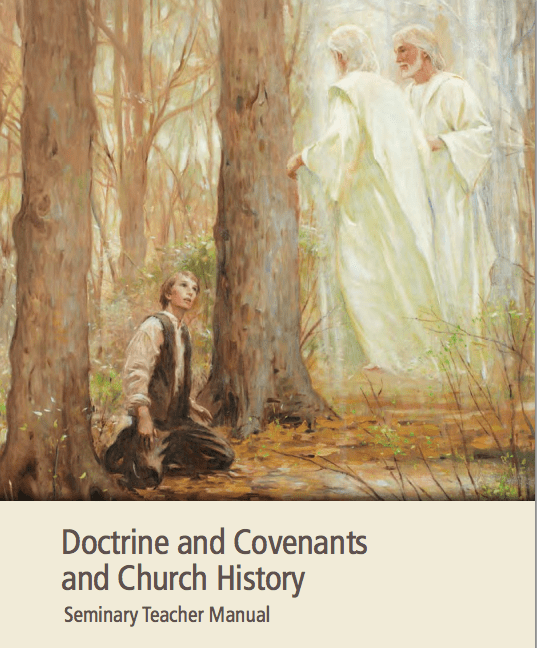
Screen Shot 2014-02-05 at 11.17.54 PM
The cover page of the new edition of the Doctrine and Covenants and Church History seminary manual.

[Cross-posted from Ploni Almoni: Mr. So-and-So’s Mormon Blog.]

The Church has released a new edition of the Doctrine and Covenants and Church History manual for seminary students. One of the remarkable aspects of the new manual is that it includes a discussion of several sensitive topics in church history. These topics include the following.

1. The various accounts of the First Vision are highlighted in the new manual. “There are nine known accounts of the First Vision—four written or dictated by Joseph Smith and five written by others retelling his experience,” the manual states (p. 20).

The multiple accounts of the First Vision were prepared at different times and for different audiences. In these accounts, Joseph Smith emphasized different aspects of his experience of the First Vision, but the accounts all agree in the essential truth that Joseph Smith did indeed have the heavens opened to him and see divine messengers, including God the Father and the Lord Jesus Christ. Because the 1838 account was part of Joseph Smith’s official history and testimony to the world, it was included in the Pearl of Great Price as scripture. (p. 20)

The manual then recommends students to read articles by Milton Backman and Richard Lloyd Anderson published in the Ensign discussing the various accounts of the First Vision (pp. 20, 22).

2. There is an entire chapter devoted to the Mountain Meadows Massacre and the Utah War (Lesson 151). The manual gives a brief historical overview of the events leading up to the massacre and acknowledges the participation of “Latter-day Saint leaders and settlers” in the crime (p. 523). Besides citing an article on the Mountain Meadows Massacre published in theEnsign, the manual also reproduces this quote given by President Henry B. Eyring at the 150 year anniversary of the massacre.

The gospel of Jesus Christ that we espouse, abhors the cold-blooded killing of men, women, and children. Indeed, it advocates peace and forgiveness. What was done [at the Mountain Meadows] long ago by members of our Church represents a terrible and inexcusable departure from Christian teaching and conduct.

3. In a chapter on the history of the Pearl of Great Price there is a brief overview of the history of the Book of Abraham, including the loss and recovery of several papyrus fragments once in the possession of Joseph Smith (pp. 524–526). Included in the discussion about the Book of Abraham is this (which is actually reprinted from the Church’s Pearl of Great Price Student Manual).

In 1966 eleven fragments of papyri once possessed by the Prophet Joseph Smith were discovered in the Metropolitan Museum of Art in New York City. They were given to the Church and have been analyzed by scholars who date them between about 100 B.C. and A.D. 100. A common objection to the authenticity of the book of Abraham is that the manuscripts are not old enough to have been written by Abraham, who lived almost two thousand years before Christ. Joseph Smith never claimed that the papyri were autographic (written by Abraham himself), nor that they dated from the time of Abraham. It is common to refer to an author’s works as ‘his’ writings, whether he penned them himself, dictated them to others, or others copied his writings later. (p. 525)

(Incidentally, yours truly has written a thing or two on this subject over at the Interpreter blog, which you can access here.) The manual also states, “Although we do not know the exact method Joseph Smith used to translate the writings, we do know that he translated the book of Abraham by the gift and power of God” (p. 525).

4. The new manual has material covering the practice of plural marriage, including an entire chapter on Joseph Smith’s plural marriage (Lesson 140) and a mentioning of Post-Manifesto plural marriage. Below are a few pertinent excerpts from the manual.

In this dispensation the Lord commanded some of the early Saints to practice plural marriage. The Prophet Joseph Smith and many other Church leaders found this commandment difficult, but they obeyed it. After receiving revelation, President Wilford Woodruff issued the Manifesto, which was accepted by the Church as authoritative and binding on October 6, 1890. This led to the end of the practice of plural marriage in the Church (see Official Declaration 1). (p. 204)

While Joseph Smith was working on the inspired translation of the Old Testament in 1831, he read about some of the ancient prophets practicing plural marriage (also called polygamy). Under this practice, one man is married to more than one living wife. The Prophet studied the scriptures, pondered what he learned, and eventually took his questions about plural marriage to Heavenly Father in prayer. . . . the Prophet Joseph Smith was reluctant to begin the practice of plural marriage. He stated that he did not begin the practice until he was warned that he would be destroyed if he did not obey. . . . Because of a lack of historical documentation, we do not know about Joseph Smith’s early attempts to comply with the commandment. However, by 1841 the Prophet had begun to obey the commandment and to teach it to some members of the Church, and over the next three years he married additional wives in accordance with the Lord’s commands. The Prophet Joseph Smith’s obedience to the Lord’s commandment to practice plural marriage was a trial of faith for him and his wife Emma, whom he loved dearly. (pp. 477–478)

Practicing plural marriage brought additional challenges. Because the practice was initially kept very quiet, rumors began to spread about Church leaders marrying additional wives. These rumors greatly distorted the truth, slandered the names of the Prophet and other Church leaders, and contributed to increased persecution against the Saints. (p. 479)

A small number of Latter-day Saints continued to enter into new plural marriages after the Manifesto was given. In 1904, President Joseph F. Smith announced “that all [plural] marriages are prohibited, and if any officer or member of the Church shall assume to solemnize or enter into any such marriage he will be . . . excommunicated”. . . . This policy continues today. (p. 530)

Towards the end of the chapter on Joseph Smith’s plural marriage, the manual warns, “Much unreliable information pertaining to plural marriage exists on the Internet and in many print sources. Be cautious and wise with such information. Some authors who write about the Church and its history present information out of context or include partial truths that can be misleading. The intent of some of these writings is to destroy faith” (p. 479). I myself have raised a similar point in this post. The manual then concludes by recommending, “Reliable historical research concerning the practice of plural marriage can be found at josephsmithpapers.org and byustudies.byu.edu” (p. 480).

5. On describing the nature of the Joseph Smith Translation, the manual says the following.

Around the fall of 1830, Joseph Smith was commanded by the Lord to translate the Bible. He did not translate the Bible from one language to another; nor did he have an original biblical manuscript to work from. Instead, Joseph would read and study passages from the King James Version of the Bible and then make corrections and additions as inspired by the Holy Ghost. Thus, the translation was more of an inspired revision than a traditional translation.The Joseph Smith Translation is estimated to have affected at least 3,400 verses in the King James Version of the Bible. These differences include additions (to clarify meaning or context), deletions, rearranged verses, and complete restructurings of certain chapters. The Joseph Smith Translation clarified doctrinal content, especially the mission of Jesus Christ, the nature of God, the nature of man, the Abrahamic covenant, the priesthood, and the Restoration of the gospel. (pp. 180–181)

6. The historical circumstances surrounding the priesthood ban and President Spencer W. Kimball’s 1978 revelation are discussed in a chapter on Official Declaration 2 (Lesson 157). As part of this discussion, the manual reprints the introductory material to OD 2 printed in the 2013 edition of the scriptures.

The Book of Mormon teaches that ‘all are alike unto God,’ including ‘black and white, bond and free, male and female’ (2 Nephi 26:33). Throughout the history of the Church, people of every race and ethnicity in many countries have been baptized and have lived as faithful members of the Church. During Joseph Smith’s lifetime, a few black male members of the Church were ordained to the priesthood. Early in its history, Church leaders stopped conferring the priesthood on black males of African descent. Church records offer no clear insights into the origins of this practice.

There is also the recommendation at the end of the chapter for students to “go to Gospel Topics on LDS.org and search for ‘race and the priesthood'” to learn more about the priesthood ban (p. 545).

7. Finally, in discussing section 77 of the Doctrine and Covenants, the manual straightforwardly says, “The 7,000 years [in vv. 6–7]  refers to the time since the Fall of Adam and Eve. It is not referring to the actual age of the earth including the periods of creation” (p. 280).

I am sure there is more that could be said about the new manual, but suffice it to say from the above examples that the Church is implementing productive measures towards introducing these sort of issues in a faith-promoting, safe, and positive environment (seminary). This will hopefully serve to “inoculate,” to use the popular metaphor, seminary students against the often highly debatable claims and negative information one can currently find on the Internet. While one might perhaps quibble over how certain issues are addressed in the new manual, that there is even a discussion at all in Church curriculum is, in my estimation, a step in the right direction.

Filed Under: Apologetics, Book of Abraham, Book reviews, Faith Crisis, First Vision, Joseph Smith, LDS History, LDS Scriptures, Polygamy, Racial Issues, Science Tagged With: Blacks and the Priesthood, Book of Abraham, Church History, Doctrine and Covenants, First Vision, Joseph Smith Translation, Plural Marriage, seminary

Joseph Smith’s First Vision Accounts: More Mormon Church Suppression and Cover-Up

May 9, 2012 by Stephen Smoot

The Church is at it again. The different accounts of Joseph Smith’s First Vision, which the Church has been sneaky enough to hide in places like the Ensign and BYU Studies, continues to be suppressed and hid from unsuspecting Church members. The damning contradictions in the Prophet’s different accounts are, in fact, so damaging that the Church thought it wise to talk about them only in a place so obscure and so concealed that nobody would be able to find it without any serious effort. I am speaking, of course, about YouTube. After all, nobody watches the Mormon Messages videos produced by the Church. What better place to hide this information from Church members than in a place that certainly has never been talked about in an official Church magazine or website?

But enough talk. Let’s take a look at the video itself:
[Read more…] about Joseph Smith’s First Vision Accounts: More Mormon Church Suppression and Cover-Up

Filed Under: Anti-Mormon critics, Apologetics, Joseph Smith, LDS History Tagged With: censorship, Church History, First Vision, Joseph Smith, Mark Ashurst-McGee, Mormon Messages

A Black Man in Zion: Reflections on Race in the Restored Gospel

Start Here

Question

How does Marcus H. Martins understand the former Latter-day Saint priesthood restriction and the 1978 revelation?

Short Answer

Marcus H. Martins argues that the former priesthood restriction was not part of the everlasting gospel but a historical Church policy whose origins remain uncertain. Speaking from his experience as a Black convert before 1978, he emphasizes that he still received baptism, the Holy Ghost, testimony, and other essential gospel blessings. He views the 1978 revelation as a major step in the worldwide restoration of priesthood and temple blessings and encourages Latter-day Saints to acknowledge the past while moving forward with faith in Jesus Christ.

Key Takeaways
  • Martins joined The Church of Jesus Christ of Latter-day Saints in 1972, six years before the priesthood restriction ended.

  • He describes both the genuine spiritual blessings he received and the burden created by racial teachings and explanations circulating among Latter-day Saints.

  • Martins states that, in his view, “the priesthood ban was never part of the everlasting gospel.”

  • He distinguishes the historical restriction itself from the “pseudo-explanations” developed to explain it, which he considers human attempts that were “way off mark.”

  • He sees the faithfulness of Black Latter-day Saints before and after 1978 as an ongoing demonstration of commitment to the restored gospel.

  • His “Nephi-Sam Continuum” illustrates that powerful spiritual manifestations are not required for genuine faith and faithfulness.

  • Martins views the 1978 revelation as a major development in taking priesthood and temple blessings to people throughout the world.

  • He encourages members to learn from painful history without perpetuating either racial prejudice or the wounds of the past.

  • The dedication of temples in Ghana and Nigeria represents for Martins the expanding fulfillment of promises concerning priesthood, temple worship, and exaltation.

  • He concludes with his testimony of Jesus Christ, living prophets, priesthood authority, temple ordinances, and the restored gospel.

Summary

Summary

In this 2006 FAIR Conference address, Marcus H. Martins examines race and the former priesthood restriction from the perspective of a Black Latter-day Saint who joined the Church in 1972. Martins describes the burden created by racial explanations surrounding the restriction while emphasizing that he continued to receive fundamental blessings of the gospel—including baptism, the gift of the Holy Ghost, testimony, and the promise of eternal life. He proposes a “typology of laws” through which he personally understands the priesthood restriction as a mortal rule rather than part of the everlasting gospel.

Martins places the 1978 revelation in a global context, viewing it as a major step in making the blessings of priesthood and temple ordinances available throughout the world. He encourages Latter-day Saints to acknowledge history without allowing its wounds or prejudices to define the present. Concluding with the expansion of temples in Africa and the biblical story of Joseph, Martins testifies that through faithfulness all of God’s children may ultimately receive the blessings promised through Jesus Christ.

TL;DR

TL;DR (Too Long; Didn’t Read)

Marcus H. Martins reflects on race, the former priesthood restriction, and his own experience as a Black Latter-day Saint who joined the Church before 1978. He distinguishes the priesthood ban and the racial explanations associated with it from what he understands to be the everlasting gospel, while emphasizing the spiritual blessings he received even before the restriction ended. His central message is one of faithfulness, reconciliation, and confidence that the blessings of the restored gospel are ultimately available to all of God’s children.

Reflections on Race in the Restored Gospel

I’m delighted to be here, and as I often say, the introduction was so good that for a moment I thought somebody else was going to speak! I don’t know why I never came to these conferences before. Maybe it’s the airfare, time zone, but I’m delighted, really and truly honored, for this opportunity to be here with you.

What I’m going to do this afternoon is present to you an essay that is sort of a synthesis of:

  1. What I have experienced and
  2. What I have concluded

in relation to race in the restored gospel of Jesus Christ. 1

This is sort of a combination of many e-mail messages of people who contact me thinking that I know something about it—which I don’t. It’s not one of my topics of research. It’s just that I have lived through the last 34 years in the Church, and so I get lots of questions, e-mails, letters.

And I’ve got a lot of frequent flyer mileage traveling around the country and speaking on the priesthood ban and race relations which, once again, is not my main research topic. But I enjoy visiting with the Saints everywhere, so it’s good.

The Issue of Race

To begin, I think it’s no surprise to any of us that few human traits throughout history have been used more persistently as a justification for so much hatred, brutality, inhumanity, and pain than race.

Since its beginnings in the 1830s, The Church of Jesus Christ of Latter-day Saints has also been affected by the issue of race. The Church is managed largely by a lay clergy—in many cases around the world a clergy composed of relatively recent converts. Because of that, The Church of Jesus Christ is not entirely immune to the predicaments found in the societies in which the members of the Church live.

My Experience as a Black Latter-day Saint

  • I am a Black man of mixed African and European ancestry.
  • I have been a member of The Church of Jesus Christ of Latter-day Saints since 1972.
  • I was the first member of my race to serve a full-time mission after the revelation that extended the priesthood to worthy men with Black African ancestry in 1978. 2
  • I was also among the first to be ordained a high priest in 1981 and quite possibly—at least outside of Africa—I may have been among the first to be ordained a bishop in 1987.

Since 1994 I have been the first of my race (or mixed race, whatever) to work as a religion professor in the Church’s universities: Brigham Young University; then Rick’s College; BYU-Idaho and BYU-Hawaii.

The Burden of the Priesthood Ban

As a researcher, I may have read every official or semi-official statement available to the public about the priesthood ban. Unfortunately, the truth must be told. After reading such documents, any reasonable person will agree that Latter-day Saints with some measure of Black African ancestry have carried a heavy burden – in addition to whatever they may have had to deal with in society.

Since I joined the Church in 1972, terms such as cursed; less valiant; fence-sitter; Cain’s lineage; and others too impolite to be repeated have been used from time to time by fellow Latter-day Saints to refer to me or those who share my racial background.

That’s part of the legacy, if you will. Or I would call it more of a burden that members of the Church with Black African ancestry have had to deal with. And notice I’m from Brazil—I’m talking about my experiences in Brazil, not just in the United States in the last 16 years.

Putting the Past “Behind Us”

Back in 1995 President Gordon B. Hinckley stated to CBS reporter Mike Wallace that such things are “behind us.”

One cannot help but wonder how far behind have Latter-day Saints as a people put this shameful tradition? Could it be that some in our midst have been carrying these ideas on their backs, instead of truly leaving them behind?

As for me, I am sure that the Board of Trustees of Brigham Young University—which includes members of the First Presidency and the Quorum of the Twelve—would not have approved my appointment as chair of the department of religious education at Brigham Young University-Hawaii if they believed that I was cursed, less valiant or whatever.

Focusing on the Gospel of the Prince of Peace

I decided a number of years ago to leave these matters to the judgment of Him who knows all things. There is enough war, needless contention, and tragic destruction in this world. I certainly don’t want to add to any of those.

Therefore, I have focused my attention on teaching the gospel of the Prince of Peace, the Savior Jesus Christ, according to the dictates of our conscience, and bring people to

  • faith,
  • repentance,
  • pure Christ-like love, and
  • obedience to the commandments of God

—the only way to peace and happiness in this life.

Still, every year I receive a number of e-mails and phone calls from people around the world asking me questions—most of the time politely—about race and the priesthood ban.

Remembering the Priesthood Ban Without Being Defined by It

A young African American sister once asked me whether it was “abnormal” to feel annoyed by the priesthood ban. I told her that all human beings have feelings, and we cannot fully stifle this important part of our humanity, which is race.

My only suggestion—and I have done this myself—is to not allow this issue to importune our children and grandchildren.

Whether we like it or not, the priesthood ban is an integral part of the history of The Church of Jesus Christ of Latter-day Saints in this dispensation. We can’t hide it. We can’t whitewash it. There’s nothing to do—it’s part of the history.

But just like the Mountain Meadows massacre and other unfortunate episodes, the ban may be remembered as an undeniable fact in history—but never as a significant factor to the present.

Therefore, for the benefit of those who never contacted me, I will share a few of my own insights on the priesthood ban based on my current understanding of the scriptures and doctrines of the Church.

The Priesthood Ban and the Everlasting Gospel

In my mind the priesthood ban was never part of the everlasting gospel. I have found peace in the idea that the Lord allowed the ban to remain in his Church in order to fulfill his inscrutable purposes, whatever they are.

That belief leads me to conclude that the ban never jeopardized my eternal salvation. There were a few significant privileges of membership in the Church that I could not enjoy before June of 1978; a few very significant things, but not very many.

I was able to:

  • receive the ordinance of baptism,
  • I received the Holy Ghost,
  • I could pay my tithing,
  • I could read the scriptures,
  • I could pray,
  • I could partake of the sacrament,
  • I could hold many callings as my parents and I did all those years between 1972–78, and also
  • keep the commandments of the Lord and
  • be blessed for doing so.

None of these privileges of membership was denied me. I simply could not:

  • officiate in priesthood ordinances like my peers, nor
  • enter a temple and receive my own endowment, nor
  • be sealed to my parents.

But other than that, all other privileges of membership were available to me.

An Ongoing Opportunity to Display Commitment

Actually, I would argue that the ban afforded me and other Black Latter-day Saints a still-ongoing opportunity to display the depth of our commitment to the Lord and his kingdom in a specific way that our fellow Latter-day Saints of other races will never be able to experience.

Let me illustrate what I mean by the expression “ongoing opportunity.” During the three years it took me to complete my Ph.D. at Brigham Young University, I was a part-time lecturer for both the Sociology and the Church History & Doctrine Departments.

I remember that every semester at least one African American student would come to my office with a major question because he or she would have heard somebody saying that since they were from the “cursed lineage” they would not enter the celestial kingdom.

Often I would respond half-jokingly that this was a very well-known false doctrine because it could not be found in the scriptures and had never been accepted officially by the Church. And then I would ask those students: Why were you baptized? What do we call baptism?

Baptism as the Gate to the Celestial Kingdom

Invariably they would respond that baptism is the gate to the celestial kingdom, to which I would reply, if baptism is the gate to the celestial kingdom how come after living faithfully your whole life you would not be allowed to go there?

And those students would see that that idea—that Blacks would not enter the celestial kingdom—was inconsistent with the true doctrines of the restored gospel.

Although they had been baptized long after the priesthood ban had disappeared, these young people still had to exercise the same faith as the early (i.e. pre-1978) Black converts in order to remain active in the Church. That’s what I meant by an ongoing opportunity to display the depth of one’s commitment to the restored gospel.

The Priesthood Ban and Its Associated Rationales

In my mind, the priesthood ban and its associated rationales were never part of the restored gospel. I would argue that they constituted educated responses to the social environment in which the Church existed in the late 19th and most of the 20th century.

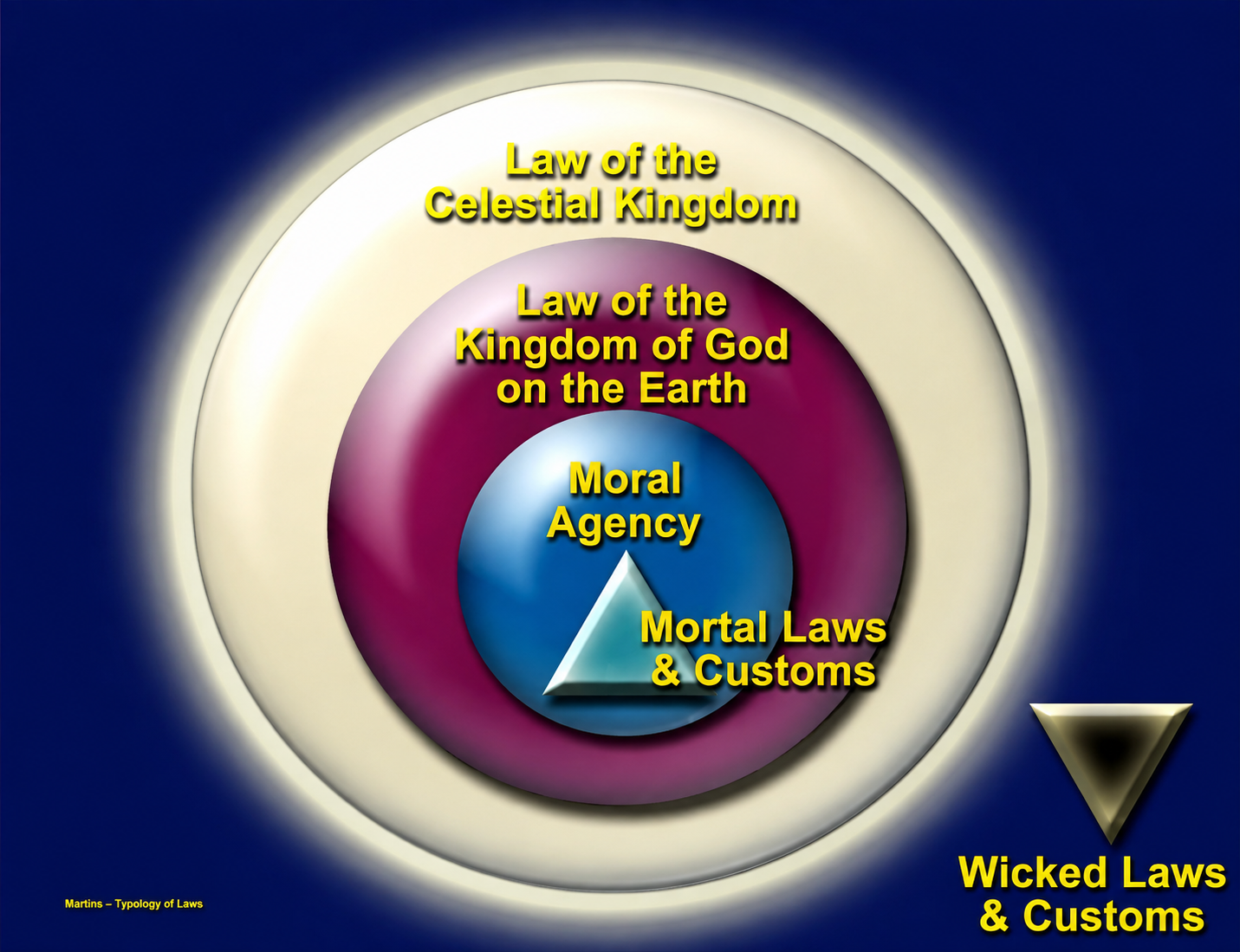
Let me try to expand this insight by resorting to a typology of laws that I conceived a few years ago.
A Typology of Laws

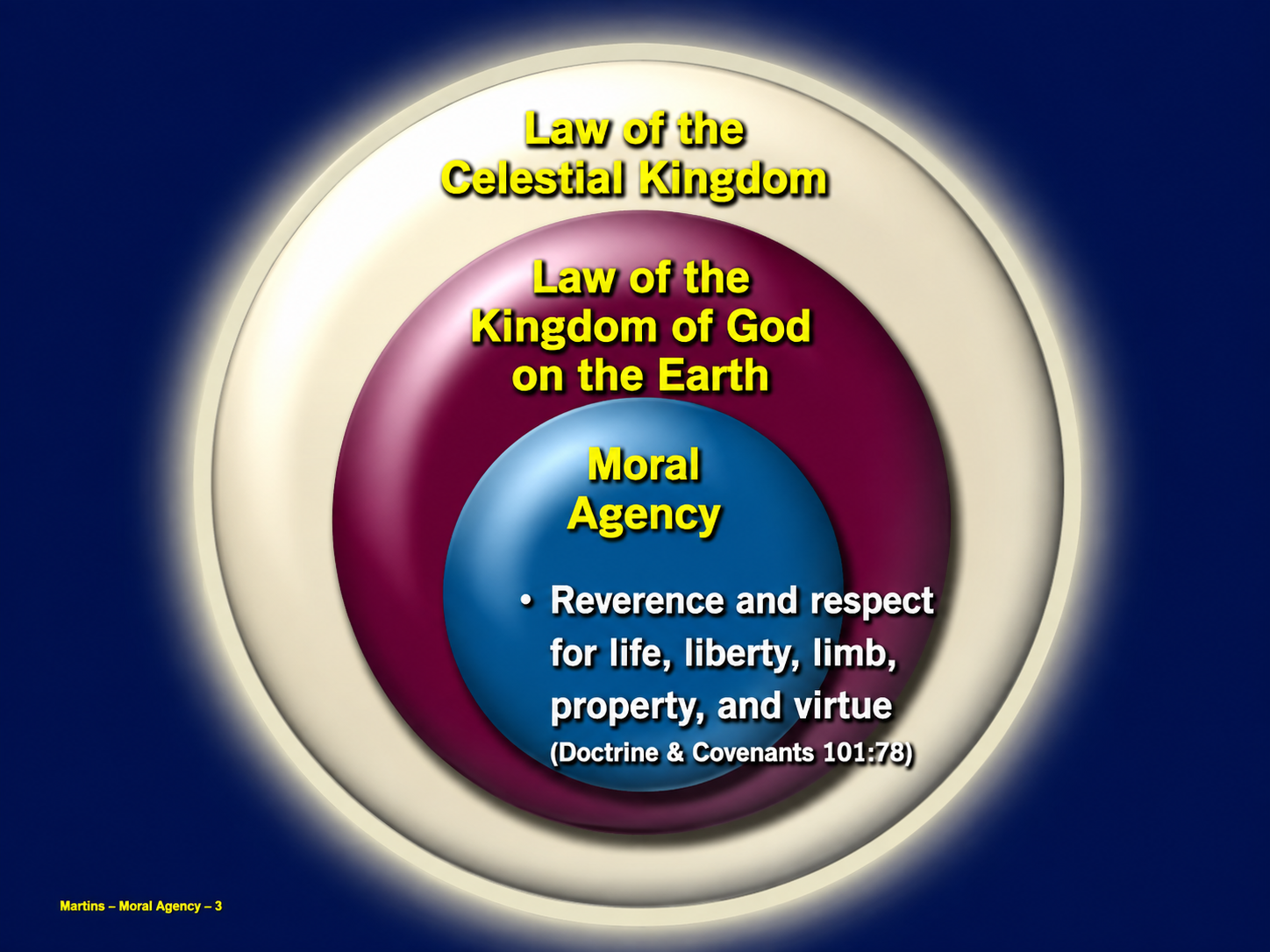
While attempting to categorize different laws we are subject to, I envisioned different “levels” which would begin with the eternal—the law of the celestial kingdom—and then after that the law of the kingdom of God on the earth.

The next level would come from an expression used by Lord himself in the Doctrine & Covenants, moral agency. Growing out of our moral agency we have several mortal laws and customs, including cultural traits and social norms.

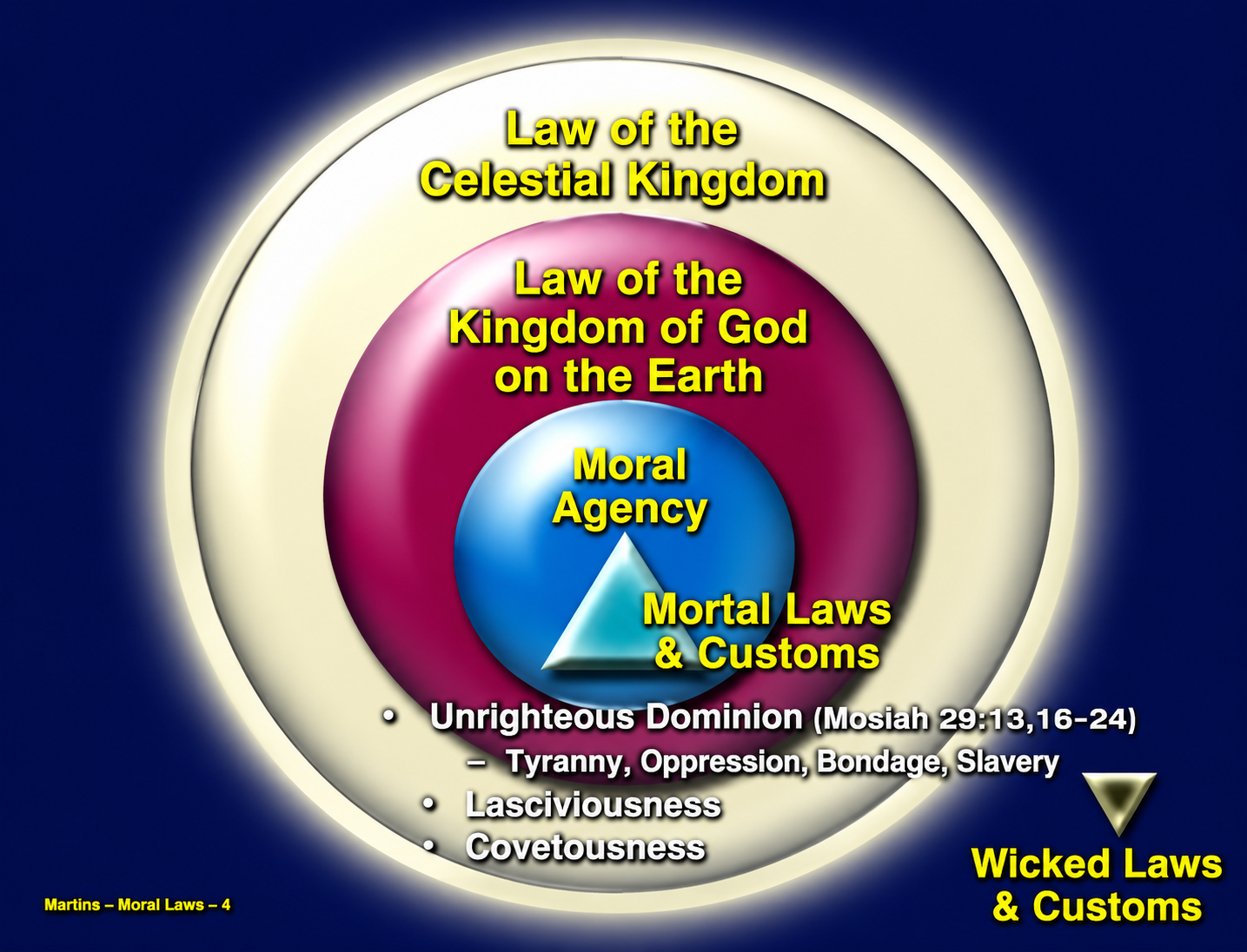
Of course this diagram, this model if you will, would be incomplete if we did not account for the opposite, that is, evil. So I added evil, outside of the diagram, meaning something that does not come from God. And for the lack of a better term I called it “wicked laws and customs”.
 

The Law of the Celestial Kingdom

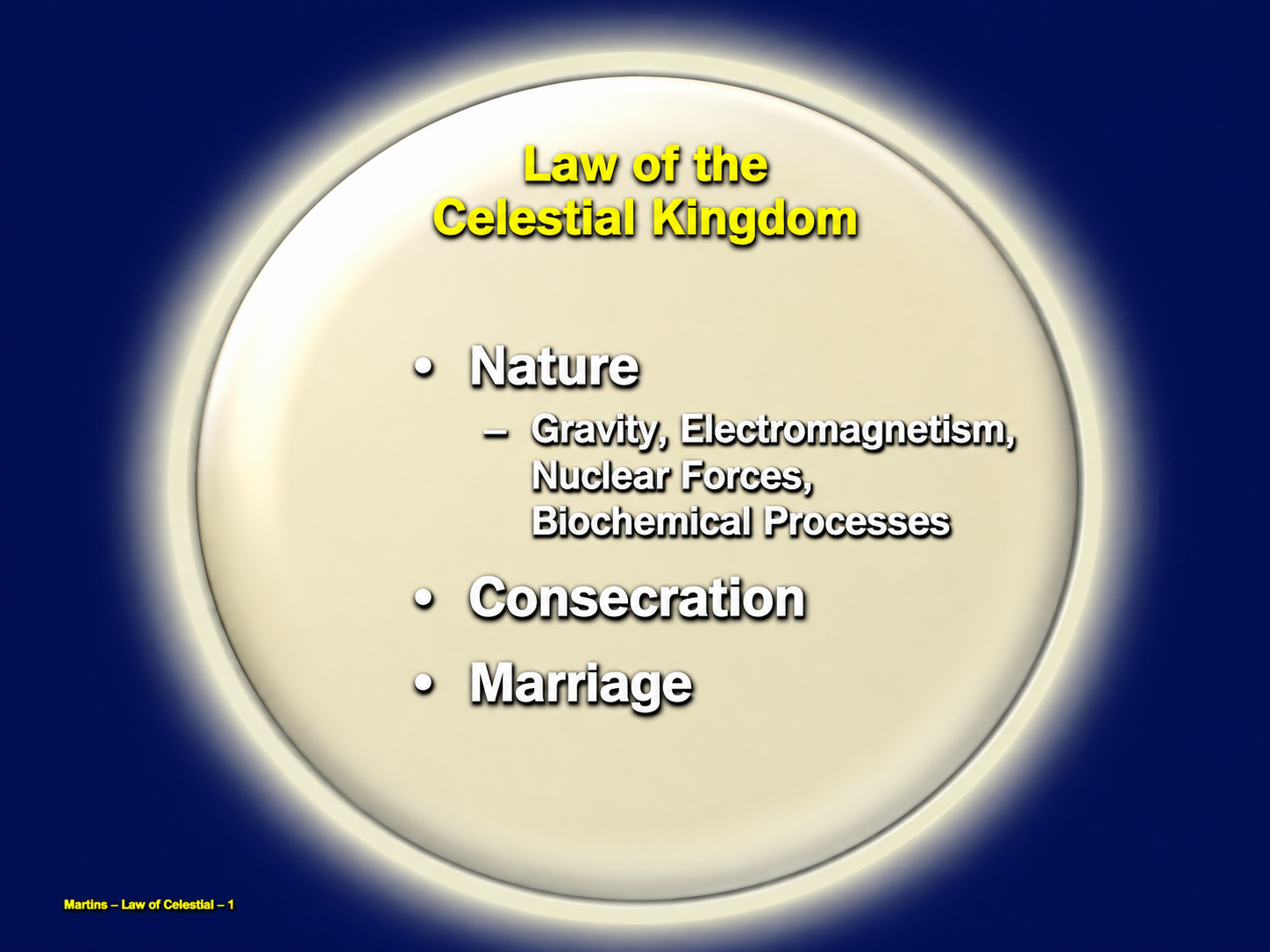
We begin with the law of the Celestial Kingdom. Here we find the so-called “laws of nature.” Elder James E. Talmage proposed that the Holy Ghost, as the third member of the Godhead, controls the forces of nature—gravity, sound, heat, electricity, etc. 3 We may assume that electromagnetism and perhaps even the weak and strong nuclear forces might also be controlled by the Holy Ghost.

Therefore, I call “laws of nature” those laws that govern the creation or organization of worlds and the maintenance of these planets, solar systems, and galaxies and so on.

At that level I also envision the Law of Consecration, which is the law of the celestial kingdom as the Lord stated in a revelation contained in section 78 of the Doctrine & Covenants.

Next we find the new and everlasting covenant of marriage, as contained in sections 131 and 132 of the Doctrine & Covenants. These are laws that people everywhere, regardless of religious affiliation, aspire to live, even if their religious denominations do not officially subscribe to such beliefs.

Some may call it instinct. Call it whatever it is, these eternal laws are inescapable, overwhelming, and deeply ingrained in us.

Consecration and Religious Devotion

Many devout men and women around the world respond to this innate desire to consecrate themselves to the glory of God by dedicating their lives to religious or humanitarian service.

Some have chosen to become preachers and evangelists, while others have focused on different roles in assisting the poor and needy. Among those without the light of the restored gospel of Jesus Christ we find some who practice celibacy and other forms of physical self-denial as a means to demonstrate the depth of their commitment.

Even without current revelations coming through living prophets to guide them, these individuals try to do the best they can, and they will be rewarded by their good works.

The Law of Consecration Today

Today in The Church of Jesus Christ of Latter-day Saints we still have the law of consecration, in the sense that we give of our time and talents, but we don’t have the stewardship portion and the United Order, which was the organizational structure that managed the law of consecration.

The only remnants of the United Order that we have among us today are the elements of the welfare system of the Church which provides temporary assistance to the poor and needy.

Eternal Marriage and the Law of the Celestial Kingdom

The next component of the law of the celestial kingdom is eternal marriage. From the time we were little children we yearn for the type of close association provided by family life. Little girls, for example, play “house,” and “mother” with their dolls.

Everyone—I have faith in and a testimony of this—will have at some point a fair opportunity to find a good person who will be pleasing to him or her, someone whom that person will love with all of his or her heart, and who believe it or not will in return love that individual with all his or her heart as well.

Many of them will have a chance to go to the House of the Lord still in this life and enter into an eternal covenant, while others who leave this life without this blessing will no doubt be an opportunity in the future.

These laws I just mentioned—the laws of nature, consecration, and marriage—constitute the category that I called the law of the celestial kingdom.
The Law of the Kingdom of God on the Earth

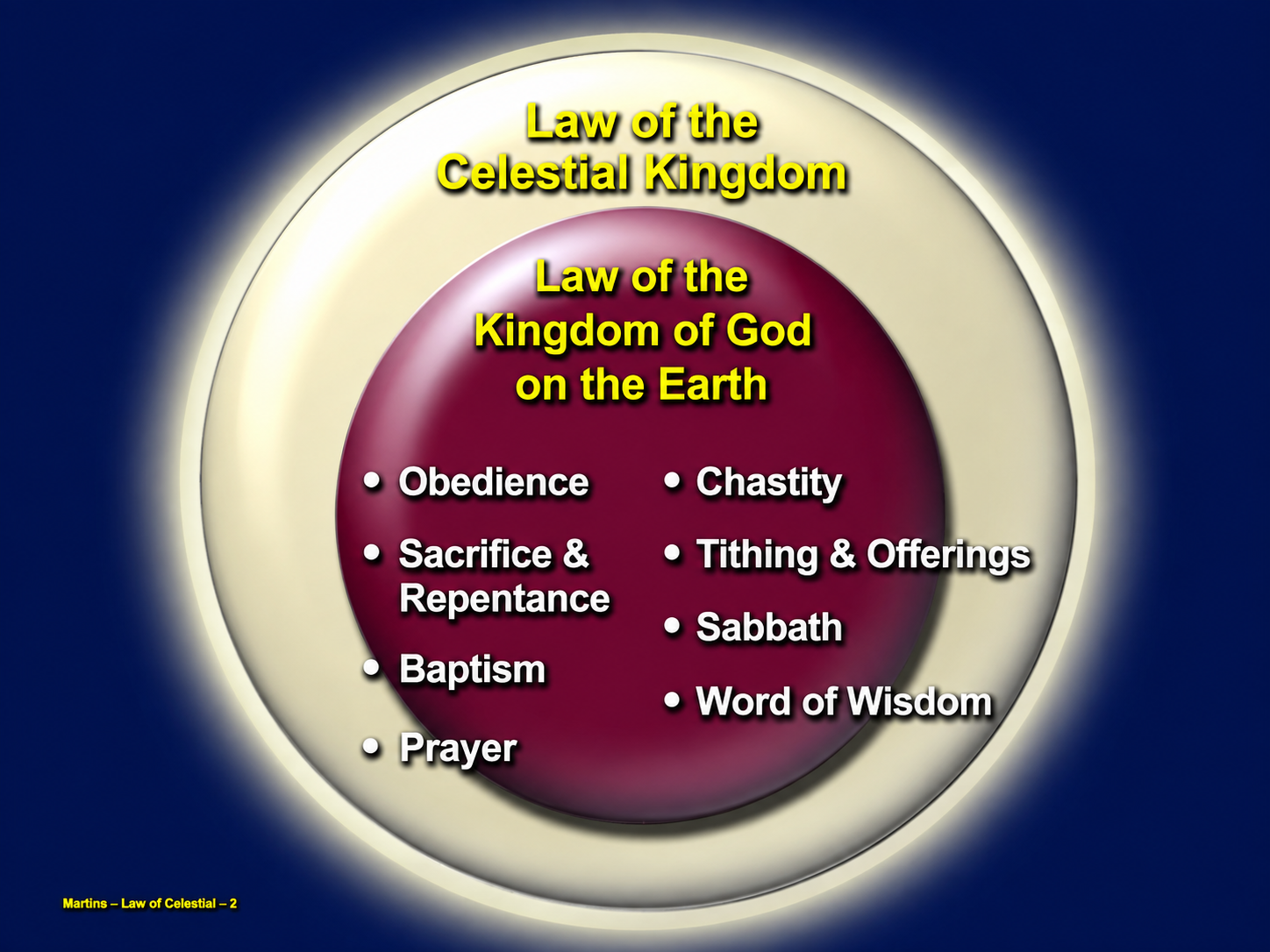
Next we arrive at what I called the law of the kingdom of God on the earth. And this is where we would find the law of obedience, the law of sacrifice and associated with sacrifice we have repentance because in order to repent we need to sacrifice something—some appetite, some passion, some pleasure—in order to conform ourselves to the laws of God that we accepted and covenanted to obey.

In this level we would find baptism, prayer, chastity, tithing and offerings, the law of the Sabbath, and the Word of Wisdom.
Moral Agency

Next we arrive at moral agency. This characteristic, if you will, is another universal human trait. By nature—regardless of nationality, culture, religion, or philosophy of life—every human being has a natural disposition to respect and revere life, liberty, limb, property and virtue. Everybody has that naturally, although some may fight that influence until they no longer feel its effects.

Then, growing out of that moral agency we would have what I call moral laws and customs. This is where we would find our political, economic, legal, and social systems. These are human developments made in response to circumstances around us under the influence of the moral agency that the Lord gave us.
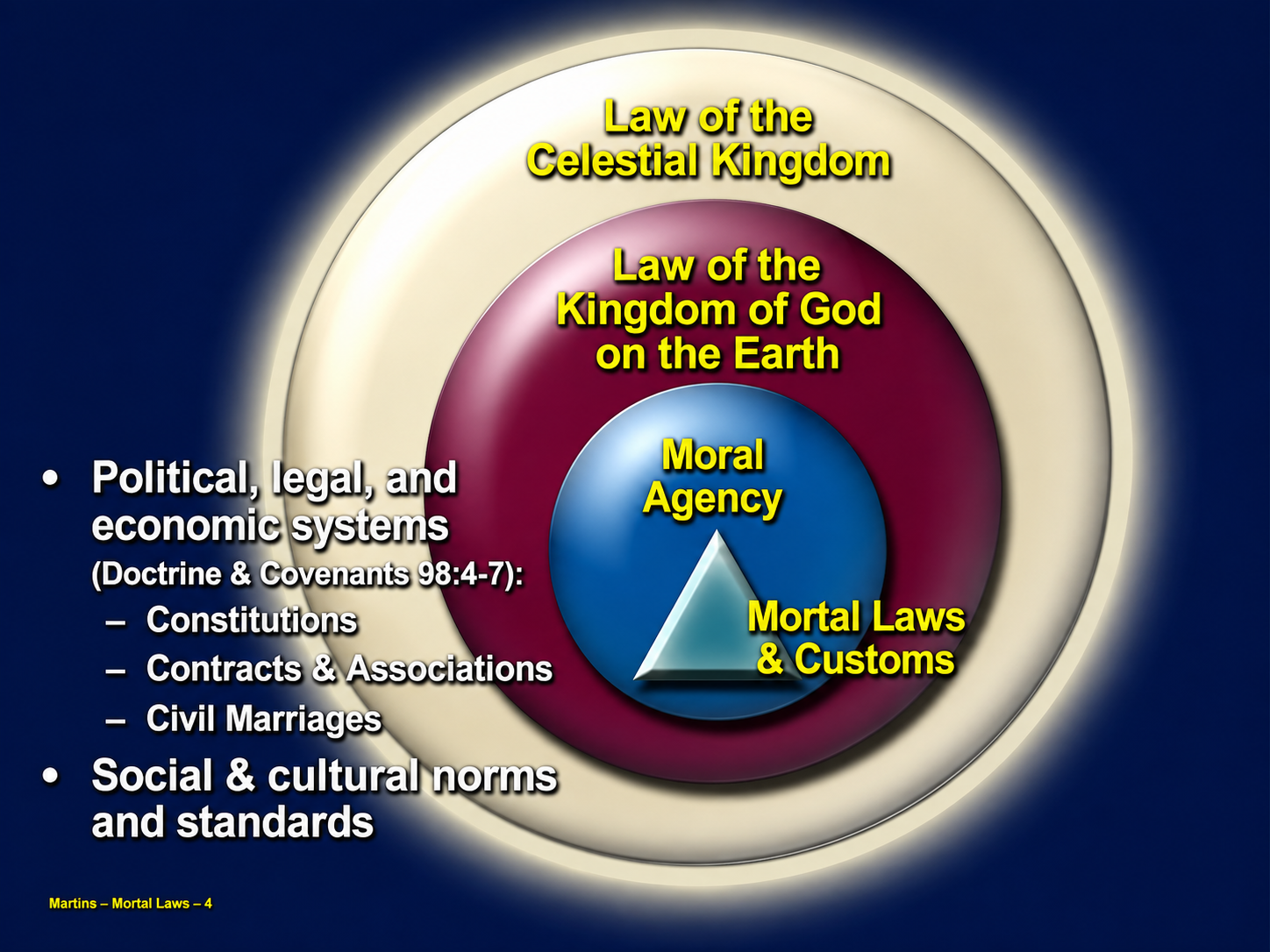
In this level we would include constitutions of nations, contracts, associations and civil marriages. We have eternal marriage in the law of the celestial kingdom, and here under mortal laws we have civil marriages for time only, or “’til death do you part.”

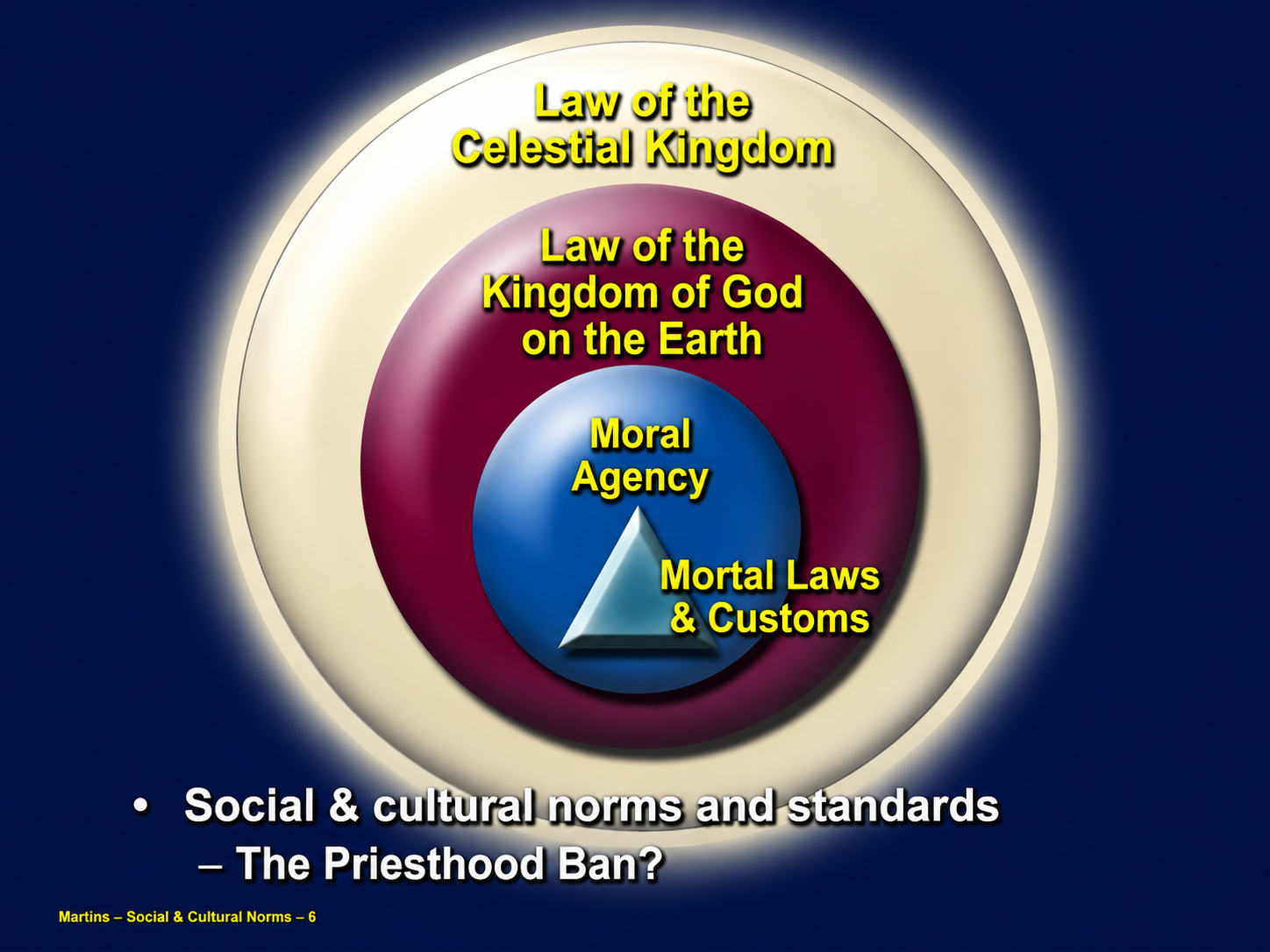
In this level of the diagram we would also find social and cultural norms, or what is considered right and wrong, appropriate or inappropriate, in specific social contexts, and in social interactions.
Wicked Laws and Customs

As I mentioned earlier, I also had to include wicked laws and wicked customs in this typology. Here we would find unrighteous dominion in all its forms—including tyranny and any form of oppression, and also bondage and slavery.

We should realize that there are many types of bondage. Bondage is not limited only to slavery itself, but there are also those who are in bondage to chemical dependency due to substance abuse, including drugs, perhaps even food. We also find people in financial bondage because of excessive debt.
Enjoying the Gospel Despite the Priesthood Ban

Considering our lack of additional information on the origin of the priesthood ban, I have used my typology to categorize the ban as a mortal law, or in other words, a rule or regulation established as an educated response to the social environment in which the Church existed in the late 19th and most of the 20th century.

This would have been what those Church leaders of 150-or-so years ago felt was the best approach at the time, and they used the keys of the priesthood in their possession to enforce it. And because of his inscrutable purposes, the Lord remained silent about the issue until June 1, 1978.

This categorization and hypothesis will be sufficient to me personally until evidence is presented of the existence of a revelation dated in the 19th century establishing the ban.

The main consequence of seeing the ban as a mortal law, and not part of the everlasting gospel is that in the things that matter most I was not losing anything. I could enjoy every blessing of the restored gospel—with the noted exception of the temple ordinances and officiating in priesthood ordinances. But I could enjoy everything else.

I could have a testimony through the power of the Holy Ghost, and indeed I received many testimonies of the truthfulness of the gospel and of the message of the restoration.

Spiritual Gifts and Testimony

Some individuals might claim that they were not so fortunate as I was, but for such cases, let me explain something about testimonies. In a revelation the Lord said something interesting about spiritual gifts.

“To some it is given by the Holy Ghost to know that Jesus Christ is the Son of God, and that he was crucified for the sins of the world. To others it is given to believe on their words, that they also might have eternal life if they continue faithful.” 4

To some it is given to know; to others it is given to believe on the testimonies of those who know. But those who just believe but did not feel or see anything will also have eternal life.

The Nephi-Sam Continuum

This is what I have called “the Nephi-Sam Continuum.” I created at BYU-Hawaii a course on Church organization and leadership in which I venture to prepare future members of Relief Society presidencies, Primary and Women’s presidencies, future members of Elders’ Quorums presidencies, Bishoprics, Stake Presidents and so on—a very lofty goal.

Actually one of my former students has already served as a Bishop after that. And so, I tell my students, some people among us are like Nephi and others are like Sam and so I term this “the Nephi-Sam Continuum.”

In the beginning of the narrative of the Book of Mormon we find Nephi enjoying powerful spiritual manifestations and visions of the future and so on, while his older brother Sam apparently does not experience any of these miraculous events.

He was not having the visions of eternity opened to him, but Nephi tells us: “I told all these things to my brother Sam and he believed me.” 5

And leaving his last blessing, Lehi blessed Sam and his posterity and said that they were also going to be blessed. 6

Faith, Obedience, and the Promise of Eternal Life

There are those among us who have very powerful spiritual experiences and come to the pulpit in testimony meetings already in tears. I believe they are really feeling something strong.

The really important question for those among us who may not as yet have been blessed with such powerful manifestations is this: “Am I faithful, obedient, loyal to God?” Those among us who might claim to never have felt these miraculous spiritual manifestations don’t need to worry.

So, until 1978 there I was, without the priesthood but having the power of the Holy Ghost and the promise of eternal life. And the question is, wasn’t that enough already?

Sure, it would have been wonderful to have enjoyed every available blessing prior to 1978, but we had solemn promises that one day we would enjoy every available blessing. That’s why I ask the question, “Wasn’t that enough?”

Nobody lost anything, no person with Black African ancestry lost anything, by becoming a member of The Church of Jesus Christ of Latter-Day Saints prior to 1978 without being able to hold the priesthood. A person could enjoy most of the blessings of membership in the Church.

But here we are, and the good news is that that’s past, and today all of us can enjoy those blessings. So that brings us the next question: “Where do we stand today?”

A Global Perspective on the 1978 Revelation

Reflecting on the long-term consequences of the revelation on the priesthood, President Gordon B. Hinckley stated that it created the conditions for the fulfillment of the scripture found in Doctrine & Covenants 1:20, which states: “… that every man might speak in the name of God the Lord, even the Savior of the world.”

In the known history of the dispensations of the gospel, this revelation from 1978—until we know more about past dispensations including in other places of the world that we may know nothing about—until we know more, this revelation stands next in importance with the revelation that extended the preaching of the gospel to the Gentiles in the Meridian of Times.

As the words spoken by President Hinckley suggest, the 1978 revelation represented an important step in the restoration of the fulness of the priesthood. The honors and privileges besought by ancient pharaohs and emperors are now available to all those who choose to come unto Christ.

This has opened the way for men and women on the entire planet to become one day priests and kings to the Most High by obeying the laws and ordinances of the restored gospel. 7

What a Wonderful Time to Be Alive

We just saw the end of the 20th century. The scriptures reveal that one thousand of our years is like one day for the Lord, so I don’t suppose he would care that much about our calendar and changes of years, centuries, and so on. “… all these are one year with God, but not with man.” 8

But for us these things are important. We just saw the 20th century come to a close, and it has been a phenomenal century. We saw the best and the worst in humanity.

Previously unimaginable heights and depths:

  • world wars,
  • violence and destruction beyond comprehension,
  • horrors that we would not see even in our worst nightmares did in fact take place in many parts of the world.

But when we consider also the achievements, the developments, the triumphs of the human spirit, and despite terrorism, drug trafficking, despite everything—when we see what looks like the beginning of a global renaissance, unprecedented, far-reaching, we have to exclaim, “What a wonderful time to be alive!”

Therefore, what befalls us now is to perpetuate whatever is good, and improve it if possible. Teach the people the lessons from the past without reliving or reopening old wounds. That is what I have been trying to do.

The Priesthood Is the Lord’s

I shared the personal perspective that I did not lose anything of eternal significance prior to 1978. The priesthood is the Lord’s. The Church is the Lord’s.

He allows his priesthood to be bestowed upon whoever he wants. He may take away the priesthood whenever he wants. It’s his church he can do whatever he wants, as far as I am concerned.

A Time for Activity, Not for Activism

This is a time for activity, not for activism. I consider myself and I hope to be worthy of the title of being a humble follower of Jesus Christ, and the honor of being a minister of his gospel.

All I want is to serve in his kingdom—to teach, to testify. And that is what I’ve been doing most of my life as a member of this Church.

Because of where my wife and I come from, we have had many opportunities to serve in many capacities in the Church. We don’t aspire to positions. We only aspire to be saved in the presence of the Father with our family and loved ones.

But the Lord found me at least sufficiently worthy to receive this priesthood, and he granted my wife and me the blessing of being sealed in the house of the Lord for time and all eternity.

Leaving Hatred and Prejudice in the Past

There is a lot of violence and war in this world. All over the world there are those who seem unable to let go of the hatreds and prejudices of the past, and others who cannot stop reliving the pains of the past.

My response to both groups today is still the same I have been giving for years.

For those who may still be unwilling or unprepared to leave the past behind, I only suggest that while they feel so they follow the Apostle Paul’s admonition to be “… an example of the believers, in word, in conversation, in charity, in spirit, in faith, in purity.” 9

People can over time prove through works—which will have a more powerful and permanent effect than any lingering prejudice—that they are indeed choice spirits kept in reserve for this era to testify to the world through deeds that “God is no respecter of persons: But in every nation he that feareth him, and worketh righteousness, is accepted with him.”10

Looking Forward with Faith

The first temple in West Africa was dedicated in Accra, Ghana, in January of 2004. The Aba Nigeria Temple followed in August of 2005.

There is a great significance in having these temples operating in our days. Their presence in Equatorial Africa seem to expand the meaning and applicability of the beautiful prophecy included in a solemn proclamation to the world written by then-Elder Wilford Woodruff and endorsed by the Twelve Apostles in 1845:
“The despised and degraded son of the forest, who has wandered in dejection and sorrow, and suffered reproach, shall then drop his disguise and stand forth in manly dignity, and exclaim to the Gentiles who have envied and sold him—‘I am Joseph; does my father yet live?’
“Or, in other words, I am a descendant of that Joseph who was sold into Egypt. You have hated me, and sold me, and thought I was dead; but lo! I live and am heir to the inheritance, titles, honors, priesthood, scepter, crown, throne, and eternal life and dignity of my fathers, who live for evermore.”
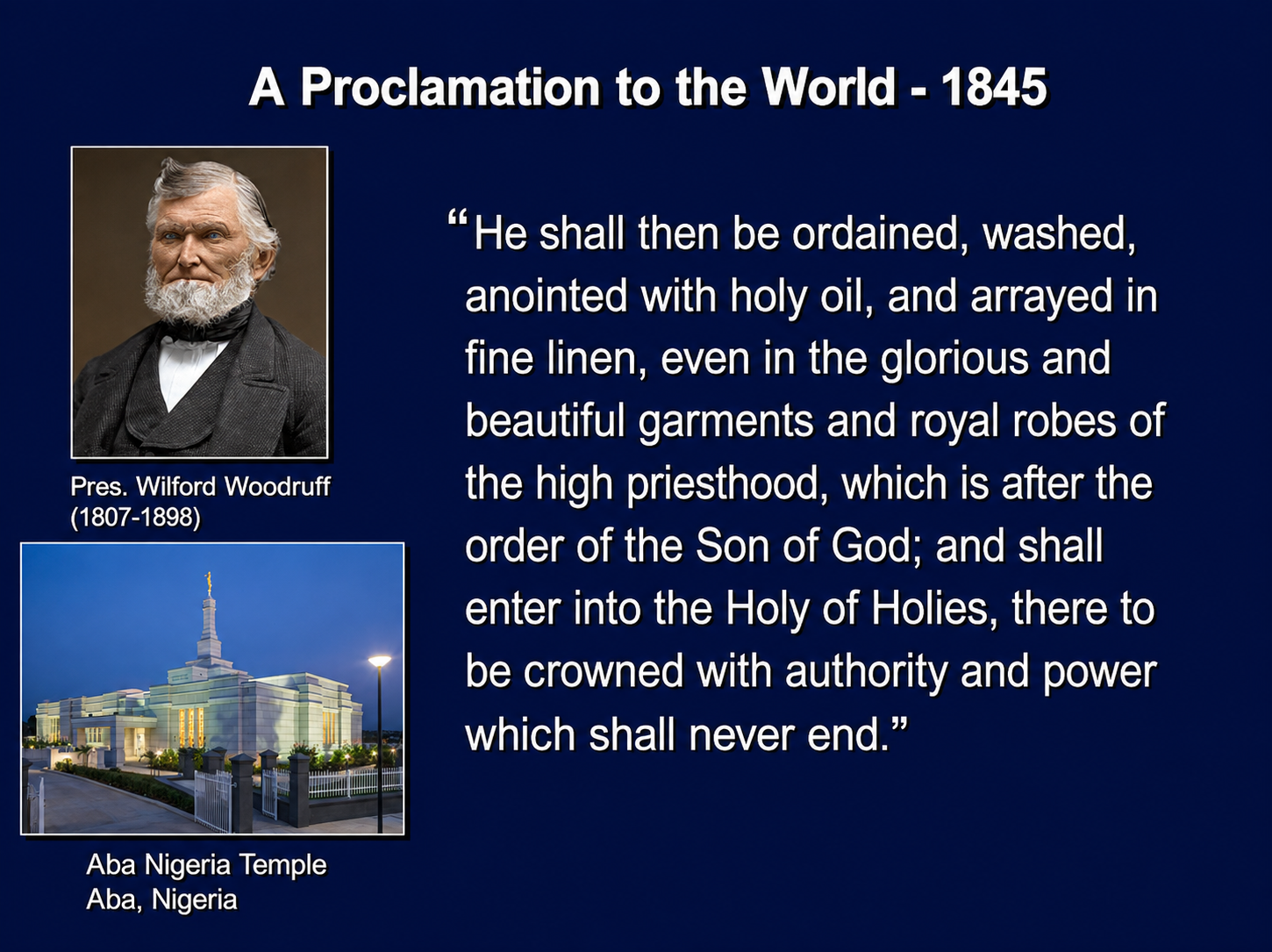
Temple Promises

“He shall then be ordained, washed, anointed with holy oil, and arrayed in fine linen, even in the glorious and beautiful garments and royal robes of the high priesthood, which is after the order of the Son of God; and shall enter into the Holy of Holies, there to be crowned with authority and power which shall never end.
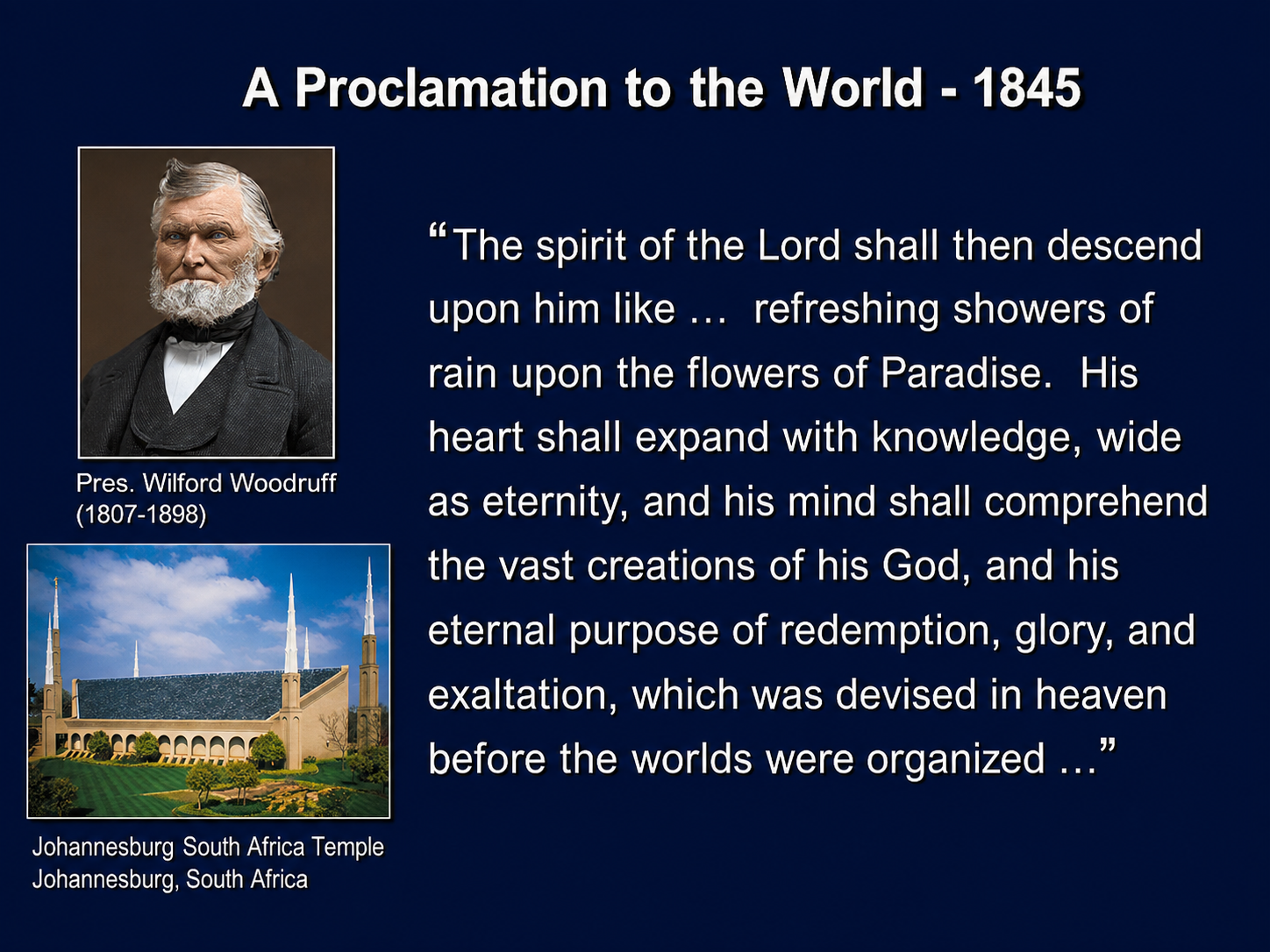
“The spirit of the Lord shall then descend upon him like the dew upon the mountains of Hermon, and like refreshing showers of rain upon the flowers of Paradise.
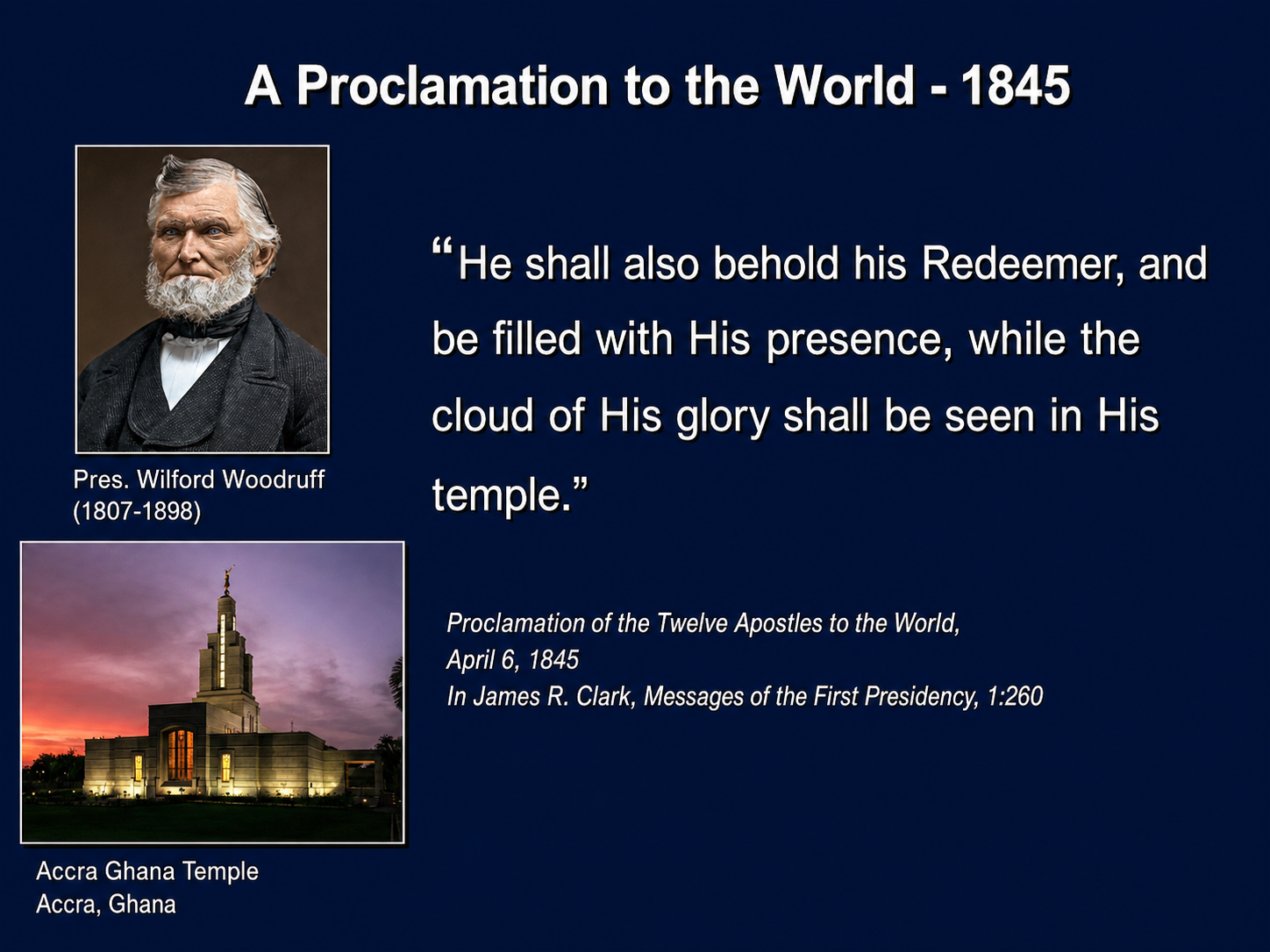
His heart shall expand with knowledge, wide as eternity, and his mind shall comprehend the vast creations of his God, and his eternal purpose of redemption, glory, and exaltation, which was devised in heaven before the worlds were organized; but made manifest in these last days, for the fullness of the Gentiles, and for the exaltation of Israel. He shall also behold his Redeemer, and be filled with His presence, while the cloud of His glory shall be seen in His temple.”11

“Our Father Joseph Was Also Sold as a Slave”

For many years I had a somber thought in my mind and I’m going to share something very personal with you, something I never disclosed in public before.

I have the thought, the somber thought, that my existence and all the blessings and privileges I enjoy today were the result of some of my ancestors being brought from somewhere in Africa as slaves to a life of horrible suffering and abuse by the hands of others of my ancestors.

But then one day I remembered that our father Joseph was also sold as a slave.

My recent ancestors were no different than Joseph. Joseph also suffered horribly when he was sold to the Midianites and later to the Egyptians. My father Joseph knows what it means to be a slave. But because of the blessings of God, and because of his faithfulness, the Lord placed him as the second in command in Egypt.

“I Am Joseph, Does My Father Yet Live?”

I don’t have any such expectations, of course, since I’m not running for political office or anything. But if I am faithful, I’ll have those thrones, principalities, dominions and exaltations promised to my wife and me when we were sealed in the temple almost three decades ago.

If my children and all of us do our part and live faithfully we will have those blessings as well. And together we will be able to stand and ask, “I am Joseph, does my father yet live?”

And then we will claim all our blessings, all the honors, all the prerogatives and privileges of the holy priesthood in the kingdom of heaven. Blessings we can’t fully understand at this time, but enough for all of us and billions and billions of our brothers and sisters.

A Testimony of the Restored Gospel

I don’t know if my words will make a whole lot of sense to some; I wish I had far more eloquence. But I can tell you this much, that I know that The Church of Jesus Christ of Latter-day Saints is the only true and living church on the face of the earth, that it is led by living prophets, that Joseph Smith was a prophet of God.

There are many things we don’t understand, and some may be hard to bear, but this is the place.

There are many good churches in the world, many great philosophies that provide varying measures of intellectual or spiritual satisfaction to billions of people.

But in The Church of Jesus Christ of Latter-day Saints

  • we have the power of the priesthood,
  • the oracles of the Lord, his living prophets,
  • the ordinances

That can prepare us to once again enter the presence of God, clothed in immortality and eternal life, to live forever with our fathers Adam and Abraham and Joseph.

I testify that these things are true and that this is part of the true gospel of Jesus Christ.


Questions and Answers

Q: Are you a son of Elder HelvÈcio Martins? If so, would you recount President Kimball’s promise to him repeated by President Faust.

Martins: Yes, I am the son of HelvÈcio Martins. The “H” stands for HelvÈcio. I am Marcus HelvÈcio Tourinho de Assis Martins. But even in Brazil it’s too long a name, so I go with Marcus H. Martins.

My father was a great man. One of the greatest men I’ve known. He passed away in May of last year. Days before I was going to visit him in Brazil we had a double whammy in our family.

My mother-in-law passed away when we were heading to Brazil for my in-laws’ Golden Anniversary. Their 50th wedding anniversary—and she passed away six days before that. And when we got there, and were visiting with my father-in-law, three days later my father passed away.

President Kimball’s Promise to HelvÈcio Martins

The promise that is being asked here, the first encounter my father had with President Kimball was in 1973. I don’t know if his autobiography is still in print—you have in greater detail in his autobiography—but Pres. Kimball told him that the keyword for him was faithfulness.

That if he would remain faithful he would receive all the blessings of the gospel someday; this was 1973. 12

That same promise was repeated by Pres. Kimball himself in 1977 at the time of the laying of the cornerstone of the Sao Paulo temple. In those days we laid the cornerstone about one year before the dedication of the temple and Pres. Kimball visited with my father.

It was kind of an interesting situation how it happened. My father gives details, a really neat experience, and Pres. Kimball asked,

“Do you remember what I told you years ago?”

My father said,

“Yes, President, I remember.”

Of course in 1973 when they met Pres. Kimball was the President of the Quorum of the Twelve. It was just a few months before Pres. Harold B. Lee passed away. So the second encounter, in 1977, Pres. Kimball was the President of the Church then.

Should the Church Apologize for the Priesthood Ban?

Q: Do you think the Church should admit the ban was racist and apologize so we can move on?

Martins:

I gave an interview to KSL in ’90-something. I told at the time, and I still feel, that nobody needs to apologize for anything.

You see, the Church as an institution is governed by revelation. A revelation was received on the priesthood in 1978. It was not received earlier.

We have, and I saw the book out there, David O. McKay and the Rise of Modern Mormonism by Gregory A. Prince and Wm Robert Wright. Take Pres. David O. McKay for example. The data that we have shows that he personally was inclined to get rid of the ban. But as a prophet he must inquire of the Lord and the answer was: “Not now.”

We have some evidence that Pres. Harold B. Lee himself, at one point as the President of the Church, also considered the issue. And also the answer to him was, “Not now.”

So no, I don’t think there should be any apology.

You see, I don’t have a problem with the ban. If the Lord were to tell Pres. Hinckley to take the priesthood away from Blacks or from Asians or whatever I would not have a problem. For one thing I wouldn’t have to go home teaching every month! (Laughter) I love home teaching! My father spoke about home teaching in General Conference.

The Ban and Its “Pseudo-Explanations”

The ‘pseudo-explanations’ for the ban were human attempts to try to explain the ban. I think they were way off mark. Now some among us, even today, harbor racist feelings.

You see, conversion is not really a destination, it’s a process. And we can be converted to a lot of things in varying degrees. So to be converted to the notion that

“We are all one worldwide family—that we are true literal brothers and sisters.”

Conversion to that may take a longer time with some people than with others. And I’m not here to judge anyone.

So, should the Church admit that the ban was racist? I don’t think the ban was racist. But unfortunately, it provided a pretty good cover to whoever harbored racist feelings. For them to continue to say “Well, I kind of have a religious justification for that”. Too bad, it happened. As I said, it’s a fact in history.

And no, I don’t think anybody should apologize. Yes, I would love to hear Brigham Young’s explanations. And John Taylor’s explanations. But they are not available for comment right now. (Laughter)

I mean, I’m in no hurry to go to the spirit world and have a nice old chat with them. So for me, I’m just moving on and this is past. It’s history—and it doesn’t hurt me at all.

Baptisms for the Dead Before 1978

Q: Were Black members able to do baptisms for the dead before June 1978?

Martins: Theoretically, yes. But if I had gone to any of my bishops or stake presidents at the time. I don’t think any of them in Brazil would have signed a temple recommend for me to do baptisms.

The first time I came to the United States was in 1976.  I remember being outside of the Los Angeles Temple and the Salt Lake Temple. I had no clue that people who were not endowed even could go do baptisms for the dead. So it was never a question.

Only many years later, looking at a number of sources, I realized theoretically it would have been possible. But a lot of it I think was a matter of interpretation by local ecclesiastical leaders. I don’t know how many of them would be in the mood.

The Influence of Local Admisitrative Details

And then, you know, I’ve been a temple officiator. And as I travel around the world, I see that some administrative details that vary from one temple to another.

So in those days, yes, a Black person with a temple recommend might even be admitted to one temple. And then, travel across state lines and not be admitted to another temple. Because the local presidency would say, “Well, we don’t think this is kosher”. 13

At least there was a possibility. I don’t know of any cases.

But what I remember from the Church is that we didn’t have the facilities for communication like we have today. (We would be talking about the mid-1970s.) So a lot of things were left to the local interpretation.

It doesn’t quite answer the question but that’s what I would say about it.

Thank you very much.

Search topics

Marcus H. Martins; A Black Man in Zion; race and the priesthood; 1978 priesthood revelation; priesthood restriction; Black Latter-day Saints; Black members of the Church; Blacks and the priesthood; race in the restored gospel; Official Declaration 2; history of the priesthood ban; Black Saints before 1978; revelation on the priesthood; Spencer W. Kimball and priesthood revelation; Gordon B. Hinckley and race; David O. McKay and priesthood ban; Harold B. Lee and priesthood ban; Helvécio Martins; Black Latter-day Saint history; priesthood and temple blessings; Accra Ghana Temple; Aba Nigeria Temple; temples in Africa; law of consecration; eternal marriage; moral agency; Nephi-Sam Continuum; spiritual gifts and testimony; faithfulness and priesthood; Wilford Woodruff 1845 proclamation; Joseph sold into Egypt; race and Latter-day Saint history

CES Letter race and priesthood; Mormon Church priesthood ban; Mormon Church racism; LDS Church racism; Mormon Church Black priesthood ban; Mormon priesthood restriction; Mormon Church race history; Mormon Church Blacks and priesthood; LDS priesthood ban explanation; why were Black members denied the priesthood; did Brigham Young ban Black priesthood; Mormon Church 1978 revelation; LDS Church apology for priesthood ban; Mormon racism criticism; Mormon Church racial teachings; Black Mormon history; LDS apologetics race and priesthood

Empathetic Imagination: Reading Between the Lines in Standing on the Promises

Start Here

Question

Who were some of the early Black pioneers and members of The Church of Jesus Christ of Latter-day Saints?

Short Answer

Early Black Latter-day Saints included Green Flake, Elijah Abel, and Jane Manning James, among others. Their experiences show that people of African descent participated in the Church from its early decades and contributed to the Latter-day Saint pioneer experience, even while confronting slavery, racial discrimination, and later restrictions within the Church.

Key Takeaways
  • Black Latter-day Saints were present in the early history of the Church.
  • Elijah Abel was an early Black member who was ordained to the priesthood.
  • Green Flake was among the Black pioneers associated with the Latter-day Saint migration to the Salt Lake Valley.
  • Jane Manning James was an early Black Latter-day Saint whose life became an important part of Utah and Church history.
  • The experiences of Black Saints cannot be understood solely through the later priesthood and temple restrictions.
  • Young and Gray seek to recover the individual lives, faith, relationships, and experiences behind the historical record.
  • Their Standing on the Promises trilogy combines extensive historical research with historical fiction to tell these stories.

Summary

Summary

Margaret Blair Young and Darius Gray bring attention to Black Latter-day Saints who participated in the early history of the Church and the settlement of the American West. Through photographs, documentary history, and stories developed during their research for the Standing on the Promises trilogy, they introduce individuals including Green Flake, Elijah Abel, and Jane Manning James as real people whose lives, faith, relationships, and contributions deserve to be remembered.

The presentation also places these individual stories within the broader history of race and the Church. Young and Gray use historical fiction alongside extensive research to help audiences move beyond names and dates and consider the lived experiences of Black Saints. Their approach emphasizes both the difficult realities these individuals encountered and their place within the larger Latter-day Saint story.

TL;DR

TL;DR (Too Long; Didn’t Read)

Black Latter-day Saints were part of the Restoration and the pioneer story from its early years. Margaret Blair Young and Darius Gray recover the stories of people such as Green Flake, Elijah Abel, and Jane Manning James, emphasizing their faith, contributions, and humanity while addressing the complicated history of race in the Church.

Introduction

Introduction

His grandfather, James Lewis Gray, was born a slave. His great-grandfather, Lewis Gray, was a slave here in Independence, Missouri.

Margaret Blair Young and Darius Gray have co-authored the Standing on the Promises trilogy. The trilogy is historical fiction, fictionalized as needed, and supplied with copious endnotes.

The three books, One More River to Cross, Bound for Canaan, and The Last Mile of the Way, cover the history of several great Mormon pioneers of color.

And now we present Margaret Blair Young and my father, her eye candy, Darius Gray. [laughter]

Darius Gray

Thank you very much, Shaw. That feels good. It’s been about, oh, 40 years and 60 lb ago that I was last eye candy. [laughter]

Testing What We Know About History

DARIUS AIDAN GRAY: Well, here we are in the afternoon of the second day, and I think we need to find out how well you people have been paying attention. You look like a fairly bright group! Yeah, a fairly bright group, so we’re going to have a test.

Now, this test is very simple, very straightforward. There are no trick answers expected. The obvious answer is the answer I’m looking for. So here we go with the test. Now you’ll see how simple and basic this is:

GRAY: For what invention was Alexander Graham Bell known? — AUDIENCE: The telephone.

GRAY: Who invented the lightbulb? — AUDIENCE: Thomas Edison.

GRAY: And this came up with a speaker we had just a short bit ago: For what is Samuel Morse known? — AUDIENCE: Telegraph.

GRAY: Morse code. Any radio amateurs here, ham operators? All right. We know what that means—you know code.

GRAY: For what was James Watt known? — AUDIENCE: Steam engine.

GRAY: See, I told you you were a fairly bright group. I had confidence.

GRAY: Who invented the cotton gin? — AUDIENCE: Eli Whitney.

From Ancient History to American History

GRAY: Well, maybe these are too easy. Let me make it a little more difficult. Let’s go to some ancient history.

GRAY: In ancient Greece, they were divided into city-states, and there were two primary heavyweight city-states, and they were always contending with each other. What were they? — AUDIENCE: Athens and Sparta.

GRAY: All right. Try this one. In ancient Egypt there was a city of great learning that had a great library. The city was? — AUDIENCE: Alexandria.

GRAY: Okay. You’re going to play like that, are ya? [Laughter]

GRAY: Well then, let’s come to some more recent history. Who lost at the Battle of Waterloo? — AUDIENCE: Napoleon.

GRAY: Wow. Extra points if you can say who won? — AUDIENCE: The Duke of Wellington.

GRAY: Now that one got a little harder. Good, I feel better.

GRAY: What happened in the year 1066? — AUDIENCE: The Norman Conquest—the Battle of Hastings.

Questions About Black American History

GRAY: Well, since you’re doing so well with all those, let’s come back to U.S. history. See how you’re going to do on some more history here.

GRAY: What year was Dr. Martin Luther King assassinated? — AUDIENCE: 1968.
GRAY: Date? — AUDIENCE: April 4.

GRAY: What was Plessy v. Ferguson, and what was its significance? — AUDIENCE: The Supreme Court decision in 1896 that formally gave legal sanction to segregation.

GRAY: By whom? You said it, but to make sure—the case was before the…? — AUDIENCE: The Supreme Court.

GRAY: The United States Supreme Court.

Now, we’ve got one young man up here who’s very in tune to this. But I noticed there were fewer of you with the answer on that one.

GRAY: Let’s try this one: Who was Marcus Garvey, and what was his principal position? — AUDIENCE MEMBER: Evangelist—early 1920s—favors a separate nation for the Negro people; moved to Cuba to establish a community which failed.

GRAY: Whoever has five bucks, I want it to go to this young man! [Laughter]

Brown v. Board of Education

GRAY: All right. What was Brown v. Board of Education, when was it, and what did it overturn—and you don’t get to answer! [Groan] — AUDIENCE: The Topeka, Kansas, Board of Education, 1954—overturned the “separate but equal” doctrine—

GRAY: Which came in what ruling? — AUDIENCE: Plessy v. Ferguson.

Yes! All right. It overturned Plessy v. Ferguson, which was in 1896, which is the year my father was born. So you see, some of these things have been right smack dab in the middle of my family from the get-go.

So we’re not talking too ‘ancient history’ here. But let’s try a few more… well, no, let’s not. Let’s move forward.

A Society Teaches What It Values

I notice that there are significantly fewer hands and answers coming to these last few questions—things about civil rights and the United States of America.

Now, some people would say, well, knowing the Battle of Hastings and Waterloo and all of those sorts of things are far more significant than Marcus Garvey. To which I would ask the question: How many of you have ever used a cotton gin? [Laughter]

How many of you have even seen a cotton gin?

Yet we know about Eli Whitney and the cotton gin, and we know of these other points of history. Why?

Because a society teaches that which it values.

We have not valued the contributions of persons of color in this country. We’ve not valued that portion of our own history in this country.

Black Latter-day Saints in Early Church History

Let’s make this a little bit more personal in terms of the LDS Church.

GRAY: What year was the LDS Church established? — AUDIENCE: 1830.

GRAY: When do we have record of the first Black member in the LDS Church?

The year was 1832. Just two years after the founding of this faith. And the individual was a man we’ll talk about a little bit more later—his name was Elijah Abel.

Elijah Abel and the Priesthood

GRAY: What year did Blacks receive the Priesthood? — AUDIENCE: 1978.

What year did Blacks receive the Priesthood? Elijah Abel was ordained to the Priesthood in 1836. Okay.

GRAY: When did the Saints migrate from the East to the Salt Lake Valley? — AUDIENCE: 1847.

GRAY: Got here in the Salt Lake Valley in ’47. They were a little slow back then; transportation wasn’t what it is now.

GRAY: When did the first Blacks with the Saints come into the Valley? — AUDIENCE: 1847.

The First Black Pioneers in the Salt Lake Valley

The very first wagon train into this valley was preceded by some Black servants, which my eminent partner and co-author Margaret Young will now speak to.

Ladies and gentlemen, Margaret Blair Young.

Green Flake and Bringing History to Life

MARGARET BLAIR YOUNG: This is Green Flake, one of the three—on the Brigham Young statue they’re referred to as “coloured servants.” It’s Green Flake, Hark Lay, and Oscar Crosby. But according to the best records we can find, the words Brigham Young spoke, “This is the right place. Drive on,” were probably spoken to this man.

In this crowd, a good many of you have probably heard of him. In a lot of crowds, he’s a name that nobody knows at all. A remarkable man—and we’ll talk just a little bit about him.

But mostly, when Renee introduced me—introduced Darius and me—she talked about us as writing fiction, which doesn’t seem to qualify us at all to be speaking to people with the kind of knowledge that you people have.

Writing Standing on the Promises

But we would like to justify ourselves in your eyes, because there’s something really interesting about choosing to do a fictional account of history, but with supporting endnotes.

And when people have asked me about the amount of work that went into writing the trilogy, I’ve said it was three dissertations—because for us to get things accurate, we needed to do the amount of work that was really like a dissertation for each book.

But the whole idea was to bring them to life, to bring these characters to life—to find out things that Green Flake had said about his time as a slave.

The fact that Green Flake had been told that his mother had died, which was not true. He was told that, according to his granddaughter, because if a slave knew that his mother was alive, he might run away and try and find her.

Green Flake’s Family and Legacy

Family meant a tremendous amount to Green. This is his gravestone. He chose the epitaph and helped carve it. It says, “In my father’s house are many mansions.”

This is a place that has great meaning for me, for Darius, for many of our members of the Genesis Group, who sometimes just find this a place of solace if they’re feeling some trials and tribulations in their lives.

To come and sit by the grave of a man who they know came across the plains twice, actually; came across, built a cabin for the Flake family, then went back and led them to it.

But the whole idea of choosing to imagine what their lives were like:

  • to not be limited to “these are facts,”
  • “these are the dates”

but to really try (as much as possible using their own words and their own writings when available) to really try to imagine:

  • This is what they felt.

Empathetic Imagination

And what this goes into is the whole idea of opening our worlds and learning to appreciate the worlds of those around us. And that’s kind of where we’re going to be heading.

We’ve titled this “Empathetic Imagination: Reading Between the Lines in Standing on the Promises.” But we’re not going to be restraining ourselves to just our books.

Learning Another Language and Another World

I want to tell you my parents are here, which is wonderful. I only get to see my parents once or twice a year. They tend to live outside the country. They’re (right now) from China. But they are here to celebrate their 50th anniversary, and then they’ll go back.

My father’s a linguist. So I grew up surrounded by books in other languages, people from other cultures. And when I was 19, Dad took us to live in Guatemala.

Now, any of you who have been to foreign countries and you’ve thought that you spoke any of that language. (I was under no illusion that I spoke the language at all.) But after a little while, it really feels like an international conspiracy to make you feel like an idiot.

When you listen to people talk and you know that there’s no way that what they’re saying could possibly make sense. It’s—you know they’ve gotten together and figured that when you’re around, they will just talk gibberish to frustrate you to no end!

Learning Cakchiquel in Guatemala

Well, I remember being terribly, terribly frustrated. I was in a little place called Patzún, Guatemala, and people spoke a language. Let me just give you a sample of the language.

Children would just laugh and laugh when I would try and say the word for yellow, which is Q’än. It’s not a sound we even have—Q’än. We don’t make that sound in English. And I would try and say it. I’d try and duplicate it. It was one of the most lovely bonding experiences because I couldn’t do it.

But the time came when, little by little, I started understanding a word, and then a few words, and then things would sort of fit together.

It came so that I returned. I ended up loving this place that initially I hated. I kind of had the people reduced to Cakchiquel Indians:

  • they’re this color,
  • they wear this kind of clothes, and
  • they talk that language.

Living With a Cakchiquel Family

And then I returned a couple of other times and actually lived with an Indian family, a Cakchiquel Indian family.

  • I slept on a mat.
  • I helped the hermana make tortillas on a comal.
  • I lived their life

and I came to a remarkable appreciation.

I learned. I don’t know if you’ve seen the Star Trek: The Next Generation episode—my husband loves it—where people talk in metaphors. In order to understand the metaphors, you have to know their culture. You have to understand the stories that they are drawing their metaphors from.

Well, Cakchiquel Indians speak in metaphors. A door is ruchi’ jay, “the mouth of the house.” And all of it is like that.

So as you move into the language, it’s a whole mindset. And if you do it with love, it becomes the most beautiful transformation. Because you start recognizing new ways of looking at things.

Learning to See Through Another Person’s Experience

That same principle—when I was quite young, I read a book that maybe many of you have read called Black Like Me by Howard Griffin.

Now, I remember my grandmother finding that book on my bookshelf—I was probably twelve—and saying,

“Oh, Margaret, I think you can find something much more uplifting than this.”

But that became an important book. I still remember a lot of it. But especially now as I look back, because so much of the work

  • that Darius and I did in moving towards the trilogy,
  • in giving life to the people we were going to write about,
  • and in my learning to work with Darius,

was learning about being Black. Learning about what things were like that I had never experienced.

Experiences I Had Never Known

Now, I have been a redhead, and that comes with its own challenges. But I’ve never had my mother explain to me that I couldn’t talk to somebody of the white race. Because she could lose her job.

I can’t go back two generations to slave years.

Truly Seeing the Other

So it was a whole concept.

One of our little conflicts was over somebody re-wrote a beautiful preface that Darius had written. Because they were afraid that the way he had written it was a little too strong.

I went along with the rewrite. That was one of the strongest arguments that we ever had. And I take full responsibility for that. Because I had not understood that they were taking his life and suggesting,

“Let’s revise this to fit the paradigm we really want.”

It doesn’t work that way.

For us to fully move into that other world involves truly seeing the other. And in this I need to quote my husband’s very favorite philosopher. I’m not actually quoting the philosopher himself. I’m quoting Bruce’s paraphrasing of him. The philosopher’s name is Immanuel Levinas.

I’ll try and read this slowly. We’ve gotten it as accessible as I think we can, but it’s a gorgeous idea:

Immanuel Levinas and the Face of the Other

“If it were not for the face of the other person, I might indeed maintain the illusion that everything I experience and enjoy—food, landscapes, the complete collection of Beatles music which my husband has—is mine.

“But once I encounter the other, I must realize that there is something absolutely and irreducibly other than myself and that the world also belongs to the other. But this does not limit my freedom, for freedom would have no meaning in a world that belonged entirely to me.

“The other invests my freedom, gives it meaning, makes it possible for me to make moral choices. I become responsible for the other, invites me simply by his or her presence to respond.

“The other, through his or her neediness and vulnerability, invites me to offer myself and what I have in service and sustenance. At the same time, the other commands not by words but simply by the vulnerability of his or her face, ‘Thou shalt not kill.’”

Immanuel Levinas is a philosopher I highly recommend.

Expanding the History We Know

But as we’ve talked about the history that we were taught in elementary and high school and middle school—I learned about Eli Whitney. I never learned about Marcus Garvey until I was working with Darius.

There are other names, Medgar Evers, who I didn’t learn about until five years ago.

All of these remarkable names. Sojourner Truth is pretty recent in my historical knowledge. All of that history was not included in my textbooks.

These faces that now have become precious to me, the history that they’ve given has become precious, but it was not included in the textbooks.

And that’s one reason that we feel so strongly about expanding LDS history to include these remarkable faces that we’ve been able to write about. It expands our sense of responsibility. It enriches the world that we have.

Darius Gray’s Family History

We want to talk a little bit about Darius’s own ancestors. There were a couple of times when, as we were writing the books, we actually wept. And one was when we were writing about Louis Gray and his wife, Gracie Gray.

I’ll let Darius introduce them, and then I’m going to read a passage from Bound for Canaan.

“I Am Darius Gray”

GRAY: I am Darius Gray.

Darius Gray was born in 1896.

It’s not just that I’m Black and I age gracefully, but we’re talking about my father. My father was Darius McKinley Gray. Named McKinley because that was the year President McKinley was elected.

My father’s father, my grandfather, was James Louis Gray. He was born in 1859 in the state of Missouri as a slave.

History isn’t that far back, really. My granddad was born a year before Lincoln was elected and two years before the beginning of the Civil War.

As a child, I grew up hearing stories about “back in slave days—such and such and such and such….” And so that was a part of my heritage, and it gives me a sense for those people that I don’t know that many others here would have.

From Maria Gaines to Louis Gray

My granddad had a father and a mother, and my granddad’s father was Louis Gray, born about 1827. And he was the son of a woman by the name of Maria Gaines.

Maria Gaines was born approximately 1796—that’s just 20 years after the founding of this nation in 1776.

We were here. We were slaves, but we contributed to the fabric of this nation.

But if we go forward from Maria Gaines to her son Louis, and to his marriage to my great-grandmother, we have an interesting story which Margaret will now read from.

I tell you this because I hope it gives you a sense of my history. Because my history is actually our history. It’s American history. We share it.

Louis and Gracie Gray in Bound for Canaan

YOUNG: We did a lot of research on what slave auctions were actually like in order to do this. I’m just going to read a few sections.

This is Louis going with his master, Mortimer Gaines, to an auction where the woman who will be his wife, Gracie, is being offered.

Whoever had sent this woman to auction had gone to some trouble making her look good. Her hair was braided down both sides and tied in colorful ribbons. Her blue dress and muslin apron were not new, but they were clean. He wondered why anyone would sell her off.

Well, sometimes folks just needed money. He understood that and knew that if his own massa should find himself in straits, the slaves would likely get sold before the furniture would.

(Of course, the massa would never sell off all his slaves. That household couldn’t run itself, and nobody but the colored help knew how to keep it running. If some slaves got sold, the remaining ones would simply get more work.)

He thanked God his massa was living well off, with hogs to process and meat to sell. Louis Gray had known his mama, Maria Gaines, all his born days, and he had never seen an auction until now. 1

Louis and Gracie Gray

YOUNG: Moving forward to the auction, the master to Louis:

“What do you think?”

“Sir?”

“Take a good look.”

Louis obeyed. “She sad but not sick.”

“How about her arms?”

“They fine, massa.”

“Tolerable strong, from what I can see. Legs?”

“Can’t say cause I can’t see.”

“She’ll need to walk for us. I won’t have a cripple. What else do we need to look at, Louis?”

It was then, in a cold sweep of realization, that Louis understood why the massa had brought him on this trip and to this auction.

“Massa, this my first time. You knows your way around.”

“I want to view the teeth. No need to buy a mouthful of trouble. You pay enough for a slave, and you’d better get your money’s worth. I paid considerable for your mama. Found her at a fine auction over in Kentucky. And she’s been worth my investment. I won’t settle for less than the best. I’ll need to check the teeth on that woman before I turn over a penny.” 2

“My Name Gracie”

We move forward to them making the purchase and then going back to the Gaines home:

It wasn’t until a week later that they were back in Marshall at the Gaines slave quarters, that the woman told her name—not to Louis but to his mama, Maria.

“My name Gracie,” she said. 3

I remember as Darius and I were at the computer, reading—we would read the words out loud to make sure we had the voice right and all of that. But reading that phrase, “My name Gracie.” Realizing that this was his ancestor and what her life had been like, and just that realization of:

She was real.

No matter how close we got to what her life actually was, she was real. And we’re going to do our best to pay tribute to that, to the life that she led.

Elijah Abel: An Early Black Latter-day Saint

I think we’ll move now to Elijah Abel. Let me just turn to his picture and have Darius explain just a little who he was, and then the idea of imagining why he made petitions for temple blessings. What it meant to him to ask for those petitions.

“This Is One of My Heroes”

GRAY: This is one of my heroes. This is quite a man.

Brother Elijah Abel joined the Church in 1832, ordained to the LDS priesthood in 1836. He served three full-time missions for the Church to the eastern States and Canada. He came back from his latest mission in time to die.

But he also worked on three of the first temples—not the very first—but he worked on the Kirtland, the Nauvoo, and the Salt Lake temples.

Yesterday, I had occasion to be with two of our Genesis members, two sisters, and we were at the funeral for Elder Haight at the Tabernacle. And when we had finished with that, I said to the sisters as we walked by the Temple.

“Come on over. We need to go over and pay our respects.”

There is a corner on the east side of the Temple, a stone, that whenever I am in the area I go by and I give a rub and I pat it and say, “Brother Elijah, that’s for you.”

I remember that good man and his contributions to this faith.

I’ve also had the honor and the pleasure of doing the very same thing in Kirtland and in Nauvoo. So this man is a part of our history. He was a significant part in the early Smith home, and Sister Young will add to that now.

Elijah Abel’s Patriarchal Blessing

YOUNG: Go to his patriarchal blessing. This is a facsimile. 4

This was given to him by Father Smith, and Father Smith tells him he’s like an orphan. He actually did have a biological father, but he says, “thy father hath not done his duty towards thee.”

But imagine what it felt like to Elijah Abel, who history suggests had used the Underground Railroad, had probably spent some time as a slave.

Imagine what it felt like to him to be told,

“thou hast been ordained an elder and shalt be protected against the powers of the destroyer,”

and then to be washed and anointed in the Kirtland Temple, to serve the missions, then to go to Salt Lake.

And by this time the policy had been set, and he petitioned to go to the Salt Lake Temple and was turned down.

Petitioning for Temple Blessings

But then President Brigham Young died in 1877. As Darius and I researched what was happening in Elijah’s life and looked at the dates, we understood why that petition would be raised again—because his wife was very ill.

For us to imagine what their relationship was like, and the thought that he knew sealing ordinances were happening in that temple, and how desperately he must’ve wanted to be sealed to Mary Ann, his wife.

And so the petition was raised again.

He was told he still had priesthood. In fact, his obituary is fascinating because it says he died of “old age and debility,” in consequence of serving his third mission for the Church.

The deceased held the Melchizedek Priesthood, and then it gives the certificate of ordination, the number. He was ordained a Seventy, as is shown in—and then it gives the certificate.

So the person writing the obituary was quite aware of the controversy about Elijah Abel’s priesthood.

Jane James and the Desire for Sealing

But the idea that Elijah Abel had desperately wanted to be sealed to his wife—and then what became even more interesting was—and by the way, this is a picture that I show with a whole lot of care.

This was given to us by a great-great-great-grandson of Jane James, who is very nervous that if people get ahold of it, they’ll make T-shirts out of it and all sorts of things.

I show it here. I do not give it to anybody for any use whatsoever. Louis Duffy is copyrighting it and will probably put it in a book at some point.

But you can just see Jane James.

Jane Manning James and Temple Blessings

As we were looking at when Jane James began petitioning for temple blessings, her first letter to John Taylor is dated December 27th, but it refers to “last Thursday”, which was December 25th, 1884—the date Elijah Abel died.

So he died on Christmas Day 1884. That day, according to Jane James’s letter, she went to President Taylor’s home. The letter itself, dated the day of Elijah Abel’s funeral, December 27th, says this:

“Dear brother, I called at your house last Thursday to have some conversation with you concerning my future salvation. I realize my race and color and cannot expect to receive my endowments as others who are white. Still inasmuch as this is the fulness of time and through Abraham all mankind may be blessed, is there no blessing for me?”

We’ve talked about the importance of connecting with a human face. Now let me show you a little bit more of Jane James’s face. And I’ll have Darius tell you more about who she was.

This one I love because it’s not posed. The next one is posed. Wasn’t she beautiful? The dignity of that carriage, the dignity of who she was. And we’ll let Darius tell you a little bit of her history.

Jane Manning James in Her Own Words

GRAY: Fortunately, we have her history in her own words. She dictated them, and I’ll just read two short paragraphs here.

When a child only six years old, I left my home and went to live with a family of white people. Their names were Mr. and Mrs. Joseph Fitch. They were aged people and quite wealthy. I was raised by their daughter.

When about fourteen years old, I joined the Presbyterian Church—yet I did not feel satisfied. It seemed to me there was something more that I was looking for. I had belonged to the [Presbyterian] Church about eighteen months when an Elder of the Church of Jesus Christ of Latter-day Saints, [who] was traveling through our country, preached there.

The pastor of the Presbyterian Church forbade me going to hear them as he had heard I had expressed a desire to hear them; nevertheless I went on a Sunday and was fully convinced that it was the true gospel he presented and I must embrace it. The following Sunday I was baptized and confirmed a member of the Church of Jesus Christ of Latter-day Saints. 5

A remarkable woman in her own words. And we have far more of her words. Another one of my heroes, Sister Jane Manning James.

“My Faith in the Gospel…Is as Strong Today”

YOUNG: Let me just show you a few other shots of Jane’s face, and I’m putting an emphasis on that face. She’s there in the midst of the pioneers celebrating the Jubilee.

This is a woman who walked 800 miles with her family from Wilton, Connecticut, to Nauvoo, Illinois. Who talked about how the soles of their shoes wore out and you could see the whole footprint of their shoes in blood on the ground—from their feet and blood on the ground. And they knelt in prayer and asked God the Eternal Father to heal their feet, and their prayers were answered and their feet were healed.

Here she is, as an older woman who closed her life story, despite everything she had endured, and the temple blessings—the petitions were answered with a recommend to do baptisms for the dead, but not with her firmest desire to receive her endowment and to have the work done for her family as well.

She closes her life story with the words:

“. . . my faith in the gospel of Jesus Christ of Latter-day Saints is as strong today—nay it is if possible stronger—than it was the day I was first baptized. I pay my tithes and offerings, keep the Word of Wisdom. I go to bed early and arise early. I try in my feeble way to set a good example to all.” 6

Remembering Jane Manning James

This is her tombstone next to her husband Isaac. They actually were divorced. He left her for 20 years and then came back, and she allowed him to return, and his funeral was held in her home.

But from this—from showing you the faces of the people who have become so dear to us as we’ve written about them and tried to imagine their lives—we don’t restrain ourselves to the history. That’s not to suggest anything against historians who do pure history. I’m looking at Davis Bitton, who does such wonderful work, and I’ve used his work as sources for my own work. But we take a few liberties by going, as much as we can, to the hearts of these people and imagining what life was like.

The Book of Mormon as a Call to Empathy

In this same idea:

  • with what I’ve read to you of the philosophies of Immanuel Levinas,
  • of letting the face of the other human being call us to responsibility,

I want to talk about the Book of Mormon as a call to empathy.

The Book of Mormon has been criticized by some as a racist document. Some of the best links I’ve seen to talk about that are on the FAIR website.

I highly recommend that you go to just the FAIR website. Look at:

  • what John Tvedtnes has said,
  • what Armand Mauss has said,
  • what Marcus Martins has said,
  • Renee Olson.

If you go to blacklds.org, it takes you right to particular discussions on this. I’m not going to repeat anything that’s already there because you can look that up.

But as I look at the Book of Mormon, I see the antidote for racism that we’re experiencing today. Because we do. And I want to tell you just a couple of experiences that I’ve had in my own life as I’ve not only worked in Genesis but also taught Institute to Hispanics.

Ammon and the Lamanites

First of all, if you have scriptures, you can turn there. You don’t need to . . . but if you go to Alma 26, Ammon refused to see the Lamanites as enemies, or less than, but always as his brethren.

And if you look—if you just do a vocabulary search—when they’re referred to as enemies and when they’re referred to as brethren, it becomes very interesting.

In fact, all of the sons of Mosiah went against the persistent traditions of their own people, who viewed the Lamanites—let’s move forward here—

“as stiffnecked . . . whose hearts delight in the shedding of blood; whose days have been spent in the grossest iniquity; whose ways have been the ways of a transgressor from the beginning?” (Alma 26:24)

Seeing the Lamanites as Brethren

YOUNG: So basically saying,

“You know, from the moment they were born, so probably ancestrally, they’ve been a cursed and wicked people.”

And then the next idea is,

“Don’t preach to them. Kill them. Destroy them from off the face of the earth. Destroy them and their iniquity.”

That’s a huge temptation, I believe, in all generations—ours not excepted.

However, the response of these remarkable missionaries—there’s the instruction to destroy them in verse 25—the response:

“But behold, my beloved brethren, we came into the wilderness not with the intent to destroy our brethren, but with the intent that perhaps we might save some few of their souls.” (Alma 26:26)

They were strengthened in this endeavor by the Lord, who told them—and again, listen to the word thy brethren:

“Go amongst thy brethren, the Lamanites, and bear with patience thine afflictions, and I will give unto you success.” (Alma 26:27)

Entering Into Their World

And how do they do it? They don’t set up a fortress that says, “Come and learn the truth.” They enter into their houses, to teach them in their streets and upon their hills. (Alma 26:29)

It reminds me of the huge change of heart. I just remember so well hating Guatemala. And then learning, as I literally lived in the homes of the Cakchiquel Indians, learning to love and adore who they were. To get a sense of their joy, to get a sense of their spirituality.

One really interesting thing, when I lived in South America. This is when I was married and my daughter had to go back to the States for an operation. And I started crying.

And one of the ladies said,

“You’re crying. The way we think of gringos is they’re so cold, that they don’t cry, but you’re crying.”

Did you know that you were considered cold people by some? Because in the countries, crying is a natural thing, abrazos and lágrimas, all of these are natural expressions.

That was a fascinating insight for me. But to enter into their temples and their synagogues, to be willing to endure ridicule and persecution. It’s always a temptation to defend ourselves and to not acknowledge our reactions.

Recognizing When We Have Caused Hurt

I want to talk very briefly—and we’re already running out of time—but the whole idea of recognizing if we have offended somebody, even if we’ve done it negligently.

And I’m going to get very personal, and some of it is so personal that I can’t talk about it without crying, and so I will have Darius help me.

This past year I’ve had a son who has just gradually been stepping out of the Church and stepping out of our family standards, and has been sometimes quite abusive in doing so.

Several months ago, I was privileged to meet a remarkable man, an AME—African Methodist Episcopal—pastor, who I just felt such a connection with. And I decided to write him about these huge struggles I was having with my son and to see what counsel he would give me.

Now, I had gotten good counsel from other people. There was something about Pastor Chip Murray that I just—I felt that he would have insights.

Counsel From Pastor Chip Murray

And he sent me an email that I’m going to have Darius read to you. But to me, this is

  • an answer to marital problems,
  • it’s an answer to problems between parents and children, and
  • it is an answer between anytime that there has been any division, whatever the basis has been.

I’ll have Darius read that.

GRAY:

“My dear son, I want to take this opportunity to ask your forgiveness. Forgive me for whatever things I have done or failed to do that cause you such anger and anguish of spirit. Forgive me for the months and years and for feeling your hostility and knowing that in some way, you were responding to me—convinced that I trigger these negative feelings in you.

“Forgive me for not having asked forgiveness before. Forgive me for not being able to sit with you and ask your pain.

“Yes, I know there are two sides to every question, but my side is not important right now. You will see a change in me from this moment on. I ask no change in you, just that you notice a change in me. I accept you just as you are. If at any time you would like counseling, I am on your program to go with you or separately from you.

“Now I shall sit and listen to you. I love you.”

Looking at the Individual Soul

YOUNG: I think that’s some of the best counsel I’ve ever been given.

I had a marvelous Institute student. I’ve had all sorts of marvelous Institute students, but let me tell you about two very quickly, and then we’ll open to questions.

Janet’s Experience With the Savior

One named Janet had had an experience when she was a teenager where she was quite ill, and she was sick enough to die.

Her father gave her a priesthood blessing, and she was carried away in a dream or a vision. But she saw the Savior leading her through a curtain and embracing her and calling her by a different name.

It was years later that Janet decided to serve a mission, and as she went to the Temple and received her new name, it was the name that she had been given in that dream.

And she—the way she described it to me, she said, “[inaudible]—what? What is that name?” Because she remembered that that’s the name that had been given.

“I Don’t Associate With Mexicans”

Imagine my grief of heart as she would report to me things like trying to make friends with somebody in the hospital where she worked and having them say, “I’m sorry, I don’t associate with Mexicans.”

“I’m sorry, I don’t like Mexicans.”

The whole idea of attaching a concept instead of looking at the individual soul. And I know there is healing available.

Serving Despite Prejudice

Another of my Institute students served in the Provo Temple as an ordinance worker. And she knew—she was doing initiatory—and knew that the person she was serving hated her because of her race.

And she prayed and prayed that she would be able to do what she needed to do without being affected by the obvious feelings this woman had for her.

A Change of Heart

YOUNG: She finished the ordinances, and as she was turning around, the woman who she knew hated her was standing in front, weeping, and told her,

“You must forgive me. I have sinned. Heavenly Father has told me, ‘This is my daughter. You are to love her.’ I’ve had feelings in my heart which are not right.”

Now that tells me that any of us are capable of having a change of heart if we’re doing all that we need to be doing.

We had a marvelous change in Church policy in 1978. Sadly, we still deal with some folklore that keeps us from our brothers and sisters. It’s one of the essential things that we get the folklore out of our systems and that all of us who are here recognize it for what it is.

Rejecting Folklore About Race

  • Were Blacks less valiant in the pre-existence? Absolutely not.
  • Are they cursed because they’re descendants of Cain? Well, we’d have to dispense with a number of scriptures if we wanted to believe that.
  • Are they cursed because they were descendants of Ham? Darius could tell you a whole lot more about that.

The basic truth is: We are all of one blood, and the commandment to love one another as Christ has loved us has never been rescinded. That’s nothing that you don’t already know.

But as we stand as witnesses of Christ, at all times and in all things and in all places, one of the most paramount lessons of the Book of Mormon must shine through our countenances and come through our words, which is that all are alike unto God and all are invited to partake. 7

The Book of Mormon and Racial Unity

That, I believe, is one of the paramount messages. As I’ve looked at the Book of Mormon—and I actually went through one time to see, okay, when is this not dealing with race?—I couldn’t find very much that wasn’t.

The Atonement, of course, is the paramount message. But the Book of Mormon is essentially the story of two races who, through the Atonement and testimony of Jesus Christ, come to unity.

Otherwise, why talk about the wars? Why talk about all the missionary work from one race to another? Why spend the time talking about what the Atonement actually accomplished in bringing people together, and then the tragedy of their returning to the traditions of division and not living the gospel?

I believe that’s why the Book of Mormon is a book for our day.

And we’ll open it to questions.

Questions and Answers

Did Latter-day Saints Have Slaves?

QUESTION: It was said that the slaves were some of the first to come to the Salt Lake Valley. Did the members of the Church have slaves?

YOUNG: Yes. Why? They were Americans, they were Southerners. What more do you need? It was—that was the time.

People had slaves during that time, and when the Mississippi Saints came, they brought about 60 slaves with them. That’s American history. That’s LDS history.

GRAY: The City County Building, down in Salt Lake City—that piece of property was purchased from the proceeds of the sale of two slaves.

Why Were Black Latter-day Saints Not Allowed to Receive Their Endowments?

QUESTION: Why were these people not allowed to receive their endowments?

YOUNG: The priesthood restriction was in force by the time that happened, by the time they were petitioning for their endowments.

Elijah Abel was not in Nauvoo when the endowment was given. He had moved to Cincinnati. When the endowment was ready in Salt Lake, the priesthood restriction was in place, and so it didn’t happen until 1978.

And it’s been a wonderful thing for us to look at the records of those who took the names of Jane, and Isaac, and all of the Black pioneers that we’ve talked about. When I’ve gone back over the records to see, was his work done? Was her work done? I haven’t found anybody whose work hasn’t been done by proxy.

Exceptions to the General Restriction

GRAY: However, while that was the general rule, it wasn’t the hard-fast rule. I had an interesting conversation yesterday.

Elijah Abel wasn’t the only Black man to hold the priesthood. There were others, and in fact, of his contemporaries: Walker Lewis, Pete McLeary, and then one of Elijah’s sons and one of his grandsons also held the priesthood.

And there’s a story of a Black African woman who married a white brother while he was in South Africa, and they came back to the States. She and he wished to be sealed together, and for that, of course, she needed to receive the endowment.

This was in the late 1800s, and in her patriarchal blessing it mentioned that she was of Ephraim. At that time it was determined that she, a Black African woman, could receive the endowment, and they were indeed sealed.

So, it’s sort of a moving target out there.

Why Did the Priesthood Restriction Continue Until 1978?

QUESTION: If Elijah Abel was able to receive the priesthood in 1836, why was the priesthood not given to men of his race later or until 1978?

YOUNG: Well, what a good time for me to finish the presentation! [Laughter]

Joseph—you know, why was he allowed to sit and wait in prison for seven years? I don’t know that there’s a hard-and-fast answer to that, and I’m sure during those seven years he must’ve wondered a whole lot.

But the whole idea that the time came when he delivered his brothers, when they looked on him and he was able—initially he did not even speak to them in their language and was not recognized—but then was able to say, “Brethren, I am Joseph.” (Genesis 45:3)

Receiving the Gifts of Our Brothers and Sisters

And, oh shucks, may as well go on.

“Biddy” Smith Mason, after she was emancipated by a judge in California, a month later she rescued the son of that judge. He was about to be run over by horses, by leaping under the carriage and rescuing him.

This is the Jane James monument. Jane is presenting two pounds of flour to Eliza Partridge Lyman. It’s from Eliza’s journal that—they were starving—and it says, “Jane James the colored woman brought me two pounds of flour it being half she had.”

Coming Together as the Body of Christ

My solid belief is that now everybody in this room, for the most part—minus Alex, Renee, Darius, I’m seeing a few other faces of color—but for the most part we’re Caucasian—I truly believe that there are gifts we must have for our own deliverance.

We need to come together as a body in Christ, and there are gifts in all of the cultures that will enhance who we are as members of the body of Christ. And I don’t think we can get there as one particular race.

I think we have to have the gifts of the others and be delivered by what God has given them to give to us.

It took some time. It took some waiting. But we are here now, and our calling is to recognize our brothers and sisters and receive their gifts.

[Applause]

Darius Gray’s Testimony

GRAY: I’d like to do something, and I don’t know if it’s appropriate—I want to bear testimony.

In just a couple of months, in December, I will celebrate my fortieth year as a Latter-day Saint. And I want to say to those of you who are of this faith, and those of you who are not, that I know this to be the restored gospel.

I don’t say I believe it to be. I know it to be the restored gospel of Jesus Christ.

It is a remarkable thing to have that gospel upon the earth. Whatever this organization does to help defend that gospel, I thank the participants in the organization.

But I say to you as individuals: Know the worth of what you have. The worth of what’s before you.

It is indeed of God.

Search topics

Black Latter-day Saint pioneers; Black Latter-day Saint history; African American Latter-day Saints; Black Mormon pioneers; Green Flake; Elijah Abel; Elijah Able; Jane Manning James; Margaret Blair Young; Darius Gray; Standing on the Promises; One More River to Cross; Bound for Canaan; The Last Mile of the Way; early Black Church members; Black Mormon history; African American Mormon history; Mormon pioneers of color; Black pioneers in Utah; slavery and early Latter-day Saints; race in Latter-day Saint history; Black priesthood holders; Elijah Abel priesthood ordination; Jane Manning James Church history; Green Flake pioneer; Utah Black history; Latter-day Saint pioneer history

Mormon Church race; Mormon Church racism; Mormon Church Black people; Mormon Church priesthood ban; Mormon Church racial restrictions; LDS Church race and priesthood; LDS Church Black priesthood; Mormon priesthood ban; Blacks and the Mormon priesthood; race and the priesthood; 1978 priesthood revelation; Official Declaration 2; Mormon Church discrimination; racism in Mormon history; Black Mormons and the priesthood; LDS Church racism criticism; Mormon apologetics race; CES Letter race and priesthood; Mormon Church slavery; Mormon Church Black history

Notes
  1. Margaret Blair Young and Darius Aidan Gray, Bound for Canaan (Standing on the Promises, Book 2), (Salt Lake City: Bookcraft, 2002), 118.
  2. Young and Gray, Bound for Canaan, 119.
  3. Young and Gray, Bound for Canaan, 121.
  4. Life History of Jane Elizabeth Manning James as Transcribed by Elizabeth J.D. Roundy. 25 October 2005.
  5. Life History of Jane Elizabeth Manning James as Transcribed by Elizabeth J.D. Roundy. 25 October 2005.
  6. 2 Nephi 26:33 .

Shining New Light on the Mountain Meadows Massacre

Gene Sessions
August 2003

Editor’s note: This is a transcription of a FAIR Conference presentation by Gene Sessions. As with most transcriptions, this one includes artifacts of speech that are not always included in written material. There are also a couple of places where the original recording was inaudible; those have been marked as such.

This is a very serious subject, I’m charged with talking to you a little bit about the Mountain Meadows Massacre and what’s happening these days with the literature on the subject.

I think most of you have seen, if not all of you, have seen a tremendous upsurge in publications on this atrocity. Hard to tell exactly why that has happened. I think there are a number of ways to understand that. One is that increasing attention came upon the state of Utah because of the Olympics; there were numerous mainstream national publications that paid much more attention to Utah and Mormonism than normally do. You may have seen some of the articles that appeared pretending to be balanced views of the state and Mormonism.

Some of you may have noticed in magazines like The New Yorker that, in that particular case as I recall, an 11-page article on the state–six pages devoted to the Mountain Meadows Massacre, and two pages to polygamy, the rest about the state of Utah and its wonders.

This event has become in recent years something that a lot of people know about who didn’t know about it before. Part of the reason for that is President Hinckley who, in 1998, decided to build a new monument at the Meadows on the spot of the original army cairn that held the partial remains of 34 victims buried there by the army in May of 1859; and I want to get back to that story in a minute but I’m trying to outline for you a few reasons in my mind that this has gained so much attention recently.

Another reason of course is the publication of Will Bagley’s book. Will began work on his book well before the Hinckley initiative on the Meadows. He was employed by a former Mormon in California who, frankly, wanted to pin the Massacre on Brigham Young. He put an ad in the Salt Lake Tribune asking for applicants to write a new history of the Mountain Meadows Massacre and in the course of interviewing several who applied (inaudible) except for Br. Bagley. Will was, by his own words to me–this is first hand words–the only one who said that he could and would pin it on Brigham Young. So Will was hired, he quit his job at Evans and went to work full-time writing a new history which was published by the University of Oklahoma Press last year.

I must tell you up front (you can throw tomatoes or whatever you want at me) that I was one of the readers that the University of Oklahoma Press sent a manuscript and I recommended publication because I believed very strongly and still do that Br. Bagley had done intense research and that it was fairly exhaustive. He solved whatever he could see and looked very deeply, plumbed very deeply, to find much information that Juanita Brooks did not have when she published her landmark book in 1950. And so I was impressed with that and recommended that the Oklahoma Press publish the book but I cautioned the Press that it was an anti-Mormon polemic and that I did not agree with Will’s conclusions and we’ll talk more about that some more here if time allows.

His book did very well in the first printing, it was very quickly into a second printing, and then shortly after all the hoopla over his book which ascribes the motivation of the murderers to Brigham Young ordering these people killed to avenge not only Joseph and Hyrum but also Parley P. Pratt who had been murdered in Arkansas the May before the Mountain Meadows Massacre occurred in September–by the way on September 11. The anti-Mormons on the web are making a whole lot out of that right now–the two atrocities happening on the same day and so on all committed by mad fanatics, religious fanatics.

In any case, we could probably waste the whole time here talking about why there is so much interest today in the Mountain Meadows Massacre. I grew up in Ogden, Utah. The first time I heard about it was from a Catholic classmate who was feeling pressure at having to take Utah history in the seventh grade which really turned out to be half a year of Sunday School (laughter) and his parents who to immunize him against Utah history told him about the Mountain Meadows Massacre and I was told about that when I was in the 7th grade and I dismissed it and later in high school heard about it again, went to my seminary teacher who said, ‘It’s a lie, it didn’t happen,’ and pretty much forgot about it until I was a history student and found out that it did indeed occur.

So I think there’s been a long period since the execution of John D. Lee in 1877 where Mormons would just as soon not talk about this and successfully did not. But beginning in 1990 when President Hinckley supported the building of the monument up on the hill there, if you’ve been there, the Dan Sill Hill monument which has all the names of the people we know were killed there; and then in 1999 when a second monument was built at the bottom of the draw on Church property with Church funds suddenly it became alright to talk about that and so there’s much discussion in Mormon circles about the Mountain Meadows Massacre.

I’ve been invited to speak in stake priesthood meetings on the subject. I’ll never forget one evening, a chapel packed as full as this room and more, I was supposed to speak for forty-five minutes and was there with them for an hour and forty-five minutes; and finally had to say that I was tired and wanted to go home! The Institute director at Weber called his staff together and had me give them a two-hour presentation on this so they’d know about it.

So it’s okay now to talk about this but let’s be honest, for years and years, this was a subject that we just didn’t talk about and when we did we either said, ‘Well that was John D. Lee and a bunch of renegade Indians,’ or we’d try to ascribe it to some external force rather than to face the fact that some 50 Mormons taking orders from local ecclesiastical leaders actually went out and tricked these 120 people out of their encampment with a white flag and then proceeded to murder them in cold blood with the exception of 17 small children.

So it’s a very, very hard thing to discuss especially if you’re a Mormon and especially as I know some of you are descended from people who were involved in this.

But anyways, we could talk about the history–I’ve got my own perspective on this. I think most of you know the great historian Carl Becker said (this was pre-feminist days) “every man is his own historian,” I guess we could say ‘every person is his or her own historian.’ And we all have to make up our own minds about what happened there that week.

It’s an awful story, you can’t put a smilie face on it. This was cold-blooded murder of innocent people. Occasionally someone will come up to me and say, ‘Well don’t you think they deserved it?’ And, no I don’t think they deserved it. I don’t care how many of the stories you believe about whatever the immigrants did to get killed, nothing they did came anywhere close to justifying the murder of little children and the oldest child saved was six-years and 11 months old. Everyone older than that was murdered. In fact most of the murdered people were women and children. So there’s no justification. Even if you wanted to make some justification for killing the men, it breaks down pretty fast. It’s just- there’s no justification for the murder of these people.

So it’s an ugly, ugly story.

Then we get to the place where, alright what are we faced with today in 2003 as non-Mormons and ex-Mormons and anti-Mormons and others take a look at this story and try to make sense out of it? I think you also, in this group are much more aware than I am, there are a lot of people out there who find not only Mormonism to be abhorrent but find religion itself to be not healthy at all, in fact not benign but dangerous.

I have not had a chance to read Krakauer’s book Under the Banner of Heaven but it’s getting lots and lots of attention. It’s selling like hotcakes, particularly in the east and California where people are more aware of Mormons and it is a sensational story about the Lafferty case. The message seems to be there, as I’ve talked with friends who have read it and read the reviews, that religion–organized religion, in this case Mormonism–can and too often is dangerous and a bad thing rather than just something that if you’re not religious you might want to ignore.

So we’ve got a big problem here as historians and in your case, if you want to defend Mormonism. I’m a practicing Mormon, I don’t smoke, drink or chew or go with girls who do (laughter). I give of my excess income once a month to the guy with the suit on at Church and so forth. So I’m with you to a point.

But as a historian, our job is to let the chips fall where they may and I’ve looked at this story for many years, long before I became involved in the Mountain Meadows Association in 1998 so I’ve been involved in this whole mess for the last five years and I think I know what happened there.

I don’t agree with Will Bagley. I certainly don’t agree with Sally Denton. Her book outsold Bagley’s book in a couple of weeks; I’m sure Will’s hurting over that. Denton’s book is just trash frankly. The first chapter is about stuff that I know about first hand and I barely got through it with my stomach contents intact. But, it sells well and I’m getting e-mail from people all over the country because I’m on our website linklist, all the e-mail that people write into the Mountain Meadows Association’s website I get their message and dozens and dozens of people writing in and saying, ‘I just finished Sally Denton’s book.’ One man said, ‘I hope that the American people within the next ten years wake up and drive the Mormon Church out of existence.’ Two sentences in his message: ‘I just finished Sally Denton’s book’ and then ‘let’s drive them out of existence.’

It’s pretty hard to look at this story without having revulsion against the men who did it. I don’t have ancestors who were there. Mine were here in Utah but they were all up north, and some of you who have ancestors who were there, it’s awful! And, I must tell you that I become very angry when people want to excuse what these men did.

Do I understand why they did it? I think I do. But I still don’t excuse it and I’ve got a friend with whom I spent hours and hours and hours discussing the Mountain Meadows Massacre–he’s a non-Mormon who has read voluminously on the subject and it’s interesting to get his perspective. And he doesn’t agree with Bagley or Denton.

We have a similar view of what happened but… I don’t know, I’m trying to make you see this is just not fun. It just isn’t fun. I’ve told my wife who was about to divorce me over it sometimes, ‘I wish (a) that it had never happened, and (b) that since it did I don’t know about it.’ I mean I really wish ignorance on myself which being a college professor makes me something of a sinner! Ignorance is bliss (the old clichÈ).

What I’d like to do for a few minutes and then we’ll open this up to questions is refer you to a particular incident that occurred–well two instances that occurred–that I think puts a perspective on how the non-Mormon/anti-Mormon quote/unquote or slash/slash–whatever you want to call people–how they view this.

In October 1998 I was invited with the rest of the Mountain Meadows Board–including descendants of the Bakers and the Fanchers and the Dunlaps and others–to visit with President Hinckley in the Church office building. President Hinckley was with us for about fifty-five minutes. It was an amazing event. He talked about his history with the mass graves, taken to the Meadows the first time in 1947 by his father; they walked the ground silently, shed tears. President Hinckley said he walked away knowing that this was a sacred place and so he had a feeling for the incident.

And then in 1998, President Hinckley was at Dixie College to dedicate the pioneer camping ground there on the campus, asked his folks to take him up to the Meadows, was ashamed at the condition of the Church property there. Called us together to say, ‘What do you want to do?’ and the result was we built this beautiful monument down there that some of you I’m sure have seen and I hope most of you have seen. It is a replica of the original cairn that the army constructed over the rifle pit where 34 partial remains were chucked in May of ’59.

In the course of preparing to put that new monument there, we made every effort in the Association to discover where the remains were because we knew that cairn had migrated a bit over the years–farmers had knocked it down, vandals had carried off rocks and so forth. Brigham Young ordered it knocked down once according to Dudley Leavitt, he was there with a party in the 1860s and they came up to it and he ordered it destroyed.

So we were worried that there were bones that we might discover and the descendants of the Bakers and the Fanchers and others had made it very clear that they did not want that to happen. So we did a lot of cores. We had an archaeologist from BYU, Shane Baker, come down and do some cores to try to find the- whatever graves might be there. Long story made short, he missed. He (inaudible) the grave by six inches and the second scoop of the backhoe dug them up. That was on August 3, 1999.

This resulted in a firestorm of activities. The remains, and all kinds of confusion about what state law had to say about these things, the sheriff came immediately and pronounced it was not a recent murder site, so it was an archaeological site and et cetera.

Eventually the remains wound up in BYU. I saw them just a few days after they were brought to BYU for the public archaeology folks to try to make some sense out of what they had. The partial remains, they found 29 individuals. We’ve known for years that some of that grave had washed away and we’ve had accounts of farmers seeing bones sticking out of the ground and so forth.

So anyway, eventually because the BYU people didn’t have the people to take care of it they transferred the cranial matter to the University of Utah where an archaeology graduate student (now has her Ph.D.) Shannon Novak was commissioned to take a hard look at the cranial material to see what she could determine from the cranial matter.

In the meantime, the descendants in Arkansas became very angry. They wanted them reburied immediately and enormous pressure began to come upon us in the Association to try and keep this whole thing afloat–to get the Church and the state and whoever else we could to get those bones back in the ground–so we worked hard to get that done.

And finally, the week before the dedication of the new monument which was to take place on September 11, a Saturday, 1999, a man in Harrison, Arkansas named J.K. Fancher who is friends with Dixie Leavitt the governor’s father, got on the phone and called Dixie and said, ‘Your son’s got to intervene.’ So the governor called the state archaeologist and within a few hours the bones had been removed from the University of Utah and brought altogether and on Friday morning, the day of the funeral that had been scheduled for the bones, they were brought to St. George and brought to a funeral parlor where they were placed in four small little caskets and buried that afternoon in a Baptist funeral.

You should’ve heard all the Mormons there trying to sing “Amazing Grace.” Then the next day you should’ve heard all the non-Mormons trying to sing “We Thank Thee O God for a Prophet.” There was some humor.

Anyway and the end of that story is; then the story is that in March of 2000, a yellow journalist by the name of Chris Smith at the Salt Lake Tribune (he’s not; his skin’s not yellow it’s what he does) published a three-part series in which he announced rather bald-faced (he knew better) that the bones were full of secrets that would have been revealed if the archaeologists had been allowed more time with them and that the Mormon Church conspired with the governor, who was a descendant of one of the killers. (Although the governor’s ancestor claims that he was just a picket rider, most of the people who were there were just there. Picket riders, eh? Didn’t do anything!) That the bones were then, under this conspiracy, quickly replanted.

The Associated Press and every other wire service in the world picked that up and here’s the message that went out to the world and which is now in all these books (Krakauer’s book, Denton’s book, et cetera): The bones came out of the ground, they were revealing the nasty truth that the Mormon Church didn’t want out there and so the Mormon Church conspired to get them buried quickly so those truths could not be revealed.

That bit of misinformation has been enormously damaging. It is one of those myths that all of you who understand history know how these things happen shows up in one book and pretty soon a graduate student puts it in his dissertation and pretty soon it’s in ten other books and pretty soon it’s the truth.

So the “truth” is, my friends, that we had twenty-nine partial remains that were going to tell us the Mormons–not Indians–killed these people and because the Mormon Church didn’t want that information out it conspired to get those bones buried quickly in order to hide the truth. That is the “truth” now.

And if you want to stand up in front of a crowd like I’ve done over and over again and try to persuade folks that isn’t the truth–you’re wasting your time. But let me tell you in just a couple of sentences how you don’t have to take my word that it’s not the truth.

In 1859 of May of that year, Major Carleton came up out of California with a bunch of guys. They’d met some other guys from Camp Floyd who were already there. And Carleton, surveyed the remains that were strewn all over the Meadows by wolves and wolverines or badgers or whatever they are. Major Carleton said this; it’s on our website,1 it’s everywhere. It’s been public record for 144 years: “…nearly every skull I saw had been shot through with rifle or revolver bullets.”

So what truths were there in the bones? Well were they smokers? Did they; were they malnourished? What did they eat? It didn’t tell us who killed them any better than we already knew. Who killed them? Who had guns in Iron County in 1857? Who? The Mormons. Did Carleton’s sentence tell how they were killed? Yes, a coup de gr‚ce, they were shot in the head. So the idea that there was a new truth here, that the Church had to be afraid of is just hogwash.

And secondly, it is also hogwash there’s (in 10 minutes on the phone you can demonstrate this) J.K. Fancher is not a Mormon. He’s a distinguished citizen of Harrison. He has no sympathy for the Mormon Church. He’s a lateral descent of Alexander Fancher. He’ll tell you, ‘I called Dixie and said, you better get your son to bury those bones or there’s going to be hell to pay.’ That’s how it happened. And Mike Leavitt called the state archaeologist and said, ‘Turn them over to those people so they can bury them or there’s going to be trouble.’

But the truth is not the truth anymore because Chris Smith said otherwise and so forth.

Let me get to the last incident. I was not in favor of the Olympics. You say, ‘So what?’ Well what the ‘so what’ is, is as soon as I saw everybody celebrating about the Olympics and as soon as I heard from my president at the University that we would be dismissing classes so they could use the ice sheet there for something called curling my wife and I began to save our money and our sky miles and planned a trip to Maui for twenty-two days (laughter) figuring that, ‘Hey it’s the last chance I’ll ever have to go to Maui in February in my racket unless I take a sabbatical and even then I probably won’t be able to.

So we were in Maui, and the second day before we came home, the Olympics were over. We were coming home on Tuesday, it was a Monday, I think the closing ceremonies were on Sunday. I’m sitting on the beach and this very piece of–whatever it is–rings. (Laughter) It rings and it’s John Hollenhorst, Channel 5 News, and he says, ‘Hey what do you think of this lead sheet they found down at Lee’s Ferry?’ I said, ‘What lead sheet?’ He says, ‘Where have you been man?’ I say, ‘In Maui, I’m still in Maui.’

Well you’re all familiar with the lead sheet and my friend Steve Mayfield here and I have had a lot of conversations. I don’t know if you’ll be able to see this. You’ve probably seen this and some of you may not be able to see this real well, but here’s a pretty poor rendition of what this–but anyways here’s what the thing looks like and a park service worker at Lee’s Ferry before the Olympics found this thing in a building at an old fort there. Steve tells me they’re pretty sure it was put where they found it in about 1998 or ’99, something like that. Right Steve?

It’s an old piece of lead; recent metallurgical studies have shown that it was mined in the (inaudible) Ozark Plateau in southern Missouri not far from the homeland of the massacred people before 1865. The script on it, in case you haven’t seen it, and I–this is my own attempt to try to copy it (Steve’s done better work) and his friends, George Throckmorton and others, says that basically, ‘Lee’s at the Paria River. It’s January of 1872, he’s sick, he’s tired, he knows he’s going to be taken pretty soon but he doesn’t really care–he’ll take the blame, he doesn’t fear death. Brigham Young through George A. Smith ordered this done.’

Well of course this created an enormous media frenzy, ‘smoking gun,’ ‘boy this is it, now we know for sure, Lee admits it’ and so on. Well somebody right away, one of my friends, wrote and said, ‘Well didn’t Lee say that in the Confessions of John D. Lee/Mormonism Unveiled?’ and the answer is yes but nobody paid any attention because everybody knew his lawyer wrote that book. Got any lawyers in here? We won’t go further with that. (Laughter) But we’ll say this, I think you know that Lee’s lawyer was working pro bono ‘almost.’ The second trial, his deal with Lee was, ‘I’ll defend you but I get your book and the rights to your book.’ And then he had the book for several months after Lee’s death and no one doubts that he manufactured much of what’s in the latter part of it because it’s so inconsistent with the rest of his work.

Anyway, long story made short, I jumped in really quickly and said, ‘It’s a hoax.’ And my reasons were (inaudible) handwriting analysis, my reasons were that the message is inconsistent with Lee’s diary at the same time. He was at the Paria but he was not saying stuff like this. In fact the day after this was supposed to be written Lee went on a five-day horse-packing trip with one of his sons looking for the location for a new ranch and was really looking forward to it. He’d just finished two houses, he put a (inaudible) in one of them and he had everything going for him at that moment–he really thought he was out of the woods and he was okay.

And if you read the rest of his diary, and six months on either side, he’s very defensive about Mountain Meadows. If anybody suggests Brigham Young does it he calls them a damn liar, I could tell you some specific incidents but I read very carefully the whole journal and six months on either side when I finally got home. I told Hollenhorst from Maui that I thought it was a hoax and he read it to me over the phone, I said, ‘That’s not Lee. It just isn’t Lee.’

Well later on–misspellings are another issue–later on, Steve and his friends in the criminal justice/criminology racket did handwriting analysis and so on and found it entirely inconsistent with Lee not only when he wrote on paper but when he writes things scratched into rocks and things like that–it’s just completely different.

He used ampersands instead of the word “and;” he didn’t use the dashes. This hoaxster tried to imitate his double line of capital letters, didn’t notice that Lee only did it on the verticals instead of; and did not do it on the horizontal so it’s a clumsy hoax.

Well, I bring this to your attention because to this day more than a year later people like Sally Denton and numerous others are still blowing this all over the place as the ‘smoking gun’ despite the fact that I think people like Steve and his associates and people in my end of things, historians like the late Dean May, he and I talked this a lot, are just utterly bemused that anyone with a brain in his head could continue to think that this is a genuine historical document. And there’s always the chance that it is, but if it is, boy there’s an awful lot of things we’ve got to explain to believe that it is.

Now why is this? And I’m going to conclude with this. I find it enormously amusing that people who hate Mormons and who hate Mormonism believe that the best way to attack Mormonism is to attack somebody like Brigham Young. This may not be a popular thing to say but I think one could very easily look at what happened at Mountain Meadows–what really happened at Mountain Meadows. It wasn’t a conspiracy; there was no order from Salt Lake to kill these people. What really happened at Mountain Meadows may call into question some other flaws that existed in the nineteenth-century Mormon Church; other flaws that exist in the way decision-making took place and so forth and make criticism that way. But for some reason people from Bagley to Denton to Krakauer and whoever else- Chris Smith; the web is full of this invective. The only thing they can do to satisfy their bloodlust is to go after Brigham Young on this. It seems to me stupid. If I were one of those people, so what? A conspiracy manipulated by a rotten guy like Brigham Young, it seems to me much less damning than if you try to call attention to some other things that may have been going on in Mormonism at the time that will allow ordinarily decent men to commit such a crime.

Anyway the point is I think for you folks and your interest, this is a good example it seems to me of how people can pick up a piece of history, some of it accurate–much of it inaccurate–twist it, turn it just a little bit. It becomes a powerful tool and there are literally thousands of people out there now who reading these books think they now understand the real nature of nineteenth-century Mormonism and nothing could be further from the truth.

And by the way Steve has a whole bunch of photographs where the Lee lead sheet was found and pictures of the location, the man who found it, better pictures of it other than I showed you, so Steve I’m sure you wouldn’t mind afterwards if people want to come up and ask you questions about it.

The information just continues to come in–Steve nod your head or shake it if I’m right or wrong–is that this is a very, very bad clumsy hoax but nobody wants to believe that outside of Mormonism. Everybody wants desperately for this to be. We’ve got a former Mormon who is now a born-again Christian secretary down the hall from me and I was preparing some materials a year ago to give a talk and she came in and she saw that and she said, ‘Oh wow that’s great can I have copies of all that?’ I said, ‘Well, I’m sorry Carol; it’s a hoax.’ And she said, ‘You’re kidding.’ That brought her down to tears!

I don’t know what else you’d like me to say about that except that, and my own belief is, let me summarize this way–that looking at incriminating statements, corroborating those incriminating statements the participants made for years afterwards, looking at other evidence that is incontrovertible–this was a bad decision made by local leaders. One bad decision followed by another. It’s like you teach your kids: you tell a lie, you’ve got to tell another lie to cover up the lie you just told and another lie to cover up the lie that you told to cover up the first lie. It goes on and on and on and that’s what happened that week in September of 1857 in Cedar City.

But I’ll also mention to you that the Glenn Leonard, Richard Turley and Ron Walker book is as I understand it finished. Some of you may have better information on that? Glenn Leonard, the Church Museum Director; Ron Walker from BYU; and Richard Turley, the Director of the Archives of the Church–they have had full access to everything the Church has including the Jenson papers, including the Morris affidavits and so on that neither Bagley nor Brooks were allowed to see and Denton didn’t even come to Salt Lake to ask if she could see.

And those materials, by their promise in public, will be available for the public to peruse when their book has been published will actually mean (inaudible) and I’ve had the privilege of seeing much of that manuscript and I’m enormously impressed with what those men are doing. I think it’s going to be an honest, painfully accurate depiction of what happened there and the cascading series of bad decisions and events that led to this horrible atrocity committed by Mormons with the help of the Paiutes.

I also believe without any question, even though the Paiutes might deny loudly that they were involved, that there indeed were. At the beginning of the attack; at the beginning of the week somewhere in the neighborhood of three hundred Paiutes–there may have been only a handful left by the end of the week when the actual murders took place–but they were involved from the beginning and anyone who suggests otherwise is just missing enormous amounts of evidence.

So that’s my view; and I also believe, when I was reading Will’s manuscript, that if you accept his thesis then you have to deny that just about everything we know about what happened down there. It doesn’t make any sense in light of what we know happened that week: the decision-making process, the people who were involved, all that has to be just entirely ignored if you believe that it was a conspiracy hatched in Salt Lake and conveyed there by George A. Smith.

So that’s my own personal view on it. I hope this is the kind of presentation you were hoping for, I wasn’t really sure exactly what you wanted from me today but I think that summarized it pretty well.

Q: I’m sorry but I’ve come to this discussion very late and I just want to know what is the evidence or non-evidence that there were rapes, that there were women and children who were seriously harmed before they were murdered?

SESSIONS: Okay most scholars I respect don’t think there were such events occurred, unless there were Paiutes who took people away from the scenes of the killings. And the main reason that we don’t believe any of those stories is because it happened so fast. One scholar–Robb Briggs from California who has done a really fine study of this from the point of view of an attorney–made this statement which is kind of chilling. He said, ‘Whatever you say about the Mountain Meadows Massacre it was really carried out well. It was timed beautifully, it was carried out with precision, there was correlation. They wiped them out in just a few minutes and there wasn’t time for any of that to happen.’ So those who suggest that I think they’re going to have to revisit their thinking. I don’t accept the accounts of those kinds of events for me are specious. That doesn’t say they didn’t happen, but it doesn’t seem to be likely at all.

Q: My question relates to Brigham Young’s involvement. Is there any; does the historical evidence vague enough that the connections to Brigham Young are based primarily on your bias? I mean just taking those vague events and if you’re against Mormonism well okay then maybe we can jump to this conclusion, or is it pretty much just bad research?

SESSIONS: Some of all of that. In the case of Will Bagley, he started with the premise that Brigham Young ordered it done and that’s been suggested for years.

Let me tell you this, if you go to Arkansas today and talk to the descendants–and I know dozens of them now–they all believe Brigham Young ordered it done. They all do and they’re; when you say well why did he order it done? They almost all of them believe it was done for greed. That Brigham Young was in a tough spot, and the Mormons were poor and this train comes through with all this money and cattle (inaudible) killed for their money.

So if you decide that at the beginning obviously, and then you can go back and find–‘Oh aha! See, oh yeah, see?’ And that’s what, in my view, Bagley did. And I tried to change his mind about that for years as he was working on the book, I was pretty good friends with him and we took a couple of trips to the Meadows together, and we had a lot of time to sit in the car together. And I could see him making that very mistake you decide upon.

As far as evidence, again, on the first of September Brigham Young met with a bunch of Paiutes; sub-chiefs brought up to Salt Lake by Jacob Hamblin. Dimick Huntington wrote in this journal (he was in the meeting) that Brigham Young said, ‘You can have the cattle on the California road.’ And Bagley makes a lot of that as a smoking gun kind of thing. In fact at one time he thought that was going to make his book. But as it turns out he also told the Utes that, he also told the Shoshone that. He was trying to get the Indians on his side in the coming Utah War; he thought there was going to be a big fight. Other than that, I don’t know of any verifiable evidence at all that Brigham Young ordered that.

The only other piece of the story that might suggest that he did is that just before the massacre happened, George A. Smith was sent on a long speech-making trip through Southern Utah. We don’t know a lot of what he said in his speeches. We know about some of what he said but they were tough speeches about standing up to the army and the Americans and it was incendiary. And so, there are those who think that Smith was sent down there with that kind of invective and then when he got done with his speech, he’d pull a stake president or a few bishops aside and say, ‘And by the way don’t hesitate to kill anybody you can.’ But that’s all speculation.

I think most scholars who are honest about this, the trail doesn’t lead to Brigham Young–it just doesn’t in my view at all.

Q: For anyone who is interested in the context that this all took place, read Gene’s book on his biography of Jedediah Grant.2 It’s an excellent background to all of this.

SESSIONS: It’s out of print.

Q: Go find it. I certainly agree with your assessment of Bagley’s book. As I read it I found it is all this prodigious research but Will just can’t seem to say probable, I mean, he always says probable when he should say possible if not definite. His bias would get in the way.

What would your advice be to a roomful of LDS apologists when they are confronted with the argument that, okay, and this is argument certainly Brooks made and certainly Bagley made that, whether or not Brigham Young ordered it done, he was involved in the cover-up. What’s your advice?

SESSIONS: I don’t think there’s a way to apologize for that because frankly, he was. And I think if you want to apologize for it, the only thing you can do is say, well let’s figure out why he committed the cover-up–and he did.

In my view if the Civil War hadn’t happened, you and I might not be here today and the Cougars might not be playing football because the momentum generating in Arkansas in 1860 for example, to come out here and do a full scale investigation was getting really intense. Then the Civil War happened and the whole thing just went away and it wasn’t until the early ’70s that it kicks back up again and by that time the crime is 15 years old and so yeah, there was a cover-up and it was done well.

In fact some people like Will like to point to statements Brigham Young made in the aftermath, like it had to be done and, when Dudley Leavitt in his diary described the tearing down of the monument there was a cross on it that quoted the Bible that, “Vengeance is mine…saith the Lord”3 and Brigham Young said, according to Leavitt, ‘It should read, “Vengeance is mine, and I have taken some.” Bagley makes a big thing out of that as well.

Now that’s all part, in my view, of the cover-up. He had to put forth this rhetoric that said, ‘Keep your mouths shut. This had to happen.’ But, it’s clear to me from other accounts that we have of Brigham Young in late ’57-early ’58 that he was furious about it. As you know he knew how to swear and he used a lot of nasty words to describe how mad he was that this had occurred.

The Lee family tradition on… (I’m positive some of you are in the Lee family. They’re everywhere.) The Lee family tradition is that when Lee went to tell Brigham about the event, Brigham already had some inkling that his worst fears were true and that it had been done by Mormons and not the Indians.

But he was very, very angry. And then in the aftermath of that meeting with Lee, he was despondent for days. We’ve got solid evidence for that. Then his reaction was, and to answer your question, well we’ve got to keep under- this would kill the Church. This is going to set the Church back, this could destroy it. So, surely, he did an excellent cover-up. The only thing he could do was say was there a good reason for it and if you were a practicing Mormon well, to save the Church. I guess that’s the best-

Q: Why did the massacre happen?

SESSIONS: In my view there’s one word that tells you why and the word is fear; these guys were scared. All the settlements had been pulled back, Cedar City was ordered to stand. It was the last major settlement between here and California going on the southern route. There were a couple of little, you know, Harmony and there were a few people living down in Washington down that way–but Cedar was it. There were six hundred people in all of Iron County between Parowan and Cedar City. These people were absolutely scared to death. They had been hearing for years the wind over the passes that the Californians were going to come and wipe them out.

You want to have a great (inaudible) if you’re interested in this. You want to see how blessed you are to just get the anti-Mormon stuff that’s out there now. Pick up the Sacramento Bee for the 1850s–hardly a week goes by that in that paper, there isn’t an editorial saying, ‘We need to raise an army and go wipe the Mormons off the face of the earth.’ And the folks in Cedar were scared, in my view, out of their minds that that was exactly what was going to happen.

On Wednesday, some militiamen who were coming out–the massacre happened on Friday–on Wednesday night some militiamen were coming out to- they were told when they were rounded up they were going to go out and bury some people that got killed by the Indians and some of them were coming out and near Pinto Junction they came upon three people from the party making their way back to Cedar City for help.

And not knowing what’s going on, they killed them. They fired on these people. They killed young William Aiden who was, had been a Mormon and was leaving with the party to come to California. Two of these guys, there are various accounts, some say two got away there- or one got away, anyway at least one got away. They killed all three of them eventually. But on Wednesday when only one got away they were just convinced that he made it back to the wagon circle and were telling them, ‘This is not Indians, this is Mormons.’

And I don’t doubt at all that that was the final straw that broke the camel’s back. The decision was made the next day to kill them and it was made out at the Meadows; and Major Higby reported in various accounts, ‘Kill everyone who is old enough to tell the tale.’ And Mormons interpreted that as people at the age of accountability so they tried to pick the kids who looked like they were under eight to save, and killed the rest.

So in my view it was naked fear–they were just scared to death that these guys were going to go on to California and report that Mormons had attacked them and this would bring them in a mob out of California. That’s my view and the view of many other historians as well.

Q: First of all who do they think did the lead sheet, is that still linked to Hofmann?

SESSIONS: Steve? You can come up here. Steve’s done a lot more work on that than I have.

STEVE MAYFIELD: First of all, it’s alright. As Scott mentioned, at Sunstone this next week on Thursday morning, the forensic examination that was done on the scroll and the background will be presented by George Throckmorton and myself. So that’s okay. First of all, does anybody not recognize George Throckmorton? George Throckmorton is a trained forensic document examiner; he’s presently the manager of the Salt Lake City Police Crime Lab where I work. He is also one of the two forensic document examiners that exposed the Mark Hofmann forgeries and he was invited by the Park Service to look at the scroll.

Now back to your question, who did it and if it’s a forgery which to get to the end–yes it is. I can give you a hundred dollar answer or the ten-cent answer and they’re both the same!

Who did it? I don’t know. Like Brother Keller said, ‘I don’t know. We don’t know.’ Part of my presentation next Thursday will be discussing the possibilities that Hofmann did it or not. After the discovery of the document last year, KSL TV and Deseret News asked Jack Ford down at the State Prison to, ‘Ask Mark.’ And so Jack Ford who is the PR man for the State Prison system, and who says he does this on a monthly basis where he’ll go over and ask Mark, ‘Will you talk to the press.’ And he says, ‘No,’ and he comes back and says, ‘Sorry.’

So he, on behalf of the press went and asked Mark, ‘Did you have anything to do with the scroll? Yes or no question.’ And Mark’s answer was, ‘I have nothing to say about it at this time.’ That’s where it stands. I wrote a letter two weeks ago to Mark asking him the same question and it came back to me with a stamp on it. We cannot deliver without his full booking name and number, like you know, this famous guy in prison and they don’t know where he is (laughter). The letter came back okay so. Come to Sunstone and we’ll discuss the matter.

SESSIONS: Linda Sillitoe who did the book Salamander: The Story of the Mormon Forgery Murders and now works at Weber in our library and I had a long chat. I asked her what she thought and she initially thought it could very likely be Mark. You may ask, ‘Well gosh he’s been in the slammer since ’86-7, but there was, Steve right? The possibility that it was put there…

MAYFIELD: What I have here is a photocopy. In 1988-89, Mark Hofmann attempted suicide–this is the second one which they took him out to the hospital. At that time he was in the hospital in Salt Lake they did a shakedown in his cell. That’s basically where they search for things. They came across a one-page piece of paper on stationary from the prison in which Mark had listed: ‘Mormon and Mormon-related autographs I have forged’ and on the other side was ‘Non-Mormon forgeries’ and down near the bottom he has listed ‘John D. Lee.’

You start asking anybody who have dealt with the forgeries says, ‘We have nothing that we are aware of that–John D. Lee.’

This was in ’89. So when this comes up, the right reaction is, when you find something like this where was Mark and has he ever been down there? Now the problem you have down there at the Fort, down there at Page, one of the investigators, Farnsworth, says, ‘In their investigations, the background- his whereabouts, (inaudible) information that he was ever down in that area.’ I’ve even asked Mark’s ex-wife Doralee the same thing, she said, ‘No, he’s never been down there.’ So if he had anything to do with it he did not most likely did not put it down there.

SESSIONS: Okay. Thanks Steve. The point that I was going to make was that Linda said, ‘Well if they ask him, he’ll say I don’t have any comment about that.’ And I said, ‘Well that’s too bad.’ Which is what he said. And then she said, ‘But it wouldn’t matter if he said yes or no, you still wouldn’t know! (Laughter) So that’s the fix we’re in with Hofmann.

I don’t think…somebody said, ‘Oh it was probably done by Will Bagley.’ (Laughter) We disagree about a lot of things, in fact we’re not really very close anymore because he got angry because I was telling the story about, ‘I can pin it on Brigham Young’ I guess. But I don’t think…I really don’t think so.

Q: I’m just wondering how well Will Bagley’s book has been received in the historical community?

SESSIONS: Depends on who the historical person is. Dave Bigler who is a former Mormon, born-again Christian thinks it’s the best thing that’s ever been done or will be done. Dean May, who died a few months ago who was the Dean of Utah History in the state I believe (inaudible) Thomas Alexander, the two of them probably share that title, have little regard for it. Tom’s comment to me was, ‘This is history by rumor.’ And so it depends who you talk to about it.

Q: You said that it was fear basically that caused the September 11 executions. They were afraid the wagon trains would get back to California and say it was the Mormons. But what caused the initial attack that started off the whole thing?

SESSIONS: Good question. As I was answering the other question I realized I was skipping past that.

There was a meeting held on Sunday, the High Council met, and the initial decision was not to attack and there had been a lot of trouble with these folks coming down the road and the same motivation, it seems to me, was involved: ‘If they get to California and tell the Californians how weak we are and how poorly defended we are, we’re in big trouble.’

I think that also provoked the initial attack. There was a sense of anger at these folks for what they’d done but there was also this sense of, ‘Gosh, if they get out of here and tell the folks in California, ‘Yeah we went through there and we can do whatever we want. We think they’re poorly armed, they’re poor, they’re living in 10×10 dugouts–no problem.”

See Brigham Young’s gamble was, and you know this in the Utah War, that he could bluff his way through to a good conclusion. Will (inaudible) he thinks Brigham Young thought that Christ was going to come and save us from the mob and that’s part of his thesis but most historians think he was trying to bluff his way by convincing people that the Indians were with us; that we had…we were well armed. That anybody who comes in here we’re going to use them up and the Fancher party knew that was all a lie and if they got to California, same thing.

Q: You mentioned about a book that is just completed and will be coming out very soon on this and, by Greg Turley? I mean he’s-

SESSIONS: There are three scholars.

UNIDENTIFIED: It’s going to be awhile.

SESSIONS: Is it?

UNIDENTIFIED: From what I understand the final manuscript will be in the spring so it will be some time after that.

SESSIONS: Okay, for those of you who can’t hear, that the final manuscript appears to be still being done.

I met with those guys and did a commentary at Kirtland in May at the Mormon History Association–they were predicting then (inaudible) summer and I assumed it was done. I think they were finding more material and wanted to make sure they were very complete in what they’re doing.

Q: I haven’t finished my question- because you know, I had briefly stopped (inaudible) Turley and some information, wanted to make sure that it was being utilized. Can you tell us who had, (inaudible) writing this book?

SESSIONS: It’s defensive. The Church came to the conclusion with Bagley’s book that there had to be another version of the story that the Church brought forth. My advice to them was to bring in a non-Mormon scholar, for example, (inaudible) a highly respected historian in Arkansas. They chose not to do that. I think that was a (inaudible) mistake but, to make up for that they have announced rather loudly that, ‘Here’s our book, once you’ve read it, everything we looked at is available.’ It will be really hard for those guys to tell any lies even if they were inclined to do so.

Q: Don’t you think there will be a lot of good information and, like, for us that are here now to not really form any conclusions until we–if we have a sincere interest in wanting to know what really is happening–to get a hold of that book and read it?

SESSIONS: I’m telling everyone–friend or foe alike–hold your judgment until you read their book and it’s going to tell, I think, a very close story to the truth.

Q: What were the three authors again?

SESSIONS: [Glen] Leonard, [Richard] Turley, and [Ronald] Walker.

Thank you.

Update

Editor’s note: The following information was provided by Gene Sessions on February 6, 2007:

When I spoke at the FAIR Conference some time ago on the Mountain Meadows
Massacre, I talked about a good friend from Arkansas named J.K.
Fancher. J.K. read the transcript of my speech on the FAIR Web site
and contacted me to correct a couple of statements I made about his
role in the 1999 reburial of remains at the Meadows. I indicated in
my remarks that J.K. “is no friend of the Mormons.” I only meant by
that remark that he is not a Mormon apologist and on the other hand is
certainly a concerned member of the victims’ family. J.K. definitely
is a friend to the Mormon people and has spent his life kindly and
positively relating to Mormons and participating in bridging the gap
between Mormons and descendants of the victims of the Massacre.

I also reported false information I had received that J.K. had been
involved directly in getting Governor Leavitt to release victims’
remains for reburial at the Meadow on September 10, 1999. J.K. tells
me categorically that he was not involved in that fashion at all and
asked me to post a correction on the FAIR site that would fix this bit
of mythmaking I had unwittingly perpetuated.

In spite of this
correction to that detail of the story, I stand by my contention that
the bones were reburied quickly to satisfy the wishes of their kin and
not to hide the truths they might reveal about the Massacre.
Anti-Mormons continue to report that the Church conspired with the
State and the Mountain Meadows Association to get the bones quickly
back into the ground because they threatened to tell a more damaging
version of what happened. This is a blatant falsehood that has become
accepted history. Thank you for allowing me to correct these
statements.

—Gene Sessions

Notes

1 Brevet Major J.H. Carleton, Special Report on the Mountain Meadow Massacre, U.S.A. May 25, 1859. <http://www.mtn-meadows-assoc.com/Carelton/maj.htm> (last accessed on 9 December 2005).

2 Gene Allred Sessions, Mormon Thunder: A Documentary History of Jedediah Morgan Grant (University of Illinois Press) 1982.

3 Romans 12:19.

  • « Go to Previous Page
  • Page 1
  • Page 2

Primary Sidebar

Faithful Study Resources for Come, Follow Me

Subscribe to Blog

Enter your email address:

Subscribe to Podcast

Podcast icon
Subscribe to podcast in iTunes
Subscribe to podcast elsewhere
Listen with FAIR app
Android app on Google Play Download on the App Store

Pages

  • Blog Guidelines

FAIR Latest

  • Come, Follow Me with FAIR – Psalms 49–51; 61–66; 69–72; 77–78; 85–86 – Jennifer Roach Lees
  • Come, Follow Me with FAIR – Psalms 49–51; 61–66; 69–72; 77–78; 85–86 – Part 1 – Autumn Dickson
  • Ministering— “That Ye Love One Another; as I Have Loved You”
  • Come, Follow Me with FAIR – Psalms 1–2; 8; 19–33; 40; 46 – Part 2 – Autumn Dickson
  • Come, Follow Me with FAIR – Psalms 1–2; 8; 19–33; 40; 46 – Jennifer Roach Lees

Blog Categories

Recent Comments

  • Nicko De Leon on In memory of Chandler “Chuck” Hendry
  • Becky Matson on In memory of Chandler “Chuck” Hendry
  • Dianna Powell on No One Walks Alone 
  • Ray on Come, Follow Me with FAIR – 2 Kings 2–7 – Part 1 – Autumn Dickson
  • David on Come, Follow Me with FAIR – 1 Kings 12–13; 17–22 – Part 1 – Autumn Dickson

Archives

Follow Us

  • Facebook
  • Twitter
  • iTunes
  • YouTube
Android app on Google Play Download on the App Store

Footer

FairMormon Logo

FAIR is a non-profit organization dedicated to providing well-documented answers to criticisms of the doctrine, practice, and history of The Church of Jesus Christ of Latter-day Saints.

Donate to FAIR

We are a volunteer organization. We invite you to give back.

Donate Now

Site Footer