As we pick up with the difficult racial quotes this week, I want to start again with the disclaimer that neither I nor anyone else at FAIR agrees with or condones the words and attitudes on display in these comments. I am not defending their use. I am just putting some history and context back into them, so that we can all approach them with a little more knowledge than we may have previously held. That doesn’t make them easier to digest. Some of them are pretty awful, and it’s incredibly difficult for me to understand how someone can hold those views about other children of God.
Racial Issues
Letter For My Wife Rebuttal, Part 20: The Early Church – Blacks and the Church [A]
We’re now moving into one of the most controversial topics in our church’s history, the Priesthood restriction for black members of African descent. Like plural marriage, this is a topic that comes with a lot of emotion behind it. People have very strong feelings about this part of our history, and for good reason. I’m no exception to that. I’ll be discussing quotes, attitudes, and beliefs that I personally find appalling.
But like I always say, history is messy. Expecting it to be easy is naïve.
There are two things that are absolutely imperative to understand when we’re talking about these things.
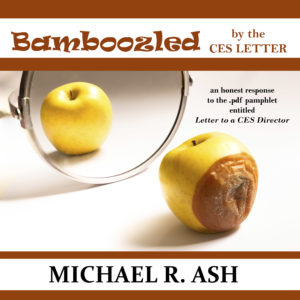
“Bamboozled by the ‘CES Letter'” by Michael R. Ash now available on audiobook!
We are pleased to announce that Michael R. Ash’s book, Bamboozled by the “CES Letter”, is now available in audiobook format from Audible and iTunes!
We’d especially like to thank Derrick Duncan for volunteering his time and talent to narrate it.
The e-book version is still available from the FAIR Bookstore and Amazon.
Come, Follow Me Week 20 – Numbers 11-14; 20-24
Rejecting the Living Prophets by Following Future Prophets
by J. Max Wilson
(Adapted from his post at Sixteen Small Stones)
One of the key doctrines of the Church of Jesus Christ of Latter-day Saints is that we have living prophets and apostles today who are authorized by God to receive revelations for the Church and for the world. The scriptures are full of stories of how the people of the Church rejected the messages of the living prophets, often justifying themselves by appealing to the words of previous prophets. Even Jesus was rejected by appealing to Moses or Abraham.
As President of the Twelve Apostles, Ezra Taft Benson warned: “Beware of those who would set up the dead prophets against the living prophets, for the living prophets always take precedence.” [Read more…] about Come, Follow Me Week 20 – Numbers 11-14; 20-24
FAIR Conference Podcast #79 – Derek Sainsbury, “We mean to elect him”: Electioneer Experiences during Joseph Smith’s 1844 presidential campaign
Podcast: Download (11.1MB)
Subscribe: RSS
This podcast series features past FAIR Conference presentations. This presentation is from our 2021 conference. If you would like to watch all the presentations from that conference, you can still purchase the video streaming.
Derek Sainsbury, “We mean to elect him”: Electioneer Experiences during Joseph Smith’s 1844 presidential campaign
Derek’s book, Storming the Nation: The Unknown Contributions of Joseph Smith’s Political Missionaries, is available from the FAIR Bookstore.
Derek R. Sainsbury has worked for 26 years in the Seminaries and Institutes of the Church of Jesus Christ of Latter-day Saints. Currently, he is an instructor in the Church History and Doctrine department at Brigham Young University. He holds a PhD in American History from the University of Utah. He is the author of “Storming the Nation: The Unknown Contributions of Joseph Smith’s Political Missionaries,” the award-nominated first book-length treatment of Joseph Smith’s presidential campaign. He has also authored other academic articles and conference papers. He volunteers for Book of Mormon and Doctrine and Covenants Central. He resides in Bountiful, Utah with his wife Meredith and their three sons and three dogs.

Answers to a Few Questions for Black History Month
for FAIR Newsletter – Black History Month Edition 4 2022
I am a white male. Well, I really have more of a ruddy complexion that looks red most of the time, but that still counts as “white.” I have found no one in my family history who owned slaves. One family line came from Scotland after the Civil war, and the other family line was simply too poor to be participating in anything like that. So why am I writing about black history? The Church is often criticized for having a “racist past” because of the priesthood ban, plus I think that we currently participate in a lot of unconscious racism and dismissive behavior that doesn’t help welcome our brothers and sisters into the Church.
So, let’s step away from the political rhetoric, tightly held positions, and defensiveness just for a moment. Let’s agree that black lives matter (of course they do – we aren’t talking about the political group), and we aren’t going to talk about Critical Race Theory (CRT) in this article. Let’s breathe deeply and step into this. [Read more…] about Answers to a Few Questions for Black History Month
FAIR Conference Podcast #71 – Rebekah Clark, “The Gospel of Equal Rights”: Latter-day Saint Suffragists, 1870-1920
Podcast: Download (11.7MB)
Subscribe: RSS
This podcast series features past FAIR Conference presentations. This presentation is from our 2021 conference held in August. If you would like to watch all the presentations from the conference, you can still purchase the video streaming.
Rebekah Clark, “The Gospel of Equal Rights”: Latter-day Saint Suffragists, 1870-1920
Rebekah Clark is co-author of the book Thinking Women: A Timeline of Suffrage in Utah and works as a historian for Better Days, a nonprofit public history organization dedicated to expanding education about Utah women’s history. She holds a law degree from the J. Reuben Clark Law School at Brigham Young University, studied as a visiting student at Harvard Law School, and practiced law in Boston for four years. She graduated with a degree in American History and Literature from Harvard University, where her honors thesis focused on Utah women’s activism in the national suffrage movement. She has worked at the LDS Church History Department and taught as an online adjunct faculty member at BYU-Idaho. Her work has appeared in journals such as the Utah State Historical Quarterly, the Journal of Mormon History, BYU Studies, Pioneer Magazine, and BYU Law Review and in podcasts by the National Conference of State Legislatures, the Church News, What’s Her Name, Zion Art Society, and the Maxwell Institute for Religious Scholarship. In addition to her work with Better Days, she currently serves on the board of the Mormon Women’s History Initiative Team. Rebekah lives in Highland with her husband Andrew and their five children.
Come, Follow Me Week 50 – Articles of Faith and Official Declarations 1 & 2
We Believe All that God Has Revealed
by Cassandra Hedelius

On social media and other discussions, it’s very common for LGBT activists/allies to invoke the ninth Article of Faith. They take for granted that the church’s teachings on marriage and sexuality are wrong, and assert that God will soon change them. After all, “we believe that God will yet reveal many great and important things pertaining to the kingdom of God!” [Read more…] about Come, Follow Me Week 50 – Articles of Faith and Official Declarations 1 & 2
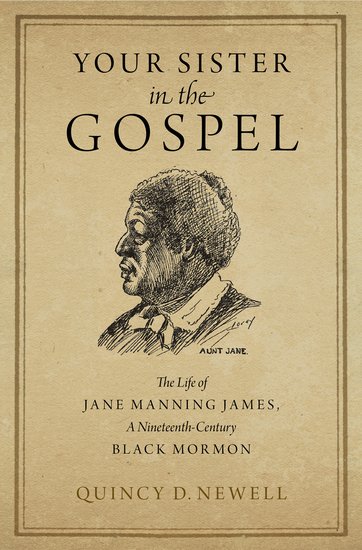
Book Review – Your Sister in the Gospel: The Life of Jane Manning James, A Nineteenth-Century Black Mormon

Quincy D. Newell’s new book Your Sister in the Gospel: The Life of Jane Manning James, A Nineteenth-Century Black Mormon is a unique and valuable addition to the fields of both Mormon Studies and nineteenth-century American History.
As Newell points out in her introduction, Jane Manning James’s story is “important because it troubles the waters” and “expands our understanding of nineteenth-century African American history beyond the standard narratives.”[1] That story is not as well-known as it should have been, and has been neglected by many scholars, perhaps, as Newell speculates, because Jane’s “membership in the LDS Church leads many scholars to see her as a dupe or a victim.”[2] Her narrative seems to move in a separate direction than many of the others. Instead of moving from “slavery to freedom”, Jane goes from being born free into a church that “treats her as a second-class citizen.”[3]
The LDS Church and the Race Issue: A Study in Misplaced Apologetics

[This talk is from the 2003 FairMormon Conference]
Forget everything I have said, or what…Brigham Young…or whomsoever has said…that is contrary to the present revelation. We spoke with a limited understanding and without the light and knowledge that now has come into the world.1
This statement by Elder McConkie in August of 1978 is an apt characterization of the doctrine and apologetic commentary so pervasive in the Church prior to the revelation on the priesthood earlier that year. That is, it was based on limited understanding. Yet, it is not clear how wide an application Elder McConkie intended for his references to “limited understanding;” for ironically, the doctrinal folklore that many of us thought had been discredited, or at least made moot, through the 1978 revelation continued to appear in Elder McConkie’s own books written well after 1978, and continues to be taught by well-meaning teachers and leaders in the Church to this very day.2 The tragic irony is that the dubious doctrines in question are no longer even relevant, since they were contrived to “explain” a Church policy that was abandoned a quarter century ago.
Indeed, it was apparent to many of us even four decades ago that certain scriptural passages used to explain the denial of priesthood to black members could not legitimately be so interpreted without an a priori narrative.3 Such a narrative was gradually constructed by the searching and inventive minds of early LDS apologists. With allusions to the books of Genesis, Moses, and Abraham, the scenario went something like this : In the pre-existence, certain of the spirits were set aside, in God’s wisdom, to come to Earth through a lineage that was cursed and marked, first by Cain’s fratricide and obeisance to Satan, and then again later by Ham’s lËse majestÈ against his father Noah. We aren’t exactly sure why this lineage was set apart in the pre-existence, but it was probably for reasons that do not reflect well on the premortal valiancy of the partakers of that lineage. Since the beginning, the holy priesthood has been withheld from all who have had any trace of that lineage, and so it shall be until all the rest of Adam’s descendants have received the priesthood, or, for all practical purposes, throughout the mortal existence of humankind. [Read more…] about The LDS Church and the Race Issue: A Study in Misplaced Apologetics