• Skip to primary navigation
  • Skip to main content
  • Skip to primary sidebar
  • Skip to footer

FAIR

  • Find Answers
  • Blog
  • Media & Apps
  • Conference
  • Bookstore
  • Archive
  • About
  • Get Involved
  • Search

Blog

The CES Letter, A Closer Look

May 23, 2016 by Brian Hales

This is Video One in the FairMormon series: “The CES Letter, A Closer Look” wherein Brian Hales examines claims posted by Jeremy Runnells in his “Letter to a CES Director”. Installments in the series run every Monday and can also be found on the FairMormon youtube channel.

In 2013 research Chris Johnson presented intriguing evidence alleging a parallel between the text of the Book of Mormon and publications printed in the early 1830s. Potential implications weighed heavy regarding the possibility that a purely secular book could duplicate key stylistic and thematic characteristics of the Book of Mormon.

The author of the The CES Letter adopted several of these primary claims, specifically charging a connection between The First Book of Napoleon printed in 1809 and The Late War published a decade later with the Book of Mormon. The CES Letter even presents paragraphs, ostensibly from The First Book of Napoleon and the Book of Mormon, side-by-side to show alleged similarities.

This video looks at things The CES Letter seems to have ignored. For example, numerous major dissimilarities exist between the Book of Mormon and The First Book of Napoleon and The Late War. Also, the attempt to show a parallel between the Book of Mormon and The First Book of Napoleon is exposed as a deception because ellipses are used to create an illusion of similarity that isn’t actually present.

It is true that the Book of Mormon uses the language of the King James Bible so it employs similar vocabulary to most books that were purposefully written to emulate that writing style. The video shows how the critics have simply failed to connect the dots. They cannot demonstrate how the commonalities equate to collusion. The likeness of language does not seem to equal to a collaboration of creators. Without additional data points connecting the two, the claims of The CES Letter seem vacuous and unimportant.

brian-hales-67Brian C. Hales is the author of The CES Letter: A Closer Look, as well as seven books dealing with Mormon polygamy—most notably the three-volume, Joseph Smith’s Polygamy: History and Theology (Greg Kofford Books, 2013). His Modern Polygamy and Mormon Fundamentalism: The Generations after the Manifesto received the “Best Book of 2007 Award” from the John Whitmer Historical Association. He has presented at numerous meetings and symposia and published articles in the Journal of Mormon History, Mormon Historical Studies, Dialogue, as well as contributing chapters to The Persistence of Polygamy series. Much of his research materials are available at  www.MormonPolygamyDocuments.org.

Filed Under: Uncategorized

Book Review: Approaching Antiquity: Joseph Smith and the Ancient World

May 22, 2016 by Trevor Holyoak

Available from the FairMormon Bookstore at 15% off

This book is from the 2013 BYU Church History Symposium, held March 7–8, 2013. The Church History Symposium is a nearly annual (there apparently wasn’t one held in 2015) event that draws speakers from places such as Brigham Young University, other universities, the LDS Church History Department, and often LDS general authorities as well. The book contains many of the papers that were presented, but unfortunately there are a few missing, such as Steven C. Harper’s presentation on masonry. However, that and most of the other papers that were given (including all but one that is in the book) are available to view here, although the video presentations are generally abbreviated versions of what is in the book.

The conference spanned two days. The first day was held at BYU and the second was at the Conference Center in Salt Lake City. I was only able to attend the first day, which is one of the reasons I was interested in this book. The keynote address was given by Richard L. Bushman, and it was very crowded, which left many of us without seats until after he was done (apparently there were many students that had come just to hear Bushman).

The preface of the book states that the theme for the conference came out of a professional development training trip taken by new faculty from the BYU departments of Ancient Scripture and Church History and Doctrine to church history sites in Palmyra, Kirtland, and Nauvoo. As they visited these sites, they “were impressed as the extraordinary range of Joseph’s encounters with antiquity became increasingly apparent” (page xiii) and “deeper reflection upon these issues convinced us that there was an important, dynamic, and under-explored relationship between Joseph Smith’s personal interactions with ancient material and many of his unfolding revelations” (page xiv). [Read more…] about Book Review: Approaching Antiquity: Joseph Smith and the Ancient World

Filed Under: Apologetics, Bible, Book of Abraham, Book of Mormon, Book of Moses, Book reviews, Early Christianity, Geography, Joseph Smith, LDS History, LDS Scriptures, Masonry

Faith and Reason 69: The Restoration

May 18, 2016 by FAIR Staff

https://media.blubrry.com/mormonfaircast/www.fairlatterdaysaints.org/wp-content/uploads/2016/05/Restoration.mp3

Podcast: Download (10.1MB)

Subscribe: RSS

temple-square-joseph-smith-768187-gallery

From the book: Of Faith and Reason: 80 Evidences Supporting the Prophet Joseph Smith

by: Michael R. Ash

During the Great Apostasy, the Lord withdrew His divine priesthood authority from the earth. Existing churches did not have the power to lead people to the true knowledge of God the Father and His Son Jesus Christ. Parts of the scriptures went missing or were corrupted, and no one had the authority to confer the gift of the Holy Ghost or perform necessary priesthood ordinances.

The gospel of Jesus Christ was restored by administering angels in 1820 through Joseph Smith. However unlike the Church in times past, The Church of Jesus Christ of Latter-day Saints will not be overcome by general apostasy. The scriptures teach that the Church will never again be destroyed (D&C 138:44; Daniel 2:44).

Michael R. Ash is the author of: Of Faith and Reason: 80 Evidences Supporting The Prophet Joseph Smith. He is the owner and operator of MormonFortress.com and is on the management team for FairMormon. He has been published in Sunstone, Dialogue: A Journal of Mormon Thought, the Maxwell Institute’s FARMS Review, and is the author of Shaken Faith Syndrome: Strengthening One’s Testimony in the Face of Criticism and Doubt. He and his wife live in Ogden, Utah, and have three daughters.

Julianne Dehlin Hatton has worked as a News Director at an NPR affiliate, Television Host, News Anchor, and Airborne Traffic Reporter. She graduated with an MSSc from the Maxwell School of Citizenship and Public Affairs at Syracuse University in 2008. Julianne and her husband Thomas are the parents of four children.

Music for Faith and Reason is provided by Arthur Hatton.

Filed Under: Faith and Reason, Julianne Dehlin Hatton, Michael R. Ash, Podcast Tagged With: apologetics, apostasy, Faith and Reason, Julianne Dehlin Hatton, Michael R. Ash

Book Review: The First Fifty Years of Relief Society: Key Documents in Latter-day Saint Women’s History

May 18, 2016 by Trevor Holyoak

Available from the FairMormon Bookstore at 15% off

This is the first publication from The Church Historian’s Press other than the Joseph Smith Papers. It is a collection of documents brought together for the first time that cover the first fifty years of the Relief Society, starting in Nauvoo, restarting in Utah, and then spreading throughout LDS settlements as far away as Canada. The book format and production procedures (transcription, verification, etc.) are very similar to how the Joseph Smith Papers are being done, and at least some of the staff (including editor Matthew J. Grow) are involved in both. And as with the JSP project, much of the book is available for free online. It is accessible at https://www.churchhistorianspress.org/the-first-fifty-years-of-relief-society

The book contains a general table of contents, then a Detailed Contents listing each document, followed by a list of illustrations, a general introduction, and a description of the editorial method. The main section is split into four parts, covering the time periods of 1830 and 1942 to 1845, then 1854 to 1866, 1867 to 1879, and finally 1880 to 1892. The end matter contains reference material including lists of the different Relief Society, Young Ladies’ Mutual Improvement Association, and Primary Association presidencies from 1842 to 1892, a biographical directory, works cited, acknowledgments, and then a pretty thorough index spanning 50 pages.

The main feature of this book is the Nauvoo Relief Society Minute Book, which was kept by Eliza R. Snow and then brought to Utah by her, where it was used in getting the Relief Society going again. This is the first time it has appeared in print, although it was included in the Selected Collections DVD set published in 2002, and more recently has been included in the online documents for the JSP project. Among other things, it has the only sermons given by Joseph Smith to the women of the church.

In one of these sermons, on April 28, 1842, Joseph Smith addressed speaking in tongues and administering to the sick: [Read more…] about Book Review: The First Fifty Years of Relief Society: Key Documents in Latter-day Saint Women’s History

Filed Under: Apologetics, Book reviews, Gender Issues, Joseph Smith, LDS History, Marriage, Polygamy, Women

Assumptions

May 15, 2016 by Mike Ash

Einstein

“Assumptions are made and most assumptions are wrong,” Albert Einstein.

We assume the best, we assume the worst. We assume what others are thinking or how they may behave in any given situation. Assumptions are the beliefs which drive what we infer from the world around us. Practically every second of our waking hours we infer things about our environment and the people around us because of belief-based assumptions. Quite frankly, we couldn’t navigate through life is this wasn’t so.

With so many things coming at us from all directions, assumptions help us make quick decisions so we don’t get stuck like a deer in headlights when we decide to go outside, drive to the store, or choose what we want on our pizza.

Dr. Daniel Kahneman, a well-known non-LDS psychologist explains that we humans have two metaphorical ways in which we think. He calls these System 1 and System 2.i

System 1 is the fast-acting assumption-driven method. It’s the instinctive level that gives us our gut reactions, our knee-jerk responses, and sees initial patterns. It is ready to contribute at a moment’s notice, is typically the first system called up in our brains, and the one which creates a coherent interpretation of what’s going on. System 2 on the other hand, is the brute when it comes to brainpower and the king when it comes to analyzing difficult data. Unfortunately, System 2 is also lazy (and thinking literally uses a lot of energy) so it usually kicks in when System 1 is overwhelmed, when more brain power is required, or when System 1 needs some confirming support.

Because it’s impossible to analyze everything all the time, we generally must rely on instincts formed by past experiences and contexts—in other words, we have to rely on assumptions—on System 1’s preconceptions, biases, pattern recognition, and predictions in order to think. System 1 draws on past experience—either recent events or distant memories—to formulate a quick assumption. If System 1 can get away with it—and it often does—it deals with inconsistencies by filling in the blanks, smoothing over the rough spots, and by fabricating coherency. What a mess we are as humans.

Sometimes Latter-day Saints get criticized for believing in the Church (or the Book of Mormon, or the prophet, etc.) because of “feelings.” Anyone who has received a testimony from the Holy Ghost, however, knows that a spiritual witness is much more than feelings. One of the wonderful things I love about this Church is that we don’t believe that feelings alone are the path to knowing truth. We believe in both study and faith (D&C 88:118).

While critics equate the LDS “burning in the bosom” with emotional feelings, and claim that feelings are a poor source for knowing truth, the fact is that more and more psychological studies prove that all people apply non-rational “feelings” in their process of making important decisions. It’s a part of humanity from which we can’t escape. We certainly hope that logic and rationale are part of the process we use when making decisions that affect important details of our lives (or the lives of others). But rational thinking—study after study has shown—is not the sole tool our brains and hearts employ when coming to conclusions.

Our System 1 brains make assumptions. System 2 can either help System 1 see some errors in those assumptions, or can create evidence to confirm those assumptions. Ultimately, to make life manageable, we settle with beliefs with which we find comfort (otherwise we would never be able to decide what shirt to wear before leaving the house). When a belief is formed, System 2 comes up with rational support to confirm that we have made the right decision—even though at least part of System 1’s conclusion is driven by emotion rather than logic. And yes, this includes the “beliefs” of atheists and agnostics. So to claim that Latter-day Saints use “emotion” when determining truth, is like claiming that Latter-day Saints are human.

All people apply extra-rational ingredients when forming their beliefs. For those who belief in the divine, at least a few ingredients include spiritual elements. Richard Hooker, a 16th century Anglican Theologian wrote that the sources of spiritual authority are Scriptures, Tradition, and Reason. Later writers described these three sources with the analogy of the legs of a three-legged stool—each leg is necessary to hold up the stool. We might modify this approach for LDS use with an analogy of a four-legged table. In Mormon thought the sources of spiritual authority would be Scripture, Modern Prophets, Personal Revelation, and Reason.

As truth-seekers we should make every effort to include all four of these ingredients into the spiritual and intellectual process that generates our individual beliefs. Utilizing all four factors helps us arrive at truth—it doesn’t guarantee we’ll arrive at ultimate truth because, once again, that’s not possible for mere mortals. We have a better chance, however, of arriving at truth if we apply all four ingredients compared to using only a few of the components.

Unfortunately, from my many years of experience helping those who have struggled with intellectual issues that have challenged faith, I’ve found that many Latter-Day Saints do not apply all four components to their approach of determining truth. Using one or two of the tools may serve some members well, but others members may end up with damaged testimonies when something shakes their faith.

From my personal perspective too many members lean unevenly on the legs of Scripture and Modern Prophets. Now admittedly, those are pretty big legs when we measure spiritual truth, but God has given us two more tools that we shouldn’t brush aside.

Several years ago my friend Ben McGuire pointed out one of the more useful lessons we learn from the story of Lehi and Nephi’s vision of the Tree of Life. Lehi saw the tree in a vision and shared the information with his family. Nephi wanted to experience the spiritual manifestation as well, so he turned to the Lord and experienced his own vision of the tree (and apparently saw some things that weren’t mentioned by Lehi).

When Nephi told Laman and Lemuel that he, like his father, has seen the Tree of Life vision his brothers complained that they didn’t understand the vision. Did you ask the Lord? Nephi asked his brothers.

“We have not,” they replied, “for the Lord maketh no such thing known unto us” (1 Nephi 15:9).

We believe that this Church is a church of revelation—not just revelation to prophets, but revelation to all members. Each person in this Church can receive personal revelation relevant to their sphere of responsibility. Prophets have stewardship over the entire world during their administration, stake presidents for their stake, bishops for their wards, parents for their homes, and each person for their own personal challenges.

In addition to personal revelation, I fear that we sometimes overlook Reason in our quest for finding truth. God gave us brains and expects us to use them. While we must certainly live, at times, by faith we don’t need to live by blind faith. I personally am utterly opposed to the idea that God is some sort of deceiver who makes the geological, archaeological, genetic, or other scientific evidences appear to support a view contrary to traditional assumptions. Truth is truth and if there is evidence that runs contrary to one of our beliefs, it could mean that more secular truth is still to come, but it could also mean that our belief is based on an unwarranted assumption rather than on an eternal truth.

For example, in 1963—more than a decade before black Latter-day Saints were allowed to receive the priesthood—the late LDS scholar Eugene England met with Apostle Joseph Fielding Smith (who would later become president of the Church) and discussed the belief that black people were less valiant in the premortal existence. Brother England recalled:

I got an appointment with him [Joseph Fielding Smith] and asked him directly if I must believe in the “pre-existence hypothesis” to have good Church standing. He replied, “Yes, because that is the teaching of the scriptures.” I asked him to show me the teaching in the scriptures, since I had not been able to see it there. President Smith patiently went through the sources with me, particularly the Pearl of Great Price, and then he said something quite remarkable: “No, you do not have to believe that Negroes are denied the priesthood because of the pre-existence. I have always assumed that because it was what I was taught, and it made sense, but you don’t have to believe it to be in good standing, because it is not definitely stated in the scriptures. And I have received no revelation on the matter.”ii

Assumptions drive our inferences about the things which we encounter. Sometimes they are right, sometimes they are wrong. We need to be careful that we don’t elevate our personal assumptions to the state of revelation, indisputable fact, or eternal truth. Faulty assumptions about what we should expect from prophets, scriptures, or even from God, can set us up for problems when these assumptions are not met. In such scenarios we may feel that prophets, the scriptures, or that God has failed rather than recognizing that we have built a house of beliefs on the sandy foundation of mistaken assumptions.

If we shore up our beliefs with the words of past and living prophets, personal revelation, and intellectual study and judgement, we will build a stronger foundation that should weather storms of spiritual disaffection.

i Daniel Kahneman, Thinking, Fast and Slow (Macmillan, 2011). ii Eugene England, “Are All Alike Unto God? Prejudice Against Blacks and Women in Popular Mormon Theology,” Sunstone April 1990, 20.

Michael Ash has been a member of FairMormon for more than a decade and has been published in various print and e-publications including the “Ensign.” He’s the author of “Shaken Faith Syndrome: Strengthening One’s Testimony in the Face of Criticism and Doubt,” as well as “Of Faith and Reason: 80 Evidences Supporting the Prophet Joseph.”

Filed Under: Uncategorized Tagged With: apologetics, assumptions, Einstein, Michael R. Ash, Truth

Fair Issues 100: Evidence versus proof

May 15, 2016 by Ned Scarisbrick

https://media.blubrry.com/mormonfaircast/www.fairlatterdaysaints.org/wp-content/uploads/2016/05/Fair-Issues-100-Pod.mp3

Podcast: Download (11.8MB)

Subscribe: RSS

Ash (newer) PictureIn this installment brother Ash explains the differences between what we consider as evidence versus proof in religious matters.

The full text of this article can be found at Deseret News online.

Brother Ash is author of the book Shaken Faith Syndrome: Strengthening One’s Testimony in the Face of Criticism and Doubt, as well as the book, of Faith and Reason: 80 Evidences Supporting the Prophet Joseph Smith. Both books are available for purchase online through the FairMormon Bookstore. Tell your friends about the Mormon Fair-Cast. Share a link on your Facebook page and help increase the popularity of the Mormon Fair-Cast by subscribing to this podcast in iTunes, and by rating it and writing a review.

The views and opinions expressed in the podcast may not reflect those of the Church of Jesus Christ of Latter-day Saints or that of FairMormon


Filed Under: Anti-Mormon critics, Apologetics, Book of Mormon, Evidences, Fair Issues, Faith Crisis, General, Hosts, Joseph Smith, Michael R. Ash, Ned Scarisbrick, Podcast, Power of Testimony Tagged With: Book of Mormon evidences

Where are the “Official” Answers?

May 11, 2016 by Mike Ash

BF

Being ignorant is not so much a shame, as being unwilling to learn, Benjamin Franklin.

I love learning new information. It’s exciting to read that the remains of three ancient Viking settlements may have recently been found in Canada. I’m fascinated to read about revolutionary gene-editing technology that may, someday, be used to fix disease-causing mutations. I was blown away to read that NASA’s Mars Orbiter spacecraft appears to have discovered hydrated salt minerals on the planet which suggests the presence of water. It was a joy to read that a well-preserved daguerreotype (early type of photograph) of early LDS president Wilford Woodruff from the Nauvoo period showed up on EBay (and was purchased by my friend, LDS photo historian, Ron Fox).

Does the Church have official positions on these, and many more, topics in the news? That, of course, is a silly question. Why would the LDS Church have an official position on the authenticity of possible Viking settlements, the possible discovery of water on Mars, or an official position on the precise date when the photo of Wilford Woodruff was taken?

“How much do we really know about…?” and we can fill in the blank with nearly anything. How much do we really know about consciousness, multiverses, what’s in the oceans, what’s out in space, who were the first humans, or how the brain understands emotions? The list could go on and on. For the most part, we know a lot more about each of these topics today than we did ten years ago, but we will likely know a lot more in another decade again.

When it comes to gospel or doctrinal topics we tend to think that all prophets knew the same things about every spiritual matter. We assume that past prophets understood the Gospel and gospel doctrines precisely the same way that 21st century American Latter-day Saints understand these same topics.

While it’s certainly possible that at least a few things were (or are) universally understood by all past and current prophets, it’s not reasonable to assume that all spiritual perspectives have been understood the same through all ages. Scholarship tells us, for example, that the early Israelites had a polytheistic view of deity (belief in the existence of multiple Gods) while pure monotheism (belief in a single God) didn’t really emerge until about the 7th century B.C.

During Christ’s ministry new teachings were added as the law of Moses was fulfilled. When Joseph Smith came on the scene he restored lost teachings but added new revelations that were given for the modern world. After Joseph’s death even more progress was made. Some of Joseph’s teachings or practices were refined, some practices—such as the United Order and Plural Marriage—were discontinued (for reasons which have not been fully revealed).

The beauty of being a member of a living Church—a Church lead by revelation—is that we can expect, and hope for, changes. “…he that receiveth light,” we read in the Doctrine and Covenants, “and continueth in God, receiveth more light; and that light groweth brighter and brighter until the perfect day” (D&C 50:24). In a Church with revelation there is no “final word” when it comes to knowing the Gospel. Like secular education, there is always more to come.

So what does this have to do with “official” answers? Let me explain: In the more than two decades that I’ve conversed with struggling members or former members as they’ve navigated challenging issues I have frequently heard the complaint that people such as myself are simply amateur (or “professional”) apologists (an “apologist” is someone who defends a belief) and therefore my thoughts on the topics can be dismissed. They want “official” answers on troubling issues.

The topics which some members find troubling include questions about the relationship between the Book of Abraham as recorded in our scriptures and the Egyptian characters on the Joseph Smith Papyri; the relationship between what we read in the Book of Mormon and what archaeologists tell us about the ancient New World; the relationship between the scriptural stories of Adam and Eve and what scientists tell us about organic evolution; the relationship between the nineteenth-century frontier American attitudes regarding folk magic, and Joseph Smith’s methods for translating the Book of Mormon plates; the difference between Joseph’s understanding of his First Vision as a young man, and his increased understanding of the experience as a seasoned prophet; the relationship between LDS temple symbols and Masonic symbols of Joseph Smith’s day; the relationship between Joseph’s restoration of the practice of plural marriage, and man-made practices that confound morality; the relationship between early nineteenth-century racial beliefs, and the priesthood ban for black members; the relationship between the spirit, the brain, and gender attraction, and traditional man-woman marriage.

Critics, and some members, think that the Church should have official responses or answers for all of these troubling issues—or for any troubling issue that may rise upon future reflection, with new discoveries, or during changes in human-relationship dynamics. Such wishful desires, however, are naïve and unrealistic.

First, the overwhelming majority of these issues deal with academic interpretations of data and do not deal with doctrinal problems. For example, the Church teaches that Lehi, Nephi, and their small group of families traveled by boat from the Old World to the New World, practiced their religion, fought with those who challenged their way of life, and wrote about these encounters on metal plates. The official teaching of the Church is that the Book of Mormon is the Word of God. The Lord has not revealed any of the historical details about the Book of Mormon people or their lands.

Now we might wish that the Lord would reveal some of the historical peculiarities about the Book of Mormon peoples; we might also wish that the Lord would reveal more details about the timing of the Second Coming or if the deceased can ever progress from one heavenly kingdom to another. We might wish that the Lord would reveal if and when the Holy Ghost will ever receive a body, or how intelligences were made into spirit children. We might wish a lot of things, but the Lord reveals those things which are necessary to guide us to become like Christ and return to the Heavenly Family.

If there is no revelation that locates the site of Lehi’s landing in the New World, if there is no revelation which tells us that the entire pre-Jaredite New World was void of all other human inhabitants, if there is no revelation which tells us the precise chemical composition of the Book of Mormon plates, then the answers cannot be found in official revelatory declarations by Church prophets—they can only be found through academic examination and discourse.

If we look at the other “troubling” issues we find the same contingency. We believe that the Book of Abraham contains the Word of God, but we have no revelation how (or by whom) the Abrahamic stories—as revealed to Joseph—were first recorded. We have no revelation as to the nature of any connection that exists between the Joseph Smith Papyri and the revealed text in our scriptures.

While we know that the Book of Mormon and other modern scripture were revealed to Joseph by the Power of God, we have no revelation that tells us how Joseph’s seer stone worked as a tool to receive scriptural revelations.

While we know that Joseph restored the practice of plural marriage, we have no revelation as to how the practice was fully implemented in Joseph’s day or how this practice interplays with family dynamics in the hereafter.

While we know from revelation that God created the Earth and humankind, we do not have revelation which tells us the how long the process took or what methods God employed.

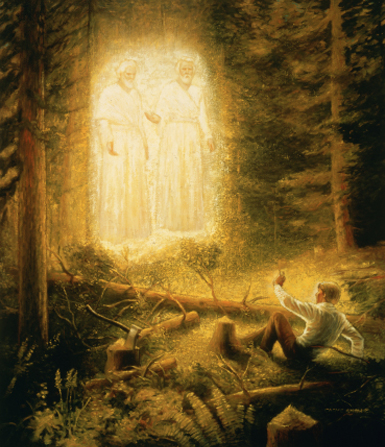
We know from Joseph’s own testimony that God and Christ visited him in a grove of trees in answer to Joseph’s pleas for spiritual help. We have no revelation that tells us precisely how Joseph was able to see divine beings while he, himself, remained in the flesh. And we have no revelation which tells us what Joseph understood about God or the Gospel when he left the grove of trees or the precise timeline in which each of his additional gospel insights were revealed to his own mind.

While black members of the Church were indisputably denied the priesthood from some point in Brigham Young’s day until 1978, we have no revelation as to why Brigham implemented the practice or even if his move to halt the practice was based on personal feelings, environmental pressures, or cultural proclivities.

While the issue of same-gender attraction has impelled the Church to make official responses addressing the earthly practice of temple marriages and the problem of sexual interactions outside of the bonds of marriage, we have no revelation telling us why a number of our faithful brothers and sisters are attracted to the same gender or how such attractions interplay with family dynamics in the hereafter.

While it’s always possible that we, in mortality, may receive revelation on these and other troubling topics, the fact is that the Lord does not give us answers to everything. Why? Some of His reasons may not be discoverable through human intellect and logic. We must also remember that mortality is a testing ground where we are required to figure things out on our own. Failure and getting things wrong is part of the process of figuring things out. Dead ends, false starts, and wrong turns are all part of life’s experience and all part of what eventually makes righteous humanity move forward. Our personal accountability lies not so much in the mishaps and stumbles, but rather in the direction we are moving and if that direction is helping us become more like Christ.

So in the absence of revelatory answers we have no choice but to turn to academic answers. Some of those answers could be right, and some could be wrong. Some may be spot on, and some may be in the general area of “correct,” but could use additional tweaking.  And when we must turn to academic answers the playing field is open to all those who would share their thoughts. There are experts with degrees in archaeology, anthropology, genetics, and history—and they can all add their thoughts and ideas to the discussion—but we must not overlook the non-experts. As Hugh Nibley said, this is the Day of the Amateur,[i] and a wide array of voices have contributed to the discussions.

The Brethren are aware that many of these topics have proven to be stumbling blocks for testimonies. Fully mindful that we seek learning “by study and also by faith” (D&C 88:118), the Church produced nearly a dozen academic essays which address some of these topics. Elder Ballard, in a recent address to those involved in the Church Education System, strongly recommended that teachers study these essays so that they would have answers for students who struggle with questions.[ii]

The fact that these essays are posted on the official Church website at LDS.org suggests that these are “official” answers by the Church and should silence those critics who claim otherwise. But it’s important that we go beyond the one-dimensional label of “official” as something posted on LDS.org. Some people equate “official” with “doctrinal,” and in human language, words can mean more than one thing. Sometimes an official statement from the Church constitutes official doctrine; sometimes an official statement characterizes the current position as agreed upon by leaders of the Church as a human-administered organization.

The essays satisfy the requirement for “official” answers but it’s important to understand that they do not represent official LDS doctrine. They are academic examinations of the issues. Academic answers can change—they can be right, they can be wrong, or they may need to be modified upon the discovery of additional information.

Which brings us back full circle to the beginning of this post…. Learning will continue. There is, for mortals, no end to what we might learn. More information—either by revelatory or secular means—will continue to come. Anything that is “official” today can be updated with additional academic or spiritual inspiration.

Our Church doesn’t have creeds (authoritative formulas or statements of religious beliefs). The closest thing we have is the Thirteen Articles of Faith which outline some of the basic tenets of our faith. As Article 9 states, however, “We believe all that God has revealed, all that He does now reveal, and we believe that He will yet reveal many great and important things pertaining to the Kingdom of God.”

Joseph said that he didn’t like creeds because they set limits. “Hitherto shalt thou come, and no further,” said Joseph, quoting Job 38:11.  A Church which believes in continuing revelation automatically believes that what is “official” today may not be “official” tomorrow. As members of a living Church we should rejoice is knowing that while the Lord is in charge, he allows us our humanity. He doesn’t force feed us with truth, but he allows us to discover truth. As LDS scientist Henry Eyring once wrote: “In the long run, the truth is its own most powerful advocate. The Lord uses imperfect people. He often allows their errors to stand uncorrected. He may have a purpose in doing so, such as to teach us that religious truth comes forth ‘line upon line, precept upon precept’ in a process of sifting and winnowing similar to the one I know so well in science.”[iii]

Insisting on official answer answers for everything is a cheap and easy approach that superficially appears to provide comfort, but is really nothing more than an information inhibitor. The Gospel is not a Wikipedia where we can find the final answer to every intellectual or spiritual issue that might pop up in our lives. The Gospel is a more like a co-operative school where we help others while helping ourselves to become—intellectually, spiritually, and physically—like our Father in Heaven. Turning to the back of the book for every answer is like looking up the answer for a math test; it may provide the correct solution, but doesn’t teach us how to do the math.

The other problem with pat answers is that too many people fall into the trap of thinking that the answer book is finished, closed, and that the answers can’t change or be updated.

Thou fool, that shall say: A Bible, we have got a Bible, and we need no more Bible…. Wherefore murmur ye, because that ye shall receive more of my word? …And because that I have spoken one word ye need not suppose that I cannot speak another; for my work is not yet finished; neither shall it be until the end of man, neither from that time henceforth and forever. (2 Ne. 29: 6-9).

As truth seekers we can’t be fully content in limiting our learning with the hopes of official answers for every question. Instead, we will find our hearts and minds contented by putting our faith in God that He has more light yet to share, by trusting God that there are always answers to difficult issues even if we don’t necessarily see them, and by recognizing that, in the words of Hugh B. Brown, “revelation does not come only through the prophet of God nor only directly from heaven in visions or dreams. Revelation may come in the laboratory, out of the test tube, out of the thinking mind and the inquiring soul, out of search and research and prayer and inspiration.”[iv]

[i] Hugh W. Nibley, “The Day of the Amateur,” Ensign January 1971 at https://www.lds.org/new-era/1971/01/the-day-of-the-amateur?lang=eng, (accessed 28 April 2016).

[ii] M. Russell Ballard, “The Opportunities and Responsibilities of CES Teachers in the 21st Century,” at https://www.lds.org/broadcasts/article/evening-with-a-general-authority/2016/02/the-opportunities-and-responsibilities-of-ces-teachers-in-the-21st-century?lang=eng (accessed 29 April 2016).

[iii] Henry Eyring, Reflections of a Scientist (SLC: Deseret Book, 1983), 47,

[iv] Hugh B. Brown, The Abundant Life (Salt Lake City, UT:  Bookcraft, 1965), 87-88.

Michael Ash has been a member of FairMormon for more than a decade and has been published in various print and e-publications including the “Ensign.” He’s the author of “Shaken Faith Syndrome: Strengthening One’s Testimony in the Face of Criticism and Doubt,” as well as “Of Faith and Reason: 80 Evidences Supporting the Prophet Joseph.”


Filed Under: Uncategorized

Fair Issues 99: Emotion is part of testimony and decision making

May 1, 2016 by Ned Scarisbrick

https://media.blubrry.com/mormonfaircast/www.fairlatterdaysaints.org/wp-content/uploads/2016/05/Fair-Issues-99-Pod.mp3

Podcast: Download (9.6MB)

Subscribe: RSS

Ash (newer) PictureIn this article brother Ash discusses how emotions play an integral part in our decision making process.

The full text of this article can be found at Deseret News online.

Brother Ash is author of the book Shaken Faith Syndrome: Strengthening One’s Testimony in the Face of Criticism and Doubt, as well as the book, of Faith and Reason: 80 Evidences Supporting the Prophet Joseph Smith. Both books are available for purchase online through the FairMormon Bookstore. Tell your friends about the Mormon Fair-Cast. Share a link on your Facebook page and help increase the popularity of the Mormon Fair-Cast by subscribing to this podcast in iTunes, and by rating it and writing a review.

The views and opinions expressed in the podcast may not reflect those of the Church of Jesus Christ of Latter-day Saints or that of FairMormon

Filed Under: Anti-Mormon critics, Apologetics, Conversion, Fair Issues, General, Hosts, Michael R. Ash, Ned Scarisbrick, Podcast, Power of Testimony Tagged With: Building a Testimony

Faith and Reason 68: Plain and Precious Parts

April 30, 2016 by FAIR Staff

https://media.blubrry.com/mormonfaircast/www.fairlatterdaysaints.org/wp-content/uploads/2016/04/Plain-and-Precious.mp3

Podcast: Download (18.6MB)

Subscribe: RSS


From the book: Of Faith and Reason: 80 Evidences Supporting the Prophet Joseph Smith

by: Michael R. Ash

Most Christians today and in Joseph Smith’s day believe that the Bible is complete –that it contains everything that God intended, and that no new scriptures should be added. From Joseph’s translation of the Book of Mormon, however, we learn that the Bible is not complete and that many important parts are missing. Today’s scholarship sides with Joseph Smith. The scriptures we have today are the result of actions taken in the second century AD by those who had a different Bible than those at the end of that same century.

Michael R. Ash is the author of: Of Faith and Reason: 80 Evidences Supporting The Prophet Joseph Smith. He is the owner and operator of MormonFortress.com and is on the management team for FairMormon. He has been published in Sunstone, Dialogue: A Journal of Mormon Thought, the Maxwell Institute’s FARMS Review, and is the author of Shaken Faith Syndrome: Strengthening One’s Testimony in the Face of Criticism and Doubt. He and his wife live in Ogden, Utah, and have three daughters.

Julianne Dehlin Hatton has worked as a News Director at an NPR affiliate, Television Host, News Anchor, and Airborne Traffic Reporter. She graduated with an MSSc from the Maxwell School of Citizenship and Public Affairs at Syracuse University in 2008. Julianne and her husband Thomas are the parents of four children.

Music for Faith and Reason is provided by Arthur Hatton.

Filed Under: Faith and Reason, Julianne Dehlin Hatton, Podcast Tagged With: bible, Church History, Faith and Reason, Joseph Smith, Julianne Dehlin Hatton, Michael R. Ash

“Bring Forth Fruit with Patience”: Lessons on Faith and Patience from the Book of Mormon Archaeology

April 30, 2016 by Neal Rappleye

“Knowing this, that the trying of your faith worketh patience” (James 1:3).

“But that on the good ground are they, which in an honest and good heart, having heard the word, keep it, and bring forth fruit with patience” (Luke 8:15).

We don’t typically think of patience as a gospel principle, even though it is mentioned 66 times in the Standard Works. Patience is a virtue, yes, but you are more likely to hear that old adage than a scripture reference when being told you’ll just have to wait for something you want right now. Yet, despite this, the fact is patience is a necessary component to faith.

The relationship of patience and faith can be illustrated well with the Book of Mormon and archaeology. Critics love to claim that there is no archaeological evidence for the Book of Mormon, and produce lists of plants, animals, and material culture items which are thought to be absent from ancient America to make their point. The pitfalls of negative evidence, however, are quickly apparent if we are we willing to step back and look at some examples.

Let’s start with barley. Barley is mentioned several times in the Book of Mormon, and was long considered an anachronism in the text. In 1983, however, domesticated barely was found in Arizona dating back to AD 900. When apologists first pointed this out, critics were slow to cede ground and nit-picked that this still was not old enough for Book of Mormon times.

Subsequent evidence has demonstrated that in native American “little barley” was cultivated as early as 800 BC, and in widespread use from 200 BC through AD 1000. Geographically, it is known in predominantly in the eastern United States, but archaeological findings also show it was cultivated in the southwest and Mexico. As Book of Mormon Central recently pointed out:

Over time, more and more evidence for domestication of little barley in the Americas has emerged over an increasingly wider span of both time and geography. Little barley may have diffused to other regions of the Americas which were known to trade with the southwest and eastern United States, including the exchange of crops. In any case, evidence demonstrates that in at least some parts of the Americas, a type of barley was a highly important crop during Book of Mormon times.

Some will still nit-pick and claim that the Book of Mormon requires old world barley, but unless one insists on a narrow interpretation of the text, that simply is not true. Barley no longer poses serious problems for the Book of Mormon, and that’s the weakness of negative evidence: a single discovery can change the picture. Book of Mormon Central gets it exactly right when they say “discoveries like little barley illustrate the wisdom in keeping an open mind and avoiding hasty judgments while considering and exploring what the Book of Mormon says about Nephite life.”

barley-meme1 1

1983 was 153 years after the Book of Mormon was published, and all that time critics took advantage of the absence of barley; and right up until 1982, the absence of barely might have seemed pretty damning for the Book of Mormon. The value of patience here is clear.

The lesson learned from barely can be extended to other examples of common and long thought anachronisms. Consider wine, for instance. It is important to note that even in today’s vernacular, wine can refer to more than just fermented grape juice. Just google “apple wine,” “banana wine,” “pineapple wine,” and even “dandelion wine” to see my point. These kinds of “wines” were certainly known in pre-Columbian America. Book of Mormon Central explained: “Alcoholic beverages were made from a variety of fruits in the Americas before Columbus. These include bananas, pineapple, and agave, among others.” There were also native grapes, with some indication that it was used for wine-making.

wine_meme 1

Yet for the purposes of this post in illustrating the value of patience, I would like to highlight something else Book of Mormon Central mentioned: “There is also some evidence that the Old World grape was known and used for winemaking at one site in Chiapas, Mexico dating to between the first centuries BC and AD.” The evidence cited comes from a master’s thesis on an archaeological site in Chiapas (the region some geographers consider the land of Zarahemla) from 1978. It is less abundant, less widespread, and less well known than that of barley, but it is interesting nonetheless, and it follows the Book of Mormon by 148 years. Score one more for patience.

These kinds of examples are important to be aware of and keep in mind when dealing with some puzzles which are not so easily solved, like the horse. As Book of Mormon Central points out, there are certainly different possibilities, like loan-shifting and translator anachronisms that we ought to be open-minded about, but they are also keen to point out patience here as well. They note that there is some promising, yet inconclusive, evidence for horses in the Americas during Book of Mormon times. They then note, “it is best to be patient with the archaeological record. There is still much work to be done, and lots to be learned about life in pre-Columbian America.” Continuing on, they stress:

The vast majority of Mesoamerican ruins remain untouched underneath thick jungle growth, and other areas in the Americas have received even less attention. Also, the preservation of animal bones is very poor in the humid jungles of Mesoamerica. … Still, several items mentioned in the Book of Mormon once considered anachronistic have since been verified. This is why John E. Clark, a Latter-day Saint and prominent Mesoamerican archaeologist, declared: “the Book of Mormon looks better with age.” Such findings should urge caution against making final judgments based on absence of evidence.

Barley, and perhaps even wine, (to say nothing of Old World examples like Egyptian writing in Palestine, once thought to be an anachronism) illustrate this very point.

horses-knowhy2 (1) 1

Other lines of evidence further encourage patience among believers. Little, if anything, was known about the ancient Mesoamerican practice of carving the history and achievements of kings on “large stones” in 1830, but now the scholarly understandings of such things converge nicely with the description in Omni 1:20–22. Or the way social stratification and polygamy functioned together in the middle pre-Classic (ca. 800–400 BC), providing a fitting context for Jacob’s sermon in Jacob 2–3. Or the lineage histories of various Mesoamerican cultures, which fit the Book of Mormon in both form and function. Or tumbaga and how the “golden” plates are consistent with this alloy. Or the way the conceptual purposes of Mesoamerican bloodletting are tied into the “atoning blood of Christ” and blended well with ancient Israelite understandings of blood sacrifice.

All of this does not even touch the Old World connections, generally seen as more abundant and persuasive. Things like the detailed understanding of ancient olive cultivation found in Jacob 5; the ancient legal practice of duplicating or abridging documents and then sealing a portion, just as the Book of Mormon plates were abridged and sealed; ancient Israelite festival and coronation tie-ins to Benjamin’s speech; the extensive use of poetic parallelisms common to Hebrew writing; the practice of subscriptio, which appears twice in the Book of Mormon; Sherem’s and Abinadi’s trials in light of ancient Israelite law; and on and on I could go. I’ve yet to mention the Nahom altars, which some critics act like is the only thing Mormon apologists ever talk about.

While there are certainly still lists of puzzling features that invite further thought and research, many things now known about both the ancient Near East and pre-Columbian Mesoamerica shed light and insight on the Book of Mormon. Why not focus on what evidence we do have rather than pine for the evidence that is missing? Few who jump on the Internet today are aware that the list of anachronisms is getting shorter. As John Clark said, the Book of Mormon truly does look better with age. This trend certainly endorses patience while grappling with persistent puzzles. Such patience has yielded abundant fruit over the last 186 years, and will likely to continue to yield even more.

Neal Rappleye is a Research Project Manager for Book of Mormon Central. He blogs on Latter-day Saint topics at http://www.studioetquoquefide.com/

Filed Under: Anti-Mormon critics, Apologetics Tagged With: barley, Book of Mormon, Book of Mormon Geography, horses, patience

  • « Go to Previous Page
  • Go to page 1
  • Interim pages omitted …
  • Go to page 110
  • Go to page 111
  • Go to page 112
  • Go to page 113
  • Go to page 114
  • Interim pages omitted …
  • Go to page 203
  • Go to Next Page »

Primary Sidebar

Faithful Study Resources for Come, Follow Me

Subscribe to Blog

Enter your email address:

Subscribe to Podcast

Podcast icon
Subscribe to podcast in iTunes
Subscribe to podcast elsewhere
Listen with FAIR app
Android app on Google Play Download on the App Store

Pages

  • Blog Guidelines

FAIR Latest

  • Come, Follow Me with FAIR – Genesis 1–2; Moses 2–3; Abraham 4–5 – Jennifer Roach Lees
  • Come, Follow Me with FAIR – Genesis 1–2; Moses 2–3; Abraham 4–5 – Part 2 – Autumn Dickson
  • Come, Follow Me with FAIR – Genesis 1–2; Moses 2–3; Abraham 4–5 – Part 1 – Autumn Dickson
  • In Memoriam: Sarah Allen
  • Come, Follow Me with FAIR – Moses 1; Abraham 3 – Jennifer Roach Lees

Blog Categories

Recent Comments

  • Matt on In Memoriam: Sarah Allen
  • Jerry Allred on Come, Follow Me with FAIR – Moses 1; Abraham 3 – Jennifer Roach Lees
  • Jann E Cahoon Campbell on In Memoriam: Sarah Allen
  • Terry Allen on In Memoriam: Sarah Allen
  • Bryan on In Memoriam: Sarah Allen

Archives

Follow Us

  • Facebook
  • Twitter
  • iTunes
  • YouTube
Android app on Google Play Download on the App Store

Footer

FairMormon Logo

FAIR is a non-profit organization dedicated to providing well-documented answers to criticisms of the doctrine, practice, and history of The Church of Jesus Christ of Latter-day Saints.

Donate to FAIR

We are a volunteer organization. We invite you to give back.

Donate Now

Site Footer